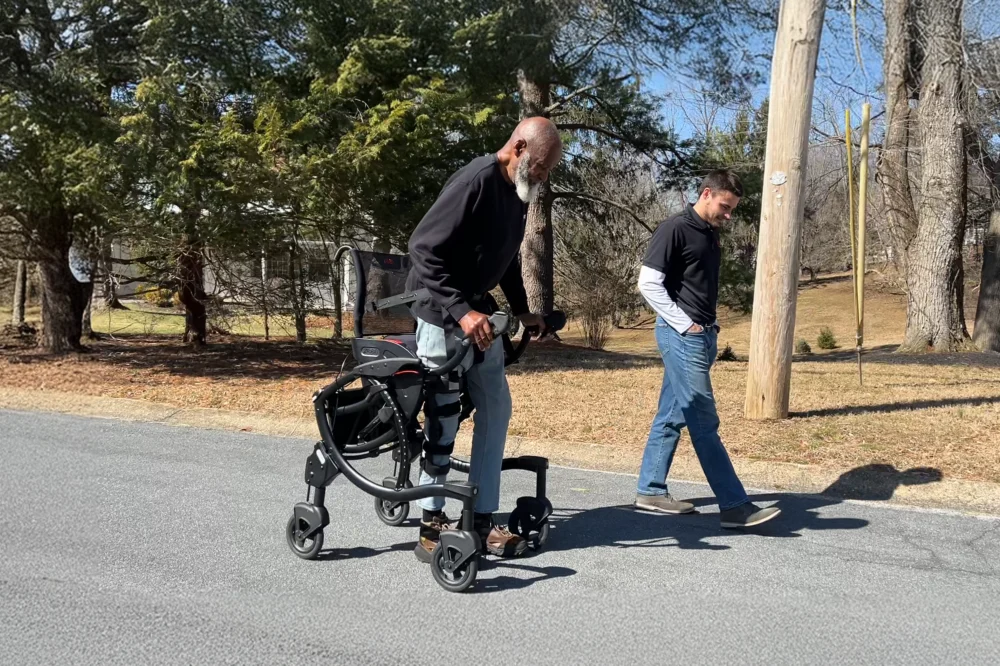
The landscape of assistive technology is undergoing a significant transformation as engineers and healthcare providers seek to address the nuanced needs of the more than 5.5 million Americans who rely on mobility devices. For decades, the industry has been bifurcated into two primary categories: manual or powered wheelchairs for those with limited lower-body function, and walkers or rollators for those who require stabilization while standing. However, a significant portion of the population falls into a "mobility gap," where neither device provides the necessary balance of support, exercise, and independence. The Zeen, a new category of mobility device developed by Exokinetics, aims to bridge this divide through a motorless, multi-use design that facilitates a seamless transition between sitting, standing, and walking.
The Genesis of Innovation: From Hollywood to Healthcare
The development of the Zeen is rooted in a surprising technological lineage. The device was conceived by Garrett Brown, the Academy Award-winning inventor of the Steadicam. In the 1970s, Brown revolutionized the film industry by creating a stabilization system that allowed camera operators to move fluidly through scenes while maintaining a steady shot. The Steadicam utilized a sophisticated system of springs and iso-elastic arms to counteract the effects of gravity and human gait.
Decades later, Brown observed his aging father struggling with the limitations of existing mobility aids. His father required the stability of a chair but the activity level of a walker, yet no single device allowed him to transition between these states safely or autonomously. Brown realized that the same physics used to stabilize a 50-pound camera could be applied to stabilize a human body. By repurposing air piston technology—similar to the mechanisms that allow heavy cameras to "float"—Brown and the Exokinetics team developed a device capable of lifting a user’s full body weight without the need for heavy electric motors or rechargeable batteries.

Technical Specifications and the Mechanics of the Zeen
At its core, the Zeen is an "exoskeletal" chair that functions as a hybrid of a walker, a stander, and a transport chair. Unlike traditional power-lift chairs that require a tether to a wall outlet or bulky battery packs, the Zeen utilizes high-pressure air pistons. These pistons are customized to the user’s specific weight and height, providing a "buoyant" lift that allows the individual to rise from a seated position to a full standing position with minimal physical exertion.
The device features five levels of lift strength, which can be adjusted as a user’s physical condition improves or declines. This "kinetic assist" ensures that the user remains centered and stable, reducing the risk of the forward or backward falls that are common when using traditional walkers. When in the standing position, the Zeen provides posterior support through the hips and buttocks, allowing the user to "coast" or walk while the device bears the brunt of their weight. This design encourages "active aging" and gait maintenance, which are critical for cardiovascular health and muscle retention in populations with degenerative conditions.
Addressing the Socioeconomic Barriers of Mobility
The financial burden of disability is a significant concern for families and the healthcare system at large. According to data from the Disability Rights Education and Defense Fund (DREDF), approximately 32 percent of mobility device users report dissatisfaction with their current equipment, often citing high costs and the inability of devices to meet both home and community needs.
A primary driver of these costs is the specialized infrastructure required for traditional power wheelchairs. A standard wheelchair-accessible van, equipped with ramps and lockdowns, typically costs between $45,000 and $80,000. For many families, the Zeen offers a path toward significant cost savings. Because the Zeen is foldable and does not require the heavy lifting mechanisms of a power scooter, many users find they can utilize standard vehicles. Rick Sherak, CEO of Exokinetics, noted a case where a family was able to sell their accessible van after transitioning to the Zeen, as the user could safely enter a standard vehicle while the device was stowed in the trunk.

Furthermore, the "multipurpose" nature of the device addresses the issue of "medical clutter." In many households, individuals own a walker for short distances, a manual wheelchair for long outings, and a stander for physical therapy. This redundancy not only creates storage issues but also contributes to environmental waste. In Massachusetts alone, the REquipment program—which refurbishes and redistributes medical gear—collected 45 tons of discarded equipment in 2023. By consolidating these functions into a single, adjustable frame, the Zeen represents a more sustainable model for assistive technology.
Clinical Implications and Fall Prevention
From a clinical perspective, the most dangerous period for individuals with mobility challenges is the "transitional phase"—the moment when a person is no longer safe using a walker but is not yet ready for the sedentary lifestyle of a wheelchair. This "in-between" stage is characterized by a high frequency of falls, which the Centers for Disease Control and Prevention (CDC) identifies as the leading cause of injury-related death among adults aged 65 and older.
The Zeen serves as a fall-prevention tool by providing a constant "safety net" behind the user. If a user loses their balance while walking, the seat remains positioned to catch them. This psychological safety has profound effects on patient outcomes. Clinical observations suggest that when patients feel secure, they are more likely to engage in physical activity, which in turn prevents the rapid muscle atrophy associated with total wheelchair dependence.
For caregivers, the Zeen reduces the physical strain of "transfers"—the act of helping a patient move from a bed or chair to a standing position. Back injuries are among the most common occupational hazards for healthcare workers and home caregivers. By automating the lift process through mechanical pistons, the Zeen allows caregivers to focus on guidance rather than heavy lifting.

Strategic Integration into the Veterans Affairs System
A pivotal moment in the expansion of this technology occurred in July 2025, when Exokinetics was awarded a contract with the Department of Veterans Affairs (VA) Federal Supply Schedule. This agreement allows veterans to access the Zeen through the VA medical system as part of their prescribed physical therapy or prosthetic benefits.
The veteran population faces unique mobility challenges, often resulting from a combination of service-related injuries, chronic pain, and the long-term effects of physical trauma. Rick Sherak, himself a U.S. Air Force veteran, emphasized that for many service members, maintaining an upright and active posture is tied to their sense of identity and dignity. The VA’s adoption of the Zeen signals a shift in institutional thinking, moving away from "accommodating" disability and toward "facilitating" active movement.
Pediatric Adaptability and Long-Term Growth
While much of the focus on mobility aids centers on the elderly, the pediatric market faces a distinct set of challenges—namely, the rapid growth of the user. Traditional wheelchairs for children often need to be replaced entirely every few years to accommodate changes in size, a process that is both expensive and administratively burdensome for insurance navigation.
The Zeen’s design allows for incremental adjustments. Rather than replacing the entire chassis, parents can adjust the frame and swap out the air pistons (springs) as the child grows or as their strength levels change. This "grow-with-the-user" philosophy ensures that children with conditions such as cerebral palsy or muscular dystrophy have a consistent tool for gait training and social interaction at eye level with their peers.

Future Outlook and the "Active Mobility" Market
The introduction of the Zeen comes at a time when the global personal mobility device market is projected to reach over $15 billion by 2030. This growth is driven by an aging global population and a rising preference for home-based care over institutionalized settings.
The success of motorless technology like the Zeen suggests a growing demand for "low-tech, high-intelligence" solutions. While robotics and AI-powered exoskeletons garner significant media attention, they often remain out of reach for the average consumer due to five-figure price tags and complex maintenance requirements. The Zeen’s reliance on mechanical physics and air pressure offers a middle ground: a sophisticated, life-changing tool that is as reliable as a bicycle and as intuitive as a chair.
As International Wheelchair Day approaches on March 1, the conversation within the disability community is increasingly focused on "mobility justice"—the idea that everyone deserves the right to move through the world in the way that best suits their body. By filling the gaps left by traditional equipment, the Zeen is not merely replacing the wheelchair or the walker; it is expanding the definition of what it means to be mobile in the 21st century. Through a combination of Hollywood-inspired engineering and a deep understanding of human biomechanics, Exokinetics is proving that for many, the path to independence is not found in a motor, but in the simple, supported act of standing up.
About the Author