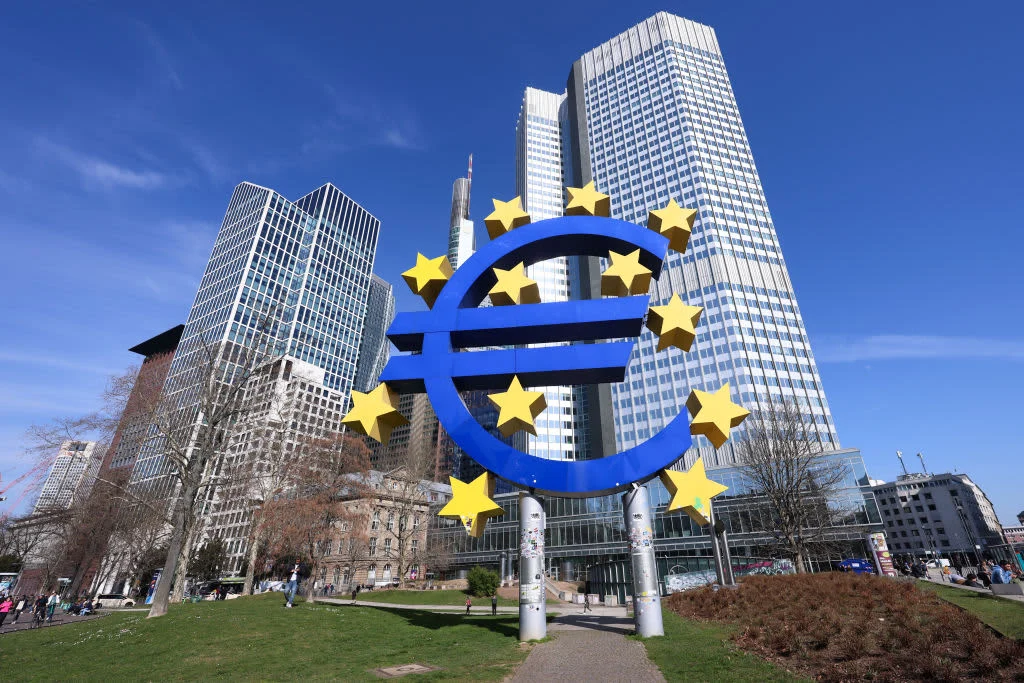
Frankfurt, Germany – In a significant recalibration of expectations, leading financial institutions including J.P. Morgan, Morgan Stanley, and Barclays have revised their forecasts, now anticipating multiple interest rate hikes by the European Central Bank (ECB) this year. This hawkish shift comes as the Eurozone grapples with the persistent specter of elevated inflation and a precarious growth outlook, intensifying pressure on policymakers to take decisive action. The Euro Sculpture at Willy-Brandt-Platz in Frankfurt’s bustling financial district, a potent symbol of the continent’s economic aspirations, stands as a silent witness to these evolving monetary policy debates.
The revised predictions mark a stark departure from earlier consensus, which largely foresaw rates remaining unchanged well into 2026. This sudden pivot reflects a deepening concern among analysts regarding the durability of price pressures and the potential for inflation expectations to become entrenched, even as economic growth momentum remains fragile. The ECB, for its part, maintained its key interest rate at 2% following its latest policy meeting, yet President Christine Lagarde’s recent warnings of a "significantly more uncertain" outlook, coupled with explicit acknowledgement of rising inflation risks, have been interpreted by markets as a clear signal of an impending shift in monetary stance.
The Shifting Consensus: A Hawkish Turn
The catalyst for this pronounced change in market sentiment was largely President Lagarde’s communication. While the ECB’s official statement remained noncommittal on future policy decisions, in line with its data-dependent approach, Lagarde’s remarks underscored the delicate balance facing the Governing Council. Her emphasis on the "significantly more uncertain" economic environment, particularly referencing geopolitical tensions and their potential knock-on effects on energy and food prices, injected a palpable sense of urgency into market analyses.
Immediately following these signals, a cascade of forecast revisions swept through the analyst community. J.P. Morgan and Barclays, notably, now project as many as three 25-basis-point rate hikes within the year. Their revised models pencil in increases in April, June, and July, which would elevate the ECB’s deposit rate to 2.75% by year-end. This aggressive trajectory reflects a belief that the ECB may need to act swiftly and robustly to re-anchor inflation expectations. For context, the deposit facility rate is a crucial tool for the ECB, representing the interest banks receive for depositing funds with the central bank overnight. An increase in this rate directly impacts interbank lending rates and, subsequently, the broader economy.
Morgan Stanley, while also adopting a more hawkish posture, offers a slightly more tempered view, forecasting hikes at the ECB’s June and September meetings. This would bring the policy rate to 2.5% by the close of the third quarter. The nuanced differences between these major institutions highlight the ongoing debate within the financial sector about the precise timing and magnitude of the ECB’s tightening cycle, yet the overarching direction of travel is now unequivocally towards higher rates.
Behind the Revisions: A Deeper Dive into Economic Headwinds
The primary drivers behind this hawkish turn are multifaceted, stemming from a complex interplay of persistent inflationary pressures, a fragile economic growth outlook, and elevated geopolitical risks.
Inflation’s Persistent Shadow: Despite earlier hopes for a sustained deceleration, inflation in the Eurozone has proven stubbornly resilient. While headline inflation figures may have shown some moderation from their peaks, core inflation – which strips out volatile energy and food prices – has remained elevated, indicating broad-based price pressures across the economy. Services inflation, in particular, has emerged as a key concern, driven by robust wage growth in some sectors and strong consumer demand. Recent data for the Eurozone’s Harmonised Index of Consumer Prices (HICP) indicates that while overall inflation currently hovers around 3.2%, core inflation remains sticky at 2.8%, still above the ECB’s symmetric 2% target. Analysts are particularly worried about second-round effects, where higher wages feed into higher prices, creating a self-perpetuating inflationary spiral. The fear is that the initial disinflationary forces observed late last year may have been temporary, and underlying price dynamics are now reasserting themselves.
Growth Under Scrutiny: Compounding the inflation challenge is the Eurozone’s anemic economic growth. While the region managed to avoid a technical recession, expansion has been lackluster, with Germany, the bloc’s largest economy, particularly struggling with industrial output and export demand. The latest Eurostat data shows quarterly GDP growth at a mere 0.1% for the final quarter of last year, with forward-looking indicators like the Purchasing Managers’ Index (PMI) suggesting continued subdued activity. Consumer confidence, while having recovered slightly from its lows, remains fragile, constrained by high living costs and economic uncertainty. Businesses, too, are grappling with higher input costs and cautious investment climates. The "lower growth" component of the current economic dilemma raises the specter of stagflation – a challenging scenario characterized by high inflation, low economic growth, and rising unemployment. While former ECB President Jean-Claude Trichet dismisses the immediate threat of a "dramatic" drop in growth leading to stagflation, the convergence of these factors creates an incredibly complex policy environment.
Geopolitical Instability: The "duration of the war" remains the overarching variable influencing central bank decisions, as articulated by Richard Carter, head of fixed interest research at Quilter Cheviot. While the original article generally referred to "the war," the context strongly implies the ongoing conflict in Ukraine and its profound impact on global energy and commodity markets. Additionally, recent tensions in the Middle East have reignited concerns about supply chain disruptions and potential spikes in oil prices, directly feeding into inflationary pressures. These geopolitical flashpoints create immense uncertainty for businesses and consumers, affecting investment decisions and consumption patterns, and further complicate the ECB’s task of forecasting and managing the economy.
Policymakers Divided: Navigating Uncertainty
The ECB’s Governing Council, comprising the six members of the Executive Board and the governors of the 20 national central banks of the euro area countries, is far from monolithic in its views. While President Lagarde endeavors to project a unified stance, subtle differences in emphasis and urgency often emerge from individual policymakers.
Lagarde’s Nuance: President Lagarde’s communication strategy has been to emphasize data dependency, flexibility, and a meeting-by-meeting assessment. This approach aims to provide the ECB with maximum optionality in a highly unpredictable environment. Her recent warning of a "significantly more uncertain" outlook signals a heightened level of concern within the Governing Council, suggesting that the risks to inflation are now seen as more pronounced than previously acknowledged. However, her deliberate avoidance of pre-commitment on future decisions also reflects a desire to avoid premature tightening that could derail an already fragile economic recovery.
The Hawkish Wing: Bundesbank’s Stance: Among the more hawkish voices is Bundesbank President Joachim Nagel. His interview with Bloomberg News on Friday provided a strong indication of a potential April rate hike, conditioned on the persistence of the war and the re-emergence of inflationary pressures. "As things currently stand, it is conceivable that the medium-term inflation outlook could deteriorate and inflation expectations could rise on a sustained basis, meaning that a more restrictive monetary policy stance would probably be necessary," Nagel stated. This position aligns with the Bundesbank’s historical emphasis on price stability and its deep-seated aversion to inflation, a legacy stemming from Germany’s experiences in the 20th century. Nagel’s comments are particularly significant given Germany’s economic weight within the Eurozone and his influence within the Governing Council.
Market’s Reading of the Tea Leaves: Financial markets are acutely sensitive to such signals, constantly "scouring for hawkish clues in policymaker rhetoric." According to LSEG data, markets are currently pricing in around a 50% chance of an ECB hike in April. This probability rises significantly to 80% for a hike in June. These probabilities reflect the collective wisdom and risk assessment of traders and investors, indicating a strong expectation that the ECB’s next move will be upwards, sooner rather than later. The swift adjustment in market pricing underscores the market’s belief that the window for complacency has closed.
Voices of Caution: Trichet and UBS: Not all observers agree with the rapid shift towards tightening. Former ECB President Jean-Claude Trichet, speaking to CNBC’s Europe Early Edition, offered a more cautious perspective. He commended the ECB’s "very wise" decision to make policy choices meeting-by-meeting, emphasizing the importance of assessing the "full facts" before committing to a course of action. Trichet also pushed back against the notion that Europe is on the cusp of stagflation, arguing that the recent drop in growth is not yet "dramatic." His view highlights the inherent risk of overtightening, which could push the Eurozone into a deeper recession.
Similarly, economists at UBS stand as a notable outlier, expecting the ECB to keep rates unchanged rather than tightening policy, "contrary to market expectations." Their analysis likely emphasizes the underlying fragilities of the Eurozone economy, the lagged effects of previous tightening cycles, and the potential for a self-correcting disinflationary trend if geopolitical tensions ease. Their position underscores the ongoing debate about the appropriate policy response and the potential for divergent economic interpretations.
Broader Implications: Ripples Across the Eurozone Economy
The prospect of multiple ECB rate hikes carries significant implications for various facets of the Eurozone economy and financial markets.
Borrowing Costs for Households and Businesses: The most immediate and direct impact of higher interest rates is on borrowing costs. Mortgage rates, which are often tied to benchmark interbank rates, would likely rise further, increasing the financial burden on homeowners and potentially cooling the housing market. For businesses, higher borrowing costs translate into reduced access to affordable credit, potentially stifling investment, expansion plans, and job creation. Small and medium-sized enterprises (SMEs), often more reliant on bank lending, would feel this pinch particularly acutely.
Impact on Government Debt: Eurozone governments, many of whom carry substantial debt loads, would face higher interest payments on their sovereign bonds. While the current environment of relatively contained bond spreads suggests market confidence in fiscal sustainability, a sustained period of higher rates could pressure national budgets, potentially leading to calls for fiscal consolidation or difficult spending choices.
Currency Strength and Trade: A hawkish ECB, signaling higher rates, typically strengthens the euro against other major currencies. A stronger euro makes Eurozone exports more expensive and imports cheaper. While this can help to temper imported inflation, it could also hurt export-dependent industries, which are crucial for the bloc’s economic growth.
Financial Market Dynamics: Bond yields across the Eurozone would likely rise further, reflecting higher borrowing costs and inflation expectations. Equity markets could experience increased volatility as investors reassess corporate earnings prospects in a higher interest rate environment. Sectors sensitive to interest rates, such as real estate and utilities, might face particular headwinds, while banking stocks could see some benefits from improved net interest margins.
Policy Challenges and the Balancing Act: The ECB faces an unenviable task: taming inflation without triggering a severe recession. This delicate balancing act requires astute judgment and a clear understanding of the complex transmission mechanisms of monetary policy. Overtightening risks suffocating an already weak economy, while insufficient action risks allowing inflation to become entrenched, eroding purchasing power and undermining long-term economic stability. As Richard Carter succinctly put it, "Any inflation spike will naturally act as a brake on economic growth, so it is important the ECB does not overtighten and keeps focus on the economic outlook."
Global Monetary Synchronization: The ECB’s potential rate hikes would also play into the broader global monetary policy landscape. Should the Federal Reserve or the Bank of England pursue different trajectories, it could lead to significant capital flows and currency fluctuations, adding another layer of complexity for the Eurozone.
The Path Ahead: A War-Driven Uncertainty
Ultimately, the path forward for the European Central Bank remains shrouded in the fog of geopolitical uncertainty. The duration and evolution of global conflicts, particularly in Eastern Europe and the Middle East, will continue to be the paramount factor influencing energy prices, supply chains, and overall economic sentiment. These external shocks make the ECB’s internal forecasting models inherently more challenging and demand a flexible, adaptive approach.
The consensus among leading brokers now points towards a decisive shift in the ECB’s monetary policy, moving away from a holding pattern towards active tightening. While dissenting voices caution against the risks of overtightening, the growing conviction is that the threat of persistent inflation now outweighs the immediate concerns about fragile growth. The coming months will be critical as the ECB navigates these turbulent waters, striving to fulfill its mandate of price stability while carefully guarding against inadvertently exacerbating the Eurozone’s economic vulnerabilities. The decisions made in Frankfurt will reverberate across the continent, shaping the financial fortunes of millions of Europeans.
About the Author