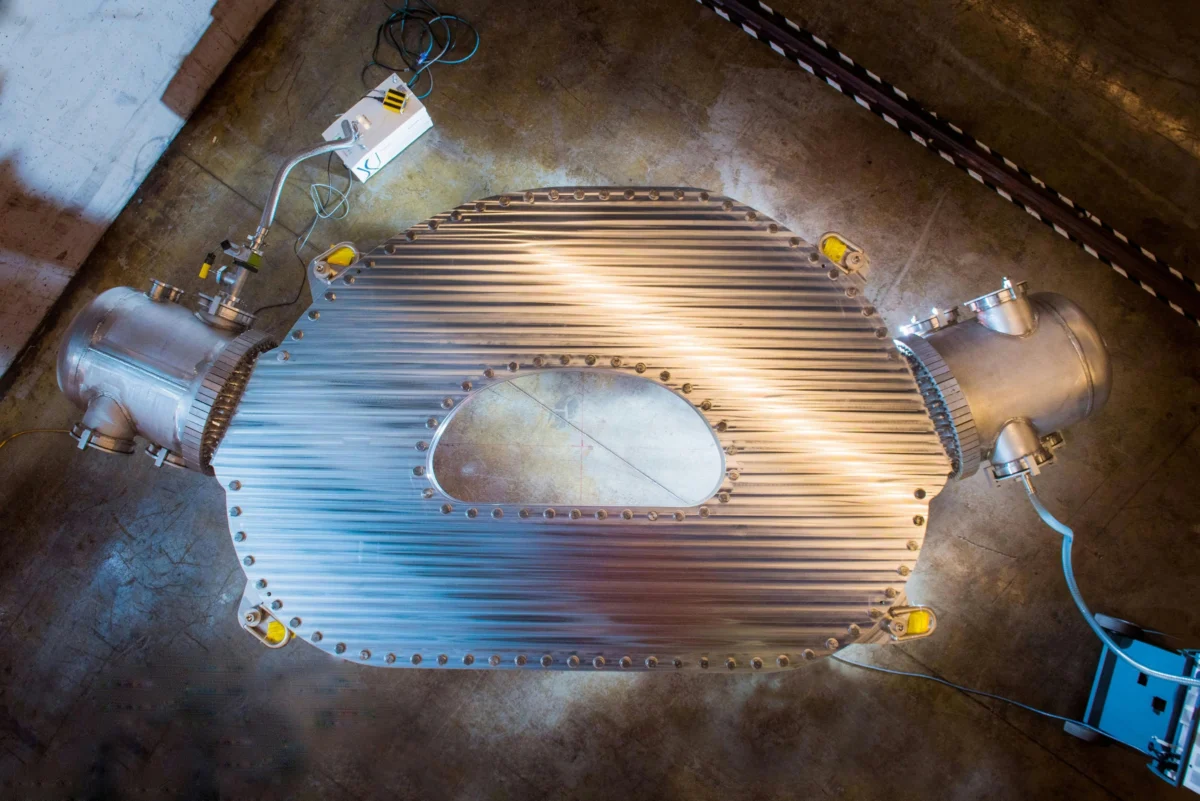
Commonwealth Fusion Systems (CFS) announced on Thursday a pivotal agreement to supply its high-temperature superconducting (HTS) magnets to Realta Fusion, marking the second such deal in a strategic pivot that underscores the company’s intent to leverage its advanced magnet technology as a significant revenue driver in the nascent fusion energy sector. This landmark transaction is not merely a component sale but a testament to the growing maturation of the private fusion industry and CFS’s unique position within it.
"It’s the largest deal of this kind to date for CFS," affirmed Rick Needham, the company’s chief commercial officer, during a call with reporters. This statement highlights the magnitude of the agreement and its importance in CFS’s evolving business model. The deal follows a previous sale of magnets to the WHAM experiment at the University of Wisconsin, a research initiative with which Realta Fusion collaborates closely, further cementing CFS’s role as a foundational technology provider in the burgeoning fusion landscape. The underlying physics explored by WHAM forms the core of Realta’s approach to fusion power, which centers on a magnetic mirror reactor design.
The Transformative Power of High-Temperature Superconducting Magnets
At the heart of these agreements lies the revolutionary potential of high-temperature superconducting (HTS) magnets. Unlike traditional low-temperature superconductors, which require cooling to near absolute zero using expensive liquid helium, HTS materials can operate at significantly warmer temperatures, often cooled by liquid nitrogen, which is far more accessible and cost-effective. This seemingly incremental difference has profound implications for fusion energy, where magnetic fields are crucial for confining superheated plasma.
For decades, the sheer scale and power required for fusion reactors were limited by the capabilities of conventional magnets. HTS materials, particularly second-generation REBCO (Rare-Earth Barium Copper Oxide) tapes, allow for the creation of far stronger magnetic fields in more compact geometries. This enables smaller, more powerful, and potentially more economically viable fusion devices. Stronger magnetic fields translate directly to better plasma confinement, which is critical for achieving the extreme conditions—temperatures exceeding 100 million degrees Celsius—necessary for sustained fusion reactions.
CFS was founded in 2018 directly out of MIT’s Plasma Science and Fusion Center, driven by the realization that this new class of commercially available HTS superconductors could underpin a viable and significantly more compact tokamak design. The company has since invested heavily in refining its proprietary HTS magnet technology, which involves intricate winding and insulation techniques to manage the immense forces and thermal loads within a fusion reactor. This expertise, developed over years and with hundreds of millions of dollars of investment, is now proving to be a valuable asset not just for its own projects but for the wider industry.
Commonwealth Fusion Systems: Pioneering Tokamaks and Beyond
CFS’s primary mission is to develop a tokamak-based fusion power plant, aiming to put electrons on the grid. Their flagship projects are SPARC (a demonstration reactor designed to achieve net energy gain) and ARC (their future commercial-scale reactor). The SPARC project, which is reportedly 70% complete and slated to turn on later this year, is designed to prove the scientific feasibility of net energy gain using HTS magnets. The subsequent ARC reactor, planned for construction in Virginia, represents the company’s ambitious leap towards commercial power generation.
The development of their magnet manufacturing facility has been a monumental undertaking, consuming seven years and hundreds of millions of dollars. This state-of-the-art factory is capable of producing HTS magnets designed to the exacting specifications required for fusion power. This vertical integration—controlling the production of a critical, enabling technology—has given CFS a significant strategic advantage. Rick Needham’s comment that "With Sparc now 70% complete, it was excellent timing to start supporting Realta with our magnet manufacturing" underscores the company’s readiness to leverage this manufacturing capability for external clients, moving beyond solely internal use.
CFS has raised nearly $3 billion to date, a substantial portion of all venture capital invested in fusion startups globally. This significant financial backing has allowed the company to build essential infrastructure, like its magnet factory, ahead of many competitors. By offering its advanced magnet technology to other fusion developers, CFS positions itself not only as a potential future energy provider but also as a critical enabler of the entire fusion industry, making technologies available that would otherwise require immense, parallel investment to replicate.
Realta Fusion’s Magnetic Mirror Vision: A Resurgent Concept
Realta Fusion, founded a few years after CFS by physicists at the University of Wisconsin, is pursuing a distinct approach: the magnetic mirror reactor. The magnetic mirror concept is one of the oldest ideas in magnetic confinement fusion, dating back to the 1950s. Its fundamental principle involves confining plasma in a magnetic field that grows stronger at its ends, effectively "reflecting" charged particles back towards the center. This creates a shape that resembles two 2-liter soda bottles connected at their bases, with powerful magnets at each "neck" forcing the plasma back, and weaker magnets encircling the middle section.
Historically, magnetic mirrors faced significant challenges, primarily plasma stability issues and excessive particle leakage from the ends of the mirror. These problems led many researchers to shift focus to other concepts, such as the tokamak and stellarator. However, the advent of HTS magnets has breathed new life into the magnetic mirror concept. As Realta co-founder and CEO Kieran Furlong stated, physicists "saw that there was a new technology, a game changer that would enable us to go back to the [magnetic] mirror and avail of those engineering advantages that the concept has."
The "engineering advantages" Furlong refers to include potentially simpler reactor geometries compared to the complex toroidal shapes of tokamaks and stellarators, easier maintenance access, and the possibility of direct energy conversion (capturing energy from escaping particles as electricity, rather than solely through heat exchange). Realta’s strategy, backed by investors like Khosla Ventures, capitalizes on the ability of HTS magnets to create much stronger mirror fields, which can significantly reduce plasma leakage and improve confinement. A key aspect of their design is scalability: to make a more powerful reactor, Realta would primarily need to expand the middle section, where the magnets are weaker and therefore cheaper. This design principle suggests that per kilowatt-hour costs could decrease as Realta’s reactors increase in size, offering a compelling economic pathway.
A Growing Portfolio: Beyond Tokamaks and Mirrors
The collaboration with Realta Fusion and the University of Wisconsin’s WHAM experiment are not isolated incidents but part of a broader strategy for CFS. The company has also licensed its HTS magnet technology to Type One Energy, another prominent fusion startup that is developing a third type of reactor design known as a stellarator. Stellarators, characterized by their complex, twisted magnetic coils, offer inherent plasma stability without the need for active control systems, but they are notoriously difficult and expensive to construct.
While the deal with Type One Energy currently involves licensing the technology rather than direct magnet manufacturing by CFS, it represents a significant vote of confidence in CFS’s HTS expertise. Christine Dunn, CFS’s head of external communications, noted that this licensing agreement could indeed lead to CFS building actual magnets for Type One in the future. This diversified engagement across different magnetic confinement approaches—tokamak, magnetic mirror, and stellarator—positions CFS as a foundational technology provider for a significant portion of the private fusion industry. It suggests a strategic recognition that while CFS has its own vision for fusion, enabling other promising pathways could accelerate the overall development of fusion power and expand the market for its core technology.
Strategic Imperatives: Revenue, De-risking, and Industry Enablement
CFS’s decision to actively sell and license its HTS magnet technology is driven by several strategic imperatives. Firstly, it provides a crucial early revenue stream for a capital-intensive industry that is still years away from commercial power generation. The "hundreds of millions of dollars" invested in the magnet factory represent a significant upfront cost, and generating external sales helps to recoup this investment and fund ongoing research and development.
Secondly, it serves as a form of risk diversification. While CFS is confident in its tokamak approach, the fusion industry is characterized by high technological uncertainty. By enabling other promising fusion concepts, CFS is, in a sense, hedging its bets. If a magnetic mirror or stellarator design proves to be quicker or more efficient to commercialize, CFS will have already established itself as a critical supplier, ensuring its long-term relevance regardless of which specific design ultimately wins the "fusion race."
Thirdly, and perhaps most altruistically, CFS frames these deals as a service to the broader fusion industry. By making its advanced HTS magnet technology accessible, CFS helps to lower the barrier to entry for other startups and accelerates their development timelines. This collaborative approach fosters a more robust and innovative ecosystem, which could ultimately benefit all players, including CFS itself, by speeding up the arrival of commercial fusion power. This aligns with a rising sentiment in the fusion community that collaboration, rather than cutthroat competition, is essential for tackling such a grand challenge.
The Broader Fusion Landscape: A Race for Clean Energy
These developments occur within a rapidly accelerating global fusion industry. Private investment in fusion has surged in recent years, driven by the urgent need for clean, carbon-free energy sources to combat climate change. Companies worldwide are exploring diverse scientific and engineering pathways, from magnetic confinement (like CFS, Realta, and Type One) to inertial confinement, and even more exotic approaches.
The ability of HTS magnets to unlock new possibilities for various fusion concepts is a significant factor in this surge of innovation and investment. Stronger magnets mean smaller reactors, which translate to lower capital costs and faster development cycles. This has reignited interest in previously sidelined concepts like the magnetic mirror, which offers distinct engineering advantages that HTS technology can now fully exploit.
The fact that CFS, a leading developer of tokamak fusion, is now supplying critical components to companies pursuing magnetic mirror and stellarator designs highlights a nuanced view of competition within the industry. CFS apparently does not view Realta and Type One as direct competitors at the moment, partly because of their differing reactor designs and also because of Realta’s initial market focus on industrial applications requiring large amounts of heat, rather than solely grid electricity. This suggests a recognition that the market for fusion energy, once it arrives, will be vast enough to accommodate multiple technologies and applications.
Investment and Future Outlook
CFS’s substantial funding, nearing $3 billion, places it in an enviable position to continue driving innovation. This financial strength has allowed it to build a formidable lead in critical areas like HTS magnet manufacturing. The company’s strategy of becoming both a fusion power developer and a key technology supplier is a clever way to de-risk its ambitious venture and potentially open up new avenues for investment. By demonstrating the commercial viability of its core technology even before its own reactors are online, CFS provides a tangible return on investment for its backers.
The Realta Fusion deal, alongside the WHAM and Type One collaborations, signals a pivotal moment for CFS and the broader fusion industry. It marks a transition from purely R&D-focused development to strategic component sales and technology licensing. This shift could accelerate the timeline for commercial fusion power by enabling a wider array of fusion companies to access cutting-edge magnet technology, ultimately bringing the promise of abundant, clean energy closer to reality. As the global demand for sustainable energy solutions intensifies, CFS’s strategic move to become an industry enabler through its magnet technology positions it as a critical player in the race towards a fusion-powered future.
About the Author