Every company today grapples with the pervasive belief that they have an Artificial Intelligence problem. This sentiment stems from a frustrating disconnect between the promise of AI and its tangible impact on business operations. Many organizations report that their AI tools generate emails that go unanswered, research customer accounts only to surface leads already lost months ago, and produce content indistinguishable from that of competitors. Despite significant investments in AI technology and extensive employee training, a persistent question lingers: why isn’t AI delivering on its potential to drive meaningful business results?
The prevailing narrative often points to deficiencies in AI models or the quality of data. However, a deeper examination reveals that the core issue lies in a critical, yet often overlooked, element: context. This encompasses the specific, nuanced knowledge of a company’s business, its customer base, their evolving needs, and the intricate workflows of its internal teams. This contextual gap is not only the most challenging problem to solve but also the one that the AI industry has been slowest to adequately address.
Context: The Unseen Infrastructure of AI Efficacy
A crucial distinction is often missed: data represents what has happened, while context imbues those events with meaning, significance, and actionable insights. Context is not merely a supplementary feature; it is the fundamental infrastructure upon which effective AI operates.
Consider a CRM system’s record of a deal closed eighteen months ago. This is data. Context, however, is the understanding that this deal was secured only after the primary champion at the client company changed roles, the pricing underwent three rounds of adjustments, and this particular customer now consistently refers new business while explicitly preferring personalized, non-automated communication. A seasoned human professional who managed that account possesses this rich contextual knowledge. Conversely, most AI systems, lacking the architecture to capture and integrate such nuanced information, remain oblivious to these critical details.
This deficiency represents a "context gap," not a deficit in AI models or raw data. It is this very gap that solutions like HubSpot’s Agentic Customer Platform aim to bridge. As highlighted by Yamini, the platform is built upon a foundational principle: a centralized repository for all customer data and business context, readily accessible to both human teams and AI agents precisely when needed. The hallmark of truly effective infrastructure is its unobtrusiveness. It operates seamlessly in the background, adapts to evolving business landscapes, and eliminates the need for repetitive explanations from users. This is the standard to which AI should be held, a standard it currently falls short of in most deployments.
The Hidden Economic Burden of Contextual Deficiencies
Beyond the upfront investment in AI tools and training, businesses incur a substantial, often unquantified, daily cost borne by their employees. This "briefing tax" represents the cumulative time and effort spent repeatedly providing AI with the necessary background information to generate useful outputs.
Before tasking an AI with drafting an email, employees must first define the brand voice. Before requesting account research, they must paste in relevant historical data. Prior to any significant task, detailed explanations of pricing structures, competitive landscapes, and ideal customer profiles are required. The following day, this process of re-briefing often begins anew, as the AI does not inherently learn or retain the specific nuances of the business. The true economic impact extends beyond lost employee hours; it encompasses the significant opportunity cost of insights that AI could have uncovered if it possessed a genuine understanding of the business.

The briefing tax is the most visible manifestation of friction. A more insidious problem, however, is the silent erosion of context over time. A company’s competitive positioning evolves, its ideal customer profile shifts, and its operational playbooks are updated. AI systems, tethered to their initial training data and conversational memory, remain unaware of these dynamic changes. They don’t "forget" in the human sense; rather, they lack the continuous connection to the underlying business realities that would inform their outputs.
For Go-To-Market (GTM) teams, this translates into AI that confidently delivers outdated or irrelevant information. As projects pivot and teams adapt, AI continues to operate on stale contextual foundations. This leads to outputs that gradually become misaligned, recommendations that no longer serve current objectives, and a general decline in the perceived value of AI assistance. When AI is disconnected from the complete, evolving business picture, it is incapable of developing the dynamic knowledge required to generate genuine, sustained value. Consequently, it remains merely a tool, failing to transcend into the realm of a trusted, intelligent teammate.
The Specialized Needs of Growth Teams: Cultivating "Growth Context"
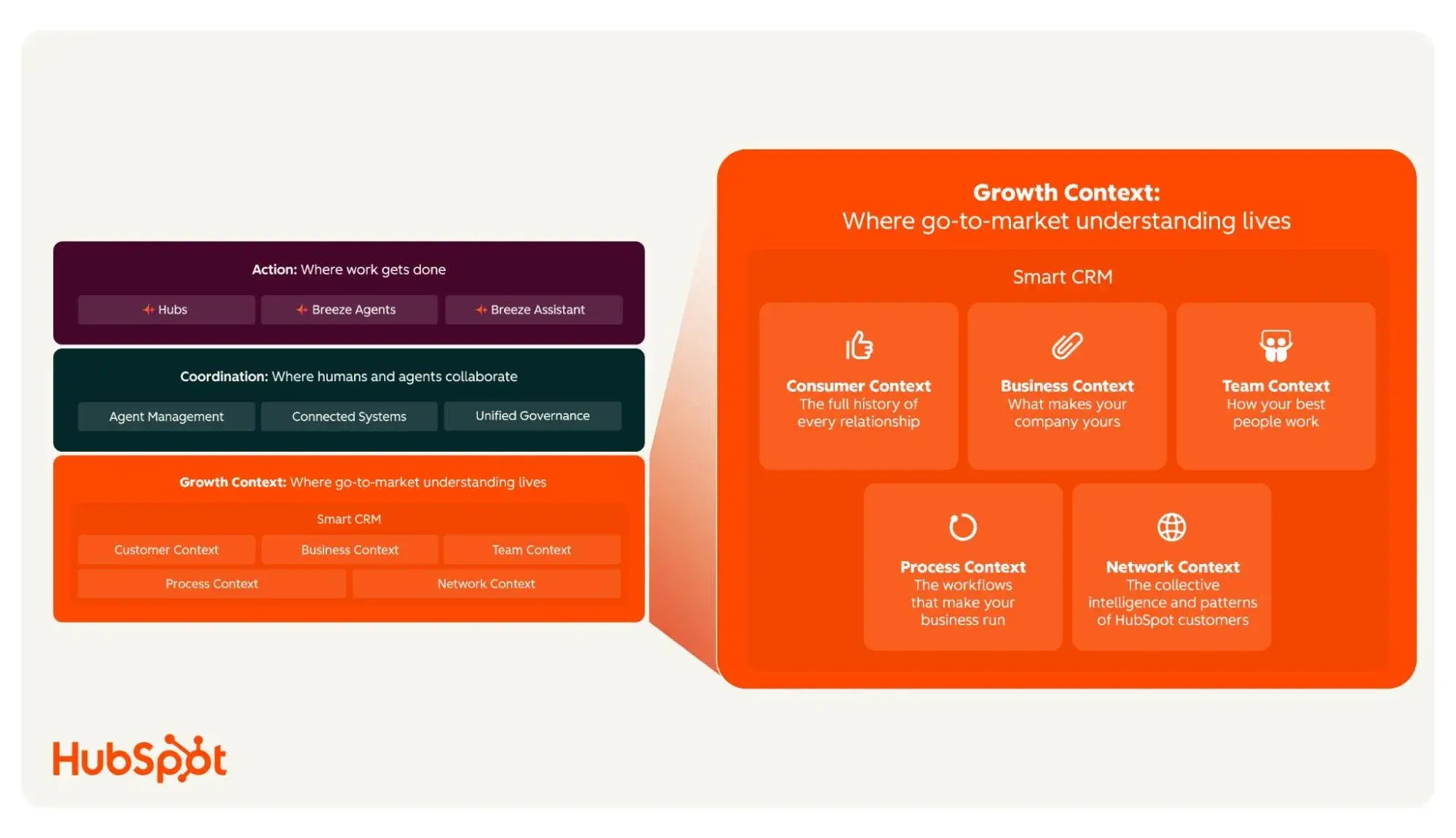
Not all forms of context are equivalent. Personal AI tools, such as advanced chatbots, focus on building individual context, encompassing user preferences, conversation history, and communication styles. Enterprise-grade AI, exemplified by platforms like Glean, concentrates on organizational context, drawing from internal documents, wikis, and institutional knowledge repositories. HubSpot, however, is pioneering the concept of "Growth Context"—a rich, high-fidelity, and precisely defined understanding that AI requires to drive tangible outcomes across marketing, sales, and customer success functions.
This is not a theoretical construct but an actively developed infrastructure. The objective is to empower businesses to both capture and maintain this critical context, while also providing them with the tools for self-management. Growth Context can be understood across five key dimensions:
- Customer Understanding: This includes detailed profiles of ideal customers, their buying journeys, engagement history, and stated needs, going beyond basic demographic data to encompass behavioral patterns and sentiment.
- Product and Service Knowledge: A comprehensive grasp of product features, benefits, pricing tiers, service level agreements, and their strategic positioning relative to market offerings.
- Market and Competitive Intelligence: Real-time insights into market trends, competitor strategies, pricing benchmarks, and evolving customer expectations within the industry.
- Internal Operations and Workflows: An understanding of how teams function, their preferred communication channels, approval processes, sales methodologies, and customer support protocols.
- Brand and Voice Consistency: The ability to consistently articulate the company’s brand identity, messaging pillars, and communication tone across all AI-generated content and interactions.
The Crucial Questions: Shifting Focus from Models to Context
As businesses evaluate AI solutions, the critical questions to ask have shifted away from the sophistication of the underlying models—which are rapidly becoming commoditized. The truly impactful inquiries revolve around the AI’s ability to access, integrate, and utilize contextual information specific to the organization.
When assessing an AI solution, consider these pivotal questions:
- Can the AI access and understand the historical context of our customer relationships, including past interactions, deal outcomes, and customer feedback, without manual input? This probes the AI’s ability to draw from a living history, not just static records.
- Does the AI have a dynamic understanding of our current product offerings, pricing structures, and service packages, and can it articulate them accurately in various scenarios? This tests the AI’s knowledge of the current commercial reality.
- Is the AI capable of learning and adapting to our evolving brand voice, messaging guidelines, and content strategies without constant re-training or explicit instruction? This assesses its capacity for nuanced brand alignment.
- Can the AI integrate with our existing sales and marketing workflows, understanding our internal processes and team roles to provide relevant, actionable assistance? This examines its integration into operational realities.
- Does the AI possess the ability to reference and learn from our internal knowledge base, including documentation, training materials, and best practices, to inform its responses and recommendations? This gauges its access to and utilization of internal expertise.
- How does the AI ensure that its outputs reflect our current market positioning and competitive landscape, rather than relying on generalized or outdated information? This challenges the AI’s ability to stay current with external dynamics.
Answering "no" to any of these fundamental questions indicates that the AI is not truly operating with your business’s current reality. Instead, it is functioning based on an outdated or incomplete version of your operations, a version that likely no longer exists.
The true race in the AI landscape is not about who possesses the most advanced algorithms, but rather who can effectively imbue AI with the deep, dynamic, and actionable context of their specific business. Companies that master "Growth Context" will not simply use AI more effectively; they will gain a significant and sustained competitive advantage with every application of the technology. This strategic imperative transcends mere technological adoption, positioning context as the ultimate differentiator in the ongoing evolution of intelligent business operations.
About the Author