An SEO audit is a critical, multifaceted examination of a website’s technical foundation, content efficacy, and overall search engine visibility. This comprehensive review aims to pinpoint issues across technical, on-page, content, and backlink profiles that may impede organic traffic, search rankings, and, crucially, conversion rates. For businesses and their SEO teams, conducting regular audits is not merely a diagnostic exercise but a strategic imperative to identify growth opportunities and align digital efforts with overarching business objectives.
In the current digital landscape, the scope of an SEO audit has expanded significantly. Beyond the traditional focus on achieving high rankings in standard search engine results pages (SERPs), modern audits must now account for the transformative impact of Artificial Intelligence (AI) on search. With AI search technologies reshaping how users discover brands and information, marketers are compelled to evaluate new metrics such as entity signals, brand presence within AI-generated answers, and content performance in generative search environments. This guide delves into the methodology of conducting an effective SEO audit tailored for today’s dynamic search ecosystem, offering clear steps, practical examples, and an actionable checklist designed to empower SEO professionals of all experience levels to drive measurable traffic growth.
Understanding the Significance of an SEO Audit
At its core, an SEO audit is a systematic evaluation of a website’s digital health, typically performed at regular intervals such as quarterly or annually. Often, third-party consultants are engaged to provide an objective, external perspective. The primary objective is to identify any barriers preventing a website’s pages from ranking effectively, being discovered by search engine crawlers, or converting visitors into leads or customers. The insights gleaned from an audit are then transformed by SEO strategists into a prioritized action plan that directly supports traffic acquisition, lead generation, and pipeline development.
A thorough SEO audit typically encompasses several key areas:
- Technical Health: This involves scrutinizing crawlability, indexability, page loading speed (including Core Web Vitals), the implementation of structured data, and the overall site architecture.
- On-Page SEO: This area focuses on elements directly on the web pages, such as metadata optimization, header tag usage, internal linking strategies, URL structure, and the effectiveness of topic and keyword clustering.
- Content Quality and Depth: Evaluation here centers on E-E-A-T (Experience, Expertise, Authoritativeness, Trustworthiness) signals, topical authority, content freshness, the presence of duplicate or thin content, and identifying content gaps.
- Top-Performing Pages: Analysis of pages that currently generate the most traffic or impressions, identifying opportunities to enhance click-through rates (CTR) and improve rankings further.
- Revenue-Generating Pages: A specific focus on product, service, or conversion-oriented pages that have the highest commercial impact, and identifying what is hindering their ascent in search results.
- Highest-Conversion Pages: Examining pages that already demonstrate strong conversion rates, with the goal of scaling, replicating, or further optimizing their performance.
- CRO Recommendations: Identifying and recommending improvements for Conversion Rate Optimization (CRO) by addressing layout friction, user experience (UX) issues, unclear calls-to-action (CTAs), messaging clarity, and engagement metrics.
- Backlink Profile and Gaps: A detailed review of the website’s backlink profile, assessing its authority, identifying any toxic or spammy links, and uncovering opportunities to acquire links that competitors are leveraging.
- Brand and Entity Signals: Assessing how clearly a brand is understood and categorized by search engines and AI models, a crucial aspect in the evolving search landscape.
- AI Search Visibility: Evaluating how a website appears in AI-generated search results, often using specialized tools to gauge readiness for generative AI interfaces.
Leveraging an SEO Audit Checklist for Immediate Impact
Embarking on an SEO audit can appear daunting, even for seasoned marketing professionals. A foundational SEO audit checklist should, at a minimum, cover critical aspects like crawlability, indexability, page speed, on-page elements, content quality, technical SEO, and backlink profiles. While a comprehensive audit can yield hundreds of insights, it’s common for teams to feel overwhelmed by the sheer volume of data. This is where identifying "quick wins" becomes invaluable. Spotting these high-impact, low-effort opportunities early provides teams with momentum and simplifies the interpretation of the broader audit findings.
![SEO audits: How to conduct one that drives traffic growth [+ checklist]](https://53.fs1.hubspotusercontent-na1.net/hubfs/53/seo-audit-1-20251217-6006144.webp)
High-impact, low-effort opportunities that SEO specialists should actively seek during an audit include:
- Identifying and resolving crawl errors: Issues like broken internal links or 404 errors that prevent search engines from accessing content.
- Optimizing meta descriptions: Ensuring they are compelling and accurately reflect page content to improve CTR from SERPs.
- Improving page load speeds: Compressing images, minifying code, or leveraging browser caching for faster loading times.
- Updating outdated or thin content: Refreshing or expanding existing pages that have become less relevant or lack sufficient depth.
- Implementing missing schema markup: Adding structured data to help search engines better understand page content and enhance rich snippet opportunities.
- Fixing broken internal links: Ensuring a seamless user journey and efficient crawlability across the site.
- Adding relevant internal links to high-authority pages: Distributing link equity and guiding users to important content.
- Ensuring mobile-friendliness: Verifying that the website provides an optimal experience across all devices.
- Identifying and consolidating duplicate content: Resolving issues that can dilute search authority.
- Optimizing title tags: Ensuring they are unique, descriptive, and include target keywords.
The Strategic Framework for Conducting a Step-by-Step SEO Audit
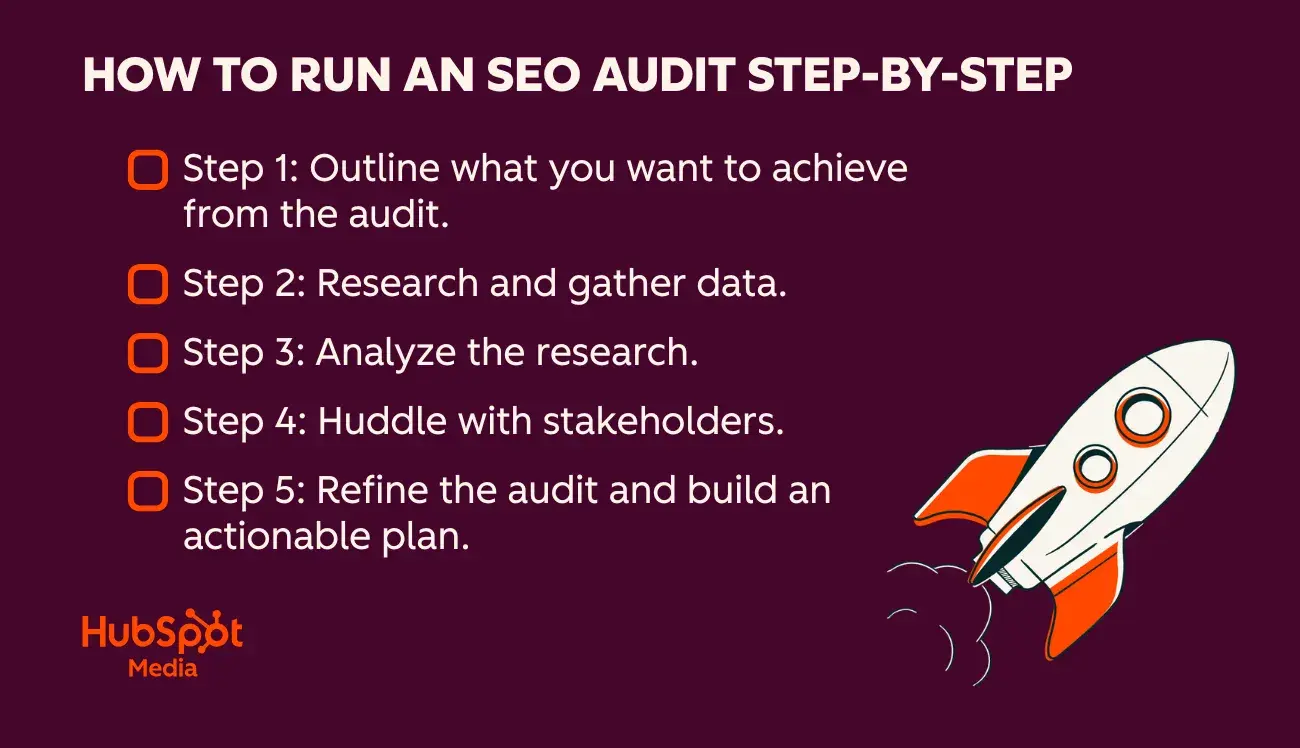
An effective SEO audit follows a structured, five-step process, moving from defining clear objectives to translating data into actionable strategies. It is crucial to note that a "modern" SEO audit must integrate Answer Engine Optimization (AEO) and Generative Engine Optimization (GEO) to accurately reflect current user search behaviors.
Step 1: Define the Business Objectives of the Audit
The initial and most critical step is to establish a clear purpose for the audit. This involves understanding precisely why the audit is being conducted and what specific problems it aims to solve. Every audit should be anchored in business goals, rather than merely being a technical checklist. While the overarching aim is to enhance website traffic and conversions, SEO consultants or internal teams must delve deeper to identify the underlying issues. This means focusing efforts on the pages, templates, and metrics that hold the most significance for the business.
Execution:
- Collaborate with Stakeholders: Engage with key business stakeholders (e.g., marketing, sales, product teams) to understand their current challenges and future aspirations.
- Identify Core Problems: Ascertain the primary reasons for the audit. Is it a decline in organic traffic, a drop in conversion rates, poor performance of a new product launch, or a need to benchmark against competitors?
- Align with Business Goals: Ensure the audit’s objectives directly support broader business objectives, such as increasing market share, launching new products, or improving customer acquisition cost.
- Prioritize Key Metrics: Determine which metrics are most crucial for success (e.g., organic traffic to specific product pages, lead generation from blog content, revenue from service pages).
It is essential to remember that an audit is a valuable practice for gaining a fresh perspective. However, each scheduled audit should have a defined purpose or goal to ensure focused efforts and measurable outcomes. The auditor’s role is to gather all findings, prioritizing them later, rather than gating information.
![SEO audits: How to conduct one that drives traffic growth [+ checklist]](https://no-cache.hubspot.com/cta/default/53/1d7211ac-7b1b-4405-b940-54b8acedb26e.png)
Step 2: Research and Gather Comprehensive Data
This phase involves collecting all quantitative data that illustrates the website’s current performance. This forms the bedrock of any SEO audit. The data points to gather typically include:
- Website Crawl Data: Information from a site crawler like Screaming Frog, detailing page URLs, status codes, meta titles, descriptions, headings, and internal/external links.
- Google Search Console Data: Insights into indexing status, crawl errors, mobile usability, Core Web Vitals, search queries, impressions, clicks, and CTR.
- Website Analytics Data: Metrics from platforms like Google Analytics, covering organic traffic volume, user behavior, conversion rates, bounce rates, and session durations across different pages and traffic sources.
- Backlink Profile Data: Information from tools like Semrush or Ahrefs, detailing referring domains, anchor text, link quality, and identifying potentially harmful links.
- Keyword Performance Data: Rankings for target keywords, search volume, and competitive density, often sourced from Semrush, Ahrefs, or Google Keyword Planner.
- Competitor Analysis Data: Insights into competitors’ keyword rankings, backlink profiles, content strategies, and overall organic visibility.
- AI Search Visibility Data: Metrics from tools like HubSpot’s AEO Grader, assessing brand and entity visibility in AI-driven search results.
Execution:
- Utilize a Suite of Tools: Employ a combination of SEO platforms, website analytics, and specialized tools to gather a holistic dataset.
- Consolidate Data: Aggregate all collected data into a centralized location, such as a Google Sheet or a dedicated audit document, for easier analysis.
- Establish Benchmarks: This data serves as a crucial benchmark for future audits, allowing for the measurement of progress and the demonstration of metric increases (e.g., rankings, traffic, AI visibility).
- Perform a Full Website Crawl: Conduct a thorough crawl to identify technical issues, broken links, redirect chains, and other structural problems.
- Analyze Google Search Console: Review performance reports, indexing status, and any manual actions or security issues flagged by Google.
- Examine Google Analytics: Understand user behavior, traffic sources, conversion paths, and the performance of key landing pages.
- Assess Backlink Profile: Evaluate the quantity and quality of backlinks, identifying toxic links that need disavowing.
- Review Keyword Rankings: Track current positions for target keywords and identify opportunities for ranking improvements.
Step 3: Analyze the Research for Actionable Insights
This is the strategic layer where raw data is transformed into meaningful insights. Tools can perform data collection, but human analysis is essential for understanding why issues exist and how they impact traffic, rankings, conversions, and AI visibility. This stage moves the audit from a spreadsheet exercise to a strategic roadmap.
Execution:
- Identify Patterns and Trends: Look for recurring issues, correlations between different data points, and significant deviations from expected performance.
- Diagnose Root Causes: Investigate why certain issues are occurring. For example, if page speed is low, determine if it’s due to unoptimized images, heavy scripts, or inefficient server response times.
- Connect SEO Findings to Business Goals: Crucially, align SEO insights with the business strategy. Consider product priorities, revenue-driving pages, seasonal demand, marketing campaigns, and sales targets. Refer back to stakeholder input from Step 1.
- Evaluate Content Performance: Analyze content for E-E-A-T signals, topical authority, user engagement, and identify content gaps or opportunities for optimization.
- Assess Technical Health: Prioritize technical issues based on their impact on crawlability, indexability, and user experience.
- Analyze Backlink Opportunities: Identify gaps in the backlink profile and potential strategies for acquiring high-quality links.
- Evaluate AI Search Readiness: Assess how well the brand and its content are positioned for AI-driven search results, looking at entity signals and structured data implementation.
- Document Insights: Record all findings and initial hypotheses in a clear, organized manner, typically within the audit document.
During this phase, the auditor begins to form strategic recommendations. For instance, if a brand aims to reach a specific audience, the auditor will identify opportunities to do so and document these insights.
![SEO audits: How to conduct one that drives traffic growth [+ checklist]](https://53.fs1.hubspotusercontent-na1.net/hubfs/53/infographic%20shows%20the%20seo%20audit%20checklist%20step-by-step..webp)
Step 4: Collaborate with Stakeholders
This crucial phase bridges the gap between SEO insights and the realities of the business. By engaging with stakeholders, SEO specialists can ensure that recommendations are practical, align with broader strategy, consider existing priorities, assess available capacity, and complement upcoming campaigns. This step validates assumptions, fills knowledge gaps, and prevents the audit from operating in isolation.
Execution:
- Present Key Findings: Share the most significant insights and potential opportunities uncovered during the analysis phase.
- Discuss Strategic Implications: Explain how the identified issues and opportunities directly impact the business’s goals and KPIs.
- Gather Feedback and Context: Understand any internal constraints, ongoing projects, or strategic shifts that might affect the implementation of recommendations. For example, a planned website redesign might influence the prioritization of certain technical fixes.
- Validate Assumptions: Confirm that the interpretation of data and the proposed solutions resonate with the stakeholders’ understanding of the business and its market.
- Identify New Opportunities: The collaborative discussion may uncover new strategic directions or previously unconsidered opportunities, such as an untapped audience segment or a high-potential content cluster.
- Realign Priorities: Based on stakeholder input, refine the initial understanding of priorities to ensure the audit plan is practical and impactful.
- Gain Buy-In: Secure commitment from stakeholders for the proposed audit direction and the subsequent action plan.
This collaborative meeting is often where the most energy and creative problem-solving occurs. When data supports intuitive business feelings or reveals unexpected avenues for growth, it fosters excitement and motivation.
Step 5: Refine the Audit and Develop an Actionable Plan
With stakeholder alignment secured, the audit findings are translated into a clear, prioritized, and executable strategy. The true value of an audit lies not just in identifying issues, but in transforming those insights into structured actions with assigned owners, realistic timelines, and clearly defined expected outcomes.
Execution:
![SEO audits: How to conduct one that drives traffic growth [+ checklist]](https://53.fs1.hubspotusercontent-na1.net/hub/53/hubfs/technical%20seo%20is%20a%20must%20as%20part%20of%20the%20seo%20audit%20checklist.%20the%20infographic%20shows%20how%20to%20prioritize%20technical%20issues..webp?width=450&height=283&name=technical%20seo%20is%20a%20must%20as%20part%20of%20the%20seo%20audit%20checklist.%20the%20infographic%20shows%20how%20to%20prioritize%20technical%20issues..webp)
- Prioritize Recommendations: Rank all identified issues and opportunities based on their potential impact, the effort required for implementation, and the availability of owners.
- Develop a Phased Approach: Group related tasks into logical sprints or phases to streamline implementation and reporting. For example, a "page speed sprint" or a "content refresh phase."
- Assign Ownership: Clearly designate who is responsible for each action item to ensure accountability.
- Set Realistic Timelines: Establish achievable deadlines for each task or sprint, considering the resources and capacity of the assigned owners.
- Define Expected Outcomes: For each prioritized recommendation, specify the anticipated results, whether it’s an increase in organic traffic, an improvement in conversion rates, or enhanced AI search visibility.
- Create a Comprehensive Report: Compile all findings, analyses, and the actionable plan into a well-structured and easy-to-understand audit report.
- Outline Implementation Strategy: Detail how the plan will be implemented, including any necessary tools, resources, or cross-functional collaboration.
- Establish Tracking Mechanisms: Define how progress and success will be monitored and measured against the defined KPIs.
A well-structured plan transforms a diagnostic document into a dynamic roadmap, making the audit a usable tool for ongoing improvement. The goal is to create a plan so actionable that any team member can confidently execute it, driving tangible results.
Interpreting the SEO Report and Prioritizing Fixes for Maximum Impact
The true impact of an SEO audit is realized during the interpretation of its findings and the subsequent prioritization of fixes. SEO specialists must evaluate recommendations based on their potential impact, the effort required, and the designated owner.
Prioritize Issues Unblocking Crawling and Indexing
Any obstacle preventing search engines from crawling or indexing critical pages must be addressed with the utmost urgency. Issues such as accidental "noindex" tags, broken internal links, or incorrectly configured robots.txt files can immediately suppress a website’s visibility. Resolving these fundamental technical barriers often yields the most rapid and noticeable improvements in organic traffic. These five categories—crawlability, indexability, accessibility, rankability, and clickability—form a hierarchy of technical SEO importance, mirroring Maslow’s hierarchy of needs but adapted for search engines.
Address Issues Posing True Business Risk
Beyond SEO performance, certain audit findings represent immediate threats to revenue or brand reputation. Security vulnerabilities, broken checkout processes, incorrect pricing information, or inaccessible forms are non-negotiable priorities. These issues directly impact conversions and erode user trust, requiring immediate attention irrespective of their SEO implications.
Align Tasks with Strategic Business Goals
SEO professionals should prioritize content clusters and pages that directly support the company’s specific objectives. This could involve targeting a new audience segment, promoting a key product line, or expanding into a new geographical market. A well-executed SEO audit must always reflect the overarching business direction.
![SEO audits: How to conduct one that drives traffic growth [+ checklist]](https://53.fs1.hubspotusercontent-na1.net/hub/53/hubfs/infographic%20shows%20a%20smart%20goal%20example.%20seo%20specialists%20need%20smart%20goals%20to%20help%20them%20prioritize%20where%20to%20focus%20efforts%20within%20the%20seo%20audit%20checklist..webp?width=650&height=374&name=infographic%20shows%20a%20smart%20goal%20example.%20seo%20specialists%20need%20smart%20goals%20to%20help%20them%20prioritize%20where%20to%20focus%20efforts%20within%20the%20seo%20audit%20checklist..webp)
Pro Tip: Encourage stakeholders to define SMART (Specific, Measurable, Achievable, Relevant, Time-bound) goals. This ensures that the prioritization process is grounded in concrete objectives, making it easier for SEO efforts to demonstrate tangible value.
Identify Content Updates Supporting Multiple Channels
Prioritize content that offers value beyond just search engine rankings. Assets that also support email nurturing campaigns, sales enablement, or product education create compounding benefits across various marketing touchpoints. A single, high-quality piece of content, especially when integrated into a defined content cluster or campaign, can effectively address needs across multiple channels. Tools like HubSpot’s free AI content writer can assist in this process.
Tackle High-Impact, Low-Effort Wins First
Focus on actionable tasks that require minimal time investment but deliver measurable improvements. Simple updates, such as optimizing title tags or adding a favicon, can significantly impact performance. Compressing images, deleting irrelevant or outdated pages, or adding a few strategic internal links can build momentum early in the implementation phase, demonstrating quick wins and motivating the team.
Pro Tip: Celebrate these early successes, particularly when collaboration with other departments, such as development teams, is involved. Positive reinforcement is a powerful motivator, and these seemingly small tasks can have a surprisingly substantial impact.
Cluster Recommendations into Sprints for Efficiency
Group related issues to enable teams to work more efficiently. Organizing tasks into thematic "sprints," such as a "page speed sprint," a "schema markup sprint," or a "content refresh sprint," helps teams maintain focus and reduces the cognitive load associated with constant context switching. This approach streamlines implementation and accelerates the delivery of improvements. Furthermore, completed sprints can be reported on individually, showcasing progress and reinforcing team motivation.
![SEO audits: How to conduct one that drives traffic growth [+ checklist]](https://53.fs1.hubspotusercontent-na1.net/hub/53/hubfs/geo-vs-aeo-4-20251216-6278594.webp?width=450&height=518&name=geo-vs-aeo-4-20251216-6278594.webp)
Focus Developer Time on Sitewide, Template-Level Issues
Developer resources are often a limited commodity. It is crucial to allocate this valuable time to fixes that offer the broadest impact. Prioritize changes that affect the entire website, such as template-level speed optimizations, site-wide schema improvements, navigation enhancements, or foundational structural updates. These interventions can positively influence hundreds or even thousands of URLs simultaneously.
Pro Tip: For teams looking to elevate their SEO expertise, resources like HubSpot Academy’s SEO Course offer comprehensive training designed to equip professionals with the skills needed to drive impactful SEO results.
Essential Tools for Conducting a Robust SEO Audit
The right set of tools can significantly enhance the speed, accuracy, and prioritization capabilities of an SEO audit. Below are commonly used and highly effective tools for this purpose:
HubSpot AI Grader
HubSpot’s AI Grader is a leading tool for integrating AI-driven insights into SEO audits. It specifically assesses a brand’s and its entities’ visibility within AI search results, evaluating how well the brand appears across generative engines, answer boxes, and conversational interfaces. This directly addresses the evolving AEO/GEO components of modern audits, focusing on entity clarity, authority signals, and overall brand prominence in AI-driven search.
- Functionality: Analyzes website readiness for Answer Engine Optimization (AEO) and Generative Engine Optimization (GEO).
- Value: Provides crucial insights into how AI systems perceive a brand, which traditional SEO metrics do not capture. It evaluates entity strength, content signals, structured data, and authority markers.
- Ideal For: Marketers seeking to understand their brand’s positioning beyond traditional SERP rankings and gain visibility in AI search.
- Pricing: Free.
HubSpot Website Grader
HubSpot’s Website Grader offers a straightforward way to obtain a quick overview of a website’s SEO health. It’s particularly useful for identifying "quick wins" early in the audit process, surfacing issues related to speed, metadata, and fundamental technical hygiene.
![SEO audits: How to conduct one that drives traffic growth [+ checklist]](https://53.fs1.hubspotusercontent-na1.net/hub/53/hubfs/seo%20audit%20tool%2c%20hubspot%E2%80%99s%20website%20grader.webp?width=650&height=538&name=seo%20audit%20tool%2c%20hubspot%E2%80%99s%20website%20grader.webp)
- Functionality: Evaluates website SEO, performance, mobile usability, and security.
- Value: Provides an easily understandable entry point for an audit, highlighting immediate fixes that can be implemented with minimal effort.
- Ideal For: Marketers desiring a high-level snapshot before delving into more complex technical or competitive analyses.
- Pricing: Free.
Semrush
Semrush is a comprehensive SEO platform renowned for its extensive capabilities in keyword research, content analysis, competitive tracking, and AI-driven recommendations. It is a powerful tool for in-depth analysis and competitive intelligence.
- Functionality: Offers a complete suite of SEO tools including keyword research, competitor analysis, backlink auditing, content insights, site audits, and AI search intelligence.
- Ideal For: Marketers and consultants requiring deep keyword data, detailed competitor insights, and robust reporting capabilities.
- Pricing: Plans start at approximately $165 per month (billed annually).
Screaming Frog SEO Spider
Screaming Frog is an indispensable tool for technical SEO audits. It excels at identifying critical issues such as orphan pages, broken links, redirect chains, thin content, and missing metadata by crawling a website locally.
- Functionality: A fast, desktop-installed crawler that identifies major technical SEO issues across a website.
- Ideal For: Technical SEO specialists or marketers who need precise, crawl-based data and can interpret the raw output to derive insights. Unlike some other tools, it focuses on data gathering rather than providing direct insights.
- Pricing: Free version available; licensed version costs approximately $279 per year.
HubSpot Marketing Hub and Content Hub
When used in conjunction, HubSpot’s Marketing Hub and Content Hub provide a powerful integrated solution for SEO audit implementation and ongoing optimization.
-
HubSpot Content Hub: This Content Management System (CMS) incorporates built-in SEO intelligence, offering AI-powered recommendations, content suggestions, and intelligent content management features. It is ideal for optimizing metadata, improving on-page signals, and managing content clusters. The AI content agent within Content Hub can further automate content production.
-
HubSpot Marketing Hub: This comprehensive marketing platform includes integrated SEO tools that directly connect to website data, content strategy, and reporting. It simplifies the process of identifying actionable tasks and implementing the audit roadmap. The SEO reporting within Marketing Hub allows for tracking performance, analyzing SEO growth, managing content clusters, assigning tasks, and measuring the impact of audit initiatives on traffic and conversions.
![SEO audits: How to conduct one that drives traffic growth [+ checklist]](https://53.fs1.hubspotusercontent-na1.net/hub/53/hubfs/seo%20audit%20tool%2c%20semrush.webp?width=650&height=374&name=seo%20audit%20tool%2c%20semrush.webp)
-
Pricing: Free plan available for Marketing Hub; tiered pricing for Starter, Professional, and Enterprise plans (starting from $9 per seat/month for Starter). Content Hub pricing varies based on features and scale.
Frequently Asked Questions About SEO Audits
How long does an SEO audit typically take?
The duration of an SEO audit can range from two weeks for smaller, simpler websites to eight weeks or more for large, complex enterprise-level sites with extensive URL structures and intricate technical architectures. The analysis and stakeholder alignment phases are often the most time-consuming and critical. Rushing these stages risks missing valuable creative insights.
Is developer assistance required for an SEO audit?
While SEO specialists are responsible for diagnosing and documenting technical issues, developers are typically required for the implementation of many fixes. Tasks such as template modifications, Core Web Vitals enhancements, schema markup integration, and JavaScript optimization often necessitate development expertise. The audit identifies the work, and developers execute it.
How frequently should an SEO audit be conducted?
Most businesses benefit from a full SEO audit annually, with quarterly or biannual reviews being beneficial for maintaining and growing search performance. Companies operating in fast-paced industries, those with frequent content updates, or businesses significantly impacted by AI search changes may find more frequent audits advantageous. A minimum of one comprehensive audit per year is recommended to benchmark performance and identify any unforeseen declines.
What tools are necessary for a free SEO audit?
A basic SEO audit can be performed using free tools, including:
![SEO audits: How to conduct one that drives traffic growth [+ checklist]](https://53.fs1.hubspotusercontent-na1.net/hub/53/hubfs/seo%20audit%20tool%2c%20screaming%20frog.webp?width=650&height=388&name=seo%20audit%20tool%2c%20screaming%20frog.webp)
- Google Search Console: For indexing, crawl errors, and performance data.
- Google Analytics: For traffic, user behavior, and conversion data.
- HubSpot Website Grader: For a quick overview of SEO, performance, and technical health.
- HubSpot AEO Grader: To assess AI search visibility.
- Screaming Frog (free version): For technical crawling and identifying basic site issues.
These tools cover core areas like crawlability, indexability, content quality, and AI search visibility.
What distinguishes an SEO audit from a general website audit?
An SEO audit is specifically focused on elements that influence search engine rankings, visibility, and online conversions, including technical health, content effectiveness, backlink profiles, and AI visibility. A website audit is broader, potentially encompassing user experience (UX) design, accessibility, CRO, branding, navigation, and overall site performance. An SEO audit can be considered a specialized component of a comprehensive website audit, directly tied to driving organic traffic and improving search performance.
The Evolving Landscape: Modern SEO Audits Transcend Traditional Blue Links
A well-executed SEO audit serves as more than just a diagnostic tool; it functions as a catalyst for website growth. By systematically reviewing technical health, content quality, authority signals, and AI search visibility, businesses can uncover immediate opportunities, shape long-term strategies, and develop a clear roadmap to enhance traffic, conversions, and pipeline.
It is imperative to recognize that modern SEO audits must extend beyond optimizing for traditional search results. They must critically evaluate a brand’s presence in generative search and ensure its content is understood as a distinct entity by search engines and AI models. For a rapid and accurate assessment of current standing, tools like HubSpot Website Grader and HubSpot AEO Grader provide accessible means to evaluate both fundamental SEO principles and AI search visibility within minutes.
The most impactful audits are those that are deeply rooted in specific business objectives and are executed collaboratively. The point at which data-driven insights align with stakeholders’ intuitive understanding, or conversely, reveal unexpected strategic pathways, is often the most illuminating. A truly effective audit empowers teams with clarity, confidence, and renewed energy, inspiring action and driving tangible, measurable results.
About the Author