An article from
HR Dive
Published April 17, 2026
By Lara Ewen, Contributor
Artificial intelligence is fundamentally reshaping entry-level roles, contributing to a precipitous decline in the longevity of acquired skills and casting a shadow over the preparedness of the future workforce. This seismic shift, detailed in a comprehensive report, indicates that traditional educational pathways are struggling to keep pace with the rapid advancements and pervasive integration of AI technologies across various industries. The report, which surveyed over 2,700 individuals including learners, higher education leaders, and employers across the United States, United Kingdom, Brazil, Saudi Arabia, Vietnam, and Malaysia, underscores a growing chasm between the skills acquired through education and the demands of the contemporary labor market.
The AI Revolution in Entry-Level Employment
The findings illuminate a stark reality: the skills that once served as a reliable foundation for early career success are now rapidly becoming obsolete. This phenomenon is directly linked to the accelerating capabilities of AI. A separate survey conducted by General Assembly in the preceding year revealed a striking sentiment among professionals, with an overwhelming 83% of workers believing that AI could perform most entry-level job functions as effectively as a human. This perception is not merely theoretical; it is beginning to translate into tangible business strategies.
Adding another layer to this complex landscape, a 2025 report from the British Standards Institution highlighted that a significant portion of employers are actively considering AI solutions as a precursor to traditional hiring. Specifically, 31% of business leaders reported that their organizations had contemplated AI-driven alternatives before filling a role. This suggests a proactive approach by some companies to leverage AI for efficiency and cost savings, potentially bypassing the need for human personnel in certain capacities.
The "AI Readiness Friction"
Despite the widespread adoption and burgeoning potential of AI, the report emphasizes that "AI readiness is breaking down at the point of execution, where learning must translate into applied workplace capability, rather than from a lack of ambition or access." This critical observation points to a disconnect between theoretical knowledge and practical application. While individuals may possess a basic understanding of AI or even a desire to engage with these technologies, the ability to effectively integrate AI into real-world work scenarios remains a significant hurdle.
Tom ap Simon, president of higher education and virtual learning at Pearson, articulated this concern, stating that rudimentary AI literacy is no longer a sufficient benchmark. He emphasized the crucial role of educational institutions in proactively addressing this challenge. "Schools that lead in AI readiness today will shape the future of workforce readiness tomorrow," ap Simon asserted. "Building an AI-ready workforce depends on structured, shared systems that amplify human skills and connect curriculum to real work." His statement underscores the necessity for a more integrated and strategic approach to AI education and its practical application in the professional sphere.
Addressing the Skill Gap: The AI Readiness Friction Framework
To help organizations and educational bodies bridge the widening gap between current learners and the evolving demands of the future workforce, the report proposes an "AI Readiness Friction Framework." This framework is designed to be a practical guide for identifying and rectifying the obstacles that impede progress along the education-to-work pipeline. It meticulously details key friction points that hinder the seamless transition of skills and knowledge into practical workplace capabilities.
The framework identifies several critical areas of friction, including:

- Pace of Change: The rapid evolution of AI technologies outpaces the traditional curriculum development cycles in educational institutions. This creates a persistent lag between what is taught and what is currently relevant and in-demand in the job market. The speed at which new AI tools and applications emerge means that skills acquired today may have a significantly shorter shelf life than in previous eras.
- Governance and Standardization: A lack of standardized approaches to AI education and assessment makes it difficult for employers to gauge the true AI proficiency of candidates. Without clear benchmarks and recognized certifications, it becomes challenging to ensure that individuals possess the necessary applied skills.
- Experiential Learning Gaps: The transition from theoretical AI knowledge to practical, hands-on application is often where the greatest friction occurs. Educational programs may not adequately provide opportunities for students to engage with AI tools in simulated or real-world work environments, leading to a deficiency in applied skills.
- Curriculum Integration: AI is often treated as a standalone subject rather than being integrated across various disciplines. This siloed approach fails to equip students with the understanding of how AI can be leveraged within their specific fields of study or future professions.
- Teacher and Faculty Preparedness: Educators themselves may not have the necessary training or resources to effectively teach about AI and its applications, further exacerbating the problem. Continuous professional development is essential for keeping educators abreast of AI advancements.
- Industry-Academia Collaboration: Insufficient collaboration between academic institutions and industry leaders results in a disconnect between educational offerings and the actual needs of the job market. Stronger partnerships are vital for aligning curricula with emerging skill requirements.
Background Context: The Accelerating Integration of AI
The current discourse surrounding AI’s impact on the workforce is not new, but the pace and depth of its integration have accelerated dramatically in recent years. Developments in machine learning, natural language processing, and generative AI have moved from theoretical concepts to practical applications that are actively deployed in various sectors. The COVID-19 pandemic also played a role, accelerating digital transformation initiatives, including the adoption of AI-powered tools, as businesses sought to enhance efficiency and remote work capabilities.
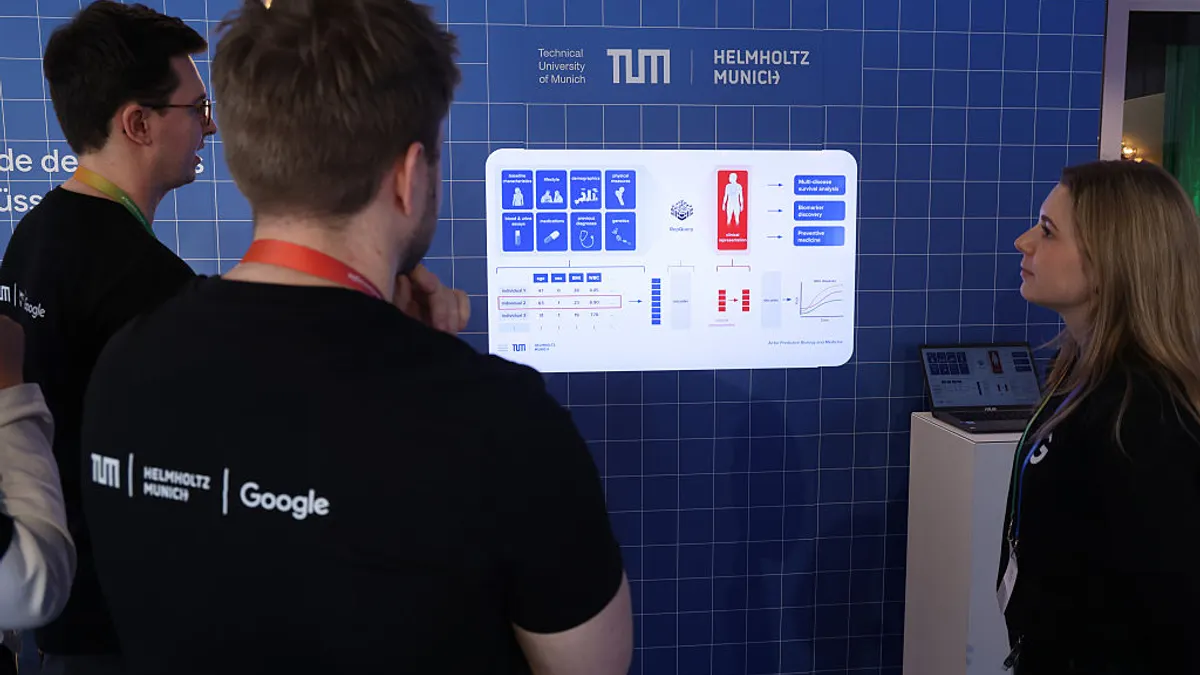
The image accompanying the article, depicting graduate students from Technical University Munich and Helmholtz Munich discussing an AI tool in a medical application, serves as a visual representation of this ongoing integration. The caption highlights that only 28% of employers believe universities are keeping pace with AI-driven change. This statistic is a critical indicator of the systemic challenges faced by higher education in adapting its offerings to the rapid evolution of technology. The launch of the new Google AI Center Berlin in March 2026 further underscores the significant investment and focus on AI development and its potential impact on various fields, including healthcare.
Supporting Data and Trends
The report’s findings are corroborated by several emerging trends:
- Decreasing Skill Shelf Life: Research from various labor market analytics firms indicates a shrinking window during which specific technical skills remain relevant. Skills that were once considered cutting-edge may become outdated within a few years, necessitating continuous learning and adaptation.
- Automation of Routine Tasks: AI is increasingly capable of automating repetitive and data-intensive tasks, which have traditionally formed a significant portion of entry-level job responsibilities. This displacement necessitates a shift in the types of skills that are valued, emphasizing critical thinking, creativity, problem-solving, and complex communication.
- Demand for AI-Adjacent Skills: While AI may automate some roles, it simultaneously creates demand for new skill sets. These include AI ethics specialists, data scientists, AI trainers, prompt engineers, and professionals who can manage and interpret AI-generated insights.
- The Rise of Upskilling and Reskilling Initiatives: In response to the changing landscape, there’s a growing emphasis on upskilling and reskilling programs. These initiatives aim to equip the existing workforce with the new competencies required to work alongside or manage AI technologies, or to transition into emerging roles.
Broader Impact and Implications
The implications of a widening gap between workforce skills and industry demands are far-reaching:

- Economic Stagnation: A significant portion of the workforce lacking the necessary AI-related skills could lead to reduced productivity, innovation, and economic competitiveness for countries and organizations.
- Increased Inequality: Individuals and communities with limited access to AI-focused education and training may be disproportionately affected, leading to a further exacerbation of socioeconomic inequalities. The digital divide could transform into an "AI skills divide."
- Talent Shortages: Despite high unemployment rates in some sectors, businesses may face persistent talent shortages in specialized AI-related fields, hindering their growth and operational efficiency.
- Rethinking Education Models: Educational institutions will need to fundamentally rethink their pedagogical approaches, embracing agile curriculum development, interdisciplinary learning, and a greater focus on lifelong learning. The traditional model of a one-time degree may become insufficient.
- Policy and Regulatory Adjustments: Governments and regulatory bodies will need to consider policies that support workforce transition, invest in AI education infrastructure, and establish ethical guidelines for AI deployment in the workplace. This includes exploring universal basic income or similar social safety nets to address potential job displacement.
The report’s call for structured, shared systems that amplify human skills and connect curriculum to real work is a critical roadmap. Without concerted efforts from educational institutions, industry leaders, and policymakers, the transformative potential of AI risks being undermined by a workforce that is ill-equipped to harness its power, ultimately jeopardizing global economic progress and individual career trajectories. The urgency for adaptive, forward-thinking strategies in education and workforce development has never been greater.
About the Author