Steve Eimers, a prominent roadside safety advocate known to millions as “The Guardrail Guy,” has officially announced an indefinite suspension of his advocacy work regarding Automatic License Plate Readers (ALPRs). The decision comes after a series of violent incidents involving the destruction of surveillance equipment and a disturbing shift in public sentiment that Eimers believes has transcended the boundaries of civil safety discourse. Eimers, whose activism was born from the tragic loss of his daughter, cited the escalation of vandalism and the radicalization of his social media following as primary factors in his withdrawal from the ALPR debate.
For years, Eimers has utilized platforms like YouTube, TikTok, and X to expose what he identifies as lethal installation errors in American highway infrastructure. However, his recent foray into the world of high-tech surveillance technology—specifically the mounting of ALPR cameras on roadside safety hardware—has ignited a firestorm of controversy that highlights a growing national tension between public safety, law enforcement technology, and civil liberties.
The Genesis of an Advocate: From Tragedy to Transformation
To understand Steve Eimers’ influence, one must look back to 2016. His daughter, 17-year-old Hannah Eimers, was killed in a car accident in Tennessee. The vehicle she was driving left the road and struck a guardrail end terminal—a device intended to telescope or peel away upon impact to absorb energy. Instead, the guardrail pierced the cabin of the car, leading to a fatal injury.
Following this tragedy, Eimers dedicated his life to auditing roadside hardware across the United States. He became a self-taught expert on the Manual for Assessing Safety Hardware (MASH) and the National Cooperative Highway Research Program (NCHRP) Report 350, which set the standards for crashworthy devices. His work led to the removal of thousands of dangerous guardrail terminals and forced state Departments of Transportation (DOTs) to re-evaluate their contracts with hardware manufacturers.
By 2022, Eimers had built a massive digital following, using his technical knowledge to point out "spears" (poorly installed guardrails) and "booby traps" (improperly placed signs) that could turn a minor roadway departure into a fatal event. His credibility with both the public and engineers made him a singular figure in the niche world of transportation safety.
The Shift to ALPR Advocacy: Safety vs. Surveillance
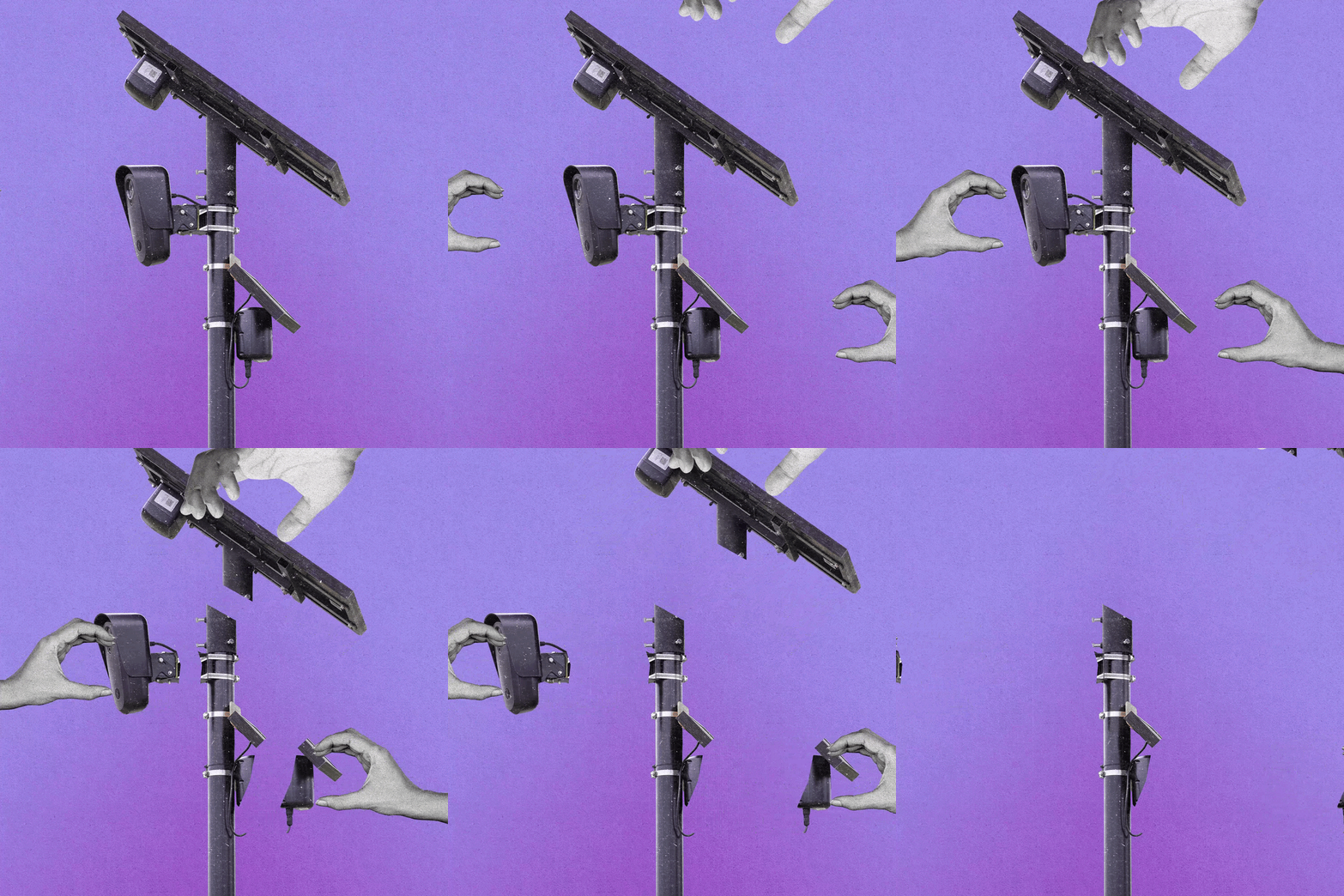
In April 2024, Eimers expanded his focus to include Automatic License Plate Readers. These devices, manufactured by companies such as Flock Safety and Axon, are designed to assist law enforcement by capturing vehicle data, including plate numbers, make, model, and color. These systems are often integrated into "hot lists" that alert police to stolen vehicles or cars associated with Amber Alerts and active warrants.
Eimers’ concern with ALPRs was not initially rooted in privacy or the ethics of mass surveillance. Rather, he approached the technology through the lens of "crashworthiness." He observed that many of these cameras were being mounted on existing "breakaway" posts—poles designed to snap off at the base when hit by a car to prevent the vehicle from coming to an abrupt, lethal stop.
Eimers argued that adding heavy camera equipment, solar panels, and battery packs to these posts could interfere with their breakaway mechanics. Furthermore, he documented instances where ALPR poles were installed directly in front of guardrails, effectively creating a "vaulting" hazard or preventing the guardrail from deflecting as designed. His technical critique was simple: the pursuit of law enforcement data was compromising the physical safety of the roadside environment.
A Timeline of Escalation and Vandalism
The transition from auditing guardrails to auditing surveillance cameras triggered an immediate and aggressive reaction from the public. While Eimers’ previous content focused on engineering failures, his ALPR videos tapped into a deep-seated resentment toward perceived government overreach and the expansion of the surveillance state.
April 2024: Eimers begins posting videos of ALPR installations, questioning their compliance with Department of Transportation safety standards.
July 22, 2024: Following Eimers’ persistent documentation of faulty installations, Garrett Langley, the CEO of Flock Safety, publicly acknowledged Eimers’ work. Langley referred to Eimers as a “true American hero” and committed the company to a nationwide audit of its camera installations to ensure they met safety regulations.
July 24, 2024: Social media comments on Eimers’ videos begin to take a dark turn. Users began sharing specific methods for destroying the cameras, including the use of large-diameter pipe cutters and firearms. Some followers suggested the devices contained precious metals, seemingly to incentivize theft.
July 25, 2024: While driving with his daughter in Tennessee, Eimers discovered that two of the cameras he had recently featured in his videos had been severely damaged. The damage appeared to be the result of gunfire.
July 31, 2024: Law enforcement in Blount County, Tennessee, announced the arrest of 36-year-old Adam Heimerman. Heimerman, who was reportedly campaigning for a seat in Congress, was charged with felony vandalism. He is alleged to have shot four ALPR cameras between July 14 and July 22.
The Data Behind the Surveillance Boom
The controversy surrounding Eimers’ advocacy is set against a backdrop of rapid technological expansion. Flock Safety, the market leader in the ALPR space, currently operates more than 120,000 cameras across 49 states. The company claims its technology helps solve approximately 10 percent of reported crimes in the U.S. by providing "objective evidence" to investigators.
However, the proliferation of these devices has outpaced the development of clear regulatory frameworks regarding their physical placement. While the Federal Highway Administration (FHWA) provides guidelines for roadside hardware, the specific integration of third-party surveillance tech on state-owned infrastructure remains a bureaucratic gray area.
Data from privacy advocacy groups like the ACLU suggest that the risks of ALPRs extend beyond physical crashes. They point to the potential for data misuse, the lack of transparency regarding data retention periods, and the creation of a "pervasive tracking" network that monitors the movements of law enforcement-sensitive populations without a warrant. In Eimers’ case, these two worlds—physical safety and digital privacy—collided, creating a volatile mix that he had not anticipated.
Official Responses and Corporate Accountability
The response from official channels has been a mix of condemnation for the vandalism and a reluctant admission that installation standards need improvement. Major Deputy Chief Ryan Rogers of the Maryville Police Department confirmed that the arrest of Adam Heimerman was directly linked to the cameras flagged by Eimers. Law enforcement officials emphasized that while citizens have a right to question technology, the destruction of public safety equipment is a felony that endangers the community.
Flock Safety has taken a proactive but guarded stance. Following the "hero" designation from their CEO, the company confirmed it is conducting a nationwide audit. However, a spokesperson for Flock, Paris Lewbel, declined to provide a specific timeline or methodology for this audit. The company continues to maintain that its devices are safe and that the benefits of crime reduction far outweigh the risks posed by the physical presence of the poles.
For Eimers, the "audit" was a major victory for roadside safety, yet it was overshadowed by the reaction of his audience. He noted that the support for the vandalized cameras—evidenced by social media comments like "Buy that man a beer"—revealed a level of civil unrest that he was no longer willing to fuel.
Analysis: The "Chilling Effect" on Safety Advocacy
The withdrawal of Steve Eimers from the ALPR space represents a significant "chilling effect" on citizen-led infrastructure oversight. Eimers’ ability to force a multi-million dollar tech company into a nationwide audit is a testament to the power of social media advocacy. However, his retreat highlights the dangers of "audience capture," where an advocate’s message is co-opted by a following with a different, more radical agenda.
Eimers’ original intent was to ensure that if a driver veers off the road, they hit a crashworthy object rather than a lethal obstacle. By focusing on the "crashworthiness" of ALPRs, he was applying the same logic he used for guardrails. But because ALPRs are symbols of police power, his technical critiques were interpreted by many as a call to arms against the surveillance state.
The situation also exposes a failure in the regulatory oversight of roadside technology. If a private company is permitted to install hardware on public rights-of-way, there must be a rigorous, transparent process to ensure that these installations do not negate the safety features of existing infrastructure. Eimers’ work proved that this process was, at best, inconsistent.
Conclusion: Staying in the Lane of Safety
In his final statements regarding the matter, Steve Eimers expressed a desire to return to his roots. He plans to leave his existing ALPR content online as a resource for engineers and safety officials, but he will no longer engage with the topic or provide new updates.
"I poke the bear too often," Eimers remarked, "And this time the bear poked back."
The "bear" in this metaphor is not just the corporations or the government, but the volatile nature of public discourse in the digital age. Eimers’ decision to "stay in his lane" is a strategic move to preserve the integrity of his primary mission: preventing families from enduring the same loss he suffered.
As the nationwide audit of Flock cameras proceeds, the legacy of Eimers’ brief foray into surveillance advocacy will likely be found in safer installation standards. However, the incident serves as a stark reminder that in the modern landscape of American infrastructure, the line between a safety device and a political symbol is increasingly thin—and often dangerous to cross.
About the Author