The burgeoning field of Answer Engine Optimization (AEO) is rapidly reshaping how businesses approach online visibility, with artificial intelligence at the forefront of search innovation. Two prominent tools, HubSpot AEO and Profound, offer distinct pathways for marketers and RevOps professionals to navigate this new frontier. While both aim to enhance a brand’s presence within AI-generated answers, their fundamental approaches—execution-driven integration versus in-depth analytical exploration—present a critical strategic decision for organizations. Understanding these differences is paramount for optimizing content, campaigns, and ultimately, business growth in an AI-centric search ecosystem.
The core divergence between HubSpot AEO and Profound lies in their operational focus: HubSpot AEO prioritizes a streamlined insight-to-execution workflow within its existing ecosystem, while Profound emphasizes a more comprehensive and granular analysis of AI visibility, brand perception, and competitive positioning. This distinction directly addresses a fundamental question facing marketing leaders and SEO strategists: do they require a faster, more integrated approach to acting on AI visibility data, or do they need a deeper, more analytical understanding of their brand’s standing across various AI platforms?
The Execution vs. Analysis Dichotomy in AEO
At its heart, the choice between HubSpot AEO and Profound boils down to a strategic prioritization between rapid content and campaign execution and a more profound analytical deep dive. For marketing professionals seeking to optimize for AI-generated answers, the immediate challenge is often how to translate newfound insights into tangible actions.
HubSpot AEO is meticulously designed to bridge this gap. It functions as an Answer Engine Optimization tool that not only tracks a brand’s appearance in AI-generated responses but also directly links these findings to content creation and campaign management functionalities already present within the HubSpot platform. This integrated approach aims to reduce the friction between identifying an optimization opportunity and implementing a solution.
Conversely, Profound operates as a more specialized AEO platform, concentrating on delivering a high degree of analytical depth. It delves into brand perception, analyzes citation sources that influence AI responses, and maps out competitive positioning across a wider array of AI platforms. Profound’s strength lies in its ability to provide comprehensive data for understanding why a brand appears—or doesn’t appear—in AI outputs, offering a richer understanding of the underlying dynamics.
For businesses that are new to AI search visibility, a valuable starting point is the free HubSpot AEO Grader. This no-cost tool provides a foundational assessment of a brand’s AI search visibility without requiring any subscription or commitment. It generates a snapshot score across popular answer engines in mere minutes, offering a low-friction entry point into the AEO landscape.
Unpacking the Features and Core Differentiators
Both HubSpot AEO and Profound are engineered to monitor a brand’s presence in AI-generated answers, but their feature sets diverge significantly when it comes to operational efficiency and analytical depth. These differences are crucial for teams to consider based on their existing workflows and strategic priorities.
HubSpot AEO: Integrated Actionability
HubSpot AEO, as a dedicated Answer Engine Optimization product from HubSpot, excels in tracking a brand’s appearance in AI-generated answers across prominent platforms like ChatGPT, Gemini, and Perplexity. Upon identifying visibility trends and potential areas for improvement, it surfaces prioritized recommendations directly within the HubSpot environment.
What truly sets HubSpot AEO apart is its seamless integration into the broader HubSpot ecosystem. AI visibility data is not an isolated metric; it’s directly connected to CRM records, contact segments, and marketing workflows. This means a team can identify a competitive gap for a specific prompt, understand its relevance to particular customer segments, and immediately transition to content creation or campaign optimization—all without leaving the HubSpot platform. The synergy with Marketing Hub for content publishing, Content Hubs for asset development, and Smart CRM for audience context ensures that recommendations are not generic but are contextually meaningful and actionable.
The HubSpot AEO Grader serves as a distinct diagnostic tool, offering a one-time assessment, whereas HubSpot AEO is an ongoing monitoring and optimization platform. For organizations building a comprehensive Answer Engine Optimization strategy, HubSpot AEO acts as the operational backbone, translating visibility data into concrete actions.
Profound: Deep Dive Analytics and Citation Tracking
Profound distinguishes itself as an enterprise-focused Answer Engine Optimization platform that offers a more extensive analysis of a brand’s AI presence. It monitors visibility, share of voice, sentiment, and crucially, citation sources, identifying opportunities for optimization. The depth of Profound’s analysis is its key differentiator.
Profound typically tracks a wider array of AI platforms in its base edition, often including Google AI Overviews and Claude, in addition to the major engines monitored by HubSpot AEO. It provides flexible custom prompt tracking across a broad spectrum of topics and queries. Furthermore, its advanced source and influence mapping capabilities reveal which domains are most instrumental in shaping AI responses. Its brand perception analysis goes beyond mere presence metrics, evaluating how AI systems actually articulate and describe a brand, offering a nuanced understanding of brand narrative.
For teams striving to comprehend the underlying reasons for their AI visibility (or lack thereof), Profound offers a wealth of data. However, this analytical prowess comes with a trade-off: Profound delivers insights but does not possess a built-in execution layer for implementing improvements. Acting on Profound’s recommendations necessitates exporting this data and integrating it into separate content management systems or marketing workflows.
Pricing and Accessibility:
HubSpot AEO offers a free AEO Grader as an initial assessment. Its standalone paid plan begins at $50 per month ($45 per month billed annually), which includes tracking for 25 prompts and a 28-day free trial. For teams looking to integrate AEO workflows with content creation and campaign execution within HubSpot, access to Marketing Hub Professional is required, with pricing starting around $800 per month. This tier unlocks the full integration layer, including CRM-informed recommendations, content workflows, and campaign triggers, representing a significant enhancement over the standalone product.
Profound provides a free one-time AEO report as its entry-level offering. Paid plans commence at $99 per month ($82.50 per month billed annually) for the Starter edition, and $399 per month ($332.50 per month billed annually) for the Growth/Standard tier. Enterprise pricing is custom, and agency plans are available from $99 per month.
For small to medium-sized businesses (SMBs) and mid-market companies operating on a budget, HubSpot AEO’s lower entry point and bundled ecosystem can reduce the overall tooling requirements. For enterprise organizations that already have a robust content operations stack and require the deep analytical capabilities of Profound, the higher price point is justified by its data richness. Nevertheless, these teams must factor in the additional tools and resources needed to act upon Profound’s detailed recommendations.
Ease of Use and Adoption: Bridging the Technical Divide
The user experience and adoption rates of AEO tools are critical for their effectiveness, particularly in cross-functional marketing teams.
HubSpot AEO: Intuitive Design for Broad Adoption
HubSpot AEO is engineered with marketing teams in mind, even those lacking deep technical expertise in AEO. Setup is designed to be swift, typically taking minutes: users input their brand information, select relevant prompts, and the platform begins tracking.
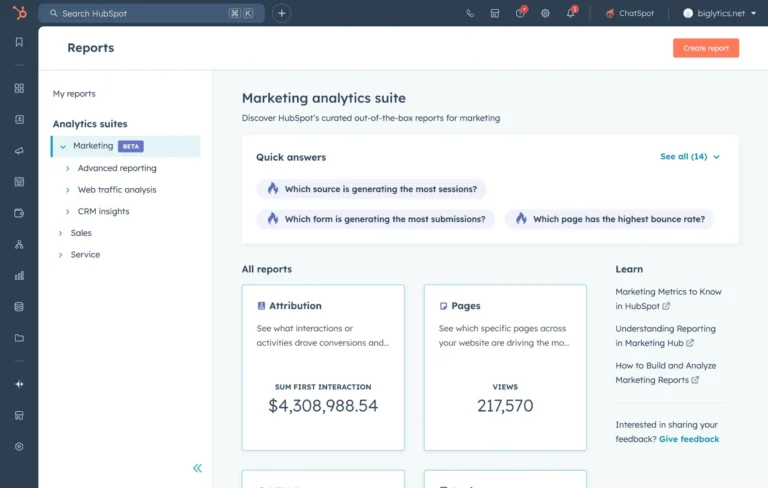
The dashboard presents visibility scores, competitor benchmarks, and prioritized recommendations in straightforward language. Guided workflows are integrated to steer users from insight generation to actionable steps, without requiring an intricate understanding of AI-generated answer mechanics. This low learning curve is a significant advantage for cross-functional adoption, ensuring that content strategists, SEO leads, and RevOps managers can all interpret the same data and collaborate effectively.
Profound: Catering to Data-Savvy Professionals
Profound features a clean, modern interface, but it is primarily designed for users comfortable with intricate visibility data. The platform rewards a deeper engagement with its data. Users who are proficient in citation analysis, detailed prompt tracking, and competitive share-of-voice metrics will derive the most value from Profound.
This orientation is advantageous for teams with dedicated SEO or data analysis functions. However, for teams without such specialized roles, the learning curve may necessitate additional onboarding time and could potentially slow adoption. For stakeholder reporting, HubSpot AEO benefits from its existing reporting infrastructure, allowing for easy dashboard sharing within the platform without the need for additional export steps.
Profound supports CSV exports and API-based reporting, but teams must configure these additional steps to align with their standard stakeholder workflows.
Actionability and Workflows: The Critical Transition from Insight to Implementation
The divergence in actionability and workflow management is perhaps the most significant differentiator between HubSpot AEO and Profound for many organizations.
HubSpot AEO: Seamless Execution Within a Unified Platform
HubSpot AEO’s primary strength lies in its ability to directly link AI visibility data to content and campaign execution within a single, integrated platform. When the tool identifies a prompt where a brand is underperforming or absent in AI-generated answers, it presents prioritized recommendations. This provides a direct conduit to creating or updating relevant content.
The seamless integration with Marketing Hub and Content Hub facilitates execution, while Smart CRM offers crucial audience context, ensuring that recommendations align with specific segments and lifecycle stages relevant to the business. The outcome is a significantly shortened cycle from identifying an AI visibility gap to publishing content designed to address it.
Profound: Analysis-Led, External Execution
Profound offers tools for improvement, including an "Improve" module that can generate FAQs based on tracked prompts. However, it lacks an integrated content execution layer. To act on Profound’s insights, users must export this data, transfer it to a separate CMS, brief their content team, and manage the production workflow externally.
While this approach is manageable for teams with dedicated content operations, it introduces friction for teams where analysts and content creators are the same individuals, or where speed to execution is a critical business imperative. The transition from insight to execution is a pivotal operational challenge in AI SEO. While tracking visibility is relatively straightforward, consistently translating that data into published content is the more complex operational hurdle, and it is precisely this challenge that HubSpot AEO is structurally designed to address.
Strategic Endorsements:
"We appreciate HubSpot AEO’s ability to provide CRM-informed recommendations," states a marketing analytics lead at a mid-sized tech company. "This allows the platform to prioritize visibility gaps based on actual audience data, rather than just generic prompt volume. We can clearly see which prompts are most relevant to our buyer segments before allocating optimization efforts."
Data Depth and Intelligence: A Spectrum of Insights
When it comes to the sheer volume and granularity of data, Profound generally holds an advantage.
-2.png)
Profound: Unparalleled Data Granularity
Profound tracks a broader spectrum of AI platforms in its foundational offerings, including Google AI Overviews and Claude, alongside other major engines. It offers more adaptable custom prompt configuration and provides highly granular insights into brand perception. This includes understanding how AI systems describe a brand, identifying the sources that most influence those descriptions, and tracking shifts in positioning across various prompts and competitors over time.
For enterprise-level brand, public relations, and data teams tasked with auditing AI-generated narratives or investigating why competitors are consistently cited more frequently, Profound delivers deeper intelligence on sources, sentiment, and brand perception.
HubSpot AEO: Clarity and Actionability in Data
HubSpot AEO reliably tracks AI visibility across ChatGPT, Gemini, and Perplexity, providing daily updates, historical trend dashboards, and citation analysis. The data presented is structured for clarity over complexity, making it particularly useful for teams focused on prioritization and action rather than exhaustive in-depth investigation.
The platform’s citation tracking effectively identifies which sources and content types contribute to AI answers, a level of detail sufficient for most content optimization decisions.
The trade-off is evident: Profound offers a greater quantity of data, while HubSpot AEO focuses on making that data more actionable. For the majority of marketing and RevOps teams, the advantage of actionability often outweighs the benefit of analytical depth. However, for enterprise teams with the resources to support extensive analysis, Profound’s sophisticated data layer can provide significant strategic value.
Integrations and Ecosystem: The Power of Connectivity
The integration capabilities of AEO tools are crucial for seamless adoption within existing tech stacks.
HubSpot AEO: Native Ecosystem Advantage
HubSpot AEO’s integration advantage is deeply embedded in its structural design. As an integral component of the HubSpot platform, AI visibility data is natively connected to CRM records, campaign workflows, contact segments, and content tools.
This native integration eliminates the need for API setup, middleware, or complex configurations to route insights into execution. For teams already operating within HubSpot, this represents a substantial compounding advantage, as AEO simply becomes another data source within a familiar system, rather than a standalone tool demanding its own distinct workflow.
Profound: Flexibility for Custom Stacks
Profound offers API access, enabling custom integrations and connections with external CMS and marketing platforms. This flexibility makes it a compelling option for enterprise teams with established data infrastructures and specific integration requirements. However, Profound’s flexibility necessitates technical setup and ongoing maintenance, introducing a layer of operational complexity that HubSpot AEO largely bypasses.
Profound integrates well into bespoke tech stacks but does not provide pre-built execution workflows.
From a competitive intelligence perspective, integration often becomes a deciding factor. Teams must critically assess where they currently operate and which tool minimizes the distance between gaining insights and implementing them.
Use Cases and Decision Framework
The optimal choice between HubSpot AEO and Profound hinges on an organization’s specific needs, priorities, and operational capacity.
Choose HubSpot AEO if:
- Execution is the primary bottleneck: Your team needs to quickly translate AI visibility insights into content creation and campaign adjustments.
- An integrated ecosystem is paramount: Your organization already relies heavily on HubSpot for CRM, marketing automation, and content management.
- Ease of use and broad adoption are priorities: You need a tool that is accessible and understandable to a wide range of marketing professionals, regardless of their technical AEO expertise.
- Budgetary considerations favor lower entry points: You are looking for a cost-effective solution that offers significant value within an existing platform.
- CRM-informed recommendations are crucial: You want AI visibility insights to be directly linked to customer data for more targeted optimization.
Choose Profound if:
- Deep analytical understanding is critical: Your team requires granular insights into brand perception, citation sources, and competitive positioning across a wide array of AI platforms.
- Comprehensive data on AI narratives is necessary: You need to audit how AI systems describe your brand and understand the influential sources behind these descriptions.
- Advanced competitive intelligence is a focus: You want to dissect competitor strategies and understand the nuances of AI-generated search results.
- A specialized data function exists: Your organization has dedicated personnel capable of leveraging complex data sets and managing external execution workflows.
- You operate with a diverse tech stack: You need a flexible tool that can integrate with various external systems and custom workflows.
Best for execution-focused teams: HubSpot AEO
Best for analysis-focused enterprises: Profound
The Synergy of Both Tools: An Enterprise Strategy
It is feasible for some enterprise teams to leverage both HubSpot AEO and Profound concurrently. In such scenarios, Profound can serve as the strategic intelligence layer, providing deep analysis on brand perception, influential sources, and competitive weaknesses. Subsequently, HubSpot AEO can function as the execution layer, translating these strategic insights into concrete content updates, campaign triggers, and CRM-aligned optimization priorities.
In practice, however, most teams find that one platform sufficiently addresses their primary bottleneck, whether it be execution or analysis. If the main challenge lies in acting on AI visibility data rather than simply analyzing it, HubSpot AEO’s end-to-end workflow is likely sufficient. Conversely, if deep brand perception analysis is a standalone, high-priority objective, particularly for large organizations managing complex AI narratives across numerous platforms, Profound can offer distinct strategic value that HubSpot AEO does not replicate.
Free Options for AEO and Initiating Optimization
For organizations looking to explore AEO without immediate financial commitment, valuable free resources are available.
The HubSpot AEO Grader: A Rapid Baseline Assessment
The HubSpot AEO Grader stands out as the most accessible method for establishing an initial baseline of AI search visibility. This free, one-time diagnostic tool generates a composite score from 0 to 100, assessing sentiment, presence quality, recognition, share of voice, and market position across ChatGPT, Perplexity, and Gemini.
While the AEO Grader does not offer continuous monitoring or custom prompt tracking, it serves as an ideal first step for any team that has not yet quantified its AI visibility. Once a baseline score is established, the decision regarding ongoing monitoring becomes clearer. If significant visibility gaps are identified and the team possesses the capacity to address them, transitioning to HubSpot AEO’s paid monitoring and execution edition can create a repeatable cycle of improvement.
Profound’s Free Report: An Analytical Starting Point
Profound also offers a free one-time AEO report, providing a useful starting point for teams prioritizing deeper analysis before committing to an optimization strategy. Both the HubSpot AEO Grader and Profound’s free report can be accessed without a credit card, allowing for risk-free evaluation.
Teams are encouraged to begin with the AEO Grader to establish a benchmark, define their optimization workflow, and then scale into the paid tool that best aligns with their operational model.
Pro Tip: Utilize the AEO Grader to benchmark a key competitor before embarking on a paid trial. This quick assessment, taking under five minutes, can provide valuable competitive context that sharpens the selection of prompts to track within any ongoing platform.
Frequently Asked Questions About HubSpot AEO vs. Profound
Do I need a HubSpot subscription to use AEO?
No. HubSpot AEO is available as a standalone product, priced at $45 per month (billed annually), and does not necessitate an existing HubSpot subscription. The free AEO Grader also requires no subscription. While teams that wish to connect AEO recommendations to content workflows and CRM data will benefit from Marketing Hub, it is not a prerequisite for accessing the core AEO product.
Can I run a one-time analysis before I commit?
Yes. Both tools offer free entry points for initial assessment. The HubSpot AEO Grader provides a complimentary one-time brand visibility score across major answer engines. Profound also offers a free one-time AEO report. These diagnostics, accessible without a credit card, are invaluable for establishing a baseline and evaluating which platform’s output best suits your team’s workflow before committing to a paid plan.
When should I use both HubSpot AEO and Profound together?
The combined use of both platforms is most beneficial for enterprise teams where distinct departments handle brand perception analysis and content execution. Profound can serve as the strategic intelligence layer for SEO or brand teams requiring in-depth citation and sentiment analysis. Subsequently, HubSpot AEO can act as the execution layer for marketing and content teams implementing these insights. For the majority of teams, a single platform will suffice, depending on whether execution or analysis represents the primary bottleneck.
How do I measure impact across channels?
AI visibility metrics should be viewed as indicators and prioritization tools rather than direct pipeline measures. They are most effective when leveraged in conjunction with conversion data, Google Search Console insights, and sales feedback. Within HubSpot AEO, historical trend dashboards allow for the tracking of visibility changes over time and their correlation with content updates. Meaningful impact measurement requires meticulous recording of when changes are implemented, comparison of performance across periods, and the linkage of visibility shifts to downstream signals such as organic traffic, lead quality, or assisted conversions, rather than treating score improvements as standalone success metrics.
About the Author