The advent of generative AI has fundamentally reshaped the digital search landscape, ushering in a new era of "answer engines" that deliver synthesized information directly to users. In response to this seismic shift, marketers and search professionals are increasingly turning to specialized tools to understand and optimize their brands’ visibility within these AI-driven results. Two prominent players in this emerging field, HubSpot AEO and Profound, offer distinct approaches to Answer Engine Optimization (AEO), catering to different operational needs and analytical depths. This comparison delves into their core functionalities, unique selling propositions, and the strategic considerations for businesses choosing between them, or even considering a synergistic approach.
The core divergence between HubSpot AEO and Profound lies in their fundamental operational philosophy: execution versus in-depth analysis. HubSpot AEO, integrated within the broader HubSpot ecosystem, prioritizes a seamless transition from AI visibility insights to actionable content creation and campaign execution. It aims to shorten the feedback loop, enabling marketing teams to respond rapidly to how their brand is represented in AI-generated answers. Profound, on the other hand, positions itself as a more comprehensive analytical platform, offering deeper dives into brand perception, citation sources, and competitive positioning across a wider array of AI platforms. For marketing leaders, SEO strategists, content teams, and RevOps professionals, the decision hinges on whether the immediate need is for streamlined workflows or a more granular understanding of the AI-generated narrative.
The Genesis of Answer Engine Optimization: A Response to AI’s Ascendancy
The rapid integration of AI into search functionalities, exemplified by the rise of chatbots like ChatGPT and the evolution of search engine results pages (SERPs) to include AI-generated overviews, has created a new frontier for digital visibility. Traditional Search Engine Optimization (SEO) principles, while still relevant, are now augmented by the need to optimize for how AI models synthesize information. This includes understanding how brands are cited, perceived, and presented in direct answers, often bypassing traditional organic listings. The emergence of AEO tools like HubSpot AEO and Profound is a direct consequence of this paradigm shift, offering solutions to a previously unaddressed marketing challenge.
HubSpot AEO: Bridging Insight and Action within an Integrated Ecosystem
HubSpot’s Answer Engine Optimization (AEO) tool is designed to provide a streamlined pathway for brands seeking to enhance their presence in AI-generated responses. The platform meticulously tracks how a brand appears across key AI platforms such as ChatGPT, Gemini, and Perplexity. It then translates this visibility data into prioritized recommendations that can be directly acted upon within the HubSpot environment.
A key differentiator for HubSpot AEO is its deep integration with the broader HubSpot suite. This means that insights gleaned from AI visibility tracking are not isolated data points. Instead, they can be seamlessly linked to Customer Relationship Management (CRM) records, enabling content creation and campaign execution to be informed by granular audience context. For instance, if a competitor is outperforming a brand on a particular AI prompt, HubSpot AEO can identify the customer segments most relevant to that prompt. This allows marketing teams to pivot directly to content creation or campaign optimization using tools like Marketing Hub for publishing, Content Hubs for asset development, and Smart CRM for audience segmentation, all without the need to switch between disparate platforms.
This integrated approach aims to make AEO recommendations more meaningful and less generic, leveraging the rich data already present within a HubSpot user’s CRM. The operational advantage lies in reducing the time and effort required to move from identifying an AI visibility gap to implementing a solution. This is particularly beneficial for teams where the lines between content strategy, campaign management, and audience segmentation are blurred.
For organizations new to the concept of AI search visibility, HubSpot offers a free AEO Grader. This tool provides a baseline assessment of a brand’s AI search performance across popular answer engines in a matter of minutes, requiring no subscription. It serves as a low-friction entry point, allowing teams to gauge their current standing before committing to ongoing optimization efforts. While the AEO Grader offers a valuable snapshot, HubSpot AEO itself functions as an ongoing monitoring and optimization platform, acting as the operational layer where visibility data is transformed into tangible marketing actions.
Profound: Unpacking the Depths of AI Brand Perception and Citation
Profound distinguishes itself by offering a more profound and analytical approach to AEO. The platform delves deeper into how a brand is perceived and represented by AI systems, extending its analysis beyond mere presence to encompass sentiment, citation sources, and competitive positioning across a broader spectrum of AI platforms. At its foundational level, Profound monitors visibility on platforms including Google AI Overviews and Claude, in addition to the engines covered by HubSpot AEO.
A significant strength of Profound lies in its advanced analytical capabilities. It allows for flexible custom prompt tracking, enabling users to monitor specific topics and queries with precision. The platform provides sophisticated source and influence mapping, revealing which domains are instrumental in shaping AI responses. Furthermore, its brand perception analysis goes beyond simple metrics of visibility, offering insights into how AI systems actually articulate and describe a brand. This granular data is invaluable for teams that need to understand the "why" behind their AI visibility, offering detailed explanations for their presence or absence in AI-generated answers.
However, this depth of analysis comes with a trade-off. While Profound excels at providing comprehensive insights, it lacks a built-in execution layer for implementing improvements. Teams utilizing Profound will need to export these detailed analyses and integrate them into their existing content management systems (CMS) or marketing workflows for action. This necessitates a clear demarcation between the analytical and execution phases of their AEO strategy.
A Comparative Look at Features, Pricing, and Implementation
When comparing HubSpot AEO and Profound, several key differences emerge in their feature sets, pricing structures, and ease of adoption.
Features and Core Differences:
- AI Platform Coverage: Profound typically covers a broader range of AI platforms in its base edition compared to HubSpot AEO.
- Analysis Depth: Profound offers more granular insights into brand perception, citation sources, and competitive influence mapping. HubSpot AEO provides actionable recommendations derived from visibility data.
- Execution Integration: HubSpot AEO’s primary advantage is its direct integration with content creation and campaign execution tools within the HubSpot ecosystem. Profound requires external execution.
- Customization: Profound offers more flexibility in custom prompt tracking.
- Data Focus: Profound prioritizes understanding the drivers behind AI responses, while HubSpot AEO focuses on identifying visibility gaps and facilitating their resolution.
Pricing and Accessibility:
- HubSpot AEO: Offers a free AEO Grader as an initial diagnostic tool. The paid standalone AEO tool starts at $50 per month (with an annual billing option at $45/month) and includes 25 tracked prompts, with a 28-day free trial. To leverage the full integration for content creation and campaign execution, a Marketing Hub Professional subscription is required, starting at approximately $800 per month. This tiered pricing makes HubSpot AEO accessible to a wider range of businesses, from SMBs to mid-market companies.
- Profound: Provides a free one-time AEO report as its entry point. Paid plans begin at $99 per month (billed annually at $82.50/month) for the Starter edition, and $399 per month (billed annually at $332.50/month) for the Growth/Standard tier. Enterprise pricing is custom, and agency plans are available starting at $99 per month. Profound’s pricing structure is generally geared towards mid-market to enterprise-level organizations that require extensive analytical capabilities.
Ease of Use and Adoption:
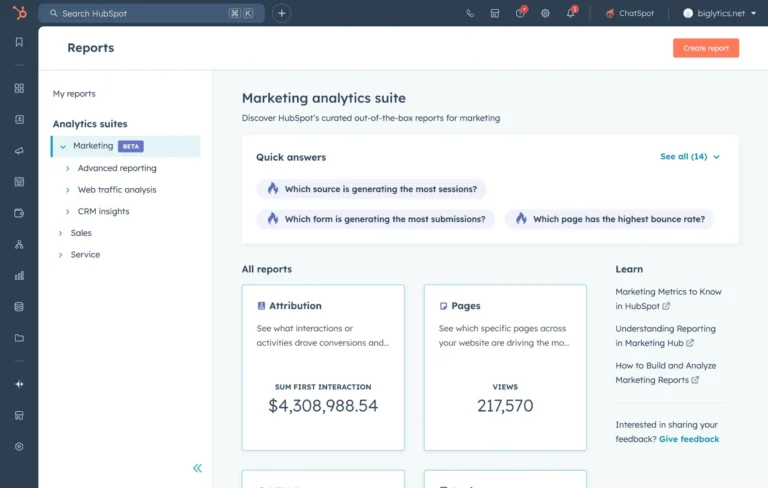
- HubSpot AEO: Is designed for marketing teams that may not possess deep technical expertise in AEO. The setup is straightforward, involving brand input and prompt selection, with the platform initiating tracking automatically. The dashboard presents visibility scores, competitor benchmarks, and recommendations in clear, accessible language. Guided workflows simplify the transition from insight to action, reducing the learning curve and fostering cross-functional adoption.
- Profound: While possessing a modern interface, Profound is tailored for users comfortable with detailed visibility data. Its platform rewards users with a strong understanding of citation analysis, prompt-level tracking, and competitive share-of-voice metrics. This can be advantageous for teams with dedicated SEO or data analysis functions but may present a steeper learning curve for those without such specialization, potentially slowing adoption. For stakeholder sharing, HubSpot AEO benefits from its existing reporting infrastructure, allowing for easy dashboard sharing. Profound supports CSV exports and API-based reporting, but this requires additional configuration for standard stakeholder workflows.
Actionability and Workflow: The Critical Juncture
The most significant operational divergence between HubSpot AEO and Profound lies in their approach to actionability and workflow integration.
HubSpot AEO is architected to bridge the gap between AI visibility insights and their implementation. When the tool identifies a prompt where a brand is underrepresented or absent in AI-generated answers, it provides a clear, prioritized recommendation. This recommendation directly leads to the creation or updating of relevant content. The seamless integration with Marketing Hub and Content Hub facilitates the execution phase, while Smart CRM provides crucial audience context, ensuring that recommendations align with specific business segments and lifecycle stages. This results in a markedly shorter cycle from identifying an AI visibility challenge to publishing a solution.
Profound, while offering robust improvement recommendations and tools such as FAQ generation based on tracked prompts, lacks an integrated content execution layer. Acting on Profound’s insights necessitates exporting them to a separate CMS, briefing content teams, and managing the production workflow externally. For organizations with dedicated content operations, this process is manageable. However, for teams where the analyst and content creator are the same individual, or where speed to execution is paramount, this external workflow adds friction that can compound over time. The ability to translate AI visibility data into a consistent publishing cadence is a critical operational challenge in AI SEO, and HubSpot AEO is structurally designed to address this.
A notable aspect of HubSpot AEO’s approach is its CRM-informed recommendations. This allows the platform to prioritize visibility gaps based on actual audience data rather than generic prompt volume. This enables teams to ascertain which prompts are most relevant to their buyer segments before investing optimization efforts.
Data Depth and Intelligence: A Tale of Two Approaches
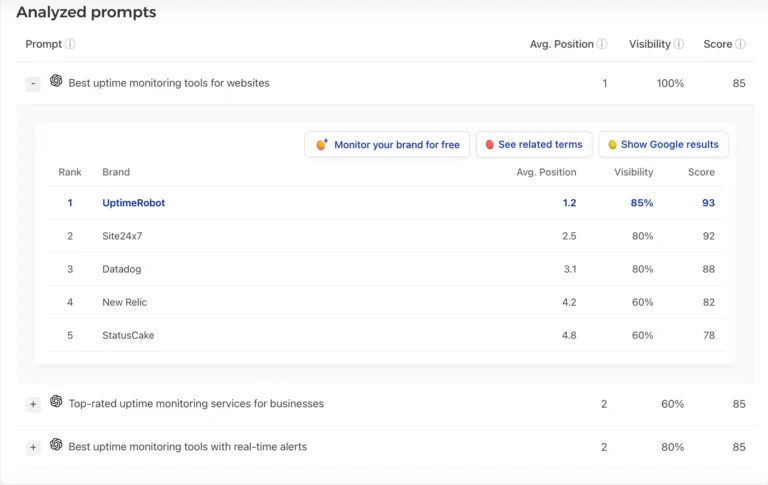
When it comes to the sheer volume and granularity of data, Profound generally holds the advantage. In its base edition, it tracks a more extensive array of AI platforms, including Google AI Overviews and Claude. It offers more adaptable custom prompt configuration and provides deeper insights into brand perception, detailing how AI systems describe a brand, which sources influence these descriptions, and how brand positioning evolves across prompts and competitors over time.
For enterprise-level brand, public relations, and data teams tasked with auditing AI-generated narratives or investigating the reasons behind a competitor’s increased citation frequency, Profound’s comprehensive data on sources, sentiment, and brand perception offers significant strategic value.
-2.png)
HubSpot AEO, while tracking AI visibility reliably across ChatGPT, Gemini, and Perplexity with daily updates, historical trend dashboards, and citation analysis, structures its data for clarity and actionability rather than exhaustive complexity. This makes it particularly useful for teams focused on prioritization and swift implementation. The platform’s citation tracking identifies the sources and content types that drive AI answers, which is typically sufficient for most content optimization decisions. The trade-off is clear: Profound provides more data, while HubSpot AEO makes the data more readily actionable. For the majority of marketing and RevOps teams, the advantage of actionability may outweigh the benefit of deeper analytical depth. However, for enterprise teams with the resources to support extensive analysis, Profound’s data layer can indeed add significant strategic value.
Integrations and Ecosystem: The Power of Native Connectivity
HubSpot AEO’s structural integration advantage is a significant factor for businesses already operating within the HubSpot ecosystem. Because it is an intrinsic part of the HubSpot platform, AI visibility data seamlessly connects with CRM records, campaign workflows, contact segments, and content tools. This native integration eliminates the need for API setup, middleware, or complex configurations to route insights into execution. For existing HubSpot users, this represents a compounding advantage, as AEO becomes another data source within a familiar system, rather than a standalone tool that necessitates its own dedicated workflow.
Profound offers API access for custom integrations and can connect with external CMS and marketing platforms, providing flexibility for enterprise teams with established data infrastructure. However, this flexibility often requires technical setup and ongoing maintenance, introducing operational complexity that HubSpot AEO circumvents. Profound integrates well into bespoke technology stacks but does not inherently provide pre-built execution workflows.
From a competitive intelligence perspective, integration often becomes a decisive factor. Businesses should evaluate where their existing operations are centered and which tool minimizes the distance between insight and implementation.
Use Cases and Strategic Decision Framework
The choice between HubSpot AEO and Profound often boils down to an organization’s primary bottleneck and strategic priorities.
Choose HubSpot AEO if:
- Execution is the priority: The primary challenge is translating AI visibility insights into timely content updates and campaign adjustments.
- Integrated workflows are desired: The organization relies heavily on the HubSpot ecosystem for marketing, sales, and service operations.
- Speed to market is critical: The need is to quickly act on AI insights to maintain competitive relevance.
- Cross-functional adoption is key: The tool needs to be easily understood and utilized by marketing, content, and RevOps teams with varying technical expertise.
- Budget is a consideration for SMBs/Mid-Market: The lower entry point and potential for bundled services offer cost-effectiveness.
Choose Profound if:
- Deep analytical insights are paramount: The organization requires a granular understanding of brand perception, citation sources, and competitive positioning within AI responses.
- Comprehensive AI platform coverage is essential: Visibility needs to be monitored across a wider array of AI technologies beyond the core platforms.
- Strategic intelligence for complex narratives is required: Enterprise brands need to audit AI-generated narratives and understand the underlying drivers of brand representation.
- Dedicated data and SEO functions exist: The organization has the specialized personnel to leverage and act upon highly detailed analytical data.
- Customizable data integration is a priority: The organization has the technical resources to integrate Profound’s data into a sophisticated, custom technology stack.
The Synergy of Both: An Enterprise Strategy
It is indeed possible and, for some enterprise teams, beneficial to utilize both HubSpot AEO and Profound in tandem. Profound can serve as the strategic intelligence layer, providing deep analytical insights into how AI systems perceive a brand, which sources wield the most influence, and where competitive positioning is weakest. This high-level strategic understanding can then inform the execution layer, handled by HubSpot AEO. By leveraging HubSpot AEO, these insights can be translated into specific content updates, campaign triggers, and CRM-aligned optimization priorities.
In practice, most organizations will find that one platform sufficiently addresses their primary bottleneck. If the main challenge lies in acting upon AI visibility data, HubSpot AEO offers a complete workflow. If deep brand perception analysis is a standalone priority, particularly for large brands managing intricate AI narratives across multiple platforms, Profound can provide a depth of analysis that HubSpot AEO does not replicate.
Free Entry Points and Getting Started Quickly
For organizations hesitant to commit to paid solutions, both platforms offer valuable free entry points. The HubSpot AEO Grader provides a rapid, one-time diagnostic of a brand’s AI search visibility across major answer engines, generating a composite score based on sentiment, presence quality, recognition, share of voice, and market position. This free tool is ideal for establishing an initial baseline without any financial commitment.
Profound also offers a free one-time AEO report, which can serve as a useful starting point for teams prioritizing deeper analysis before investing in ongoing monitoring. Both the AEO Grader and Profound’s free report are accessible without requiring credit card information, allowing for risk-free evaluation.
The recommended approach for most teams is to first utilize the free AEO Grader to benchmark their current AI visibility and potentially that of a key competitor. This exercise helps in defining which prompts are most critical to track and clarifies the need for ongoing optimization. Once a baseline is established, the decision regarding which paid platform to adopt becomes clearer, based on whether the organization’s primary need is for streamlined execution or in-depth analytical intelligence.
Frequently Asked Questions
Do I need a HubSpot subscription to use AEO?
No, HubSpot AEO is available as a standalone product. The core AEO product, which includes monitoring and recommendations, starts at $45 per month (billed annually) and does not require an existing HubSpot subscription. The free AEO Grader also requires no subscription. However, to fully leverage the integration of AEO recommendations with content workflows and CRM data, a Marketing Hub subscription is beneficial but not mandatory for accessing the core AEO features.
Can I run a one-time analysis before I commit?
Yes. Both HubSpot and Profound offer free, one-time analysis tools. The HubSpot AEO Grader provides a diagnostic score of brand visibility across major answer engines at no cost. Profound also offers a free one-time AEO report. These diagnostic tools are excellent for establishing a baseline and evaluating the output and workflow utility of each platform before committing to a paid plan.
When should I use both HubSpot AEO and Profound together?
The combined use of both platforms is most advantageous for enterprise teams where distinct departments handle brand perception analysis and content execution. Profound can serve as the strategic intelligence engine for SEO or brand teams requiring deep citation and sentiment analysis. Subsequently, HubSpot AEO can function as the execution engine for marketing and content teams acting upon those insights. For the majority of organizations, one platform will suffice, depending on whether execution or analysis presents the primary bottleneck.
How do I measure impact across channels?
AI visibility metrics are best viewed as indicators and prioritization tools rather than direct pipeline measures. To effectively measure impact, these metrics should be used in conjunction with conversion data, Google Search Console data, sales feedback, and other relevant performance indicators. In HubSpot AEO, historical trend dashboards facilitate tracking visibility changes over time and their correlation with content updates. Meaningful measurement requires diligent recording of when changes are made, comparative analysis of performance periods, and linking visibility shifts to downstream signals such as organic traffic growth, improved lead quality, or assisted conversions. The improvement of a score should not be treated as an isolated success metric.
About the Author