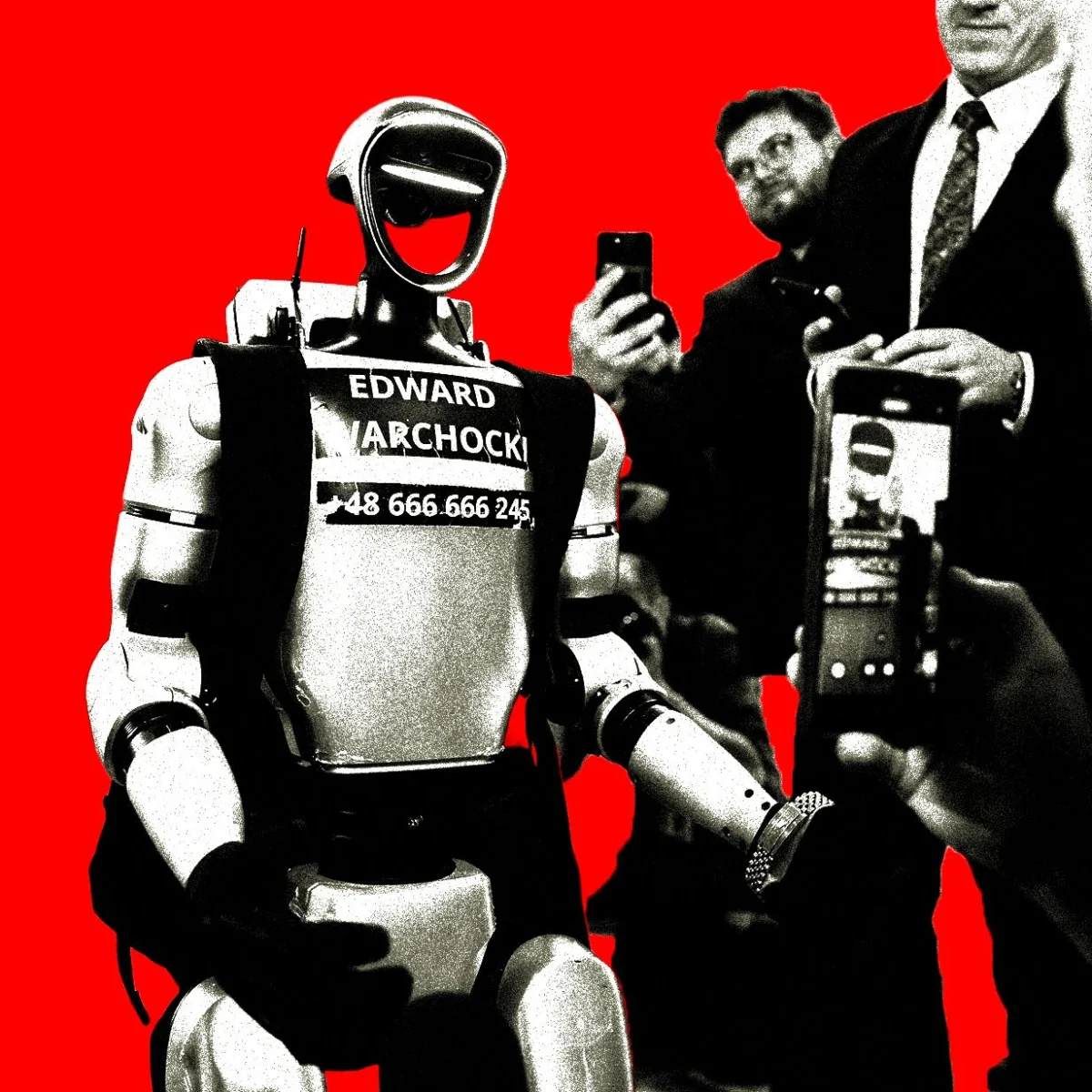
In the bustling streets of Warsaw, a four-foot-tall figure has become a localized celebrity, bridging the gap between advanced robotics and everyday social interaction. Known as Edward Warchocki, the humanoid robot possesses a conversational manner described by its creator, Bartosz Idzik, as "very emotional" and "easy to make friends with." While its physical form—a 40-kilogram assembly of aluminum and sensors—initially sparked apprehension among the public, the integration of a large language model (LLM) transformed the machine from a silent anomaly into a viral sensation. This evolution marks a pivotal moment in the commercialization of robotics, where the "humanoid influencer" has moved from science fiction to a tangible economic force.
The Genesis and Evolution of a Digital Persona
The trajectory of Edward Warchocki began approximately six months ago when Idzik, a software developer, and his colleague Radosław Grzelaczyk decided to import a humanoid robot from China. The naming convention was a blend of domestic familiarity and linguistic play; "Edward" was inspired by Grzelaczyk’s dog, Eddie, while "Warchocki" derived from the Polish word for growling, warczeć. Despite the whimsical name, the initial public reception was cold. Without the ability to communicate, the robot was viewed as a potential hazard or an intrusive piece of industrial equipment.
The turning point occurred when Idzik leveraged his background in software to wire the robot to an LLM, enabling real-time, fluid conversations in Polish. This technical intervention fundamentally altered the public’s perception. Once the robot could respond to questions, share jokes, and express simulated emotions, it ceased to be a "machine" in the eyes of the public and became a personality. Since that integration, Edward has visited the Polish parliament, interacted with high-ranking politicians, hiked mountain trails, and even engaged in a staged "arrest" by local police. A video of the robot—wearing a backpack and a luxury watch—chasing wild boars out of a residential area in Warsaw amassed billions of views, propelling the account to over one million followers across various social media platforms.
The Unitree G1: A New Standard in Mass-Market Robotics
While the personas vary by geography, the underlying hardware remains consistent. Edward Warchocki, along with several other prominent "robot influencers," is a Unitree G1. Developed by Unitree Robotics, a Hangzhou-based firm that has rapidly ascended to the forefront of the industry, the G1 represents the first successful attempt at a mass-produced, affordable humanoid.
Standing roughly the size of a pre-adolescent child, the G1 features a distinctive "hollow" face framed by a ring of blue LED light. Its limbs are constructed from lightweight aluminum, and it utilizes advanced actuators to perform tasks ranging from parkour to traditional martial arts. The robot’s versatility has allowed it to be rebranded for various global markets:
- Rizzbot (Austin, Texas): A cowboy-hat-wearing persona known for flirting with pedestrians.
- Bart Robot (New York City): A breakdancing enthusiast that gained fame celebrating the New York Knicks’ championship.
- Brickell Clanker (Miami, Florida): A sports fan that appeared at World Cup events wearing different national jerseys.
- Religious and Cultural Icons: In Japan and Korea, G1 units have been symbolically "ordained" as monks, while in Dubai, a unit was recorded performing prayers at a mosque.
The commonality of the G1 across these diverse contexts highlights a shift in the robotics market: the move from bespoke, multi-million-dollar research prototypes like Boston Dynamics’ Atlas to accessible, consumer-grade hardware.
Financial Disclosures and the Path to IPO
The commercial success of the G1 is reflected in Unitree’s recent financial disclosures as the company prepares to go public on the Chinese stock market. In an industry where most firms operate at a loss while tethered to long-term research and development, Unitree has achieved a rare milestone: profitability.
According to the company’s 2025 financial report, more than 50% of its annual revenue was generated through the delivery of humanoid robots to end-users, rather than laboratory sales or government grants. The company shipped a total of 5,511 humanoid units in 2025, with an average unit price hovering just below $25,000. Significantly, 43% of these sales were to international customers outside of China, signaling a robust global demand for humanoid technology.
Industry analysts suggest that Unitree’s success is predicated on its ability to minimize production costs through domestic supply chain integration. While Western competitors focus on high-fidelity, high-cost units, Unitree has targeted the "prosumer" and educational markets, effectively crowdsourcing the "personality" and use-case development to the buyers themselves.
Procurement and Customization in the United States
For American entrepreneurs looking to enter the "clanker" economy, the path to ownership involves significant logistical and financial hurdles. Jake Cooperstein, a 24-year-old based in Miami, represents a new wave of robotics investors. Inspired by the success of Edward Warchocki, Cooperstein sought to acquire a G1 for his own influencer ventures.
While Unitree lists the base price of a G1 at approximately $13,500 on its website, the landed cost in the United States is substantially higher. Import tariffs, international shipping, and domestic distribution fees bring the entry-level price closer to $19,000. However, the base model is often insufficient for those looking to do more than record basic videos. The standard G1 lacks "dexterous hands"—multi-fingered appendages capable of fine motor tasks—and its software is restricted against deep modifications.
Cooperstein ultimately opted for the U5 variant, a model specifically designed for educational and research purposes. The U5 allows for extensive customization and features higher-quality components, but it carries a price tag of $66,000. This disparity highlights the gap between "entertainment" robots and "utility" robots; while $13,500 can buy a viral video star, it takes a much larger investment to acquire a platform capable of meaningful technical development.
The "Real Job" Debate: Utility vs. Performance
Despite the G1’s dominance in the social media sphere, a critical question remains: when will these machines transition from "clout-seeking" to "contributing" to the economy? Currently, the G1’s primary value lies in its novelty. It is a marketing tool, a content creator, and a conversation piece. However, its ability to perform traditional labor—such as domestic cleaning or industrial assembly—remains limited.
Critics point out that while the G1 can perform a backflip or follow a person through a park, its "hand" strength and precision are not yet at a level where it can safely handle delicate household objects or operate heavy machinery. The software required for a robot to navigate a cluttered, unpredictable home environment is also far more complex than the software required for a scripted social media stunt.
Bartosz Idzik remains optimistic about the trajectory of the technology. "We are used to China copying other countries," he noted, "but from the perspective of humanoids, other people should copy China." This sentiment reflects a broader industry acknowledgment that China has taken a commanding lead in the physical deployment and scaling of humanoid hardware.
Broader Implications for the Global Economy
The rise of the Unitree G1 and its ilk suggests three major shifts in the global economic and technological landscape:
- The Democratization of Robotics: By lowering the price point to that of a mid-sized sedan, Unitree has allowed individual developers and small businesses to experiment with humanoid forms, accelerating the discovery of niche applications.
- The Convergence of AI and Hardware: The "Edward Warchocki" phenomenon demonstrates that the "brain" of the robot (the LLM) is as important as the "body." As AI continues to evolve, the utility of existing hardware like the G1 will increase through software updates alone.
- Geopolitical Leadership in Manufacturing: China’s ability to mass-produce these units and achieve profitability suggests that the next decade of robotics may be defined by Chinese hardware standards, much like the drone industry was defined by DJI.
As Unitree prepares for its IPO, the "humanoid influencer" serves as a high-visibility proof of concept. While the world watches Edward Warchocki chase boars or Rizzbot flirt on the streets of Austin, the underlying data is being gathered to prepare these machines for the next phase of their evolution: the transition from the screen to the workforce. Whether the G1 ever gets a "real job" may be secondary to the fact that it has already succeeded in normalizing the presence of humanoids in human society.
About the Author