The digital marketing landscape is undergoing a seismic shift, with traditional search engine optimization (SEO) evolving to encompass a new paradigm: Answer Engine Optimization (AEO). As buyers increasingly turn to AI-powered platforms like ChatGPT, Perplexity, and Google’s Gemini for direct product and service recommendations, the ability for brands to accurately and effectively appear within these AI-generated responses has become paramount. This necessitates a new class of analytical tools – AEO audit tools – designed to measure brand visibility and citation accuracy across these emerging answer engines. While conventional SEO audits focus on metrics like keyword rankings and website crawlability, AEO audit tools provide a critical measurement layer that many marketing teams currently lack, offering insights into how brands are represented in direct, AI-driven discovery.
The proliferation of advanced AI models capable of synthesizing information and providing direct answers has fundamentally altered the buyer journey. Instead of navigating multiple search results pages, consumers are now posing questions directly to AI assistants, expecting concise and authoritative responses. This presents both an opportunity and a challenge for businesses. The opportunity lies in being a trusted source that AI models cite. The challenge, however, is understanding if and how your brand is being cited, and whether those citations are accurate and beneficial. This is where AEO audit tools become indispensable.
The Evolving Buyer Journey: From Search to Answer
For years, SEO has been the bedrock of online visibility, guiding businesses to optimize their websites for search engine algorithms. This involved a meticulous process of keyword research, content creation, technical optimization, and link building, all aimed at ranking higher in traditional search engine results pages (SERPs). However, the advent of sophisticated Large Language Models (LLMs) has introduced a significant disruption. Platforms like ChatGPT, Perplexity AI, and Google’s Gemini are not merely returning links; they are generating synthesized answers, often directly extracting information from various online sources to provide a comprehensive response.
This shift means that a brand’s presence in a traditional search ranking is no longer the sole determinant of its visibility. A brand might have a top-ranked page for a given query, but if an AI model bypasses that page to synthesize an answer from other, perhaps less authoritative, sources, the business misses a crucial touchpoint with a potential customer. This is the core problem that AEO audit tools are designed to address. They extend the concept of "visibility" beyond traditional search rankings to encompass presence and accuracy within AI-generated answers.
Why AEO Audit Tools Are Crucial for 2026 Strategies
As we look towards 2026 and beyond, the influence of AI in the discovery process is only expected to grow. Predictions from industry analysts suggest that AI-driven search and content synthesis will become increasingly sophisticated and integrated into daily user habits. This trend underscores the urgency for businesses to adapt their strategies.
AEO audit tools are not just about tracking rankings; they are about understanding how your brand is perceived and utilized by AI systems. They measure:
- Citation Presence: Do AI answer engines cite your brand’s content when responding to relevant queries?
- Citation Accuracy: When your brand is cited, is the information presented correct and representative of your offerings?
- Query Coverage: For which types of questions and queries does your brand appear in AI responses?
- Competitor Landscape: How does your brand’s citation performance compare to that of your competitors?
Without these insights, businesses are operating blind in a rapidly evolving digital environment. The ability to monitor these factors on an ongoing basis is critical, as AI models are not static. They are constantly being retrained on new data, and their algorithms are subject to updates. A brand that appears in a prominent citation today might see that citation disappear next month if a competitor publishes more authoritative or relevant content, or if the AI model’s weighting of sources changes. Therefore, AEO audits must be viewed as a continuous process, not a one-time snapshot.
The Challenge of Evaluating AEO Solutions
While the need for AEO audit tools is clear, navigating the market can be complex. A variety of solutions exist, ranging from enterprise-grade answer engine optimization platforms and standalone AEO trackers to specialized keyword research tools that can indirectly inform AEO efforts. The primary challenge lies in evaluating these options effectively and determining whether existing SEO tools can adequately cover the nuances of AEO. Many traditional SEO platforms, while robust in their original domain, may lack the specific functionalities required to monitor AI-generated content citations.
How to Conduct an Answer Engine Optimization Audit
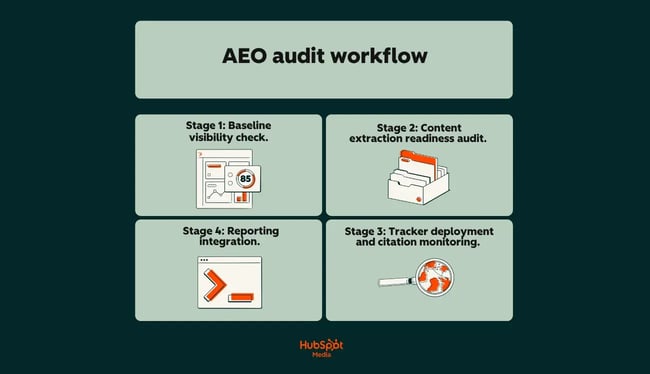
A comprehensive AEO audit involves a structured approach, moving from baseline assessment to ongoing monitoring and integration. This process can be broken down into several key steps:
Step 1: Baseline Visibility Check
Before investing in specialized AEO software, it is crucial to establish a foundational understanding of your brand’s current visibility. Free diagnostic tools can provide an initial assessment. For instance, HubSpot’s AI Search Grader offers a baseline check across major AI search engines, allowing teams to identify where their brand appears (or is absent) without any initial financial commitment. This step is invaluable for validating the need for AEO efforts and prioritizing subsequent investments.
Step 2: Content Extraction Readiness Audit
Answer engines operate by extracting relevant information from web content. Therefore, the structure and format of your published content play a significant role in its discoverability by AI. This audit focuses on ensuring your content is optimized for AI extraction. Key considerations include:
- Answer-First Intros: Reformatting introductory paragraphs to directly answer the core question or provide the most critical information upfront. This aligns with the AI’s need for immediate, concise answers.
- Q&A Blocks: Incorporating dedicated Question and Answer sections within articles. These structured formats are easily digestible by AI models.
- Comparison Tables: Presenting information in tabular formats, especially for product or service comparisons, makes it simple for AI to extract and synthesize data.
Teams should audit their top-performing content (e.g., the top 50 pages) against these structural criteria to identify areas for improvement.
Step 3: Tracker Deployment and Citation Monitoring
Once a baseline is established and content is optimized for extraction, the next phase involves deploying AEO trackers. These dedicated tools are essential for continuous monitoring of citation coverage and brand accuracy. They map which specific queries trigger citations and whether the brand is included in those AI-generated responses. This provides actionable data on performance and identifies potential issues or opportunities.
Step 4: Reporting Integration
The ultimate goal of AEO auditing is to integrate the insights gained into broader marketing strategies and reporting frameworks. This means connecting AEO citation data with existing marketing dashboards. Success in AEO can be measured not only by the quantity of citations but also by customer sentiment, share of voice, and ultimately, its impact on key business metrics like lead generation and sales. By correlating AEO performance with other marketing KPIs, such as SEO gains and campaign results, teams can demonstrate the value of their AEO efforts and make more informed strategic decisions.
AEO Audit Tools Tailored to Company Size and Team Maturity
The requirements for AEO audit tools vary significantly based on the size of the organization, the maturity of its marketing team, and its budget. A three-person startup will have different needs than a large enterprise with multiple product lines and a sophisticated analytics infrastructure.
Startup and Small to Medium-Sized Business (SMB) Stack
For emerging businesses, the primary question is often: "Does AI search even surface our brand at all?" The initial focus is on validating AI visibility.
-
Recommended Stack:
- HubSpot’s AI Search Grader: For a free, initial baseline assessment of brand visibility across major AI engines.
- Manual Query Testing: Performing direct searches using key brand terms and industry-relevant questions on platforms like ChatGPT, Perplexity, and Gemini.
- Content Audit (Manual or Template-Based): Reviewing top-performing content for answer-first intros, Q&A blocks, and comparison tables.
-
Best For: Teams of one to five marketers who need to confirm AI search as a viable channel before allocating budget to dedicated tracking software.
-
What We Like: This approach is cost-effective and addresses the fundamental question of AI channel viability. If results are poor, the immediate investment should be in content optimization rather than software.
-
Pro Tip: Before considering paid AEO tools, ensure at least 30% of your top content assets feature answer-first intros, Q&A sections, and comparison tables. AI-extractable content is a prerequisite for visibility.
Mid-Market Stack

For mid-sized companies, manual checks become inefficient, and enterprise-level solutions might be cost-prohibitive. The ideal AEO audit tools at this stage are platforms that offer robust citation tracking, integrate with existing workflows, and provide valuable query research capabilities without requiring a standalone, expensive dashboard.
-
Recommended Stack:
- Dedicated AEO Tracking Platforms: Tools that offer ongoing citation monitoring across multiple AI engines, providing dashboards for performance analysis.
- Keyword Research Tools with AI Focus: Tools that can identify AI-relevant queries and topics.
- CRM and Marketing Automation Integration: The ability to link AEO data with customer profiles and campaign performance for a holistic view.
-
Best For: Teams of five to 20 marketers with a dedicated SEO function, requiring consistent citation monitoring, query insights, and integration with existing reporting structures.
-
What We Like: Dedicated tools streamline the monitoring process, reducing manual effort and enabling proactive adjustments.
Enterprise Stack and Compliance Checklist
Large organizations, especially those with multiple business units or regulated industries, require standardized measurement across diverse operations. The best AEO audit tools for enterprises consolidate citation tracking and content governance within existing systems, preventing tool sprawl and ensuring consistent reporting.
-
Recommended Stack:
- Enterprise-Grade AEO Platforms: Comprehensive solutions offering advanced analytics, multi-brand management, and robust reporting capabilities.
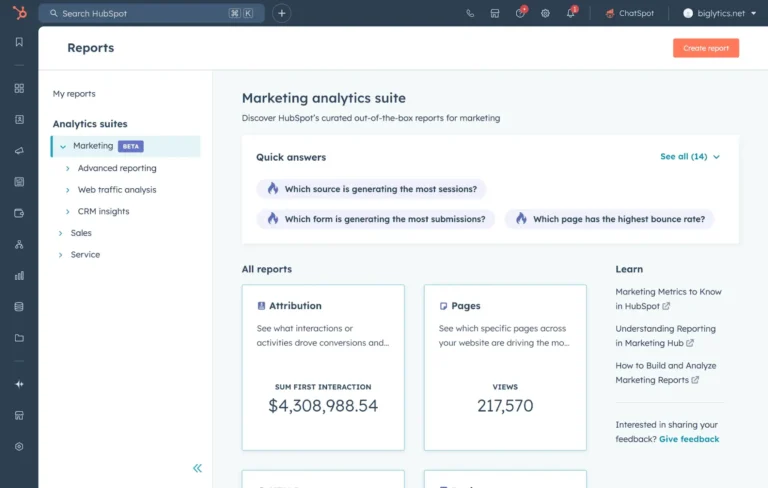
- HubSpot’s Marketing Attribution: To connect AEO citation data with overall marketing campaign effectiveness and ROI.
- Content Management Systems (CMS) with AI Optimization Features: Tools that facilitate the creation and management of AI-friendly content.
- Data Warehousing and Business Intelligence Tools: For advanced data analysis and custom reporting.
-
Best For: Teams of 20+ marketers, multi-brand organizations, and companies in regulated sectors.
-
What We Like: Integrating HubSpot’s marketing attribution with dedicated AEO trackers addresses the critical measurement challenge that often hinders enterprise AEO initiatives. This allows for demonstrating AEO success alongside established marketing metrics.
-
Enterprise Vendor Compliance Checklist: Before signing any enterprise AEO contract, confirm:
- Data Granularity: The ability to track citations at the query, page, and engine level.
- Reporting Customization: Flexible reporting options that can be tailored to different stakeholders.
- Integration Capabilities: Seamless integration with existing martech stacks (CRM, analytics, CMS).
- Data Security and Compliance: Robust security protocols and compliance with relevant data privacy regulations.
- Scalability: The platform’s ability to scale with the organization’s growth and evolving needs.
-
Pro Tip: When negotiating enterprise AEO platform pricing, focus on the number of tracked queries and answer engines rather than user seats. Data volume is the primary cost driver at scale, not user access.
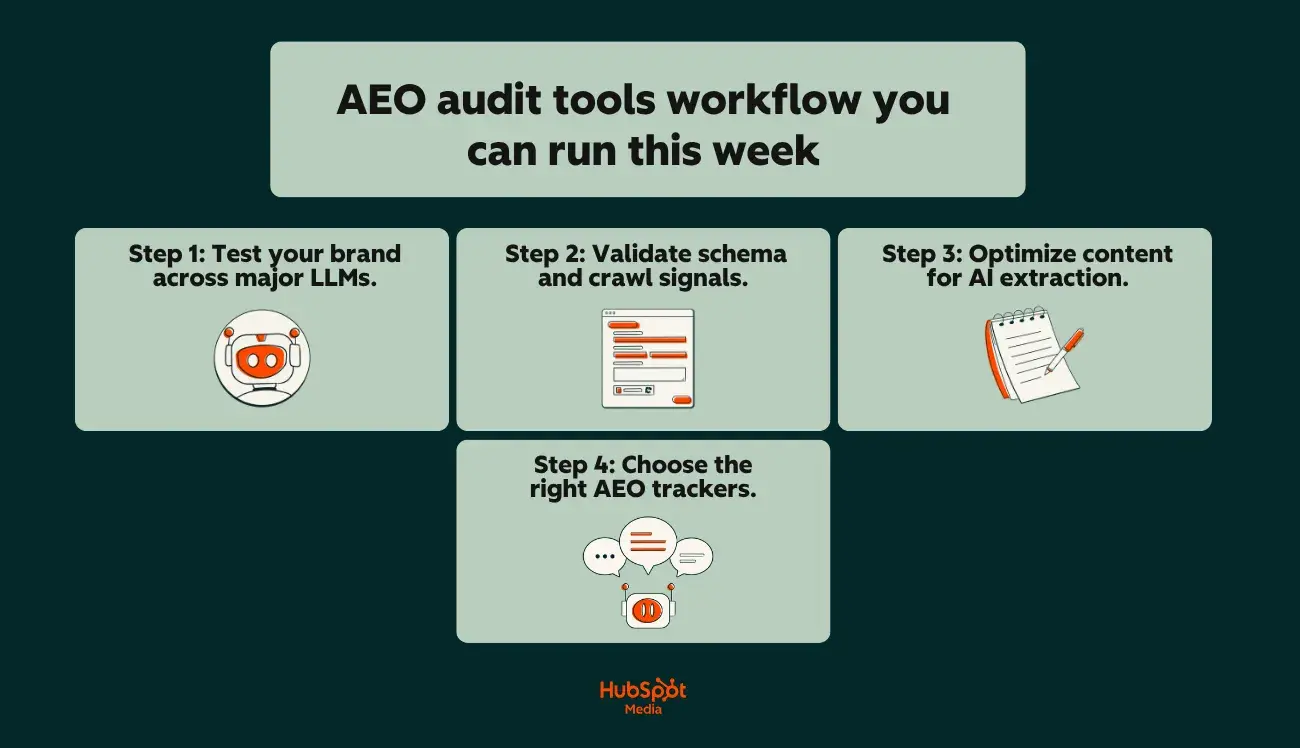
AEO Audit Workflow You Can Implement This Week
Getting started with AEO auditing doesn’t require a complete overhaul of your existing processes. A phased approach can yield immediate insights.
Step 1: Test Your Brand Across Major Answer Engines
Begin with a foundational test of your brand’s visibility.
- Compile a Core Query List: Identify 20-30 critical queries related to your brand, products, services, and industry.
- Execute Manual Searches: Search these queries on ChatGPT, Perplexity AI, and Google Gemini. Document where your brand appears, the context of the citation, and the accuracy of the information.
- Utilize Free Graders: Run HubSpot’s AI Search Grader to cross-reference your manual findings and gain a broader overview.
- Save Your Query List: Maintain this list for consistent monthly re-testing to track progress.
- Pro Tip: Consistency in query phrasing is key for tracking directional progress.
Step 2: Validate Schema and Crawl Signals
Ensure AI can access and interpret your content.
- Crawlability Check: Use tools like Google Search Console to verify that your key pages are crawlable and indexed.
- Schema Markup Audit: Review your website for the presence and correctness of schema markup (e.g.,
FAQPage,HowTo,Product) which helps AI understand your content’s structure and meaning. - Robots.txt and Meta Robots Directives: Confirm these are not inadvertently blocking AI crawlers from accessing important content.
- Site Speed and Mobile-Friendliness: Ensure your website loads quickly and is responsive on all devices, as these are general indicators of technical health that can impact AI’s ability to process your site.
Step 3: Optimize Content for AI Extraction
Refine your content to be AI-friendly.
- Answer-First Intros: Review your top 20 pages to ensure the first paragraph directly addresses the main query.
- Q&A and Comparison Table Integration: Add or enhance Q&A sections and comparison tables where relevant.
- Structured Data Markup: Implement or verify schema markup for these structured content elements.
- Prioritize Content: Create a prioritized list of the top 20 pages requiring reformatting, with specific action items for each.
- Pro Tip: HubSpot’s Content Hub offers AI-optimized modules like answer-first layouts and FAQ components to streamline this process.
Step 4: Select the Right AEO Trackers
With baseline data and content readiness in hand, you can make informed decisions about paid tools.
- Define Your Needs: Based on your audit findings, identify the most critical metrics to track (e.g., citation volume, accuracy, specific query performance).
- Evaluate Tool Features: Compare the functionalities of different AEO tracking tools against your defined needs.
- Consider Integration: Prioritize tools that integrate with your existing marketing technology stack.
- Trial and Demo: Utilize free trials and demos to test the user interface and data output of potential solutions.
Automating Recurring AEO Reports
A one-time audit provides a snapshot, but sustained success requires an automated reporting cadence. This ensures you stay ahead of AI model updates and competitive content shifts.
Weekly: Citation Alerts and Brand Accuracy Flags
- Automate: Real-time alerts for new citations, significant drops in citation frequency, and any reported inaccuracies in brand mentions.
- Focus: Catching and rectifying immediate issues that could negatively impact brand perception or customer understanding.
- Pro Tip: Route these alerts to the same channels as your SEO alerts to centralize team communication and response.
Monthly: Citation Share Reviews and Content Performance
- Automate: Reports on citation share trends, performance of specific content pages in AI responses, and analysis of competitor citation activity.
- Focus: Strategic analysis, understanding what drives AI visibility, and identifying content optimization opportunities. This cadence addresses the question of how to measure AEO success beyond simple presence.
- Metrics to Track: Citation volume by engine, accuracy score, share of voice compared to competitors, top-performing content for citations.
Quarterly: Full Engine Tests and Stack Evaluation
- Automate: Comprehensive re-testing of the entire query set across all relevant AI engines.
- Focus: Strategic review, evaluating the effectiveness of the current AEO tool stack, and presenting long-term performance trends to leadership.
- Actions: Re-evaluate tool selection, identify new AI engines to monitor, and refine AEO strategy based on comprehensive data.
Avoiding Common AEO Audit Tool Pitfalls
Several common mistakes can hinder the effectiveness of AEO audit efforts:
- Tool-First Buying: Purchasing AEO software before conducting a baseline visibility test. This can lead to investing in tools that don’t address the most pressing needs or purchasing unnecessary features. A content audit for AI readiness should precede software acquisition.
- Weak Documentation and No Measurement Framework: Implementing AEO tools without a clear definition of success or a framework for measuring progress. This results in data without actionable insights. A measurement framework outlining key metrics, goals, and reporting structures should be established before deploying trackers.
- Pro Tip: Centralize your measurement framework and baseline data within your marketing hub (e.g., HubSpot Marketing Hub) alongside other performance metrics.
- Single-Engine Focus: Limiting AEO audits to a single AI engine (e.g., only ChatGPT). Each AI model has unique data sources, training schedules, and citation logic. A brand’s performance can vary drastically across different platforms. A comprehensive audit requires testing across multiple engines like ChatGPT, Perplexity, and Gemini.
Frequently Asked Questions About AEO Audits
- How often should we run an AEO audit?
A tiered cadence is recommended: weekly for alerts, monthly for strategic review, and quarterly for comprehensive baseline testing and stack evaluation. - Which answer engines should we prioritize first?
Prioritize ChatGPT, Perplexity, and Gemini initially, as they represent a significant portion of AI-driven discovery. However, expand testing to other relevant engines as your strategy matures. - Can we adapt our existing SEO tools for AEO?
Existing SEO tools provide foundational insights but cannot fully replace dedicated AEO audit tools. AEO tools offer specialized functionalities for tracking AI citations, accuracy, and identifying specific gaps within AI-generated content. The best AEO tools integrate with, rather than replace, existing SEO infrastructure. - How can I measure AEO success without new software?
A meaningful AEO measurement baseline can be established using free tools like HubSpot’s AI Search Grader and manual testing. Key metrics for measuring AEO success include citation share, citation accuracy, share of voice, and customer sentiment.
Conclusion
The current search landscape unequivocally demands the implementation of AEO audit tools. As buyers increasingly rely on AI platforms like ChatGPT, Perplexity, and Gemini for product recommendations and information, ensuring your brand’s accurate and prominent presence within these answers is no longer optional, but a strategic imperative. AEO audit tools empower teams to evaluate their performance, identify visibility gaps, and optimize their content and technical presence to resonate with AI-driven discovery. By adopting a structured approach, leveraging appropriate tools for their organizational maturity, and establishing a regular reporting cadence, businesses can navigate this new frontier and secure their position in the future of buyer discovery.
Ready to discover where your brand stands in the evolving world of AI-powered answers? Explore HubSpot’s AEO solutions to begin your journey towards enhanced visibility.
About the Author