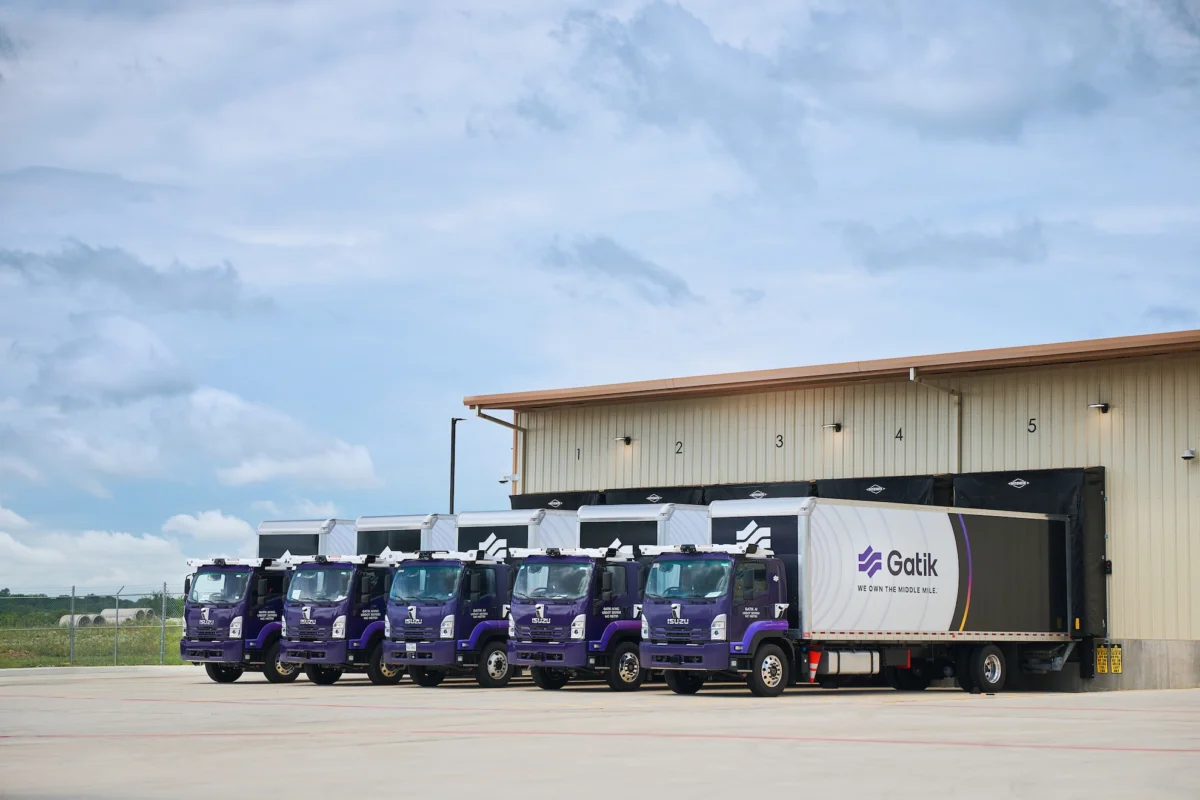
Gatik, the pioneering autonomous vehicle startup specializing in self-driving box trucks for business-to-business (B2B) logistics, has successfully closed a significant funding round, raising $200 million. This substantial capital injection, announced just two months after the company finalized a multiyear commercial agreement with global food and beverage giant PepsiCo, underscores a pivotal moment for the company and the broader autonomous vehicle industry. The latest round elevates Gatik’s total funding to approximately $500 million since its emergence from stealth mode in 2019, positioning it for aggressive expansion in a rapidly evolving market.
The Series C funding round was co-led by two formidable investors: the Qatar Investment Authority (QIA), Qatar’s sovereign wealth fund known for its strategic global investments, and Koch Disruptive Technologies (KDT), the venture capital arm of Koch Industries, focused on high-growth, disruptive technologies. The round also saw robust participation from existing and new investors, including Millennium Management, ARK Invest – a prominent investment firm known for its focus on disruptive innovation – and Intact Private Capital. While the company did not disclose its post-money valuation, the caliber of investors suggests a strong market confidence in Gatik’s technology, operational model, and commercial viability.
A New Chapter: From Pilots to Commercial Scale
This $200 million raise, the largest in Gatik’s history, signifies a crucial transition point. According to company leadership, it marks Gatik’s evolution from a startup primarily focused on pilot programs and technological validation to a fully operational entity poised to scale commercial driverless operations across multiple cities and with an expanding roster of commercial customers. This strategic shift is critical in an industry where achieving true commercialization and scale has historically presented significant hurdles.
Gautam Narang, co-founder and CEO of Gatik, emphasized the strategic alignment with their new financial partners in a recent interview. "These are all long-term investors," Narang stated, highlighting the shared vision for sustained growth. "All the scale-up plans that we have and the growth that we have in mind for the next few years – these are the kind of financial partners that can help us." This focus on long-term partnership is indicative of the capital-intensive and time-consuming nature of autonomous vehicle development and deployment, where patient capital is often a prerequisite for success. Narang articulated a clear vision for the future: expanding Gatik’s fleet of driverless trucks, onboarding more commercial customers, establishing operations in additional cities, and eventually exploring opportunities beyond North America.
Carving a Niche in the Autonomous Landscape: The Middle Mile Advantage
Gatik has strategically differentiated itself within the highly competitive and burgeoning autonomous vehicle (AV) industry. While many startups and well-funded tech giants have pursued diverse applications – ranging from sidewalk delivery robots and urban robotaxis to long-haul self-driving big rigs and specialized vehicles for construction and mining – Gatik identified and focused intently on the "middle-mile" segment of logistics. This niche, which involves the movement of goods from distribution centers to retail stores or other local hubs, often over fixed or semi-fixed routes, has proven to be a strategic sweet spot.
The company’s approach involved developing a purpose-built fleet of driverless box trucks, manufactured by industry leader Isuzu Motors. These vehicles are specifically designed for the efficient and reliable delivery of food, beverages, and other consumer packaged goods for suppliers. Gatik’s operational model began with short, fixed-route trips, often less than 10 miles, which allowed for controlled testing and data collection. Over time, the capabilities have expanded to dynamic routes encompassing dozens of pick-up and drop-off locations and covering distances of up to 400 miles. This incremental, data-driven expansion has been key to their success and technological maturation.
The "middle-mile" segment, sometimes referred to as regional hauling or replenishment logistics, represents a critical link in the supply chain. It bridges the gap between the large-scale efficiency of long-haul trucking and the complex, often unpredictable environment of last-mile delivery. Gatik’s singular focus on this sector has allowed it to become a dominant player, demonstrating the efficacy and economic benefits of autonomous operations in a clearly defined operational design domain (ODD). This specialization has enabled the company to build deep expertise and robust technology tailored to the specific demands of B2B short-haul logistics.
Key Milestones and Commercial Traction
Gatik’s journey from a nascent startup to a commercially viable autonomous logistics provider is marked by several significant milestones. The company first emerged from stealth mode in 2019, publicly announcing its initial partnership with retail giant Walmart. This early collaboration provided invaluable real-world data and operational experience, laying the groundwork for future expansion. Since then, Gatik has cultivated a portfolio of high-profile commercial customers, including Canada’s leading grocery retailer Loblaws, the prominent American supermarket chain Kroger, and global food processing company Tyson Foods.
A pivotal achievement occurred last year when Gatik successfully removed the safety driver from behind the wheel on its commercial routes. This critical technical and operational milestone signified a major leap forward, demonstrating the maturity and reliability of Gatik’s autonomous driving system. Achieving fully driverless commercial operations is a significant differentiator in the AV industry, where many companies are still operating with safety drivers or in limited pilot capacities. Gatik now operates dozens of fully driverless self-driving trucks commercially across several markets, showcasing its ability to navigate a variety of conditions and environments effectively.
Narang underscored the advancements in their technology: "The technology has evolved and matured a lot over the last few years, especially with the latest generation of our tech." He noted that the company’s third-generation self-driving trucks are designed for round-the-clock operation on both surface streets and highways, capable of handling challenging weather conditions such as light rain and snow – a testament to the robustness of their sensor suite and AI algorithms.
While Gatik maintains confidentiality regarding precise fleet numbers and the full roster of its customers, its most prominent public partnership is with PepsiCo. This agreement involves 41 driverless box trucks dedicated to shuttling Frito-Lay products, including popular brands like Cheetos and Doritos, from distribution centers to retail stores. These operations are currently active in key markets such as Dallas, Phoenix, and Northwest Arkansas, demonstrating Gatik’s ability to deploy and manage a substantial fleet across diverse geographical areas. The scale of this partnership highlights the trust and value that major corporations are placing in Gatik’s autonomous logistics solutions.
Financial Momentum and Future Outlook
The strategic focus on the middle-mile niche has yielded impressive financial results for the Santa Clara, California-based startup. Narang revealed that Gatik has secured commercial deals representing $600 million in contracted revenue, a strong indicator of market demand and the economic benefits its services provide to customers. This contracted revenue base provides a solid foundation for future growth and validates the company’s business model.
The fresh $200 million in funding is earmarked to accelerate Gatik’s scaling efforts. This expansion will necessitate a significant increase in its workforce, which currently stands at 350 employees. Narang indicated plans to hire extensively across engineering and operational roles, crucial for both continuous technological development and the efficient management of an expanding fleet and new market entries. The company aims to broaden its presence in existing markets and establish operations in new ones, both domestically and potentially internationally.
Broader Implications for the Logistics and Autonomous Vehicle Industries
Gatik’s success and substantial funding round carry significant implications for the broader logistics and autonomous vehicle industries. For logistics, the demonstrated capability of driverless middle-mile operations offers a compelling solution to persistent challenges such as driver shortages, rising fuel costs, and the demand for faster, more predictable deliveries. Autonomous trucks operating 24/7 can significantly improve supply chain efficiency, reduce operational expenses, and enhance resilience. This can lead to a paradigm shift in how goods are moved from warehouses to retail shelves, potentially freeing up human drivers for more complex, long-haul routes or specialized last-mile deliveries.
From an autonomous vehicle perspective, Gatik’s focused strategy and proven commercial traction provide a powerful counter-narrative to the skepticism that has sometimes surrounded the AV sector. By choosing a specific, less complex operational domain (fixed-route B2B logistics) and demonstrating real-world, driverless commercial operations, Gatik offers a blueprint for how autonomous technology can achieve viable deployment. This success could inspire further investment and innovation in targeted AV applications, moving beyond the "one-size-fits-all" approach that has challenged some earlier AV ventures.
The involvement of high-profile investors like the Qatar Investment Authority and Koch Disruptive Technologies further legitimizes Gatik’s approach and signals growing confidence from institutional capital in the economic potential of autonomous logistics. These investors bring not only financial resources but also strategic connections and long-term vision, which will be invaluable as Gatik navigates the complexities of regulatory frameworks, technological scaling, and market expansion.
As the autonomous vehicle industry continues to mature, companies like Gatik, with their clear commercial applications, robust technology, and strong investor backing, are poised to lead the charge in transforming the future of transportation and logistics. The $200 million funding round is not just a financial injection; it is a powerful affirmation of Gatik’s strategy and a catalyst for accelerating the widespread adoption of autonomous middle-mile delivery. The road ahead involves continued technological refinement, meticulous operational execution, and strategic market expansion, but Gatik appears well-resourced and strategically positioned to drive significant innovation in the coming years.
About the Author