Beijing, China – China has formally announced a 7% increase in its defense budget for 2025, a proposal unveiled by the Ministry of Finance on Thursday during the pivotal National People’s Congress. This planned expenditure marks the slowest rise in the nation’s annual military spending since 2021, signaling a nuanced approach to defense financing amidst a complex global landscape characterized by escalating conflicts in the Middle East, persistent tensions over Taiwan, and a broader fracturing of geopolitical alliances worldwide.
The announcement positions China’s defense outlay as a critical indicator of its strategic ambitions, particularly as it continues a robust program of military modernization. While the percentage increase is marginally lower than the 7.2% budgeted for the preceding three years (2022-2024), it still represents a substantial allocation of resources towards strengthening its armed forces and projecting its influence. The government’s work report, also released on Thursday, explicitly outlined an accelerated development of advanced combat capabilities and a pursuit of "high-quality" modernization for its national defense and armed forces.
A Decade of Sustained Military Expansion
China’s defense spending has consistently grown over the past two decades, reflecting its rise as a global power and its ambition to field a world-class military. The 7% increase for 2025 follows a pattern of steady, significant growth:
- 2021: 6.8% increase
- 2022: 7.1% increase
- 2023: 7.2% increase
- 2024: 7.2% increase
- 2025: 7.0% increase (proposed)
This sustained trajectory underscores Beijing’s unwavering commitment to transforming the People’s Liberation Army (PLA) into a modern, technologically advanced fighting force capable of defending its interests both regionally and globally. The proposed 2025 budget, while not yet fully detailed in yuan terms, is expected to build upon the 1.78 trillion yuan (approximately $244.99 billion at the time) allocated in 2024.
The Driving Forces Behind China’s Military Buildup
Several intertwined factors contribute to China’s continuous defense spending growth and its military modernization drive.
Geopolitical Imperatives: The official justification for increased spending often centers on safeguarding national sovereignty, security, and development interests. In the current global climate, these interests are perceived as increasingly threatened.
- Taiwan Strait Tensions: The issue of Taiwan remains paramount for Beijing. The government work report unequivocally stated its intent to "resolutely fight against separatist forces aimed at ‘Taiwan independence,’ and oppose external interference." This firm stance reiterates Beijing’s long-held position that Taiwan is an inseparable part of China and signals its determination to prevent any move towards formal independence, by force if necessary. The increasing military exercises conducted by the PLA near Taiwan and the rhetoric from both sides highlight the volatile nature of this issue.
- Regional Security Concerns: China is engaged in various territorial disputes in the South China Sea with several ASEAN nations, and its growing naval presence is a source of regional anxiety. The country also faces strategic competition with India along their disputed border and maintains a significant military presence in the East China Sea, where it asserts claims over islands administered by Japan.
- Global Instability: The escalation of conflicts in the Middle East, including the ongoing Israel-Hamas conflict and heightened tensions in the Red Sea, contribute to a perception of a more unstable world order. While geographically distant, such instability can have far-reaching economic and strategic implications, potentially influencing China’s energy security and maritime trade routes.
The "High-Quality" Modernization Mandate:
The emphasis on "high-quality" modernization signifies a shift beyond merely increasing troop numbers or acquiring basic equipment. It points towards a focus on technological superiority, joint operational capabilities, and the professionalization of the armed forces. This includes:
- Naval Expansion: The commissioning of China’s first domestically built aircraft carrier, the Fujian, in November 2025, represents a significant leap in its naval capabilities. The Fujian, equipped with an advanced electromagnetic catapult system, signals China’s ambition to project power further afield and challenge the dominance of the U.S. Navy in blue-water operations. Future plans likely include more carriers and a robust fleet of destroyers, frigates, and submarines.
- Advanced Aerospace Capabilities: The development of stealth fighters like the J-20, advanced reconnaissance drones, and sophisticated air defense systems are central to China’s air force modernization.
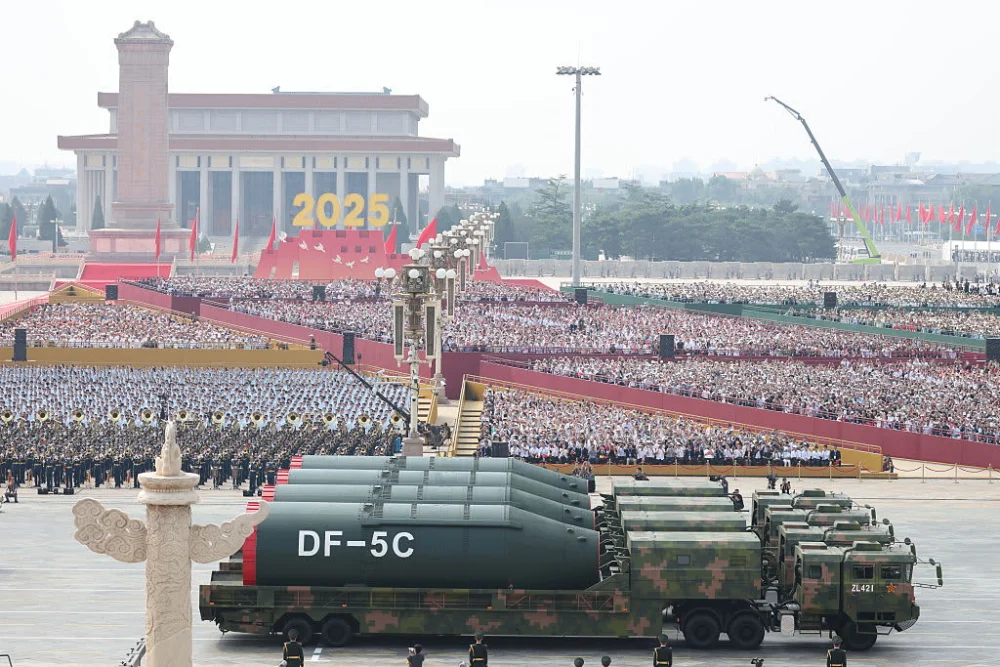
- Strategic Missile Forces: China’s intercontinental strategic nuclear missiles, such as the liquid-fueled DongFeng-5C, demonstrated during the V-Day military parade on September 3, 2025, in Beijing, possess a global strike range. The parade itself, attended by international dignitaries, served as a powerful display of China’s burgeoning military might, showcasing a range of its latest weapon systems, including long-range conventional and nuclear missiles. The development of hypersonic missiles and advanced anti-ship capabilities (often referred to as "carrier-killer" missiles) are also key components of China’s strategy to deter potential adversaries.
- Cyber and Space Warfare: Beijing is investing heavily in cyber warfare units and developing anti-satellite capabilities, recognizing these domains as crucial battlegrounds in future conflicts. The integration of artificial intelligence and big data into military operations is also a high priority.
The National People’s Congress: A Unifying Policy Platform
The budget proposal was unveiled during the annual National People’s Congress (NPC), an eight-day parliamentary meeting that serves as a crucial platform for the Chinese government to approve its annual budget, set development goals, and outline policy directives for the coming year. While often described as a "rubber-stamp" parliament, the NPC provides a formal mechanism for announcing major policy decisions and projects an image of national consensus and unified purpose, both domestically and internationally. The event is closely watched by global observers for insights into China’s economic, social, and military priorities.
The Understated Reality: Discrepancies in Defense Spending Figures
Despite China’s official declarations, international defense analysts and foreign governments consistently suggest that Beijing’s publicly announced military budget significantly understates its true defense expenditure. This discrepancy is a long-standing point of contention and a source of concern for many nations.
According to the U.S. Department of Defense’s 2025 report to Congress on China’s military, Beijing’s actual defense spending in 2024 was estimated to be between $304 billion and $377 billion. This range represents a substantial increase of approximately 32% to 63% higher than its officially announced budget of $231 billion for that year. The report, a comprehensive annual assessment of China’s military capabilities and strategies, attributes this gap to several "off-budget" items that are not included in the official figures. These typically encompass:
- Research and Development (R&D): A significant portion of R&D costs for advanced weapon systems and military technologies is often categorized under civilian or dual-use programs, thus not appearing in the defense budget.
- Foreign Arms Acquisitions: Costs associated with purchasing military hardware from other countries might be funded through separate channels.
- Paramilitary Forces: The People’s Armed Police, a heavily armed internal security force with military-like capabilities, is often not fully accounted for in the defense budget.
- Military Pensions and Veterans’ Benefits: These substantial outlays may be funded through other government ministries.
- Space Program Costs: Elements of China’s ambitious space program, particularly those with military applications, may not be fully attributed to defense.
The International Institute for Strategic Studies (IISS) further corroborates this trend, highlighting China’s growing regional dominance in defense spending. In 2025, Beijing accounted for nearly 44% of Asia’s total defense expenditure, a notable increase from 39% in 2017. This concentration of military spending underscores China’s overwhelming military economic weight within the Asian continent and raises questions about regional power dynamics and potential arms races.
Global Context: China vs. The United States
While China’s defense spending is substantial and growing, it remains second globally to the United States. The U.S. continues to maintain the largest military budget in the world, reflecting its extensive global commitments, technological leadership, and a vast network of alliances.
For the 2025 fiscal year, the U.S. budgeted an estimated $849.77 billion for defense. However, estimates from non-profit organizations like USAFacts suggest that actual U.S. spending during that period could have reached approximately $919.2 billion, representing a 2% increase from the prior year and accounting for a significant 13% of the overall federal budget. This comparison highlights the scale of the U.S. defense apparatus, which continues to outspend China by a factor of roughly 2.5 to 3 times, even when considering the higher estimates for China’s actual expenditure.
However, the gap is narrowing, and China’s military investment is concentrated on specific areas relevant to its regional objectives and anti-access/area-denial (A2/AD) strategies, aiming to deter or defeat potential interventions by external powers in areas like the Taiwan Strait or the South China Sea.
Implications for Regional and Global Security
The sustained growth in China’s defense budget, even at a slightly slower pace, carries significant implications:
- Regional Arms Race: China’s military buildup is prompting neighboring countries, including Japan, South Korea, India, and Australia, to increase their own defense spending and forge stronger security alliances, particularly with the United States. This dynamic risks escalating regional tensions and creating a more militarized Indo-Pacific.
- U.S.-China Strategic Competition: The military dimension of the U.S.-China rivalry will continue to intensify. Washington views China’s military modernization as a direct challenge to its global leadership and the established international order. The ongoing competition extends across technological innovation, cyber capabilities, and strategic influence.
- Taiwan’s Security Calculus: The explicit mention of "fighting against separatist forces" and "opposing external interference" regarding Taiwan sends a clear message. This will likely reinforce Taiwan’s resolve to strengthen its own self-defense capabilities and deepen its security cooperation with the U.S. and other like-minded democracies.
- Economic Burden vs. Strategic Necessity: While defense spending contributes to economic growth in certain sectors, a sustained high level of military expenditure can also divert resources from other critical areas such as social welfare, infrastructure, or environmental protection. For China, balancing these priorities within its broader economic development goals remains a key challenge, especially as its economy faces headwinds.
- Technological Advancement and Self-Reliance: The push for "high-quality" modernization underscores China’s ambition to achieve self-reliance in critical military technologies. This drive for indigenous innovation aims to reduce dependence on foreign suppliers and bolster its capabilities across the spectrum of modern warfare.
In conclusion, China’s proposed 7% increase in defense spending for 2025, while representing a marginal deceleration in growth, signals a steadfast commitment to its military modernization agenda. Driven by acute geopolitical pressures, particularly surrounding Taiwan, and an overarching ambition to secure its national interests in an increasingly volatile world, Beijing’s military expansion continues to reshape regional power dynamics and fuel a broader strategic competition with global ramifications. The true scale of this investment, as suggested by international analyses, further underscores the profound impact of China’s military rise on the 21st-century global order.
About the Author