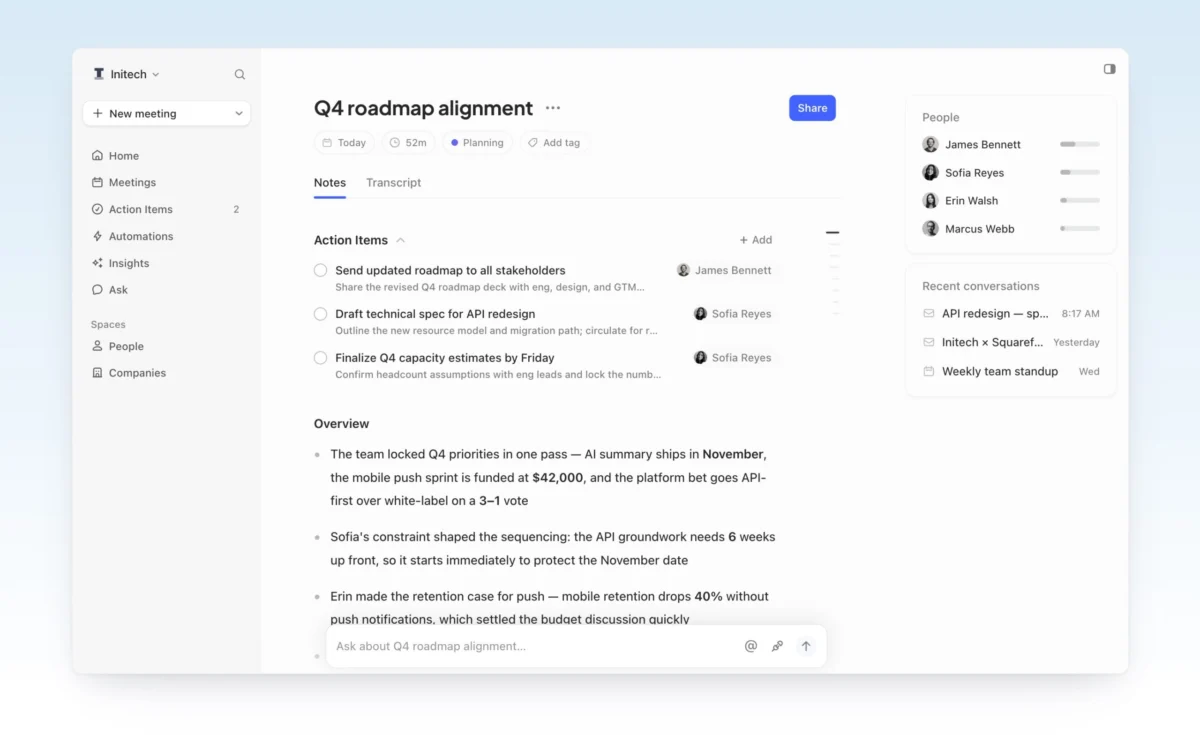
In a significant strategic pivot, Circleback, a Y Combinator-backed startup specializing in AI-powered meeting summarization and note-taking, has introduced a free subscription tier for its platform. This move comes as the market for AI meeting assistants intensifies dramatically, with a flurry of new entrants and established players aggressively expanding their offerings. The decision by Circleback is a direct response to the escalating competitive landscape, aiming to broaden its user base and solidify its position in a sector rapidly becoming a cornerstone of modern workplace productivity.
The introduction of a freemium model by Circleback allows users to transcribe an unlimited number of meetings, granting access to their meeting history for the most recent 30 days. This new offering significantly lowers the barrier to entry for potential users who previously faced a subscription-only model, with plans starting at $20.83 per month. The updated pricing structure now sees premium plans, offering full integration capabilities, unlimited meeting history, and comprehensive API and MCP access, starting at $15 per month when paid annually. This revised approach mirrors a similar strategy recently adopted by Granola, another prominent player in the space, which also introduced a free tier a few months prior.
The Genesis of a Strategic Shift: Responding to Market Pressures
The AI meeting note-taker market has witnessed an explosion of activity in recent weeks and months. Long-standing dedicated solutions such as Granola, Read AI, and Fireflies have collectively raised tens of millions of dollars in venture capital, signaling strong investor confidence in the sector’s growth potential. However, the landscape has become increasingly crowded and dynamic with recent expansions from adjacent technology providers. For instance, Wispr, a dictation app, recently unveiled its own meeting note-taker functionality, while scheduling giant Calendly integrated a similar tool into its existing suite of services. This convergence of capabilities, where tools traditionally focused on specific niches are now incorporating AI note-taking, underscores the perceived value and demand for automated meeting intelligence.
Ali Haghani, co-founder of Circleback, articulated the rationale behind the strategic shift, highlighting a noticeable drop-off in user engagement observed during the company’s previously limited trial periods. "If we just open the gates and allow more people to use the product, that’s gonna bring Circleback in front of more people," Haghani stated. He expressed confidence in the company’s ability to convert free users into paying subscribers, adding, "Then we’re very good at making the product good and monetizing those users." This philosophy aligns with a well-established freemium strategy prevalent across the SaaS industry, where offering a compelling basic service for free acts as a powerful acquisition channel, allowing the product itself to serve as the primary marketing engine.
Circleback’s Journey: From Founding to Profitability
Founded in 2023 by Ali Haghani and Kevin Jacyna, Circleback quickly garnered attention, securing $2.5 million in funding in 2024. Remarkably, the company asserts it has achieved profitability since its funding round, a rare feat for a venture-backed startup, especially in such a nascent and competitive domain. With a lean team of eight employees, Circleback reports an impressive annual recurring revenue (ARR) of over $1 million per employee, translating to an approximate total ARR of $8 million. This efficiency and fiscal prudence differentiate Circleback from many competitors who often operate at significant losses while chasing market share.
Haghani emphasized that the company’s robust financial health and lean operational model mean it is not actively seeking additional funding, despite receiving expressions of interest from investors. He clarified that fundraising would only be considered if a clear bottleneck emerged in their growth trajectory that capital could demonstrably resolve. "We are consistently competing and winning customers against much bigger companies, both in terms of number of people and funding raised. And I feel like there is now more of an appetite [to win]," Haghani remarked, conveying a strong sense of competitive drive and self-sufficiency. This stance challenges the conventional wisdom in Silicon Valley, where rapid fundraising is often seen as a prerequisite for scaling.
The Freemium Imperative: A Deep Dive into Market Dynamics
The adoption of a freemium model by Circleback is not merely a reactive measure but a strategic move that reflects broader trends in the software-as-a-service (SaaS) industry and the specific dynamics of the AI productivity tool market. Freemium, characterized by offering a basic version of a product for free while charging for advanced features or increased capacity, serves multiple critical functions:
- User Acquisition at Scale: In a crowded market, a free tier significantly reduces the friction for new users to try a product. This organic growth model can be more sustainable and cost-effective than relying heavily on paid advertising, which Circleback explicitly states it avoids. The company views the free tier as a direct substitute for traditional marketing expenses, transforming product usage into a form of marketing.
- Data Collection and AI Model Improvement: For AI-driven products, a larger user base translates directly into more data, which is crucial for refining and improving the underlying AI models. More diverse meeting transcripts and user interactions allow Circleback’s AI to become more accurate, understand nuances better, and offer more relevant insights, creating a virtuous cycle of improvement.
- Product-Led Growth (PLG): Freemium is a cornerstone of the PLG strategy, where the product itself drives customer acquisition, conversion, and expansion. By allowing users to experience the value proposition firsthand, companies can build stronger relationships and trust, leading to higher conversion rates to paid plans.
- Competitive Differentiation: While many players offer free trials, a perpetual free tier signals a different level of commitment and accessibility. It can capture a segment of the market that is price-sensitive or simply wants to experiment without a time constraint, potentially converting them into loyal users over time.
- Network Effects: In a collaborative work environment, tools that are easily accessible and widely adopted can benefit from network effects. As more team members use Circleback, the value proposition for the entire team grows, making it harder to switch to alternative solutions.
However, the freemium model also presents challenges, primarily balancing the value offered in the free tier with the incentive to upgrade. Circleback’s approach of limiting historical access to 30 days and restricting full integration capabilities strikes a common balance, ensuring that power users or teams requiring comprehensive historical data and seamless workflow integration will find value in the paid subscriptions.
The Broader Landscape of AI in Workplace Productivity
The rise of AI meeting note-takers is part of a larger phenomenon: the integration of artificial intelligence into every facet of workplace productivity. This includes everything from AI-powered writing assistants and project management tools to sophisticated data analysis platforms. The market for AI-driven productivity software is projected to grow substantially, with some estimates placing its global value in the tens of billions of dollars within the next few years. The driving forces behind this growth include:
- Increasing Meeting Fatigue: Modern workplaces are often characterized by an abundance of meetings, many of which are perceived as inefficient or unproductive. AI note-takers promise to alleviate this burden by automating the mundane task of transcription and summarization, freeing up human participants to focus on strategic discussions.
- Demand for Actionable Insights: Beyond simple transcription, advanced AI tools can identify key decisions, action items, and follow-up tasks, transforming raw meeting data into actionable intelligence. This capability is invaluable for project managers, team leaders, and executives.
- Hybrid Work Models: The proliferation of hybrid and remote work has underscored the need for robust digital tools that ensure equitable access to information and foster seamless collaboration, regardless of physical location. AI meeting assistants play a crucial role in documenting discussions and making them accessible asynchronously.
- Technological Advancements: Continuous improvements in natural language processing (NLP), speech-to-text accuracy, and large language models (LLMs) have made these AI assistants increasingly sophisticated and reliable, moving them from novelty to necessity.
Timeline of Competitive Intensification:
- Early 2020s: Dedicated AI meeting note-takers like Fireflies, Read AI, and Granola gain traction, securing initial funding rounds and building specialized platforms.
- Late 2023: Circleback founded, quickly establishing its presence in the market.
- Early 2024: Circleback raises $2.5 million, emphasizing its focus on profitability and lean operations. Granola introduces its own free tier, signaling an initial shift in market strategy among dedicated players.
- Mid-2026 (Recent Weeks): Wispr, a dictation app, and Calendly, a scheduling app, expand their core offerings to include AI meeting note-taking, signaling a convergence of functionalities and intensifying competition from broader productivity ecosystems.
- Present: Circleback introduces its free subscription tier, a direct strategic response to the escalating competitive pressures and a validation of the freemium model’s efficacy in the current market climate.
Implications for the AI Meeting Assistant Market
Circleback’s move, combined with the actions of competitors, suggests several key implications for the future of the AI meeting assistant market:
- Race to the Bottom (or Freemium): The trend towards freemium models is likely to accelerate. Companies that do not offer a compelling free entry point may find it increasingly difficult to acquire users organically, especially against well-funded competitors with robust marketing budgets.
- Feature Convergence and Differentiation: As core transcription and summarization capabilities become commoditized, differentiation will increasingly hinge on advanced features (e.g., deeper integrations, specialized analytics, custom AI queries, enhanced security, domain-specific AI models) and superior user experience.
- Consolidation Potential: The intense competition and significant funding in the sector could lead to consolidation. Smaller, less differentiated players might be acquired by larger tech companies looking to integrate AI meeting capabilities into their broader enterprise suites.
- Value Proposition Evolution: The focus will shift from "what can it transcribe?" to "what insights can it provide?" and "how seamlessly does it integrate into my workflow?" Solutions that offer true ambient intelligence and proactive assistance will likely gain a lasting advantage.
- Data Security and Privacy: As AI tools become more ubiquitous in capturing sensitive corporate discussions, data security, privacy, and compliance with regulations (like GDPR, CCPA) will become paramount differentiators.
In conclusion, Circleback’s strategic introduction of a free tier is a calculated maneuver in a rapidly evolving and fiercely competitive market. It underscores the company’s confidence in its product and its lean, profitable operational model. More broadly, this development reflects a significant industry shift towards democratizing access to AI-powered productivity tools, leveraging freemium as a powerful engine for growth, user acquisition, and AI model refinement, while simultaneously pushing the boundaries of what is expected from workplace technology. The battle for the future of meeting intelligence is truly heating up, and accessibility is proving to be a critical front.
About the Author