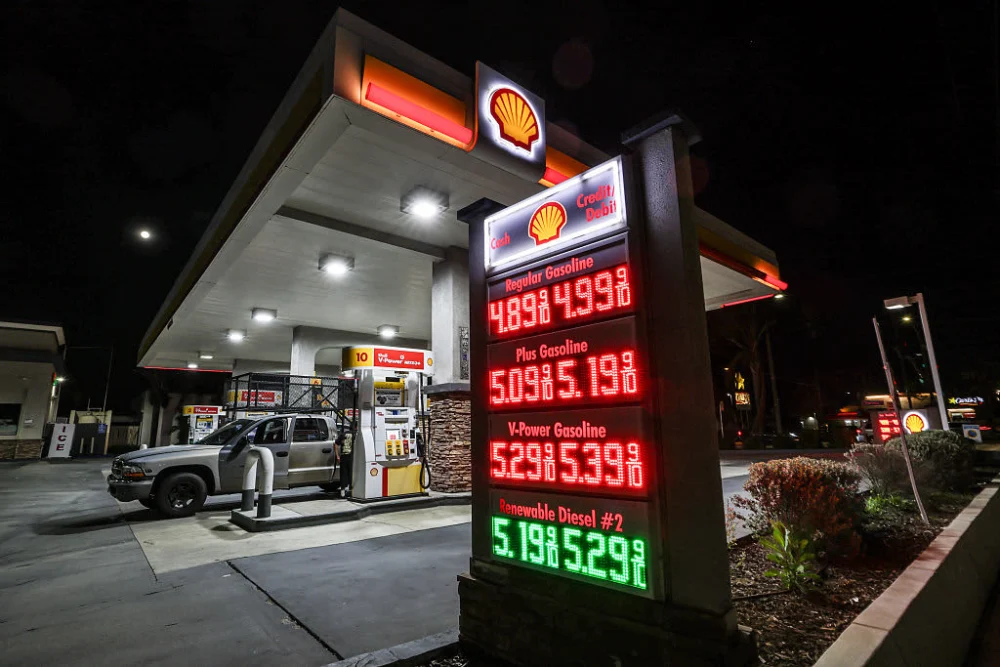
The economic uplift anticipated from President Donald Trump’s signature legislative achievement, the "big beautiful bill," particularly its individual tax cuts, faces a significant headwind from rapidly escalating oil prices. What was initially conceived as a powerful fiscal stimulus to boost consumer spending and accelerate U.S. economic growth now stands at risk of being largely — if not entirely — negated by the increased financial burden on households at the gas pump, according to analyses from prominent financial institutions and economists. The confluence of geopolitical instability, specifically the U.S.-Iran war, and the ongoing distribution of tax refunds has created a precarious economic balancing act, raising concerns about inflation, consumer resilience, and the overall trajectory of the American economy.
The Economic Collision Course: Tax Cuts vs. Energy Costs
At the heart of this economic dilemma is a stark comparison: the financial benefit bestowed upon American consumers through tax reductions against the sudden, unavoidable increase in their daily expenses due to higher energy costs. Raymond James strategists, led by Tavis McCourt, have posited that a sustained elevation of oil prices by more than $20 per barrel compared to pre-U.S.-Iran war levels could effectively "erase the fiscal benefit" of the "big beautiful bill’s" individual tax cuts. McCourt’s analysis, detailed in a recent client note, highlights that the dramatic $25 surge in oil prices experienced last week, if sustained, would essentially cancel out the intended economic boost.
To quantify this impact, McCourt’s model extrapolates the increase in oil market prices to the substantial consumer expenditure on gasoline. In the fourth quarter of 2025 alone, American consumers collectively spent over $420 billion on gasoline. Accounting for potential reduced demand due to higher prices and the need for companies to maintain profit margins, McCourt estimates that a $20 rise in oil prices translates to an additional $150 billion in consumer spending at the pump annually. This figure stands in stark contrast to the estimated $129 billion in individual tax cuts for 2025, as projected by the Tax Foundation, the overwhelming majority of which was slated to materialize through sweetened tax refunds during the ongoing filing season. This suggests a direct redirection of disposable income from discretionary spending or savings towards essential fuel costs, effectively neutralizing the stimulus effect.
Chronology of Escalation and Economic Policy
The current predicament is rooted in a specific timeline of events and policy implementations:
- Pre-War Stability: On February 27, prior to the outbreak of the U.S.-Iran war, U.S. oil (West Texas Intermediate futures) closed at $67.02 per barrel, reflecting a relatively stable global energy market.
- The "Big Beautiful Bill": President Donald Trump’s "big beautiful bill," formally known as the Tax Cuts and Jobs Act of 2025, was enacted with the stated goal of stimulating economic growth through a combination of corporate and individual tax reductions. The individual tax cuts, in particular, were designed to put more money into the pockets of American households, either through smaller withholdings from paychecks throughout the year or through larger tax refunds during the filing season of 2026. The economic consensus anticipated these measures would bolster consumer spending, investment, and ultimately, GDP growth in 2026.
- Outbreak of U.S.-Iran War: The geopolitical landscape shifted dramatically with the onset of the U.S.-Iran war. While the precise trigger and full scope of the conflict are complex, its immediate impact on global oil markets was pronounced. Concerns over supply disruptions, particularly regarding oil shipments through critical chokepoints like the Strait of Hormuz, where a significant portion of the world’s seaborne oil passes, sent crude prices soaring.
- Oil Price Surge: Following the outbreak of hostilities, oil prices experienced rapid and significant appreciation. As of Tuesday morning, after considerable market volatility and a major whiplash in prices on Monday, crude oil was trading at $88.20 per barrel – more than $20 higher than its pre-war level. This rapid increase has translated almost immediately into higher prices at the gasoline pump for consumers across the nation, as evidenced by rising prices at stations like the Shell on Foothill Blvd.
- Tax Refund Distribution: The timing of the oil price shock coincides directly with the period of peak tax refund distribution. Citadel Securities estimated that only 30% of refunds had been distributed by March 1, with the figure projected to rise to approximately 75% by May 1. This means a substantial portion of the fiscal stimulus is hitting consumer bank accounts precisely when energy costs are rapidly climbing.
- President Trump’s Stance: President Trump, in an interview with a CBS News reporter on Monday, characterized the U.S.-Iran war as "very complete," although he did not provide a specific timeline for its resolution in a subsequent press conference. While an end to hostilities would theoretically alleviate pressure on oil prices, historical precedents suggest that market normalization takes time.
Supporting Data and Economic Models
The financial community’s assessment of this unfolding situation is underpinned by robust economic modeling and historical data.
- Consumer Spending Habits: The $420 billion spent on gasoline in Q4 2025 underscores the non-discretionary nature of fuel consumption for most households. When prices rise, this is often a fixed cost that cannot be easily avoided, forcing consumers to cut back elsewhere. McCourt’s calculation of a $150 billion increase in pump spending for a $20 oil price hike highlights the sheer scale of the potential transfer of wealth from consumer wallets to energy producers and distributors.
- Tax Cut Impact: The Tax Foundation’s estimate of $129 billion in individual tax cuts for 2025 reflects the intended boost to disposable income. The majority of this benefit comes through tax refunds, which are often viewed by consumers as "found money" that can be used for larger purchases, debt reduction, or savings. The diversion of this sum to gasoline purchases fundamentally alters its economic impact.
- Historical Precedents: Tavis McCourt also drew parallels to past geopolitical oil shocks, noting that it took approximately six months for oil prices to return to pre-surge levels following significant events such as the Gulf War in 1990 and Russia’s invasion of Ukraine in 2022. This historical context suggests that even if the U.S.-Iran conflict de-escalates quickly, consumers may face elevated energy costs for an extended period, prolonging the offsetting effect on tax cut benefits. The 1990 Gulf War, for instance, saw crude oil prices more than double in a matter of months, while the 2022 Ukraine invasion pushed Brent crude past $130 a barrel. In both instances, the ripple effects on global supply chains and consumer confidence were significant.
Expert Reactions and Divergent Views
The potential economic fallout has elicited varied responses from leading economists and financial strategists:
- The "Voiding Out" Hypothesis: Gabriel Shahin, CEO of Falcon Wealth Planning, articulated the concern directly: "The bottom line is that if we were expecting those tax refunds to lift consumer spending, these higher oil prices are just redirecting all that cash toward energy costs. It’s essentially voiding out the economic boost we were set to see." This perspective emphasizes the direct, zero-sum nature of the trade-off for consumers.
- Duration is Key: Stephanie Roth, chief economist at Wolfe Research, while acknowledging that her own estimations for consumer impact from elevated oil prices are similar to the projected spending from the tax law, cautioned that the duration of high oil prices is critical. In a Tuesday note, Wolfe Research indicated that oil prices would need to remain above $100 per barrel for an extended period for the full offsetting effect to materialize. "In all these scenarios, it has to last longer than it is now," Roth stated. "The impact on gas prices so far has been short-lived, and modest compared to how it may ultimately play out." This introduces a temporal element, suggesting that a brief spike, while painful, may not entirely derail the economic outlook if it recedes quickly.
- Resilience and Buffer: Conversely, Dan Niles, portfolio manager at Niles Investment Management, offered a more optimistic outlook, framing the tax refunds as a crucial buffer that could help the economy weather higher oil prices. Niles pointed to the economy’s resilience in 2022 and 2023 when oil prices hit similar levels amid surging inflation and rising interest rates, yet Wall Street’s widespread predictions of a recession largely failed to materialize. "You already had that stress tested a bit," Niles remarked. "So if that’s the case back then, and coming off of inflation surging in 2021, and you still didn’t get a recession, why would you think inflation down at 3% and oil at $100 would cause a recession now?" This perspective underscores the underlying strength of the labor market and consumer balance sheets.
- Distinguishing Economic Backdrops: However, Roth strongly cautioned against relying too heavily on comparisons to the 2022 oil surge following the Russia-Ukraine invasion. She emphasized the vastly different economic backdrops: "The economic backdrop is not a mirror image of where we are today. Core inflation was running at 5.5% compared to 3% today. Job growth was running at around 500,000, now we’re at 37,000 over the past couple of months. So it’s just an entirely different backdrop." This highlights the importance of context, suggesting that an economy with lower inflation and significantly slower job growth may be more vulnerable to an oil shock than one operating at a hotter pace.
Broader Impact and Implications
The interplay between energy costs and fiscal stimulus carries wide-ranging implications for the U.S. economy, markets, and monetary policy.
- Consumer Spending and Retail Sector: If consumers are forced to allocate a larger portion of their disposable income to gasoline, it inevitably curtails spending on non-essential goods and services. This could dampen the performance of the retail sector, particularly segments focused on discretionary items. The fact that consumer discretionary stocks have underperformed the S&P 500 in 2026, as noted by McCourt, may already reflect investor apprehension about this potential shift in spending patterns. While overall consumer spending might not collapse as long as the labor market remains strong, the composition of that spending could change significantly, favoring essentials over luxuries.
- Inflationary Pressures and the Federal Reserve: A sustained rise in oil prices presents a renewed challenge to inflation control. Higher energy costs feed into the Consumer Price Index (CPI) directly through gasoline prices and indirectly through increased transportation and production costs for businesses, potentially leading to a broader increase in goods and services prices. This could complicate the Federal Reserve’s efforts to achieve its 2% inflation target and might delay anticipated interest rate cuts. Should inflation re-accelerate, the Fed might even be compelled to reconsider its monetary policy stance, creating further uncertainty for financial markets and economic growth. The risk of a "wage-price spiral," where higher prices lead to demands for higher wages, which in turn fuel further price increases, is a persistent concern for policymakers.
- GDP Growth Outlook: The fiscal stimulus from the "big beautiful bill" was expected to be a significant contributor to U.S. growth in 2026, with some economists forecasting a reacceleration. If the benefits are indeed nullified by oil prices, these growth forecasts may need to be revised downwards. While a recession may not be imminent, as suggested by Dan Niles, the pace of expansion could certainly decelerate, impacting corporate earnings and investment decisions.
- Political Ramifications: For President Trump, who campaigned on a platform of economic prosperity and lower inflation, the current situation presents a political challenge. The "big beautiful bill" was touted as a cornerstone of his economic legacy. If its intended benefits are overshadowed by rising costs of living, it could impact public perception of his economic management and broader policy effectiveness.
- Market Sentiment and Investment Decisions: Investors are closely monitoring the situation. While the stock market may not have fully priced in a massive surge in consumer spending from the tax cuts, any significant erosion of consumer purchasing power due to energy costs could still weigh on corporate profits, particularly for companies reliant on discretionary consumer spending. Uncertainty surrounding the duration of the conflict and its economic consequences could lead to increased market volatility and a cautious approach from investors.
Outlook and Key Uncertainties
The ultimate impact of this economic tug-of-war hinges on several critical uncertainties:
- Duration and Intensity of Conflict: The timeline for the resolution of the U.S.-Iran war remains the most significant unknown. A swift de-escalation could allow oil prices to normalize more quickly, mitigating the economic damage. Conversely, a prolonged or escalating conflict would exacerbate the energy crisis.
- Global Supply and Demand Dynamics: Beyond the immediate geopolitical concerns, underlying global oil supply and demand dynamics will play a role. Factors such as OPEC+ production decisions, the pace of global economic growth, and the strategic petroleum reserves of major nations will all influence price stability.
- Consumer Behavior: The resilience of the American consumer, particularly their willingness and ability to adjust spending habits in the face of higher costs, will be paramount. While a strong labor market provides a buffer, sustained erosion of purchasing power could eventually lead to broader economic deceleration.
- Monetary and Fiscal Policy Responses: The reactions of the Federal Reserve and the U.S. government to persistent inflationary pressures or a significant slowdown in growth will also shape the economic trajectory.
In conclusion, the surge in oil prices stemming from the U.S.-Iran war has cast a long shadow over the anticipated economic benefits of President Trump’s "big beautiful bill" tax cuts. What was intended as a significant fiscal boost now runs the risk of being absorbed by higher energy costs, creating a challenging environment for American consumers and policymakers alike. The coming months will be crucial in determining whether the economy can successfully navigate these headwinds or if the geopolitical shock will ultimately diminish the impact of a cornerstone economic policy.
About the Author