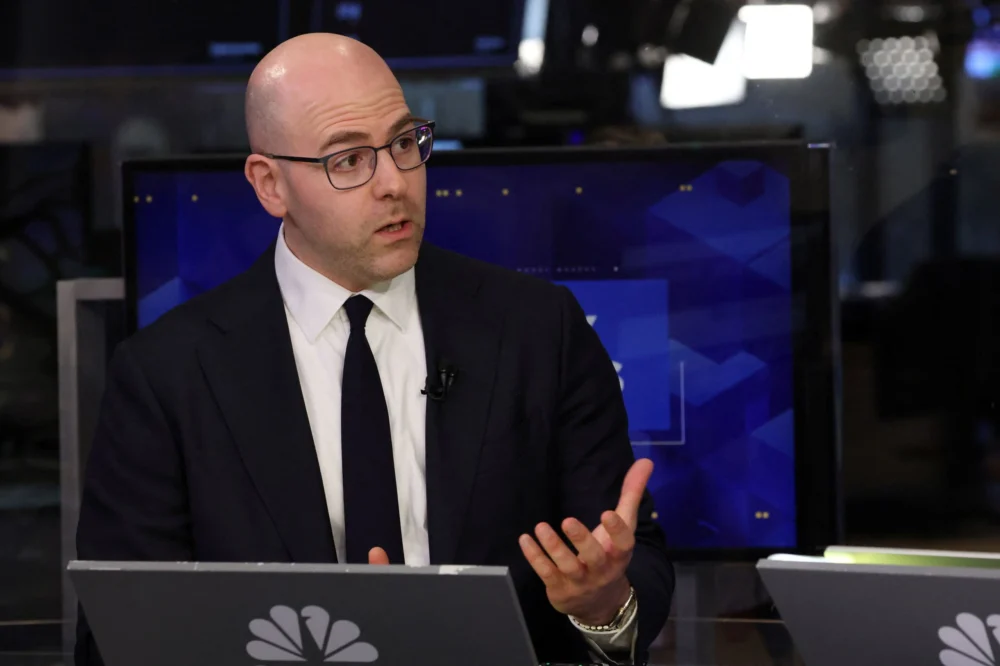
Federal Reserve Governor Stephen Miran announced Friday that the unexpectedly weak February jobs report significantly bolsters the rationale for the central bank to implement further reductions in interest rates. His remarks, delivered during a CNBC interview, underscored a persistent divergence from the prevailing consensus within the Federal Open Market Committee (FOMC), emphasizing the urgency of supporting a decelerating labor market over lingering concerns about inflation, which he argues is largely mismeasured.
The February Jobs Report: A Signal of Weakness
The Bureau of Labor Statistics’ report, released Friday, revealed a substantial drop of 92,000 in nonfarm payrolls for February 2026, a figure that starkly contrasted with analyst expectations of a modest gain. This unexpected contraction immediately sent ripples through financial markets and reignited debates about the health of the U.S. economy. Beyond the headline payroll number, other indicators within the report painted a picture of softening labor demand: the unemployment rate edged up to 4.2% from 4.0% in January, average hourly earnings growth slowed to an annualized 3.5% from 3.8%, and the labor force participation rate showed a marginal decline, suggesting a cooling in what had previously been a robust job market.
"I think that we don’t have an inflation problem," Miran stated emphatically on the "Money Movers" program. "I think that the labor market can use more accommodation from monetary policy. And I don’t see having a modestly restrictive stance of monetary policy as opposed to a neutral stance as being appropriate. I think being close to neutral is appropriate." Miran’s statement aligns with the dovish wing of the Fed, advocating for a more proactive approach to employment stability, even as some of his colleagues remain wary of reigniting inflationary pressures. This perspective highlights the inherent tension within the Fed’s dual mandate of achieving maximum employment and stable prices.
Miran’s Call for a Truly Neutral Stance
Currently, the Fed’s benchmark interest rate is targeted within a range of 3.5% to 3.75%. This range was established following three consecutive quarter-percentage-point cuts implemented in the latter part of 2025, a period that saw initial signs of economic deceleration and a gradual moderation of inflation from its peaks earlier in the decade. However, Miran contends that this level remains "modestly restrictive" and is impeding the labor market’s full potential.
According to Miran, a truly "neutral" interest rate – one that neither stimulates nor constrains economic growth – should be approximately a full percentage point lower than the current range. The consensus view among Fed officials at their December meeting pegged the neutral rate at around 3.1%. If Miran’s preferred neutral rate is a full percentage point below this consensus, it implies a target range closer to 2.1%. This substantial difference underscores the depth of the policy disagreement within the FOMC. Achieving the consensus neutral rate of 3.1% from the current 3.5%-3.75% would require at least one or two additional quarter-point cuts, but Miran’s more aggressive stance would necessitate even more significant action, advocating for a path that could involve several more aggressive reductions.
The Nuances of Inflation Measurement
A cornerstone of Miran’s argument for lower rates rests on his contention that stubbornly high inflation numbers are not reflective of true underlying price pressures but are, instead, a function of how inflation is measured by key government agencies like the Commerce and Labor departments. He has consistently argued that methodological quirks distort the actual inflationary landscape.
One specific factor he frequently cites is the treatment of portfolio management fees within inflation calculations. These fees, often charged as a percentage of assets under management, naturally increase in dollar value when the stock market performs well. For instance, if the S&P 500 saw a 15% gain over a year, the total fees collected by asset managers would rise, even if the underlying service charge rate remained constant. Miran argues that this increase in dollar value of fees, driven by market appreciation rather than an increase in the cost of financial services themselves, artificially inflates measured inflation without reflecting genuine price pressure on goods and services consumed by households. While a seemingly minor component, these factors can collectively skew the headline figures, especially in periods of robust financial market performance.
Furthermore, Miran differentiates between "headline inflation" and "core inflation." He acknowledges the recent surge in oil prices, and the corresponding boost in costs at the pump, largely attributable to the ongoing geopolitical tensions related to the Iran war. However, he dismisses these as primary concerns for monetary policy. "Typically, the Federal Reserve doesn’t respond to higher oil prices like that. It [boosts] headline inflation, but it tends to be a one-off shock," he explained. "When you think about core inflation [which does not include energy prices], it tends to be more predictive of where inflation is going over the medium term than headline inflation." Core inflation, which typically strips out volatile energy and food prices, is generally preferred by central bankers as a better gauge of underlying, persistent inflationary trends. Miran’s emphasis on core inflation suggests he sees the current price pressures as largely transitory or externally driven, rather than indicative of deeply embedded demand-side inflation that would warrant tighter monetary policy.
A Chronology of Dissent and a Divided Committee

Governor Miran’s tenure on the Federal Reserve Board has been marked by a consistent and outspoken dovish stance. He was appointed by President Donald Trump to fill the unexpired term of Adriana Kugler, who resigned in August 2025. Although his term officially expired in January 2026, Miran has continued to serve, as is customary, until a successor is officially approved by the Senate.
Since his first Federal Open Market Committee meeting in September 2025, Miran has dissented at every subsequent meeting. This record of dissent is particularly noteworthy, signaling a significant fracture within the policymaking body, potentially making the current FOMC one of the most divided in over a decade. During the three consecutive quarter-percentage-point rate cuts in late 2025, Miran advocated for more aggressive half-percentage-point reductions, believing the economy required a more substantial monetary stimulus to avert a slowdown. In January 2026, when the FOMC ultimately voted to hold rates steady, Miran again dissented, arguing for a quarter-point reduction, highlighting his consistent belief that the current policy stance is unduly restrictive.
When asked if he anticipated another dissent at the upcoming FOMC meeting in a couple of weeks, Miran replied, "I hope not, but that would be up to my colleagues. I hope that we vote to cut." This statement encapsulates the ongoing internal debate and the significant pressure on the committee to find a consensus path forward, particularly in light of the weakening jobs data.
The Federal Open Market Committee: Dynamics and Future Leadership
The FOMC, comprising the seven members of the Board of Governors and five of the twelve Federal Reserve Bank presidents, operates on a consensus-driven model. However, the current environment has seen a pronounced split between "hawks," who prioritize inflation control, and "doves," who emphasize maximum employment. Governor Miran clearly positions himself among the doves, believing that the risks of an economic slowdown outweigh the risks of resurgent inflation, especially given his skepticism about current inflation metrics.
The internal divisions within the Fed are further complicated by impending leadership changes. President Trump has nominated Kevin Warsh to a position that is widely expected to be a replacement for current Fed Chair Jerome Powell, whose term is set to expire in May 2026. Warsh, a former Fed governor himself, has a complex history, sometimes viewed as leaning hawkish, but also having expressed concerns about the Fed’s balance sheet and potential for over-tightening in the past. His potential appointment as Chair could significantly alter the FOMC’s overall direction, potentially shifting the balance of power within the committee and influencing future policy decisions.
Broader Economic Implications and Market Outlook
The weakening labor market, coupled with Miran’s outspoken advocacy for deeper rate cuts, presents a complex challenge for financial markets and economic forecasting. The immediate reaction to the February jobs report saw U.S. Treasury yields decline, as bond investors priced in a higher probability of rate cuts. Equity markets, initially spooked by the poor jobs data, later found some footing on the prospect of more accommodative monetary policy.
If Miran’s perspective gains traction, or if the economic data continues to deteriorate, the market could see a more aggressive easing cycle than currently anticipated by the majority of analysts. Such a shift would likely lead to further declines in bond yields, potentially boosting interest-rate-sensitive sectors of the stock market, though concerns about a broader economic slowdown could temper enthusiasm. Conversely, if the FOMC continues its cautious approach, prioritizing inflation vigilance, then the economy might face a period of sustained "modestly restrictive" policy, potentially prolonging the softness in the labor market and risking a more pronounced slowdown.
Beyond the domestic implications, the U.S. monetary policy stance has significant global repercussions. A more accommodative Fed could weaken the U.S. dollar, impacting global trade and capital flows. The ongoing geopolitical situation, particularly the Iran war and its impact on energy prices, adds another layer of complexity. While the Fed typically overlooks such "one-off shocks," a sustained surge in oil prices could eventually feed into core inflation through second-round effects, forcing the committee to re-evaluate its stance.
Conclusion: A Critical Juncture for Monetary Policy
Governor Stephen Miran’s impassioned argument for aggressive interest rate cuts, underscored by the disappointing February jobs report, highlights a critical juncture for U.S. monetary policy. His consistent dissents and detailed critiques of inflation measurement methodologies represent a significant internal challenge to the Federal Reserve’s current trajectory. With a divided FOMC, a looming leadership transition, and an economic landscape showing signs of fragility, the decisions made in the coming months will profoundly shape the trajectory of the U.S. economy. The delicate balance between supporting employment and maintaining price stability, always a central tension for the Fed, has rarely been more pronounced, making the upcoming FOMC meetings pivotal for investors, businesses, and policymakers alike. The debate over what constitutes a truly neutral stance, and how best to interpret complex economic data, will continue to define the Fed’s path forward.
About the Author