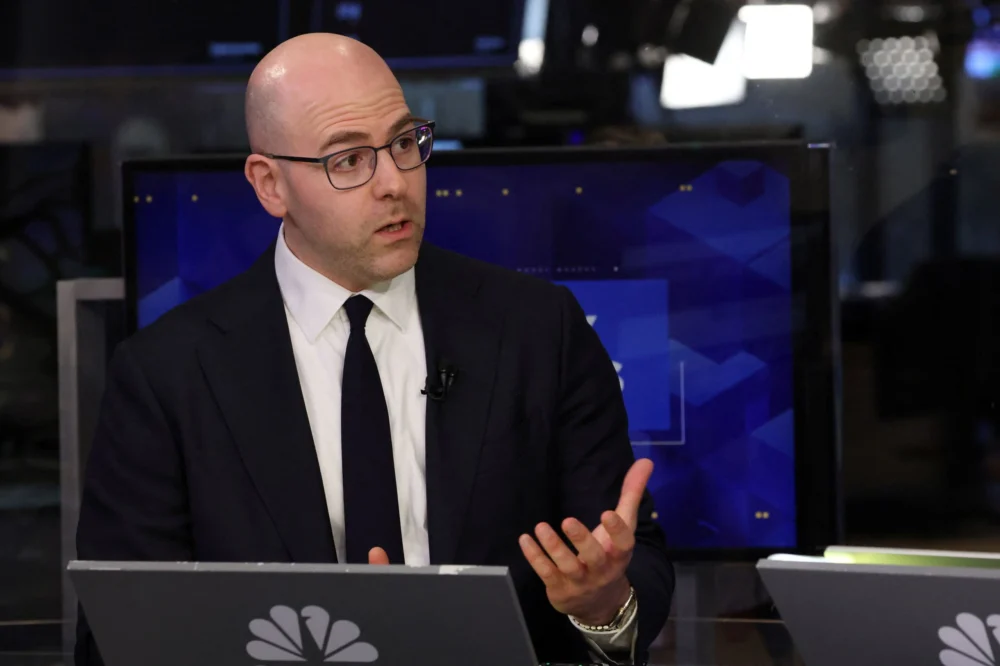
Federal Reserve Governor Stephen Miran on Friday reiterated his strong conviction that the central bank’s monetary policy is unduly restrictive, advocating for deeper interest rate cuts following the release of a surprisingly weak February jobs report. The Bureau of Labor Statistics (BLS) reported a significant drop of 92,000 in nonfarm payrolls, a figure that starkly contrasted with market expectations for a modest gain and underscored a potential softening in the U.S. labor market. Miran, known for his consistently dovish stance, argued in a CNBC interview that the Federal Reserve should prioritize supporting employment growth over what he perceives as a non-existent inflation problem, pushing for a more accommodative policy approach.
Speaking on the "Money Movers" show, Governor Miran articulated his view, stating, "I think that we don’t have an inflation problem. I think that the labor market can use more accommodation from monetary policy. And I don’t see having a modestly restrictive stance of monetary policy as opposed to a neutral stance as being appropriate. I think being close to neutral is appropriate." His comments highlight a growing divergence within the Federal Open Market Committee (FOMC) regarding the appropriate path for interest rates, particularly in light of evolving economic data.
The February Jobs Report: A Signal of Softening?
The headline figure from the February 2026 jobs report—a net loss of 92,000 nonfarm payrolls—sent ripples through financial markets and economic circles. This contraction marked a significant departure from analyst consensus, which had generally anticipated a modest expansion in employment, often in the range of 50,000 to 100,000 new jobs, albeit lower than the robust gains seen earlier in the economic recovery. The unexpected decline raised questions about the underlying health and momentum of the U.S. labor market, suggesting that the cumulative effect of the Fed’s previous rate hikes might finally be exerting a more pronounced drag on hiring.
While the headline payroll number garnered immediate attention, a comprehensive assessment of the labor market typically involves examining several other key indicators. Alongside the payroll data, the unemployment rate, average hourly earnings, and labor force participation rate provide a more nuanced picture. If, for instance, the unemployment rate ticked up significantly, or wage growth decelerated sharply, it would further bolster arguments for monetary easing. Conversely, if other indicators remained robust, some economists might view the payroll decline as an anomaly or a temporary blip rather than a definitive trend. The February report’s full details, including sector-specific job changes and revisions to prior months’ data, would be crucial for a more complete understanding of the labor market’s trajectory. For instance, a significant portion of job losses concentrated in interest-rate-sensitive sectors like construction or manufacturing could point directly to the impact of tighter monetary conditions.
Miran’s Call for a Neutral Stance
Currently, the Federal Reserve’s benchmark federal funds rate is targeted within a range of 3.5% to 3.75%. This level was established after three consecutive quarter-percentage-point cuts implemented during the latter part of 2025, following a period of aggressive rate hikes aimed at taming inflation. Governor Miran’s contention is that this range remains "modestly restrictive," implying it continues to weigh on economic activity and, crucially, the labor market.
Miran advocates for moving the policy rate closer to what is considered "neutral." The neutral interest rate, often denoted as R*, is a theoretical rate that neither stimulates nor constrains economic growth, allowing the economy to operate at its full potential with stable inflation. The consensus among Fed officials at their December meeting pegged the long-run neutral rate around 3.1%. Miran’s desire for the rate to be approximately a full percentage point lower than the current target suggests he believes the actual neutral rate is significantly lower than the FOMC’s consensus estimate, or that the economy currently requires a slightly accommodative stance to regain full employment. Achieving his desired level would necessitate at least two more quarter-point rate cuts, or potentially one larger half-point reduction.
The concept of the neutral rate itself is subject to considerable debate among economists. It is unobservable and can only be estimated, with different models yielding varying results. Factors such as demographic changes, productivity growth, and global savings gluts can influence estimates of R*. If Miran believes the true neutral rate is lower than his colleagues, it explains his consistent push for more aggressive easing.
Challenging the Inflation Narrative: Measurement vs. Reality
A cornerstone of Governor Miran’s argument is his skepticism regarding the accuracy of reported inflation numbers. He has consistently maintained that stubbornly high inflation figures are, to a significant extent, an artifact of how the Commerce and Labor departments measure certain components, rather than reflecting genuine, broad-based underlying price pressures. This perspective offers a crucial counter-narrative to those within the Fed who remain cautious about easing policy too quickly, fearing a resurgence of inflation.
One specific factor Miran frequently cites is the treatment of portfolio management fees in inflation calculations. These fees, often structured as a percentage of assets under management, tend to increase in dollar terms when financial markets perform well and asset values rise. For example, if the stock market experiences a bull run, the nominal value of investment portfolios grows, and consequently, the fees charged on those portfolios also increase, even if the underlying percentage rate charged by asset managers remains unchanged. Miran argues that this rise in dollar-denominated fees contributes to inflation metrics like the Consumer Price Index (CPI) or Personal Consumption Expenditures (PCE) index, yet it does not represent an actual increase in the cost of providing the service or a broader inflationary pressure on goods and services consumed by the average household. Instead, it reflects the wealth effect of asset appreciation, potentially distorting the true inflation picture.
Another significant component often scrutinized by policymakers is energy prices. Miran addressed the recent surge in oil prices, and the corresponding increase in costs at the pump, which have been attributed to the ongoing Iran war. He asserted that such energy shocks are typically "one-off" events that boost "headline inflation" but do not necessarily reflect persistent inflationary trends. The Federal Reserve, historically, tends to "look through" such temporary supply-side shocks, focusing instead on "core inflation," which strips out volatile food and energy prices. Core inflation is generally considered a more reliable predictor of where inflation is headed over the medium term because it captures more fundamental demand-side pressures and the stickiness of prices for goods and services. Miran’s emphasis on core inflation aligns with the conventional wisdom that central banks should not react aggressively to temporary supply disruptions that are beyond their control. The geopolitical instability in the Middle East, particularly the conflict involving Iran, has indeed created significant uncertainty in global energy markets, leading to price volatility that can temporarily skew headline inflation figures without signaling a widespread overheating of the economy.
A History of Dissent: Miran’s Independent Voice

Governor Miran’s advocacy for lower rates is not a new development; it is part of a consistent pattern of dissent within the Federal Open Market Committee. Appointed by President Donald Trump to fill the unexpired term of Adriana Kugler in August 2025, Miran quickly established himself as a prominent dovish voice. Since joining the FOMC, he has dissented at every single meeting he has attended since September 2025, marking him as one of the most consistently dissenting governors in over a decade.
His dissenting votes underscore a significant division within the committee. In the latter part of 2025, when the FOMC approved three consecutive quarter-percentage-point rate cuts, Miran consistently argued for more aggressive action, preferring half-percentage-point reductions. This indicates his belief that the economy required a more substantial injection of monetary accommodation to counteract restrictive conditions. Furthermore, in January 2026, when the FOMC voted to hold rates steady, Miran again broke ranks, advocating for a quarter-point reduction. His repeated willingness to publicly disagree with the majority reflects a deep-seated conviction that the current policy stance is fundamentally misaligned with economic realities, particularly concerning the labor market and true inflation dynamics.
Asked if he would dissent again at the upcoming FOMC meeting, Miran responded, "I hope not, but that would be up to my colleagues. I hope that we vote to cut." This statement highlights both his personal desire for a policy shift and the internal dynamics of the committee, where consensus is often sought but not always achieved. His continued dissent, however, serves to push the boundaries of the policy debate, ensuring that alternative viewpoints on inflation and employment are strongly represented.
The Broader Economic Landscape and the Federal Reserve’s Dual Mandate
The Federal Reserve operates under a "dual mandate" from Congress: to foster maximum employment and maintain price stability. Navigating these two objectives can be particularly challenging when economic signals are mixed or when different interpretations of data exist. Miran’s position emphasizes the "maximum employment" leg of this mandate, arguing that the labor market is not yet strong enough and requires further support. His focus on the weak February jobs report underscores this priority.
Conversely, other members of the FOMC might place a greater emphasis on "price stability," even if inflation numbers have moderated, fearing that premature easing could reignite price pressures. The post-pandemic era saw a surge in inflation, prompting the Fed to embark on an aggressive rate-hiking cycle that brought the federal funds rate from near zero to over 5% in 2023-2024. While inflation has largely receded from its peaks, the lingering memory of that period, coupled with geopolitical uncertainties and potential supply chain vulnerabilities, can make some policymakers more cautious about declaring victory too soon. The current economic cycle, moving from rapid recovery to inflationary pressures, then to aggressive tightening, and now to a phase of potential easing, necessitates careful balancing acts from the central bank.
Market Reactions and Economist Perspectives
The confluence of a weaker-than-expected jobs report and a prominent Fed governor’s dovish comments typically elicits a reaction in financial markets. A significant drop in nonfarm payrolls often signals a weakening economy, which can increase the likelihood of future rate cuts. This expectation can lead to a rally in bond markets, as lower future rates make existing bonds more attractive, and can also provide a boost to equity markets, as lower borrowing costs generally improve corporate profitability and valuations. The U.S. dollar might also weaken against other major currencies if the market anticipates more aggressive easing from the Fed compared to other central banks.
Economists often diverge in their interpretations of such data. Some might agree with Miran, viewing the February jobs report as clear evidence that the Fed’s policy is too tight and risks pushing the economy into a recession if not promptly adjusted. They might also concur with his assessment of inflation measurement, suggesting that certain components indeed overstate true price pressures. Other economists, however, might counsel caution, pointing to other indicators that still suggest labor market resilience, or expressing concern that easing too quickly could lead to a re-acceleration of inflation, even if certain components are skewed. They might argue that the Fed needs to see a sustained period of low inflation and moderate wage growth before committing to significant rate cuts. The debate within the FOMC, therefore, mirrors broader disagreements within the economic community.
The Road Ahead: FOMC Meetings and Leadership Transitions
The immediate focus following Miran’s comments and the jobs report will be the next Federal Open Market Committee meeting, scheduled in a couple of weeks. This meeting will be pivotal in determining the near-term direction of monetary policy. Miran’s stated hope for a vote to cut rates underscores the intensity of the internal discussion.
Beyond the immediate policy decisions, the Federal Reserve is also undergoing significant leadership transitions. Governor Miran was initially appointed to fill an unexpired term, which concluded in January. While he has continued to serve, as is customary until a successor is approved, his tenure is effectively temporary. President Trump has nominated Kevin Warsh, a former Fed Governor himself, to a position that is widely speculated to be a replacement for current Fed Chair Jerome Powell, whose term is set to expire in May. This nomination signals a potential shift in the Fed’s leadership and, consequently, its policy direction. A new Chair, particularly one with a different economic philosophy, could significantly alter the committee’s dynamics and its approach to inflation, employment, and interest rates. Miran’s comment, "I will be at the meeting in a couple weeks, and after that I will take it a day at a time," reflects the transient nature of his current position while emphasizing his commitment to participating in the upcoming crucial policy debate.
Implications for Policy and the Economy
Should Governor Miran’s views gain broader traction within the FOMC, the implications for U.S. monetary policy and the economy would be substantial. A more aggressive pace of rate cuts would lead to lower borrowing costs for consumers and businesses, potentially stimulating investment, hiring, and consumption. This could provide a much-needed boost to sectors sensitive to interest rates, such as housing and automotive, and alleviate pressure on companies facing higher debt servicing costs.
However, a more dovish stance also carries risks. If Miran’s assessment of inflation is incorrect, and underlying price pressures are stronger than he believes, then premature and aggressive rate cuts could risk reigniting inflation, forcing the Fed to reverse course later, which can be destabilizing for markets and the economy. The ongoing internal debate highlights the complexities of monetary policymaking in an environment characterized by shifting economic data, geopolitical uncertainties, and differing interpretations of key economic indicators. The Federal Reserve stands at a critical juncture, with the path it chooses having profound consequences for employment, inflation, and the overall stability of the U.S. economy.
About the Author