The digital landscape is witnessing a significant paradigm shift as LimeWire, a brand once synonymous with the early 2000s peer-to-peer file-sharing era, completes its transition into a sophisticated generative artificial intelligence (AI) and Web3 content publishing platform. This transformation represents more than a mere rebranding; it signifies a strategic pivot toward the creator economy, leveraging blockchain technology and advanced machine learning models to provide a comprehensive suite for content generation, distribution, and monetization. In an era where AI tools are becoming increasingly commoditized, LimeWire has positioned itself as a verticalized ecosystem that not only assists in the creation of digital assets but also facilitates their commercialization through automated Non-Fungible Token (NFT) minting and ad-revenue sharing models.
The Historical Trajectory: From Litigation to Innovation
To understand the current state of LimeWire, one must examine its historical context. Founded in 2000 by Mark Gorton, the original LimeWire was a cornerstone of the Gnutella network, allowing millions of users to share music and software. However, following a protracted legal battle with the Recording Industry Association of America (RIAA), the platform was shuttered by a federal court injunction in 2010. For over a decade, the brand remained dormant until its intellectual property was acquired in 2022 by Austrian entrepreneurs Julian and Paul Zehetmayr.
The new leadership envisioned a platform that would correct the copyright issues of the past by empowering creators rather than bypassing them. The chronology of the relaunch began in mid-2022 with the debut of an NFT marketplace, followed by the mid-2023 launch of the LimeWire AI Studio. This strategic roadmap illustrates a move from a simple secondary market for digital collectibles to a primary production environment where AI-driven creativity is the central pillar.
Technical Capabilities of the LimeWire AI Studio
At the core of the current LimeWire offering is the AI Studio, a versatile environment currently optimized for high-fidelity image generation. Unlike many platforms that rely on a single proprietary model, LimeWire has adopted a multi-model approach, integrating some of the most advanced open-source and commercial AI technologies available today.
Users can interface with Stable Diffusion 2.1 and Stable Diffusion XL, models renowned for their ability to interpret complex photorealistic prompts and artistic nuances. Additionally, the integration of OpenAI’s DALL-E 2 provides a different stylistic output, favoring creative interpretations and conceptual art. This technical flexibility allows users to toggle between diverse visual identities, including cinematic, digital art, pixel art, anime, and analog film aesthetics.
Beyond simple text-to-image generation, the platform provides advanced controls for seasoned creators. These include "samplers," which are algorithms that define how the AI de-noises an image to reach the final result, and "guidance scales," which determine how strictly the AI adheres to the user’s text prompt versus exercising creative liberty. The company has also signaled that it is in the final stages of developing its own proprietary AI model, which aims to further differentiate its output from competitors and optimize the generation process for the platform’s specific blockchain requirements.
Blockchain Integration and Automated NFT Minting
A distinguishing feature of the LimeWire ecosystem is its seamless integration with decentralized ledgers. When a creator generates an image or a piece of content, the platform offers an automated "minting" process. This process converts the digital file into a unique asset on the Polygon or Algorand blockchains.
The choice of these specific blockchains is a calculated technical decision. Polygon, a Layer-2 scaling solution for Ethereum, offers high transaction speeds and negligible gas fees, making it ideal for high-volume content creation. Algorand, known for its pure proof-of-stake consensus mechanism, provides a carbon-neutral alternative for environmentally conscious creators. By automating this process, LimeWire removes the technical barriers associated with Web3, such as setting up external wallets or navigating complex smart contract deployments.
This blockchain layer serves as a digital provenance system. Every piece of content generated becomes a tradeable asset, providing creators with a 2.5% royalty on all secondary market sales. This ensures that as an artist’s popularity grows, they continue to benefit from the appreciation in value of their early works, a feature traditionally absent in the Web2 "likes and shares" economy.
The Monetization Framework: Ad Revenue and LMWR Tokens
LimeWire has introduced a multi-layered monetization model designed to provide sustainable income for digital creators. Central to this is the ad-revenue sharing program. Creators who publish their AI-generated content on the LimeWire Studio receive up to 70% of the ad revenue generated from other users viewing their content on the platform. This model mirrors the revenue-sharing successes of platforms like YouTube but applies them to the burgeoning field of generative art.
The platform’s internal economy is powered by the LMWR token, a proprietary cryptocurrency. Earnings from ad revenue and NFT sales are distributed in LMWR, which can be held as an investment, used within the platform to pay for additional AI prompts, or traded on major global cryptocurrency exchanges including Kraken, ByBit, and UniSwap. This tokenization of the creative process provides a liquid incentive for creators to produce high-quality, engaging content.
Comparative Analysis of Subscription Tiers and Data
To cater to both hobbyists and professional studios, LimeWire has established a tiered pricing structure that balances accessibility with high-performance features. The data below outlines the current offerings as of 2024:
- Free Tier: Offers 10 credits daily (allowing for approximately 20 image generations), a 50% ad revenue share, and basic access to AI models.
- Basic Plan ($9.99/month): Increases capacity to 1,000 credits per month (up to 2,000 images), grants early access to new models, and maintains a 50% revenue share.
- Advanced Plan ($29/month): Provides 3,750 credits (7,500 images), early access, and an increased 60% ad revenue share.
- Pro Plan ($49/month): Offers 5,000 credits (10,000 images) and a 70% ad revenue share.
- Pro Plus Plan ($99/month): The highest tier, providing 11,250 credits (22,500 images) and a 70% ad revenue share.
All premium tiers include "Pro" profile badges, full creation history logs, accelerated generation speeds, and a completely ad-free browsing experience. This structured approach allows the platform to scale its infrastructure costs while providing a clear path for creators to turn their output into a professional enterprise.
Industry Impact and Participant Reactions
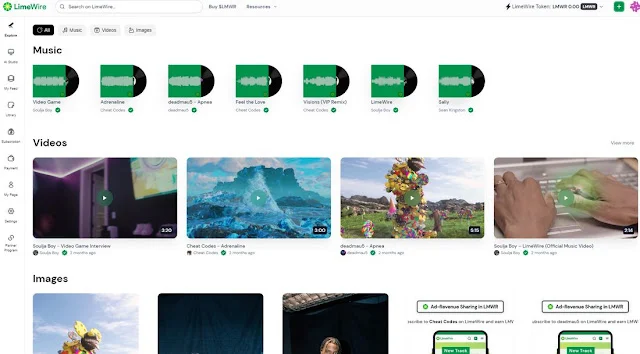
The re-emergence of LimeWire has drawn the attention of the global music and arts community. High-profile artists such as Deadmau5, Soulja Boy, and Sean Kingston have utilized the platform to release exclusive content, signaling a growing acceptance of AI and Web3 tools among established creators.
Industry analysts suggest that LimeWire’s approach could serve as a blueprint for the future of digital rights management. By embedding ownership and monetization into the point of creation, the platform addresses the "value gap" that has plagued digital creators for decades. "The goal is to make content creation and ownership as simple as it was to share files twenty years ago, but within a legal and rewarding framework," noted a spokesperson during a recent technology summit.
However, the platform also faces scrutiny regarding the ethics of AI training data. While LimeWire utilizes established models like DALL-E and Stable Diffusion, the broader conversation regarding how these models were trained remains a point of debate in the artistic community. LimeWire has attempted to mitigate these concerns by focusing on the "Studio" aspect—emphasizing that the AI is a tool for the human creator rather than a replacement for them.
Future Roadmap: Expansion into Music and Video
While image generation is the current focal point, LimeWire’s roadmap includes the imminent rollout of AI-powered music and video generation tools. This expansion is particularly poignant given the brand’s musical heritage. The upcoming music tools are expected to allow users to generate high-fidelity tracks, stems, and loops through text prompts, which can then be minted as NFT audio files.
The video generation tools aim to lower the barrier for entry for independent filmmakers and social media influencers, providing the ability to create short-form cinematic content without the need for expensive production hardware. This evolution toward a "full-stack" AI creative suite positions LimeWire as a direct competitor to both traditional creative software and emerging AI startups.
Conclusion and Broader Implications
The transformation of LimeWire from a peer-to-peer file-sharing service to a regulated, AI-driven creative ecosystem is a testament to the rapid evolution of digital technology. By combining generative AI, blockchain-based ownership, and a transparent revenue-sharing model, LimeWire is attempting to democratize the creative process. It provides a platform where the distance between an idea and a monetizable asset is reduced to a few clicks.
As the platform continues to iterate on its proprietary models and expands into multimedia generation, its success will likely depend on its ability to maintain a vibrant community of creators and navigate the complex intersection of AI ethics and digital property rights. For now, LimeWire stands as a unique case study in brand resurrection and a significant player in the ongoing shift toward a decentralized, AI-augmented creator economy. For creators looking to explore these new frontiers, the platform offers a low-barrier entry point into the future of digital art, music, and video.
About the Author