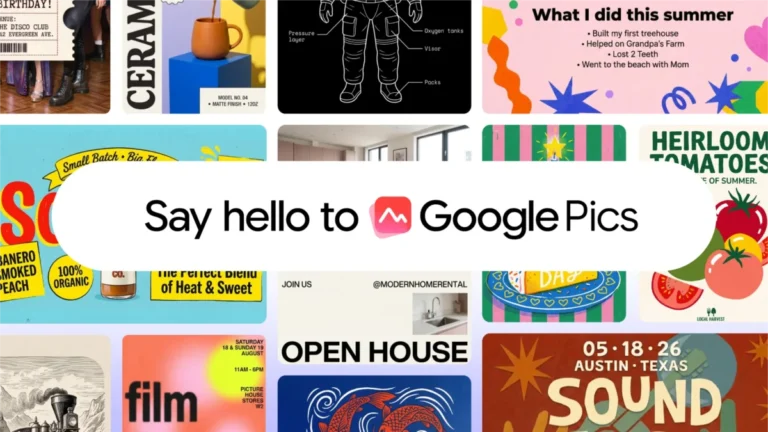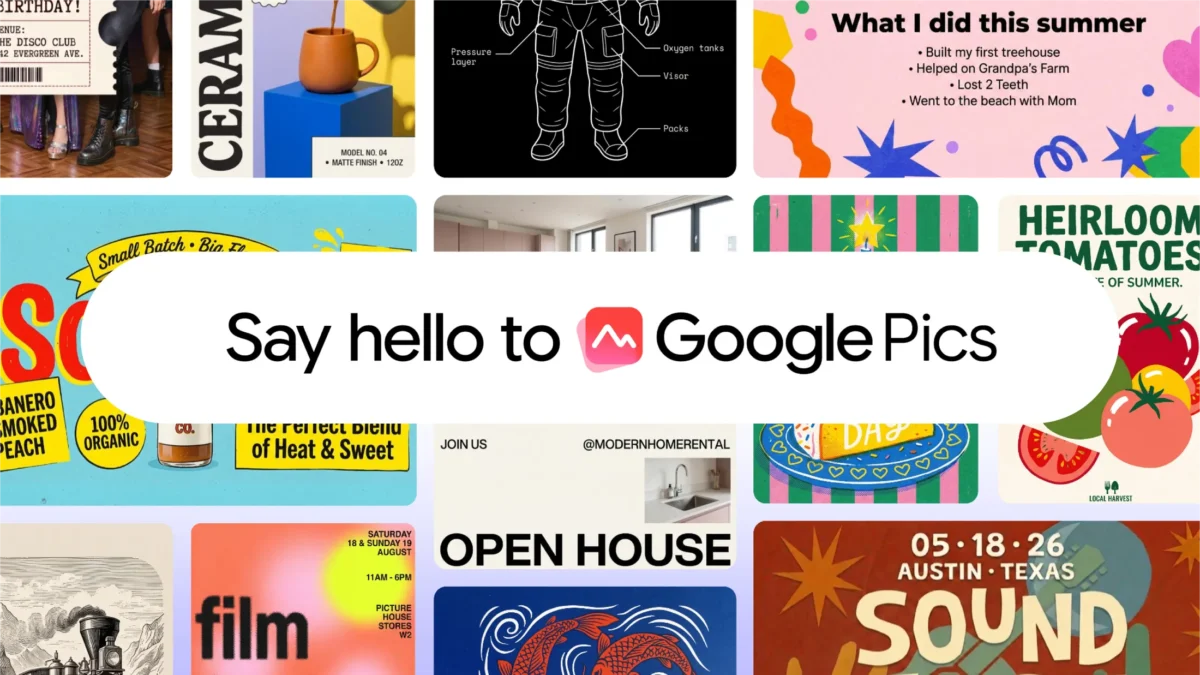
Google is making a significant foray into the burgeoning creative design market with the introduction of Google Pics, an innovative image creation and editing tool. This new offering is set to become an integral part of the Google Workspace suite, targeting business customers and premium Google AI subscribers. The announcement marks a strategic expansion for Google, aiming to democratize visual content creation and enhance productivity within its existing ecosystem.
The technology powering Google Pics is the company’s proprietary Nano Banana image generation model. This advanced AI model is designed to interpret textual prompts and translate them into unique visual assets. The phased rollout of Google Pics will commence in the coming weeks, making it accessible to the majority of Workspace customers and users subscribed to Google AI Pro or Ultra. This strategic integration suggests Google’s intent to leverage its AI prowess to deliver tangible value within its business productivity tools, directly addressing the growing demand for readily available and easily customizable visual content.
Designed to cater to a wide spectrum of user needs, Google Pics aims to streamline everyday design tasks that are common in both professional and personal contexts. The tool is envisioned to assist users in generating a variety of visual materials, including marketing posters, engaging social media posts, and bespoke illustrations. This positions Google Pics as a direct competitor to established players in the user-friendly design space, such as Adobe Express and Canva, both of which have cultivated large user bases by simplifying complex design processes.
However, Google Pics distinguishes itself from its competitors in several key aspects. Unlike Canva, which features a robust marketplace where artists and creators can monetize their work by publishing templates, graphics, and other artistic assets, Google Pics operates on a different paradigm. Its core functionality revolves around AI-driven content generation, where users provide prompts, and the AI creates images based on its training data. While the Nano Banana model is trained on a vast dataset of artistic works, the revenue-sharing or direct monetization model for original artists, as seen in Canva’s marketplace, is not a feature of Google Pics. This distinction highlights Google’s focus on leveraging AI for content creation rather than facilitating a creator economy within the tool itself.
Furthermore, Google Pics differentiates itself from Adobe Express, another prominent design tool often used by creators to develop their work from scratch. While Adobe Express offers a more traditional design environment allowing for granular control and from-scratch creation, Google Pics emphasizes a prompt-based generative approach. Users will interact with the tool by describing their desired image, and the AI will then produce the output. This "prompt-to-create" model is a hallmark of generative AI tools and suggests a workflow focused on rapid ideation and visual concept generation, rather than intricate manual design.
The integration of Google Pics into Google Workspace is a significant strategic move. Initially, the tool will be embedded within Google Docs and Google Slides, with a rollout commencing immediately. Future updates are planned to extend its reach to Google Drive, further embedding its utility across the Workspace ecosystem. This seamless integration means that users will be able to access and utilize Google Pics without needing to navigate to separate applications, thereby enhancing workflow efficiency and encouraging broader adoption.
Beyond its core image generation capabilities, Google Pics incorporates a suite of sophisticated editing tools. These functionalities include the ability to isolate and transform specific objects within an image, modify or translate text embedded in visuals, and generate multiple variations of a requested image. The latter feature is particularly noteworthy, allowing users to explore different AI-generated interpretations of their prompt and select the most suitable option. Collaborative editing support further enhances its utility for team-based projects, aligning with the collaborative nature of Google Workspace.
Background and Market Context
The launch of Google Pics arrives at a pivotal moment in the evolution of digital content creation. Generative AI, particularly in the realm of image generation, has seen explosive growth in recent years. Tools like DALL-E, Midjourney, and Stable Diffusion have captivated the public imagination and demonstrated the immense potential of AI to create novel and complex visual art. This surge in interest has been fueled by advancements in machine learning, particularly in transformer models and diffusion models, which have enabled AI to understand and generate photorealistic and stylized imagery with unprecedented accuracy and creativity.
The market for creative design tools is substantial and continues to expand. Adobe, a long-standing leader in creative software, has been actively integrating AI into its products, notably with Adobe Firefly, its own generative AI model. Canva, known for its user-friendly interface and extensive template library, has also embraced AI features to aid in content creation. Google’s entry into this space, with a tool integrated into its widely adopted Workspace suite, signals a direct challenge to these established players and an intent to capture a significant share of the business and productivity-oriented design market.
The economic implications of generative AI in creative industries are profound. Estimates suggest that AI could automate a significant portion of routine design tasks, freeing up human creators to focus on higher-level conceptualization, strategy, and refinement. For businesses, this translates to potential cost savings and accelerated content production cycles. However, it also raises questions about the future of certain creative roles and the ethical considerations surrounding AI-generated art, including copyright, attribution, and the potential for bias in AI models.
Chronology of Development and Integration
While the specific development timeline for Google Pics and the Nano Banana model has not been publicly disclosed in detail, the announcement follows a period of intense research and development in AI at Google. The company has been a pioneer in AI research for years, with significant breakthroughs in areas like natural language processing and computer vision. The Nano Banana model is likely a culmination of this ongoing work, refined and optimized for image generation tasks.
The integration strategy into Google Workspace suggests a phased approach. The initial rollout to Docs and Slides indicates a focus on applications where visual content is frequently incorporated into documents and presentations. The subsequent expansion to Google Drive will broaden its accessibility for file management and content storage. This strategic phasing allows Google to gather user feedback, refine the tool’s performance, and ensure a smooth user experience before a wider release. The fact that the rollout begins "over the coming weeks" suggests a deliberate and controlled deployment, allowing for technical adjustments and user support.
Supporting Data and Technological Underpinnings
The Nano Banana model is a key technological component of Google Pics. While detailed specifications are scarce, it is understood to be an advanced generative AI model. Generative AI models for image creation typically rely on deep learning architectures, such as Generative Adversarial Networks (GANs) or diffusion models. These models are trained on massive datasets of images and their corresponding textual descriptions, enabling them to learn complex patterns and relationships between words and visual elements.
The ability to "create several different generations of the image" points to the stochastic nature of generative AI, where multiple outputs can be produced from a single prompt, allowing for user selection. The editing features, such as object isolation and text modification, likely leverage Google’s advancements in computer vision and optical character recognition (OCR) technologies. The collaborative editing functionality will be built upon the existing real-time collaboration infrastructure of Google Workspace.
Official Responses and Strategic Vision
While no direct quotes from Google executives were provided in the initial summary, the strategic decision to integrate Google Pics into Workspace and offer it to premium AI subscribers speaks volumes about the company’s vision. This move aligns with Google’s broader strategy to infuse AI capabilities across its product portfolio, from search to cloud services and productivity tools. By making advanced AI accessible within familiar workflows, Google aims to enhance user productivity, foster creativity, and maintain its competitive edge in the rapidly evolving technology landscape.
The emphasis on serving "business customers and premium Google AI subscribers" indicates a targeted approach. This suggests that Google sees a strong business case for AI-powered design tools within corporate environments, where the demand for marketing materials, internal communications, and presentations is constant. The premium tier also signals a commitment to providing advanced AI features to users willing to invest in higher-tier services, potentially creating a new revenue stream for Google.
Broader Impact and Implications
The introduction of Google Pics has several significant implications for various stakeholders:
- For Businesses: Companies can expect to see a reduction in their reliance on external design agencies for routine visual content. The ability to generate on-demand visuals for marketing campaigns, social media, and internal communications can lead to faster turnaround times and cost efficiencies. The collaborative features will further enhance teamwork on visual projects.
- For Individual Users: Professionals and freelancers who regularly create visual content will have a powerful new tool at their disposal. The prompt-based generation can accelerate brainstorming and initial design concepts, while the editing tools offer refinement capabilities.
- For the Creative Industry: The rise of AI-powered design tools presents both opportunities and challenges for artists, designers, and illustrators. While it may automate some tasks, it also opens avenues for new forms of creative expression and collaboration with AI. The ethical debates surrounding AI-generated art and copyright will likely intensify. Google’s approach, while not a direct creator marketplace, relies on AI trained on artists’ work, raising ongoing discussions about fair compensation and attribution in the AI era.
- For Google: This move strengthens Google’s position in the productivity software market and further solidifies its AI leadership. By integrating advanced AI into Workspace, Google can differentiate its offering from competitors and attract new users. It also provides a platform for further AI innovation and monetization.
The success of Google Pics will likely depend on its ability to deliver on its promise of ease of use, quality of output, and seamless integration. As generative AI technology continues to mature, tools like Google Pics are poised to redefine how visual content is created and consumed, ushering in a new era of AI-assisted creativity. The ongoing development and user adoption will be closely watched as Google navigates this competitive and rapidly evolving landscape.
About the Author