The International Chamber of Commerce (ICC) has announced the upcoming release of the 2026 ICC Global Trade Intelligence Report, a comprehensive analysis designed to serve as the definitive benchmark for the global trade and supply chain finance industry. Built upon more than a decade of longitudinal data and an unprecedented repository of over $25.7 trillion in transaction history, the forthcoming report aims to provide financial institutions, policymakers, and corporate entities with actionable insights into risk performance, default rates, and emerging market opportunities. As the global economy navigates a landscape defined by geopolitical shifts, fluctuating interest rates, and the rapid digitalization of commerce, the ICC’s latest intelligence suite is positioned as a critical tool for institutional decision-making and regulatory advocacy.
The ICC Global Trade Intelligence Report, formerly known as the ICC Trade Register, has evolved from a specialized data collection exercise into a sophisticated strategic asset. The 2026 edition continues this evolution, leveraging the combined expertise of the ICC, the Boston Consulting Group (BCG), and Global Credit Data (GCD). By aggregating data from 22 of the world’s leading global banks, the report offers a granular view of the credit risk associated with trade finance products, which have historically demonstrated significantly lower default rates compared to traditional corporate lending. This data is instrumental for banks seeking to optimize capital allocation and meet the stringent requirements of international regulatory frameworks, such as the Basel III and Basel IV accords.
The Evolution of Trade Finance Intelligence
The origins of the ICC’s data initiatives trace back to the aftermath of the 2008 financial crisis. At that time, the global banking community recognized a significant gap in objective, industry-wide data regarding the safety and reliability of trade finance instruments. Regulators often treated trade finance—which includes products like Letters of Credit (LCs), Guarantees, and Supply Chain Finance (SCF)—with the same risk weighting as more volatile commercial loans. The ICC Trade Register was established to prove the "low-risk" nature of trade finance, providing empirical evidence that these instruments are typically self-liquidating and backed by physical goods.
Over the last ten years, the project has expanded its scope. What began as a defensive regulatory tool has transformed into a proactive intelligence platform. The rebranding to the "Global Trade Intelligence Report" reflects a shift toward providing forward-looking analysis. The 2026 report is expected to delve deeper into the nuances of regional trade corridors, the impact of ESG (Environmental, Social, and Governance) criteria on lending, and the performance of trade assets during periods of high inflation and supply chain disruption.
Data Foundation and Strategic Partnerships
The integrity of the 2026 report rests on its robust data foundation. The $25.7 trillion in transactions analyzed represents a significant portion of total global trade, offering a statistically significant sample size that covers diverse geographies and industrial sectors. This massive dataset allows for the calculation of Probability of Default (PD) and Loss Given Default (LGD) with high degrees of precision.
The strategic partnership between the ICC, BCG, and GCD ensures that the data is not only accurate but also analyzed through a lens of high-level management consulting and advanced credit modeling. Global Credit Data, a non-profit association owned by 55 member banks, provides the technical infrastructure for data pooling and quality control. Meanwhile, the Boston Consulting Group contributes the macroeconomic context and strategic interpretation, helping users understand how micro-level transaction data reflects broader global economic trends.
For the 2026 release, the ICC has emphasized that the report will be delivered in a multi-faceted format. The "complete package" will include a Global Overview Report, which outlines high-level trends and systemic risks; regional data analyses that focus on specific economic zones like the Asia-Pacific, EMEA, and the Americas; and product-specific reports. These product-specific insights are particularly valuable for banks looking to refine their strategies in specialized areas such as Export Finance or Standby Letters of Credit.
Key Focus Areas for the 2026 Edition
The upcoming report is expected to address several critical themes that have emerged in the mid-2020s. Chief among these is the resilience of trade finance in the face of "de-risking" and "friend-shoring." As multinational corporations shift their supply chains away from traditional hubs to more geopolitically aligned regions, the ICC report will provide the data necessary to evaluate the risk profiles of these new corridors.
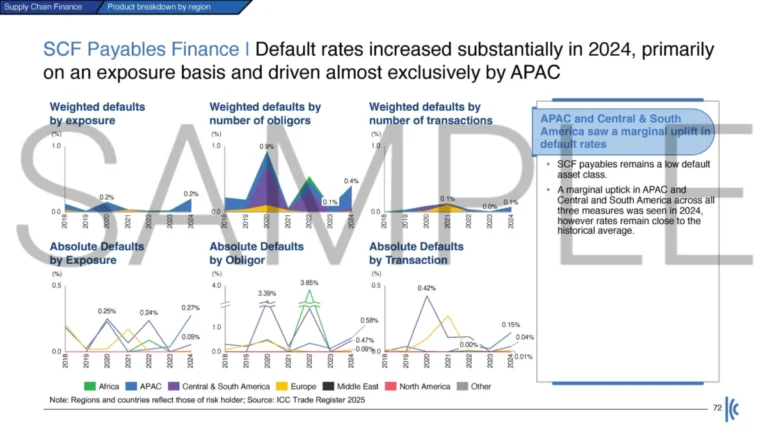
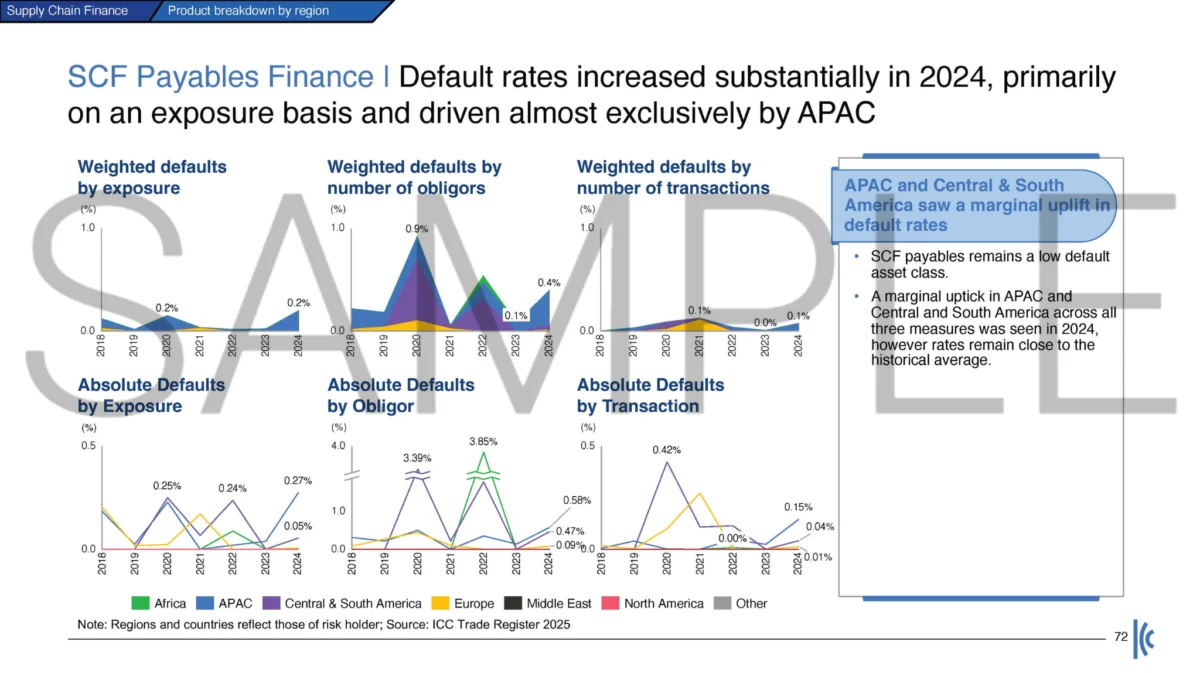
Furthermore, the 2026 report will likely provide an updated look at the performance of Supply Chain Finance (SCF). While SCF has seen explosive growth over the last decade, it has also faced scrutiny regarding transparency and accounting standards. By providing objective default data on SCF programs, the ICC helps stabilize market perceptions and encourages best practices among lenders.
Another significant area of interest is the digitalization of trade documents. As the industry moves toward Electronic Bills of Lading (eBLs) and digital trade platforms, the ICC Global Trade Intelligence Report will begin to reflect how these technological shifts impact operational risk and fraud mitigation. Although the core of the report remains credit risk, the intersection of technology and risk performance is becoming an unavoidable topic for the banking sector.
Membership and Collaborative Governance
The ICC Global Trade Intelligence Report is unique because it is a "by the industry, for the industry" initiative. The 22 member banks that contribute data are not merely passive observers; they are active participants in a consortium that shapes the methodology and scope of the research. This collaborative model ensures that the intelligence produced is relevant to the real-world challenges faced by trade finance practitioners.
Membership in the ICC Global Trade Intelligence project offers several advantages. Participating banks gain access to an exclusive benchmarking tool that allows them to compare their own portfolio performance against global and regional averages. This is vital for internal risk management and for justifying credit limits to board-level committees. Additionally, members have a "seat at the table" during discussions with global regulators, using the report’s findings to advocate for fair capital treatment of trade finance assets.
For non-bank corporations and service providers, the ICC offers sponsorship opportunities. These partnerships allow organizations to increase their visibility within the global banking community and align their brands with the industry’s most respected source of trade data. The ICC has noted that the report serves as an ideal platform for institutions looking to demonstrate their commitment to transparency and data-driven decision-making.
Implications for Global Trade and Economic Stability
The release of the 2026 report comes at a time when trade finance is increasingly viewed as a pillar of global economic stability. According to the World Trade Organization (WTO), up to 80% of global trade relies on some form of financing or credit insurance. Without a stable and well-capitalized trade finance sector, the movement of essential goods—including food, medicine, and energy—could be severely hampered.
By providing a clear, data-backed picture of trade finance risk, the ICC report helps prevent "liquidity crunches." When banks have access to reliable default data, they are less likely to pull back from markets during times of uncertainty. Instead, they can make informed decisions based on historical performance rather than speculative fear. This is particularly important for Small and Medium-sized Enterprises (SMEs) in emerging markets, who are often the first to lose access to credit when global banks reduce their risk appetite.
Industry analysts suggest that the 2026 report will reinforce the narrative that trade finance is an "all-weather" asset class. Even during the height of the COVID-19 pandemic and the subsequent inflationary period, trade finance defaults remained remarkably low compared to other asset classes. The ICC’s ongoing documentation of this trend is essential for attracting institutional investors—such as pension funds and insurance companies—into the trade finance space, thereby narrowing the "global trade finance gap," which currently stands at an estimated $2.5 trillion.
Timeline and Access
While the full 2026 report is "coming soon," the ICC has opened channels for early interest and membership inquiries. The publication schedule typically involves a phased rollout, beginning with the Global Overview followed by the deep-dive regional and product modules. Financial institutions looking to join the consortium or purchase the report are encouraged to engage with the ICC’s experts to understand how the data can be tailored to their specific strategic needs.
The ICC Global Trade Intelligence Report 2026 represents more than just a collection of statistics; it is a testament to the power of industry collaboration. In an era where data is often siloed and fragmented, the ICC’s ability to aggregate information from 22 global competitors into a single, cohesive intelligence suite is a significant achievement. As the world moves toward 2026, the global trade community will be watching closely, ready to use these insights to navigate the complexities of international commerce and build a more resilient financial future.
About the Author