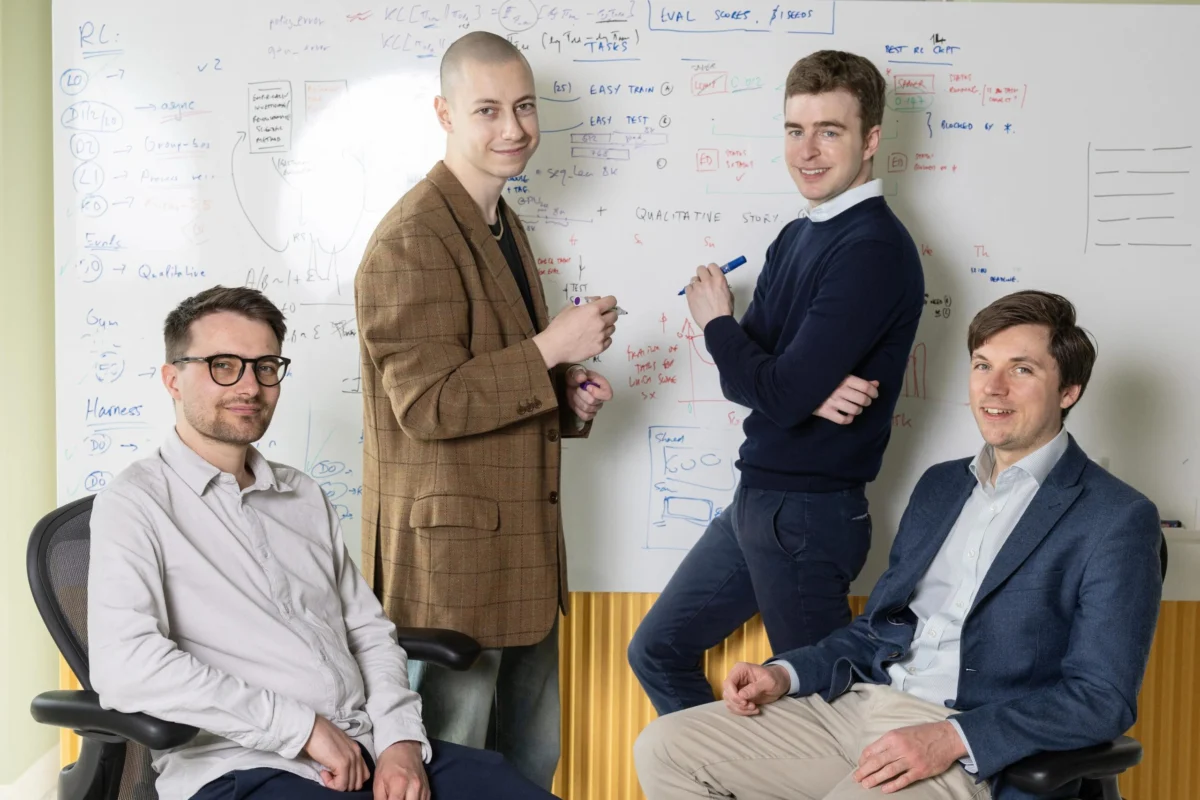
Inherent, a London-based artificial intelligence laboratory founded by alumni of the renowned Google DeepMind, has announced a significant achievement with its newly developed AI agent, Faraday. The company claims that Faraday has demonstrably outperformed much larger and more established AI models from industry giants Anthropic and OpenAI in the critical task of independently reproducing the findings of published scientific papers. This breakthrough, achieved with a comparatively smaller AI model, suggests a potential paradigm shift in the efficiency and capability of AI in scientific research.
The revelation comes shortly after Inherent emerged from stealth mode, having secured a substantial $50 million in seed funding. While many startups founded by former DeepMind researchers have garnered considerable attention, Inherent has, until recently, operated with a lower public profile. However, the team’s recent unveiling of Faraday’s capabilities signals a deliberate shift towards showcasing tangible progress in a field often characterized by ambitious pronouncements but limited concrete deliverables from emerging players.
Faraday’s Scientific Prowess: Beyond Verification
Faraday’s core function, as demonstrated, is the ability to autonomously replicate the results presented in scientific publications. This capability, according to Inherent’s co-founder and chief scientist Edward Hughes, serves as a foundational training exercise for human scientists, akin to a doctoral student’s initial research endeavors. “Many PhD students actually start by doing this,” Hughes explained, highlighting the inherent complexity and intellectual rigor involved in accurately reproducing scientific findings.
While the ability to verify existing research might appear to be a precursor to Inherent’s ultimate ambition – the development of AI capable of generating novel scientific knowledge – Hughes emphasized that the significance lies not merely in the outcome, but in the methodology. “What was most interesting to us about this was not so much the result of beating those frontier agents – which of course we liked – but was actually the way we went about building this,” he stated. This focus on the underlying architecture and training process underscores Inherent’s belief in a more efficient and scalable approach to AI development.
A Comparative Leap in Efficiency: Size vs. Performance
The most striking aspect of Inherent’s announcement is the stark contrast in model size between Faraday and its competitors. Faraday operates on Qwen 3.6, a model comprising a mere 27 billion parameters. This stands in sharp contrast to the significantly larger, frontier-scale systems against which it was benchmarked: Anthropic’s Claude Opus 4.8 and OpenAI’s GPT-5.5. The number of parameters in an AI model is a widely accepted proxy for its size, computational requirements, and associated training costs.
Inherent’s benchmark for success extended beyond mere accuracy in replication. The company sought to imbue Faraday with what Hughes termed "research taste" – an intuitive understanding of which experiments are worth pursuing and how to meticulously design them. This abstract quality, often developed through years of human scientific experience, poses a significant challenge for AI development.
Reinforcement Learning: The Key to Cultivating "Taste"
To address the intangible nature of "research taste," Inherent has heavily leveraged reinforcement learning (RL). Unlike traditional supervised learning methods that explicitly define rules, RL trains AI systems by rewarding desirable outcomes. This approach allows the AI to learn through trial and error, adapting its strategies based on feedback. Inherent’s decision to prioritize RL over extensively training its agents on the mechanics of scientific conduct suggests a strategic bet on the generalizability of this reward-based learning paradigm. This, the company believes, will better equip its agents to contribute across a diverse spectrum of scientific disciplines in the future.
“We’re always guided by that north star of building an AI scientist agent and imbuing our agents with taste,” Hughes reiterated. This guiding principle has also informed Inherent’s strategic decisions regarding tool development. Instead of building its own proprietary coding tools, Faraday was designed to utilize existing resources, such as OpenAI’s GPT-5.5 Codex. This mirrors the real-world practice of human scientists who rely on established software and tools rather than reinventing every component from scratch.
A Collaborative Ethos: Beyond Mere Information Retrieval
Inherent’s vision for its AI agents extends to fostering a spirit of genuine scientific inquiry, rather than simply providing answers. Hughes articulated this by drawing a parallel to his ideal colleague: one who proactively explores new avenues of research and presents novel findings for discussion. This collaborative instinct is not confined to the AI’s operational framework; it is deeply embedded in Inherent’s own corporate culture.
The company currently comprises a team of approximately a dozen employees, all working collaboratively in person at their King’s Cross office in London. This neighborhood, once considered underdeveloped, has transformed into a vibrant global AI hub, partly due to the presence of Google DeepMind. "We believe that London is the place to be," Hughes asserted, underscoring the strategic importance of the city’s burgeoning AI ecosystem.
Navigating the Talent Landscape: The Garden Leave Debate
While bullish on London’s AI talent density, Hughes has also voiced his support for ending the practice of "garden leave." This U.K.-specific employment convention restricts departing employees from joining or establishing rival companies for a period following their resignation. This contrasts with the more fluid talent mobility observed in the United States, where such restrictions are less common and can provide U.S. startups with a distinct advantage in recruiting experienced AI professionals. "This is a personal view rather than a company view, but I was affected by the garden leave problem," Hughes candidly shared.
Despite personal encounters with such restrictions, Hughes, alongside two other DeepMind alumni and a fourth co-founder, successfully established Inherent. The company is actively expanding its team, with plans to grow its headcount to between 20 and 25 individuals by the end of the year. As Inherent pursues its ambitious goals in areas such as "world models" – a sophisticated type of AI capable of understanding and predicting complex systems – and amidst a period of transition for some DeepMind personnel following Demis Hassabis’s new role, Inherent presents a potentially attractive destination for DeepMind employees considering career moves.
The Broader Implications for Scientific Discovery
The implications of Inherent’s advancements are far-reaching. The ability for AI to independently replicate scientific findings with greater efficiency and smaller model footprints could democratize access to advanced research tools. This could accelerate the pace of scientific discovery by enabling researchers, particularly those in academic institutions with limited resources, to validate and build upon existing work more rapidly.
Furthermore, the development of AI agents possessing "research taste" could fundamentally alter the landscape of scientific innovation. Such agents might identify novel research pathways, propose groundbreaking experiments, and even contribute to the formulation of new scientific theories, acting as genuine collaborators rather than mere computational assistants. This potential for AI to transcend its current role as a tool and evolve into a proactive participant in the scientific process marks a significant milestone.
The success of Faraday also highlights a potential trend towards developing more specialized and efficient AI models, rather than exclusively pursuing larger, general-purpose architectures. This approach could lead to more sustainable AI development, reducing the significant energy and computational resources currently required to train and operate frontier models.
A DeepMind Legacy: Building the Future of AI Science
Inherent’s origins within the Google DeepMind ecosystem provide a strong foundation for its ambitious goals. The collective expertise of its founding team, honed at one of the world’s leading AI research institutions, positions the company to tackle some of the most complex challenges in artificial intelligence. Their focus on developing AI that can contribute meaningfully to scientific progress represents a direct continuation of the spirit of innovation that characterized their time at DeepMind.
The company’s commitment to in-person collaboration and its strategic location within London’s burgeoning AI hub further underscore its deliberate approach to building a strong, cohesive team capable of executing its long-term vision. As Inherent continues to develop its AI scientists, the scientific community will undoubtedly be watching closely to see if these agents can indeed unlock new frontiers of knowledge and usher in a new era of discovery. The journey from replicating known science to discovering the unknown is a monumental one, and Inherent’s early success with Faraday suggests they are well on their way.
About the Author