The evolution of online search has fundamentally altered how consumers discover and evaluate brands, moving beyond traditional keyword rankings and organic traffic metrics. In this new paradigm, AI-powered answer engines like ChatGPT, Perplexity, and Gemini are increasingly becoming the initial touchpoints for buyer journeys. Recognizing this seismic shift, marketing teams are seeking advanced AI visibility platforms that offer more than just monitoring. These platforms, often referred to as AI Overviews Optimization (AEO) or Generative Engine Optimization (GEO) tools, are designed to help marketers identify and close citation gaps, connect AI search data to CRM attribution, and manage campaigns across diverse regions and content workflows. As Peec AI has established itself in this emerging market, a competitive landscape of alternatives is solidifying, each offering distinct strengths for different marketing needs in 2026.
This comprehensive analysis delves into the leading Peec AI alternatives, evaluating their capabilities beyond basic monitoring and providing a framework for marketers to build a technology stack that transforms AI visibility into tangible revenue. The urgency for such tools stems from the observable change in consumer behavior: instead of performing traditional searches, buyers are now prompting AI chatbots for product recommendations, seeking synthesized information before ever visiting a vendor website. While Peec AI excels at tracking this emerging visibility and monitoring brand presence within AI-generated responses, the limitations become apparent when teams need to act on these insights and directly link them to measurable pipeline growth.
The Rise of AI Visibility Monitoring
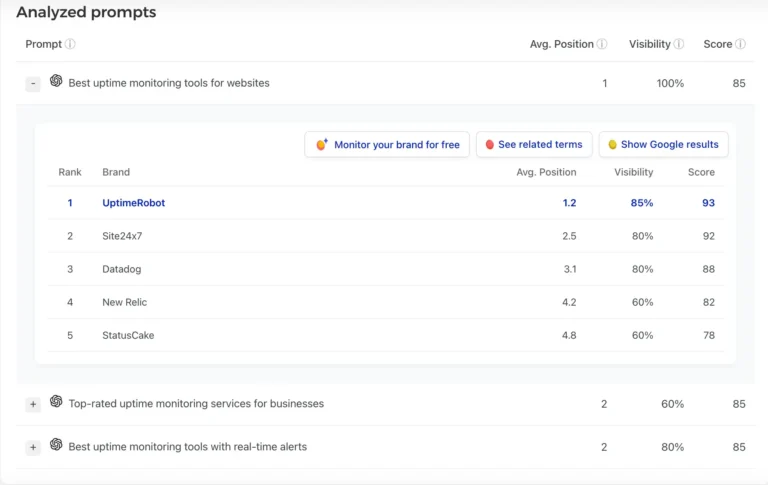
AI visibility monitoring, also known as AI brand monitoring, is the practice of tracking how frequently and favorably a brand appears within responses generated by AI answer engines. This differs significantly from traditional search engine optimization (SEO). While classic rank tracking focuses on a page’s position within a search engine results page (SERP) for a specific keyword, AI visibility monitoring assesses whether an AI system has incorporated a brand into its synthesized answer. Crucially, it also identifies which sources the AI cited to arrive at its conclusion and how competitors are positioned within the same response.
The mechanics of AI visibility monitoring involve running structured prompts that mirror real buyer intent across multiple AI platforms and meticulously recording the resulting answers. This generates a share-of-voice metric for AI-generated responses, rather than a simple ranking position. This fundamental difference necessitates a nuanced approach when evaluating tools in this space, moving beyond direct comparisons to traditional SEO rank trackers.
A key strategic advantage of AI visibility monitoring lies in citation analysis. If an AI engine, when asked for the "best CRM for mid-market B2B teams," recommends a competitor over a specific brand, marketers can reverse-engineer the reasoning. By identifying the sources the AI consulted—whether third-party reviews, comparison pages, or documentation—content and SEO teams gain a prioritized list of areas for strategic investment. This process reshapes the understanding of digital authority, shifting focus from mere traffic generation to the strategic influence within AI-driven information synthesis.
Peec AI: Strengths and Limitations in the Evolving Market
Peec AI has made notable contributions to the AI visibility landscape. The platform effectively tracks brand mentions, sentiment, and citation presence across a range of popular AI models, including ChatGPT, Gemini, and Claude. It distinguishes between different AI functionalities, such as Google AI Overviews and Google AI Mode, providing more accurate reporting than some competitors that may conflate these distinct metrics. Peec AI’s "Actions" feature also offers prioritized recommendations, simplifying the interpretation of raw data for marketing teams. For global brands and multilingual content teams, its per-country and per-language tracking capabilities are particularly strong.
However, Peec AI’s current architecture presents several limitations that are driving the demand for alternative solutions. Firstly, the platform excels at identifying gaps but lacks robust remediation capabilities. It does not actively assist in closing these identified citation gaps by generating briefs, drafting copy, or automating publishing workflows, placing the entire burden of content creation on the marketing team, which can be a significant constraint for those with limited bandwidth.
-1.png)
Secondly, Peec AI falls short in attribution. It lacks native CRM integration, meaning visibility data remains siloed within its dashboard. Connecting this data to pipeline, revenue, or overall campaign performance requires considerable manual effort, including exporting data, building attribution models in separate systems, and maintaining these integrations over time. This absence of seamless CRM connectivity is a significant hurdle for RevOps-focused teams aiming to quantify the revenue impact of AI visibility efforts.
A third limitation is the absence of historical data backfill. Tracking commences only upon signing up, preventing users from benchmarking against prior performance or understanding their AI visibility trends before the paid subscription began. Finally, while Peec AI covers popular AI models, its platform coverage may not encompass all emerging answer surfaces. Furthermore, its prompt methodology relies on AI-generated queries rather than actual user prompts, a distinction that can impact the accuracy of the data.
These limitations highlight the critical need for solutions that not only monitor but also enable action, provide attribution, and offer comprehensive insights. The market in 2026 is responding with a diverse array of tools designed to address these specific shortcomings.
Top Peec AI Alternatives for 2026: A Comparative Analysis
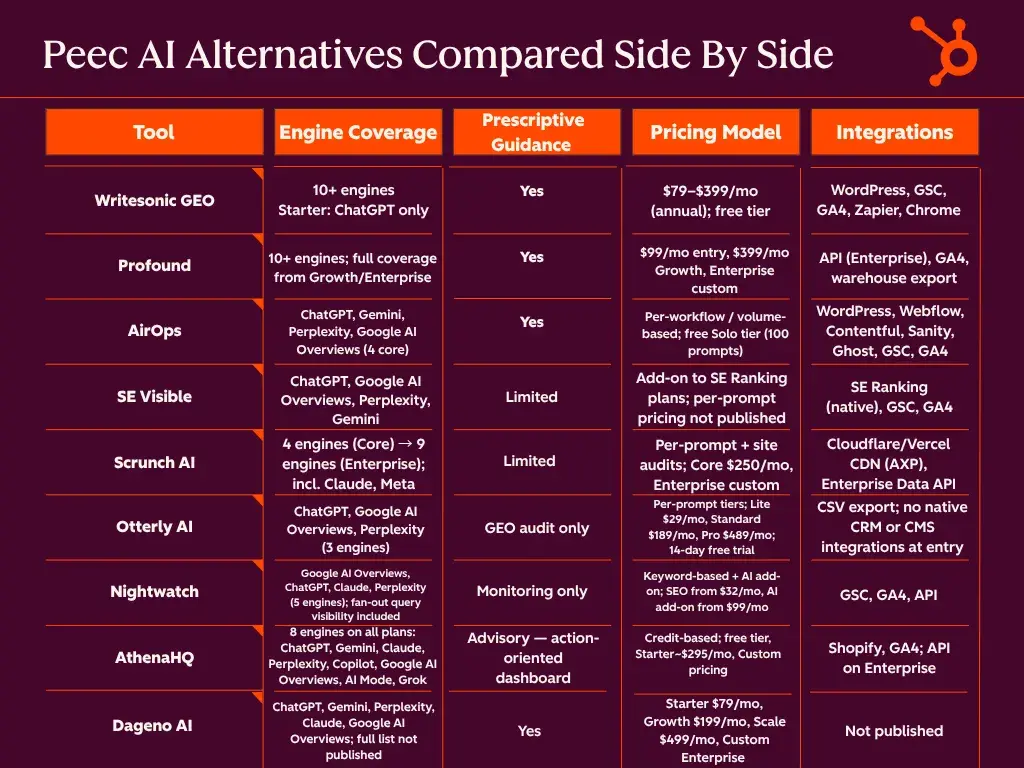
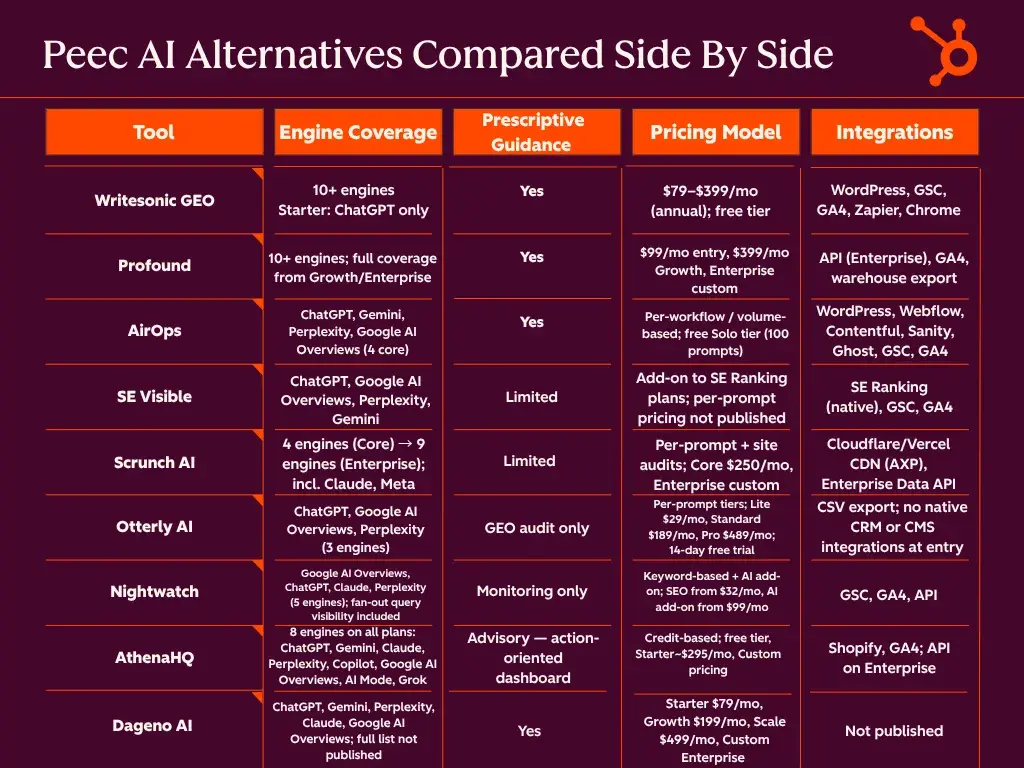
The following platforms have emerged as the strongest contenders, each offering unique value propositions that extend beyond basic AI visibility monitoring:
1. Writesonic GEO: Best for Prescriptive Optimization
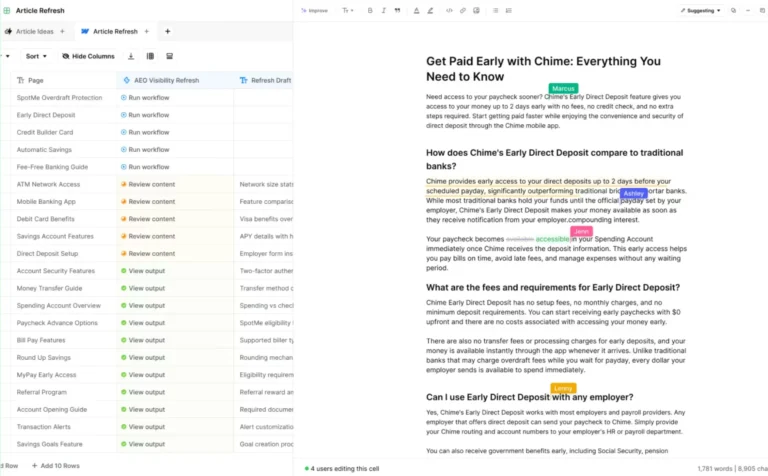
Writesonic GEO stands out as a nearly end-to-end AEO/GEO platform. It combines AI visibility tracking with actionable insights and content creation capabilities. When a citation gap is identified, teams can immediately leverage Writesonic’s tools to brief and generate the necessary content without switching to separate applications. This integrated approach, combining monitoring with creation, offers a compounding advantage over time.
Key Strengths: Seamless integration between visibility data and content generation.
Limitations: The monitoring layer is newer compared to dedicated tracking tools; engine coverage can be narrower on entry-level plans.
Pricing: Starts at approximately $79/month, offering a competitive price point for combined writing and monitoring features.
2. Profound: Best for Enterprise Security and Compliance
Profound is tailored for enterprise marketing teams, large agencies, and organizations where AI recommendations directly impact revenue. It offers a comprehensive feature set, including brand mention tracking, citation analysis, sentiment monitoring, and prompt volume data across over 10 AI platforms. Its "Agents" feature enables the creation of AEO-optimized content at scale, with a human-in-the-loop review process. Profound boasts an extensive dataset of over 1.5 billion real user prompts, providing unparalleled credibility.
Key Strengths: Robust measurement credibility, significant content execution capacity, and enterprise-grade security features like SSO and role-based access.
Limitations: The Growth plan, starting at $399/month, is necessary for full functionality, making it a significant investment and potentially overkill for smaller teams.
Pricing: Growth plan at $399/month.
3. AirOps: Best for Agencies and Multi-site Teams
AirOps is a content operations platform that integrates AEO research and visibility analysis. Its "AirOps Insights" tracks citation and mention rates, along with sentiment, across popular answer engines. "Page360" links this visibility data to Google Search Console and GA4. Crucially, its "Quill" feature, part of the "Playbooks" functionality, can research, draft, and publish content directly to various CMS platforms like Webflow, WordPress, and Contentful.

Key Strengths: Streamlined agency workflows with templated and reusable "Playbooks," connecting insights directly to publishing in a single workflow.
Limitations: Tracking depth is less mature than dedicated monitoring tools; may be more than needed for teams focused solely on measurement.
Pricing: Offers a free entry tier, with paid plans scaling based on volume and workflow complexity.
4. SE Visible (by SE Ranking): Best for Multi-engine Coverage
SE Visible integrates AI overview tracking into the existing SE Ranking ecosystem, providing a unified view of both traditional SEO and AI visibility. This is particularly advantageous for teams already utilizing SE Ranking, as it avoids the need for a separate subscription. It offers unlimited seats on all plans, making it accessible for entire marketing teams without escalating costs.
Key Strengths: Unified SEO and AEO view, historical SEO context for comparative benchmarking, and unlimited seats.
Limitations: AI visibility data is a relatively new addition compared to SE Ranking’s core SEO functionality.
Pricing: Included as part of SE Ranking plans.
5. Scrunch AI: Best for AI Crawler Analytics
Scrunch AI targets the enterprise market, offering standard brand visibility tracking alongside advanced AI crawler analytics. This feature reveals how AI bots and agents interact with a website before constructing their answers, providing a deeper diagnostic capability. Its "Agent Experience Platform" (AXP) can serve AI-optimized content to AI agents without impacting the human-facing website.
Key Strengths: AI crawler analytics for understanding how AI "reads" a site; valuable for technical SEO teams.
Limitations: The Core plan starts at $250/month, a significant entry point; content generation capabilities are less developed than some competitors.
Pricing: Core plan at $250/month; Enterprise is custom; offers a seven-day free trial.
6. Otterly AI: Best for Low-Cost Entry
Otterly AI is positioned as the most affordable credible entry point in the AEO category, starting at $29/month. It tracks brand mentions and citations across multiple answer engines and includes a GEO audit feature that evaluates over 25 on-page factors, providing actionable checklists.
Key Strengths: Excellent price-to-functionality ratio for startups and SMBs; provides a real monitoring capability at an accessible price point.
Limitations: Narrower engine coverage compared to top-tier tools; no CRM integrations at entry-level prices.
Pricing: Lite at $29/month, Standard at $189/month, Pro at $989/month; offers a 14-day free trial.
7. Nightwatch: Best for Understanding AI Reasoning
Nightwatch offers a unique perspective by providing "fan-out query visibility," revealing the real-time web searches AI systems perform before composing answers. This allows marketers to understand the underlying AI reasoning process and the specific sources being consulted, offering a deeper diagnostic capability than simply viewing the output.
Key Strengths: Fan-out query visibility for understanding "why" citations are missing, not just "that" they are missing.
Limitations: Narrower engine coverage; AI tracking is an add-on to its core SEO monitoring, which can feel fragmented.
Pricing: Base SEO from $32/month; AI tracking add-on from $99/month.
8. AthenaHQ: Best for Budget-Conscious Teams
AthenaHQ provides a free entry point, making it ideal for early-stage programs or teams needing to build a business case for AEO investment. It functions as a brand intelligence tool with AI visibility capabilities, covering mentions, citations, and competitive share of voice.
Key Strengths: Low-friction entry point for demonstrating value before budget approval; allows for building a case with real data.
Limitations: Lacks auditing and optimization capabilities; limited enterprise-grade security features.
Pricing: Credit-based, with a free tier; Starter ~$295/mo.
9. Dageno AI: Best for Full-Workflow GEO Execution
Dageno AI is a newer entrant with an ambitious scope, aiming to provide a full workflow from data monitoring and strategy to content generation and attribution, all within a single platform at a competitive price point. It seeks to bridge the gap between identifying visibility issues and actively closing them.
Key Strengths: Focus on the attribution layer, attempting to connect content actions to visibility outcomes and demonstrate ROI.
Limitations: Early-stage platform, with the depth of each capability still under development; requires verification of feature maturity.
Pricing: Starter $79/mo, Growth $199/mo, Scale $499/mo.
Choosing the Right Tool: A Strategic Framework
The selection of a Peec AI alternative hinges on a team’s specific needs and current limitations. A decision tree can guide this process:
- Content Production Bottlenecks: For teams struggling with content creation, Writesonic GEO or AirOps offer integrated solutions that link monitoring to creation.
- Enterprise Requirements: Organizations prioritizing security, compliance, and executive reporting should consider Profound for its robust enterprise features and data credibility.
- Existing SEO Tools: Teams already invested in SE Ranking will find SE Visible a natural and efficient extension.
- Agency or Multi-brand Management: AirOps excels in content operations scale for agencies, while Scrunch AI is ideal if technical AEO and crawler analytics are key service offerings.
- Budget Constraints: For teams operating under tight budgets, Otterly AI or AthenaHQ provide valuable starting points for measurement.
- Understanding AI Decision-Making: If the goal is to deeply understand the AI’s reasoning process behind citations, Nightwatch‘s fan-out query visibility is invaluable.
Connecting AI Visibility to Revenue: The CRM Imperative
Ultimately, the true value of AI visibility monitoring lies in its ability to drive revenue. This requires integrating the data into a robust attribution model. Key steps include:
- Tagging AI-Sourced Traffic: Implementing dedicated UTM parameters for AI-referred campaigns and configuring analytics platforms like GA4 and HubSpot to capture AI-sourced traffic, which often appears as "direct" traffic due to inconsistent referrer data.
- Standardizing Tracking: Establishing a consistent UTM taxonomy across all AEO/GEO initiatives ensures a clear line from identified visibility gaps to content published and leads generated.
- CRM Integration: Utilizing custom contact and deal properties within CRM systems like HubSpot to tag leads and deals influenced by AI visibility efforts. This allows for pipeline reporting filtered by AI-sourced origins, fundamentally changing the conversation around AEO tool budgets.
Best Practices for Maximizing Tool ROI
Beyond tool selection, implementing effective AEO and GEO best practices is crucial for success:
- Query Clustering and Intent Mapping: Grouping prompts by intent (navigational, informational, commercial investigation) to prioritize high-value citations.
- Entity and Schema Hygiene: Ensuring clear and consistent representation of brands, products, and personnel in structured data to aid AI entity resolution.
- Answer-First Content Structure: Prioritizing direct answers to queries at the beginning of content to enhance utility for AI systems.
- Comparison and Alternative Formats: Creating pages that directly compare products or services, as these consistently generate higher citation rates.
- Testing and Refresh Cadence: Regularly refreshing key content to maintain citation relevance as AI training data evolves.
- Validating with Owned Data: Cross-referencing AI visibility tool data with GA4, Search Console, and CRM data to ensure accuracy and identify discrepancies in prompt methodology.
The strategic adoption of AI visibility platforms, coupled with robust attribution models and best practices, is no longer a niche marketing tactic but a fundamental requirement for brands seeking to thrive in the evolving digital landscape. As AI continues to shape consumer discovery, marketers must adapt their measurement and execution strategies accordingly.
About the Author