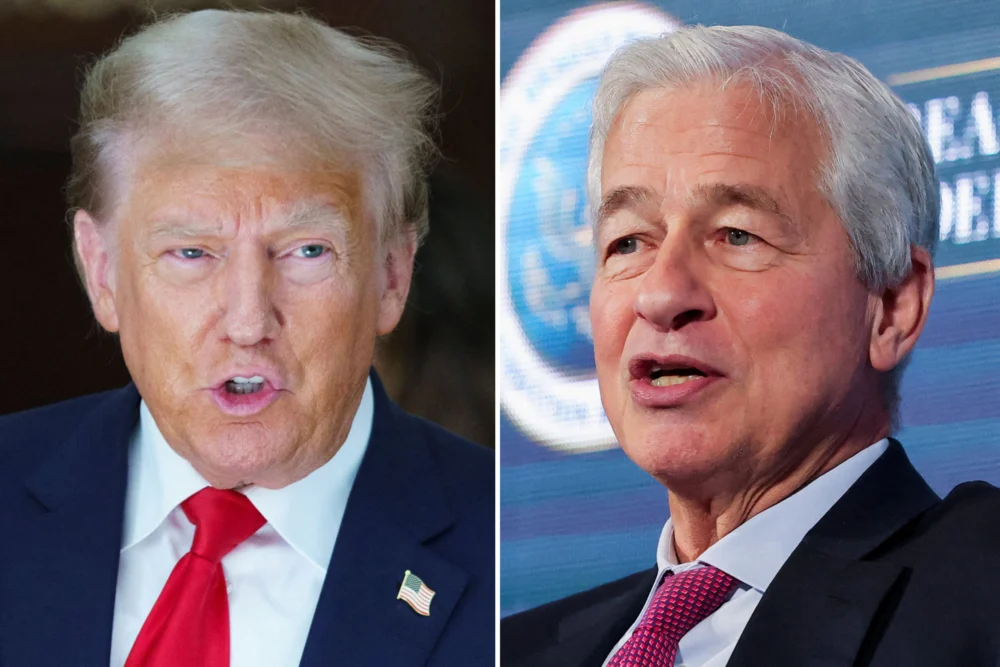
JPMorgan Chase CEO Jamie Dimon recently addressed the high-profile lawsuit filed by former President Donald Trump, acknowledging Trump’s palpable anger over the shuttering of his accounts while firmly asserting that the bank’s actions were without legal fault. Speaking on the sidelines of a JPMorgan conference in Miami, Dimon told CNBC’s Leslie Picker that while the $5 billion damages claim lacked merit, he could empathize with the former president’s frustration. This intricate legal and public relations challenge places one of the financial industry’s most prominent figures in a delicate balancing act, navigating the complexities of regulatory compliance, reputational risk, and a highly charged political landscape.
The Genesis of the Dispute: Allegations of Political Discrimination
At the heart of the contentious lawsuit is Donald Trump’s accusation that JPMorgan Chase, along with other financial institutions, closed his accounts for politically motivated reasons. This claim resonates with a broader narrative among some conservative circles, which allege a pattern of discrimination by financial services against individuals and entities deemed politically disfavored. Trump’s legal team contends that these closures amount to an unlawful attempt to silence or inconvenience him, seeking a staggering $5 billion in compensation for the alleged damages. The lawsuit represents a significant escalation in Trump’s post-presidency campaign against what he perceives as targeted attacks from various sectors, including media outlets, regulatory bodies, and now, major banks.
The former president’s legal offensive against financial institutions began in earnest following his departure from office. Beyond JPMorgan Chase, Trump and his associated companies have reportedly pursued similar claims against other banks, including Capital One, alleging a coordinated effort to "debank" him and his organizations. These actions form part of a wider strategy that has seen Trump initiate lawsuits against media organizations for alleged defamation and even the Internal Revenue Service over the purported leak of his tax information, underscoring a persistent legal posture aimed at combating perceived adversaries across multiple fronts.
Dimon’s Defense: The Imperative of Regulatory Compliance and Reputational Risk
Jamie Dimon’s defense of JPMorgan Chase’s actions hinges on the formidable weight of regulatory obligations and the pervasive threat of reputational risk that banks constantly confront. "The case has no merit," Dimon stated unequivocally, before adding a nuanced layer of understanding: "But I agree with them. They have the right to be angry. I’d be angry, too. Like, why is a bank allowed to do that?" His rhetorical question immediately led to his answer: banks are frequently "forced" into such decisions to comply with an intricate web of regulatory mandates.
Dimon elaborated that banks operate under constant scrutiny from regulators, who possess the authority to levy substantial penalties for non-compliance. These penalties extend beyond direct violations of specific statutes and encompass situations where a bank is perceived to be exposed to undue "reputational risk." This concept, while not always explicitly codified as a single law, is a critical component of the regulatory framework governing financial institutions. Regulators expect banks to maintain sound risk management practices, and associating with clients who could generate negative publicity, invite regulatory enforcement actions, or become embroiled in controversies can be deemed a significant reputational hazard.
"We debank people because it causes legal, regulatory risk for us," Dimon explained. "It’s been much easier for a bank to say, ‘I’m not taking the risk, let them go bank elsewhere.’" This statement encapsulates a prevalent sentiment within the banking industry, where the cost of managing perceived risk, both financial and reputational, often outweighs the benefits of retaining certain high-profile or controversial clients. The potential for heavy fines, consent orders, increased compliance costs, and damage to public trust makes banks inherently risk-averse, particularly when dealing with entities that could draw unwanted attention from government agencies or the media.
A Chronology of Events: From January 6th to Legal Battles
Understanding the context of JPMorgan’s decision to close Donald Trump’s accounts requires a brief timeline of key events, particularly surrounding the tumultuous period of early 2021.
- January 6, 2021: The U.S. Capitol is stormed by a mob of Trump supporters, seeking to disrupt the certification of the 2020 presidential election results. The event sends shockwaves across the nation and internationally, prompting widespread condemnation and calls for accountability.
- Weeks Following January 6, 2021: In the immediate aftermath of the Capitol attack, numerous corporations, including financial institutions, reassessed their relationships with political figures and organizations associated with the events. Public pressure mounted on businesses to take a stand against political extremism and perceived threats to democratic institutions.
- JPMorgan’s Account Closures: In recent court filings related to Trump’s lawsuit, JPMorgan Chase explicitly acknowledged that it closed dozens of accounts associated with Donald Trump and his entities in the weeks following the January 6th incident. While the bank has not publicly detailed the specific reasons beyond general risk management, the timing strongly suggests a connection to the heightened scrutiny and reputational concerns that arose after the Capitol attack.
- Mid-2023 – Early 2024 (Approximate): Following his departure from office and amid ongoing legal and political challenges, Donald Trump embarks on a broader campaign against what he terms "debanking." This campaign targets multiple financial institutions, alleging political discrimination in the closure of accounts.
- January 2024 (Assumed): Donald Trump formally files a lawsuit against Jamie Dimon and JPMorgan Chase, seeking $5 billion in damages and alleging that the bank’s actions were politically motivated and discriminatory. This lawsuit becomes a prominent part of his wider legal strategy.
- Recent Days/Weeks: Jamie Dimon’s public comments at the Miami conference bring the lawsuit back into the spotlight, offering the bank’s perspective on the underlying reasons for account closures and the pressures faced by financial institutions.
The Broader "Debanking" Phenomenon and Regulatory Landscape
The term "debanking" has gained significant traction in recent years, particularly among conservative groups, to describe instances where financial institutions deny or terminate services to individuals or organizations, often perceived as being due to their political views or affiliations rather than traditional financial risks. While Trump’s case is high-profile, the phenomenon is not entirely new and extends beyond political figures.
The financial industry operates under a stringent regulatory framework designed primarily to combat money laundering, terrorist financing, and other illicit financial activities (Anti-Money Laundering – AML, and Countering the Financing of Terrorism – CFT). Regulators, including the Office of the Comptroller of the Currency (OCC), the Financial Crimes Enforcement Network (FinCEN), and the Federal Reserve, issue extensive guidance on "Know Your Customer" (KYC) requirements, suspicious activity reporting, and managing various categories of risk.
While there isn’t a specific statute that explicitly mandates banks to "debank" customers solely for "reputational risk," the cumulative effect of these regulations, coupled with enforcement actions, creates a powerful incentive for banks to err on the side of caution. For example, a bank that is perceived to be lax in its risk management, or that continues to serve clients who attract negative attention for non-financial reasons (e.g., involvement in political controversies, environmental disputes, or human rights issues), could face:
- Enforcement Actions: Fines, cease and desist orders, or even restrictions on growth from regulators.
- Increased Scrutiny: Higher compliance costs due to intensified regulatory oversight.
- Loss of Public Trust: Damage to brand reputation, impacting customer acquisition and retention.
- Investor Concerns: Negative impact on stock price and investor confidence.
Historically, the concept of regulatory pressure on banks to discontinue services to certain industries or clients has precedent. "Operation Choke Point," an initiative by the U.S. Department of Justice during the Obama administration, aimed to combat fraud by pressuring banks to cut off financial services to certain types of businesses deemed high-risk, such as payday lenders and firearm dealers. While officially targeting fraud, critics argued it amounted to de-facto debanking of legal businesses, illustrating the fine line between legitimate risk management and potentially overreaching pressure. This historical context provides a backdrop to the current concerns raised by Trump and his supporters about political motivations in banking decisions.
JPMorgan’s Legal Strategy and the Burden of Proof
JPMorgan Chase’s legal strategy will likely center on demonstrating that its decision to close Trump’s accounts was a legitimate exercise of its risk management policies, driven by objective factors related to regulatory compliance and reputational risk, rather than political bias. The bank will argue that it has a right, and indeed a responsibility, to manage its client portfolio to mitigate exposure to legal, regulatory, and reputational hazards.
The burden of proof will largely fall on Trump’s legal team to convincingly demonstrate that the bank’s actions were indeed politically motivated and constituted unlawful discrimination. This can be a challenging endeavor, as banks typically have broad discretion in choosing their clients, provided those decisions are not based on protected characteristics like race, religion, or national origin. Proving political discrimination, especially when a bank can articulate legitimate business reasons for its actions, requires a high bar of evidence.
Legal experts suggest that the timing of the account closures, immediately following the January 6th Capitol attack, will be a key point of contention. While Trump’s team will likely frame this timing as evidence of political retaliation, JPMorgan will argue that the events of January 6th significantly altered the risk profile associated with certain individuals and entities, necessitating a re-evaluation of client relationships to protect the bank’s interests and uphold its regulatory obligations.
Jamie Dimon: The Financial Leader in a Political Crucible
Jamie Dimon’s position in this high-stakes legal and political drama is particularly challenging. As one of the most respected and outspoken leaders in global finance, his words carry significant weight. His previous interactions and comments concerning Donald Trump have at times been critical, but he has also maintained a pragmatic relationship with administrations of both parties.
The lawsuit forces Dimon to walk a tightrope: he must robustly defend JPMorgan Chase against a $5 billion claim and protect its corporate integrity, while simultaneously avoiding further antagonizing a figure who, despite being out of office, retains immense political influence and the capacity to move markets with a single social media post. Trump’s ability to rally his base and influence public opinion adds an extra layer of complexity to any public statements or legal maneuvers by JPMorgan.
Furthermore, the financial industry has historically benefited from deregulatory pushes under Republican administrations, including aspects championed by Trump appointees. These regulatory changes often aim to reduce compliance burdens and capital requirements, potentially enabling banks to become more profitable. Aligning too strongly against a powerful political figure who could return to office might be seen as strategically unwise for an industry that seeks a favorable regulatory environment. Dimon’s expressed hope that "the law will change, and hopefully it’ll get sorted out" reflects a desire for greater clarity and perhaps a more streamlined process for banks navigating such complex client relationships.
Broader Impact and Implications
This lawsuit carries significant implications not just for Donald Trump and JPMorgan Chase, but for the entire financial industry, regulatory bodies, and the broader political discourse:
- For the Banking Sector: The outcome could set a precedent for how banks manage politically sensitive client relationships. It could lead to calls for clearer regulatory guidance on what constitutes "reputational risk" and when banks are justified in terminating accounts. Banks may face increased pressure from both sides of the political spectrum regarding their client selection policies.
- For Political Figures: The case highlights the challenges political figures, especially those deemed controversial, might face in accessing and maintaining essential financial services. It raises questions about the balance between a bank’s right to manage risk and an individual’s right to access basic financial infrastructure.
- For Regulatory Bodies: Regulators might come under pressure to provide more explicit guidelines on the interplay between AML/KYC requirements, reputational risk, and potential political discrimination. A lack of clear directives can place banks in an unenviable position, caught between competing demands.
- The Free Speech vs. Corporate Discretion Debate: This case also reignites the broader debate about corporate social responsibility versus freedom of association. How much discretion should private companies have in choosing their clients, especially when those decisions appear to intersect with political viewpoints?
- Market Perception: While a single lawsuit against a major bank is unlikely to cause significant market volatility, the ongoing scrutiny of banks’ practices and their interactions with politically charged figures contributes to an environment of uncertainty, which markets generally dislike.
The Path Forward: Legal Resolution and Policy Evolution
The legal proceedings between Donald Trump and JPMorgan Chase are expected to be protracted and intensely scrutinized. The outcome will depend on the strength of the evidence presented by both sides regarding the motivations behind the account closures. Beyond the courtroom, this case underscores a growing need for clearer policies and perhaps legislative action to address the complex issue of "debanking," particularly when political considerations are alleged.
Jamie Dimon’s measured response, combining empathy for Trump’s anger with a firm defense of his bank’s actions, encapsulates the intricate tightrope walk that financial institutions must perform in an increasingly polarized world. As the case unfolds, it will undoubtedly contribute to a larger national conversation about the responsibilities of banks, the rights of individuals, and the delicate balance between regulatory compliance and perceived political neutrality in the American financial landscape. The ultimate resolution could shape how banks interact with controversial public figures for years to come, influencing both corporate policy and the legislative environment governing financial services.
About the Author