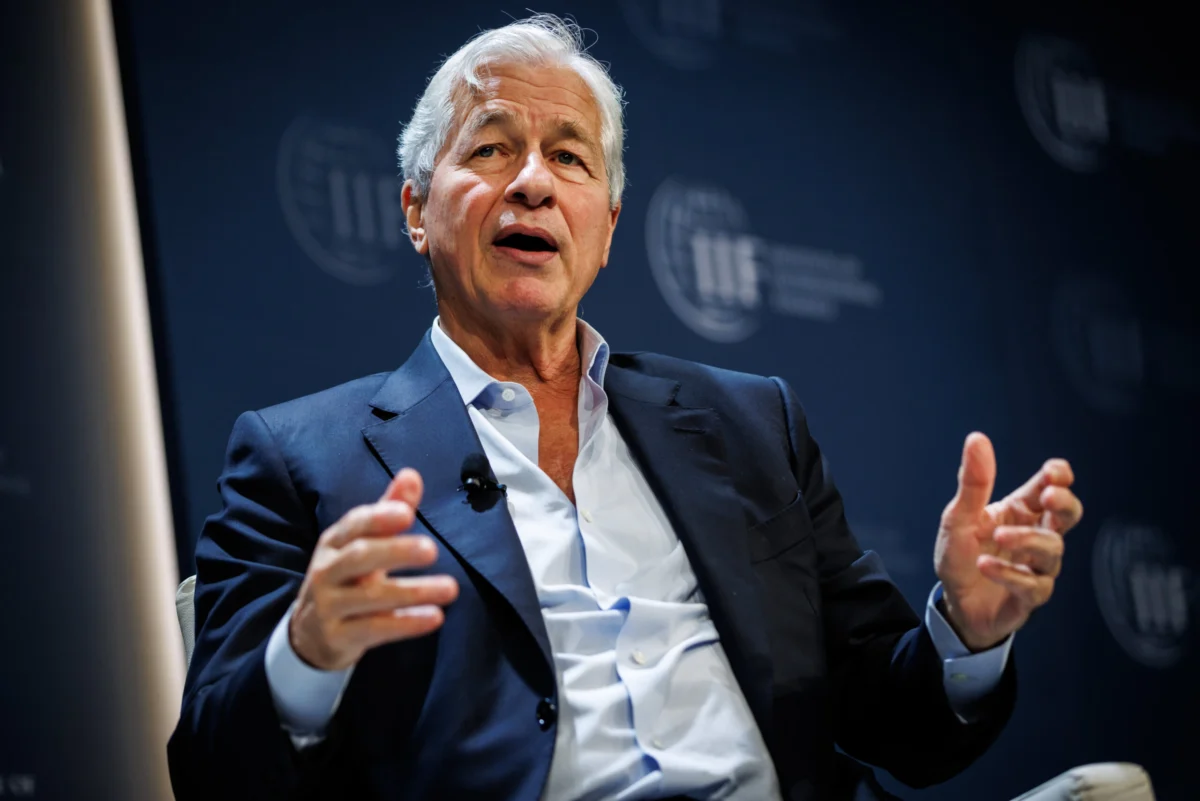
Jamie Dimon, the influential chief executive officer of JPMorgan Chase & Co., delivered a noteworthy assessment on Tuesday regarding the ongoing conflict involving Iran, positing that while immediate dangers are undeniable, the hostilities could paradoxically pave the way for enduring peace in the Middle East. Speaking at a high-profile conference in Washington, D.C., where he engaged in a wide-ranging interview with Palantir executive and former Congressman Mike Gallagher, Dimon articulated a contrarian viewpoint rooted in a perceived convergence of economic interests among key regional players.
"I think the Iran war makes it a better chance in the long run – it’s probably riskier in the short run, because we don’t know the outcome of it," Dimon stated, highlighting the inherent uncertainty of current events while forecasting a potentially transformative future. His analysis centers on the premise that Saudi Arabia, the United Arab Emirates, Qatar, the United States, and Israel are increasingly aligned in their desire for permanent stability, driven primarily by the imperative for economic development and foreign direct investment. This, he argued, marks a significant attitudinal shift from two decades prior, with Gulf states, in particular, demonstrating a clear willingness to pursue this trajectory.
The Genesis and Immediate Fallout of the Iran Conflict
The conflict to which Dimon referred began last month, in what represented a dramatic escalation of long-simmering regional tensions. According to reports, the United States and Israel jointly launched hundreds of precision strikes against targets within Iran, an offensive that culminated in the death of the country’s Supreme Leader. This unprecedented military action sent immediate shockwaves across global markets, triggering a significant surge in crude oil prices as investors grappled with fears of widespread supply disruptions from the critical Middle Eastern energy corridor.
The immediate aftermath saw heightened geopolitical volatility. While global stock markets experienced a temporary rally following a social media post by President Donald Trump, who claimed that the involved parties were discussing a "complete and total resolution" to the conflict, Iran swiftly denied any such talks were underway. This denial underscored the profound mistrust and communication challenges inherent in the crisis, leaving global observers and financial markets in a state of heightened uncertainty. The killing of a national leader of Iran, a nation with significant regional influence and a history of complex relations with the West, marked a pivotal and dangerous turn in Middle Eastern geopolitics. The economic repercussions extended beyond oil, impacting shipping lanes, insurance premiums, and broader investor confidence in a region already prone to volatility.
Economic Imperatives Driving a Push for Peace
Dimon, who helms the world’s largest bank by market capitalization, directly linked his unexpected optimism for long-term peace to fundamental economic realities. He emphasized that the Middle East’s burgeoning need for foreign direct investment (FDI) serves as a powerful incentive for stability. For years, substantial capital has flowed into the wealthy Gulf nations, fueling ambitious diversification projects aimed at reducing their reliance on hydrocarbons. However, Dimon cautioned, this crucial inflow of capital would "dry up without stability."
The strategic visions articulated by nations like Saudi Arabia’s Vision 2030, the UAE’s economic diversification agenda, and Qatar’s robust investment in infrastructure and technology, all hinge on a predictable and secure environment. These multi-trillion-dollar initiatives are designed to transform economies, create jobs, and foster innovation, but they are inherently vulnerable to geopolitical upheavals. Dimon’s blunt assessment – "They can’t have neighbors lobbing ballistic missiles into their data centers" – powerfully illustrates the direct threat that ongoing conflict and instability pose to these grand economic ambitions. Major multinational corporations and sovereign wealth funds, the bedrock of such FDI, prioritize security and predictability above all else. A region plagued by active warfare, even localized, deter foreign capital and expertise essential for growth. The recent oil price spikes serve as a stark reminder of the economic costs of instability, not just for producers but for global consumers and industries dependent on stable energy supplies.
A Shifting Regional Dynamic: Convergence of Interests
Dimon’s assertion of a "convergence of interests" among disparate regional powers represents a potentially transformative shift from historical paradigms of conflict and proxy warfare. He highlighted that Saudi Arabia, the UAE, Qatar, the U.S., and Israel are now collectively seeking permanent peace. This perspective suggests that the sheer economic cost of perpetual conflict, coupled with the rising global competition for investment and influence, is compelling these nations to reconsider long-held animosities.
While Iran has historically been viewed as a destabilizing force by many of its neighbors and Western powers, the recent escalation might, in Dimon’s view, force a re-evaluation of strategies across the board. The Abraham Accords, signed in 2020, demonstrated a prior willingness by some Arab nations to normalize relations with Israel, partly driven by shared security concerns regarding Iran and economic opportunities. While the current conflict is of a different magnitude, Dimon’s analysis implies that the severe disruption and the direct threat to economic lifelines might accelerate a more pragmatic approach to regional security. The Gulf states, in particular, have invested heavily in modern infrastructure and technology hubs, making them increasingly vulnerable to the very ballistic missile attacks Dimon referenced. Their economic future, therefore, is inextricably linked to regional stability, potentially fostering a collective will to de-escalate and find long-term solutions, however challenging.
Broader National Security and U.S. Policy Critiques

Beyond the immediate focus on the Middle East, Dimon utilized the platform to voice profound frustrations with American domestic policies, particularly concerning national security and economic competitiveness. In a wide-ranging interview, he delved into topics such as the impact of artificial intelligence on the workforce, the role of stablecoins in finance, and JPMorgan’s new global headquarters in New York. However, issues of national security and geopolitics clearly dominated his discourse.
Dimon passionately argued that the U.S. needs to "get our act together" in industries critical to national security. He underscored this commitment by referencing JPMorgan Chase’s substantial $1.5 trillion initiative launched last year, aimed at investing in key American industries to bolster domestic capabilities. "I am deeply frustrated… about our own policies in America which set us back," Dimon asserted, citing the nation’s inability to rapidly scale up the manufacturing of essential munitions as a prime example of systemic shortcomings.
He drew a stark comparison, stating, "We’ve become like Europe, we’re unable to move and change, change budgeting, change procurement." This critique points to a perceived bureaucratic inertia and lack of agility within the U.S. government and defense industrial base, hindering its capacity to respond effectively to evolving global threats. Decades of offshoring manufacturing and prioritizing efficiency over resilience have, in Dimon’s view, created significant vulnerabilities that now demand urgent attention. The reliance on foreign supply chains for critical components, from semiconductors to rare earth minerals and even basic defense materiel, exposes the U.S. to geopolitical leverage and disruptions.
The Looming Challenge of China
Dimon dedicated a significant portion of his critique to the strategic missteps in the U.S. approach to China over the past few decades. He contended that the U.S. government and corporate sector "made a huge mistake" by allowing the nation to become overly dependent on China for critical components, a vulnerability that now complicates geopolitical maneuvering.
Acknowledging China’s remarkable economic and technological advancements, Dimon stated, "We should acknowledge they’ve done some things magnificently well," specifically crediting China for its prowess in building batteries, electric vehicles, drones, and ships. This recognition of China’s industrial might served as a precursor to a stern warning: Americans must assume that a conflict may one day arise over China’s long-standing desire to integrate Taiwan.
In light of this potential flashpoint, Dimon stressed the imperative for the U.S. to conduct a candid self-assessment. "We should look at our own shortcomings, and then be prepared, if they ever become an adversary, to face off against them," he advised. This call for strategic preparedness encompasses not only rebuilding domestic manufacturing capabilities but also investing in advanced technologies, strengthening alliances, and developing robust contingency plans.
He further interconnected the global geopolitical landscape, arguing that successful outcomes in the conflicts in Ukraine and Iran "would be very helpful" in dealing with China. This perspective suggests that demonstrating resolve, maintaining global order, and preventing resource drains in other theaters could strengthen the U.S. position and deter potential Chinese aggression, particularly concerning Taiwan. The perceived inability to manage or conclude these conflicts effectively could signal weakness, inviting further challenges to U.S. global leadership and influence.
Expert Reactions and the Road Ahead
Dimon’s contrarian optimism regarding the Middle East and his candid critique of U.S. strategic policies have resonated across financial and geopolitical circles. While some analysts agree that economic imperatives can indeed drive shifts in regional dynamics, many remain cautious, highlighting the deep-seated ideological, sectarian, and historical grievances that often overshadow economic logic in the Middle East. Geopolitical experts point to the formidable challenges of brokering a lasting peace, especially after such a dramatic escalation involving a major regional power.
The immediate market reactions to the "Iran war" underscore the short-term risks Dimon acknowledged. Oil prices, a bellwether of Middle Eastern stability, remain susceptible to volatility, with implications for global inflation and economic growth. However, Dimon’s long-term vision offers a glimpse into a potential future where the region’s vast economic potential, currently constrained by instability, could be unlocked through collective action towards peace.
His remarks on U.S. national security and industrial policy have found broader resonance among policymakers and industry leaders who have increasingly voiced concerns about supply chain resilience and strategic competition with China. The call for a re-evaluation of manufacturing capabilities and defense procurement processes aligns with a growing consensus that the U.S. must strengthen its domestic industrial base to safeguard its economic and national security interests in an increasingly complex world.
In conclusion, Jamie Dimon’s recent statements offer a dual message: a cautious but distinct optimism for the Middle East’s long-term prospects, contingent on a pragmatic embrace of stability for economic growth, and an urgent, unvarnished call for the United States to address its own strategic vulnerabilities. His commentary underscores the intricate and interconnected nature of global finance, geopolitics, and national security, signaling that the paths to both regional peace and American strength are fraught with challenges but also laden with transformative potential. The outcomes of the ongoing conflicts and the strategic choices made in Washington will undoubtedly shape the global order for decades to come.
About the Author