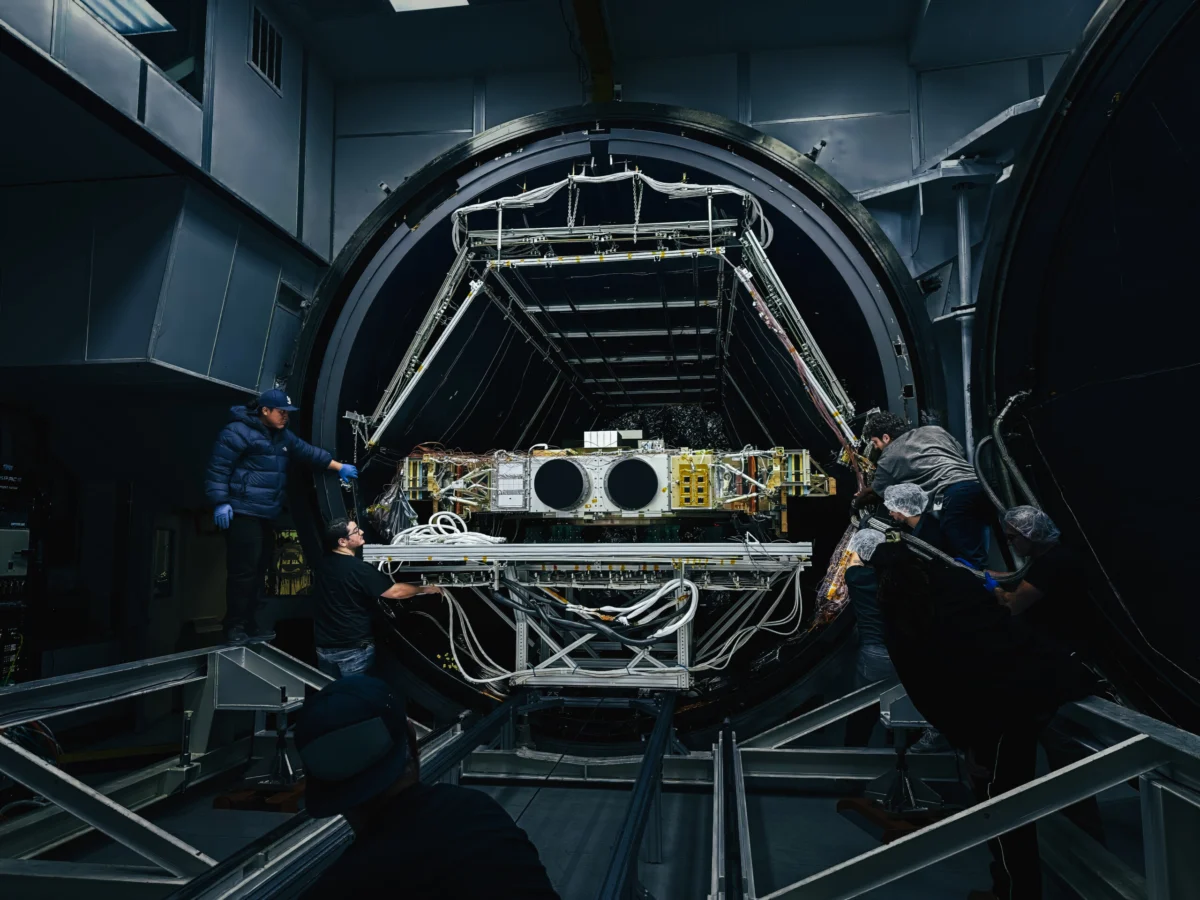
K2 Space, an ambitious aerospace firm founded by former SpaceX engineers Karan and Neel Kunjur, is on the cusp of a pivotal moment, preparing to launch one of the most powerful satellites ever constructed. The mission, featuring their Gravitas spacecraft, is designed to demonstrate critical technologies essential for the future development of in-orbit data centers and a new generation of high-throughput space infrastructure. This launch marks K2 Space’s maiden voyage into real space operations, a significant step in its declared iterative journey to revolutionize satellite capabilities.
The Gravitas Mission: A Leap in On-Orbit Power Generation
The Gravitas satellite, a two-metric-ton behemoth, has been meticulously packed into a SpaceX Falcon 9 rocket, with its launch anticipated as early as the end of the current month. Upon deployment, Gravitas will unfurl its impressive solar panels, extending to a wingspan of 40 meters. This substantial design is not merely for aesthetics; it is engineered to achieve unprecedented power generation in orbit. Gravitas is designed to produce 20 kilowatts (kW) of electricity, a figure that places it among the elite class of high-power spacecraft.
To put this capability into perspective, many conventional satellites operate on merely a handful of kilowatts. Even larger, more expensive platforms like the ViaSat-3 spacecraft generate slightly more than 25 kW, while SpaceX’s Starlink V3 satellites are also targeting a 20 kW output. K2 Space’s ability to achieve this power density with Gravitas positions it as a significant contender in the burgeoning market for robust space infrastructure. This substantial power output is crucial for supporting advanced payloads such as powerful sensors, high-bandwidth transceivers, and sophisticated on-board computers – components that are increasingly vital for a wide array of space-based applications.
Karan Kunjur, CEO of K2 Space, succinctly articulated the company’s core philosophy: "The future is higher power." This vision underpins K2 Space’s strategy and has attracted substantial investment, with the company raising $450 million and achieving a valuation of $3 billion by its investors in December 2025. The Gravitas mission represents the tangible first step in realizing this ambitious future, validating the company’s engineering prowess and strategic direction.
Demonstrating Advanced Capabilities for Future Orbital Computing
The Gravitas mission is not just about power generation; it’s a comprehensive technology demonstrator. The satellite will carry 12 undisclosed payload modules from various customers, including a crucial deployment for the Department of Defense. Central to the mission’s objectives is the testing of a 20 kW electric thruster, which K2 Space anticipates will be the most powerful ever flown in space. This thruster technology is critical for efficient orbit raising, station-keeping, and maneuvering, especially for larger, more massive satellites.
Kunjur outlined a multi-tiered evaluation process for the mission’s success. The initial phase focuses on the fundamental deployment of the spacecraft and its ability to generate the target power. Subsequent tiers involve activating and running the on-board payloads, meticulously testing the powerful electric thruster. Should these initial phases prove successful, the ultimate goal is to utilize the thruster to raise Gravitas thousands of kilometers into a higher operational orbit, a challenging maneuver that would further validate K2 Space’s propulsion capabilities.
Developing and launching a new spacecraft, especially one with novel components, is fraught with technical complexities and financial risks. Kunjur acknowledges this reality, noting that 85% of Gravitas’s components were designed and built in-house, a testament to K2 Space’s vertical integration strategy but also an indicator of the inherent challenges. The space industry is notoriously unforgiving of anomalies, making robust data collection paramount. Kunjur emphasizes that maximizing data acquisition from this inaugural flight is crucial to inform and refine the designs of future satellites. K2 Space plans an aggressive follow-on schedule, aiming to launch 11 additional satellites within the next two years, a mix of further demonstration and initial commercial missions. By 2028, the company projects it will be actively producing satellites for customers, enabling them to build out their own commercial networks of high-powered space vehicles.
The Strategic Imperative for High-Power Satellites
The increasing role of satellites in the global economy is driving an escalating demand for on-orbit power. Higher power translates directly into enhanced capabilities and opens up new business cases across various sectors. In communications, more power means higher data throughput, enabling faster internet speeds, greater capacity, and signals that are more resilient to interference or jamming. For Earth observation, increased power allows for more sophisticated sensors, higher resolution imaging, and longer operational durations.
Perhaps the most transformative impact will be on the burgeoning field of on-orbit data processing. As the volume of data generated by space-based assets grows exponentially, the need to process this data closer to its source becomes critical. High-powered satellites are indispensable for operating advanced processors, enabling complex computations, artificial intelligence (AI) inference, and machine learning (ML) directly in space. This capability promises to reduce latency, decrease reliance on ground infrastructure for basic processing, and unlock entirely new applications in areas like real-time environmental monitoring, advanced navigation, and autonomous orbital operations. The concept of "data centers in orbit" moves beyond science fiction, becoming a tangible engineering goal.
The demand for enhanced satellite capabilities is evident across multiple fronts. Massive commercial communications networks, such as SpaceX’s Starlink and Amazon’s Project Kuiper, are continuously pushing the boundaries of satellite constellation performance, requiring more powerful individual spacecraft to meet subscriber demands. Hyperscale cloud providers are actively exploring the potential of orbital compute, recognizing the strategic advantages of processing data in space. Furthermore, national defense initiatives, such as the Pentagon’s ambitious plans for a multi-billion-dollar missile defense system involving thousands of new satellites, unequivocally point towards a future dominated by satellites with significantly greater electrical clout. These diverse market drivers underscore the strategic importance of K2 Space’s focus on high-power platforms.
Addressing the Launch Cost Conundrum: A Vision Tied to Next-Generation Rockets
A primary challenge for all large satellites, and especially for the envisioned orbital data centers, remains the substantial expense associated with launching them into space. K2 Space’s foundational business pitch was strategically designed to leverage the anticipated capabilities and cost efficiencies of SpaceX’s Starship, the enormous, fully reusable launch vehicle currently under development. Starship promises to dramatically reduce the cost of access to orbit, potentially enabling the deployment of much larger payloads at a fraction of current prices.
However, the operational timeline for Starship remains uncertain, and its availability for low-cost commercial services is yet to be definitively established. This uncertainty presents both a challenge and an opportunity for K2 Space. While waiting for Starship, K2 must demonstrate its technology using existing launch vehicles, primarily the SpaceX Falcon 9.
Kunjur argues that even with current launch costs, K2 Space’s approach remains economically viable. A Gravitas satellite, priced at approximately $15 million, is positioned to be more cost-effective than high-powered satellites traditionally built by established contractors, while simultaneously offering superior power output compared to equivalently-priced smaller spacecraft. Even at current customer rates for a Falcon 9 launch (estimated around $7.2 million), K2 argues its total mission cost offers compelling value. This compares favorably to a future scenario where Starship might hypothetically reduce launch costs for outside customers to as low as $600,000, illustrating K2’s strategic positioning across different launch cost paradigms.
K2 Space’s forward-looking strategy is not merely reactive but proactive. Kunjur states that his team is actively preparing for a future where next-generation heavy-lift rockets like Starship and Blue Origin’s New Glenn become routinely available. "The thinking is, let’s build all the components that we’re going to go need to be a first mover when Starship and New Glenn are available for everybody else," Kunjur explained. This foresight is already manifesting in their design pipeline, with K2 reportedly having designs "taped out" on their factory floor for a colossal 100 kW satellite, a spacecraft so large it would stretch across an entire building. This ambition highlights K2 Space’s long-term vision to scale its technology in anticipation of a new era of ultra-low-cost, high-volume access to space.
Funding, Valuation, and the Road Ahead
K2 Space’s financial trajectory reflects strong investor confidence in its vision. The $450 million in funding and the $3 billion valuation achieved in December 2025 underscore the market’s belief in the company’s potential to disrupt the satellite industry. This substantial capital infusion provides the necessary runway for K2 Space to execute its ambitious development and launch schedule.
The company’s journey, from its founding in 2022 by the Kunjur brothers to the imminent launch of Gravitas, has been rapid. Their background as former SpaceX engineers provides a strong foundation of experience in rapid prototyping, iterative design, and the challenges of high-performance space hardware. This expertise is evident in their aggressive timeline for subsequent launches and their commitment to in-house component development, which allows for greater control over design, quality, and cost.
The success of the Gravitas mission will be a critical validation point, not just for K2 Space but for the broader industry trend towards more powerful and capable satellites. It will provide invaluable data for future designs, influencing everything from power systems and thermal management to propulsion and payload integration. As K2 Space progresses towards its goal of producing satellites for commercial networks by 2028, it stands to become a key enabler for the next wave of space-based innovation.
Broader Implications for the Space Economy
K2 Space’s venture into high-power satellites carries significant implications for the evolving space economy. If successful, it could accelerate the development of:
- Advanced Communication Networks: Enabling truly global, high-bandwidth internet with reduced latency and increased resilience.
- Enhanced Earth Observation: Facilitating more precise and frequent monitoring of environmental changes, disaster zones, and economic activity.
- Orbital Manufacturing and Servicing: Providing the necessary power infrastructure for future in-space assembly, repair, and refueling operations.
- Scientific Discovery: Supporting more complex and power-intensive scientific instruments for deep space exploration or astrophysical observations.
- National Security: Bolstering defense capabilities through more robust surveillance, communication, and missile defense systems.
The focus on high power represents a paradigm shift from previous generations of satellites, which often prioritized miniaturization and low cost at the expense of capability. K2 Space, along with other players like SpaceX with its Starlink V3, is signaling a future where raw power and advanced processing are paramount. This trend is not without its challenges, including increased complexity, heat dissipation, and the ongoing need for more efficient launch solutions. However, the potential rewards – a more connected, observed, and intelligent planet – are driving this innovation forward at an unprecedented pace. K2 Space’s Gravitas mission is a bold step into this high-powered future, promising to unlock new frontiers in what satellites can achieve.
About the Author