The Strategic Pivot: From P2P File Sharing to AI Studio
The history of LimeWire provides critical context for its current iteration. Originally launched in 2000 by Mark Gorton, the platform became one of the most prominent Gnutella network clients, facilitating the exchange of music and software. However, following a protracted legal battle with the Recording Industry Association of America (RIAA), the original service was shuttered by a federal court injunction in 2010. The brand remained dormant until 2022, when entrepreneur brothers Paul and Julian Zehetmayr acquired the rights to the name.
The relaunch was not a restoration of the previous business model but a total pivot toward the "Creator Economy" and Web3. The new LimeWire initially launched as an NFT marketplace for music and entertainment before identifying a strategic opportunity in the generative AI sector. By mid-2023, the platform introduced the LimeWire AI Studio, effectively positioning itself at the intersection of AI-driven creativity and blockchain-verified ownership. This shift allows the company to capitalize on two of the most significant trends in modern technology: the democratization of artistic tools through AI and the establishment of digital scarcity through Non-Fungible Tokens (NFTs).
Technical Infrastructure of the LimeWire AI Studio
The LimeWire AI Studio is engineered to support a variety of generative tasks, currently specializing in high-fidelity image generation with documented plans to expand into audio and video synthesis. The platform’s architecture is model-agnostic, meaning it integrates several industry-leading AI models rather than relying on a single proprietary source.
Integration of Advanced Generative Models
As of the current production cycle, LimeWire supports several prominent models:
- Stable Diffusion 2.1 and XL: These models are utilized for their high degree of user control and ability to generate photorealistic or highly stylized imagery based on latent diffusion processes.
- DALL-E 2: Developed by OpenAI, this model is integrated to provide users with sophisticated natural language processing (NLP) capabilities, translating complex text prompts into nuanced visual representations.
- Proprietary Development: LimeWire has confirmed the ongoing development of its own proprietary AI model. This move is viewed by industry analysts as a step toward reducing dependency on third-party APIs and establishing a unique visual "signature" for the platform.
User Interface and Creative Control
The studio provides a tiered interface that caters to both novice users and professional designers. Technical features include:
- Prompt Engineering Tools: Users can input descriptive text to guide the AI, with the platform offering guidance to optimize output quality.
- Style Selection: The interface includes presets for various aesthetics, including cinematic, digital art, pixel art, anime, and analog film.
- Quality Fine-Tuning: Advanced settings allow for the selection of different samplers and detail levels, providing a granular approach to image synthesis that rivals standalone professional AI tools.
The Blockchain Integration: Automated Minting and Ownership
A distinguishing factor of the LimeWire ecosystem is its seamless integration with blockchain protocols. Unlike traditional AI tools where the output remains a simple digital file, LimeWire automates the transition from creation to asset.
Multi-Chain Support
When a creator publishes a piece of content on the LimeWire Studio, the platform offers the option to automatically mint the creation as an NFT. This process is primarily handled via two high-efficiency blockchains:
- Polygon: An Ethereum Layer-2 scaling solution chosen for its low "gas" (transaction) fees and high speed, making it accessible for frequent creators.
- Algorand: A pure proof-of-stake blockchain known for its carbon neutrality and technical finality, appealing to environmentally conscious creators and collectors.
Ownership and Royalties
By minting content as an NFT, LimeWire establishes a verifiable ledger of authenticity. This technical framework enables a royalty system where creators receive a 2.5% commission on all secondary market trades. This ensures that as an artist’s reputation grows and their work appreciates in value, they continue to benefit financially from the lifecycle of their creations.
Monetization Models and the LMWR Token
LimeWire has introduced a multi-faceted revenue model designed to incentivize consistent content production. This model is a departure from traditional social media platforms where the majority of ad revenue is retained by the hosting corporation.
Ad Revenue Sharing
One of the most disruptive features of the platform is the 70/30 ad revenue split. Creators who publish content on LimeWire receive 70% of the advertising revenue generated from users who view their work. This provides a passive income stream that scales with the creator’s popularity and engagement metrics.
The LMWR Cryptocurrency
The economic engine of the platform is the LMWR token, LimeWire’s native ERC-20 utility token.
- Distribution: Earnings from ad revenue and NFT sales are distributed in LMWR.
- Utility: The token can be used within the platform to pay for AI prompts and premium features.
- Liquidity: LMWR is traded on several major global cryptocurrency exchanges, including Kraken, ByBit, and UniSwap. This provides creators with a direct path to convert their digital earnings into other cryptocurrencies or fiat currency.
Subscription Tiers and Resource Allocation
To manage the high computational costs associated with generative AI, LimeWire utilizes a credit-based subscription system. This allows the platform to offer a entry-level "freemium" experience while providing robust resources for professional users.
| Plan | Monthly Cost | Monthly Credits | Image Generations | Ad Revenue Share |
|---|---|---|---|---|
| Free | $0 | 10 | ~20 per day | 50% |
| Basic | $9.99 | 1,000 | ~2,000 | 50% |
| Advanced | $29.00 | 3,750 | ~7,500 | 60% |
| Pro | $49.00 | 5,000 | ~10,000 | 70% |
| Pro Plus | $99.00 | 11,250 | ~22,500 | 70% |
Premium subscribers also receive a "Pro" profile badge, faster processing times for image generation, and a completely ad-free browsing experience.
Industry Adoption and Market Impact
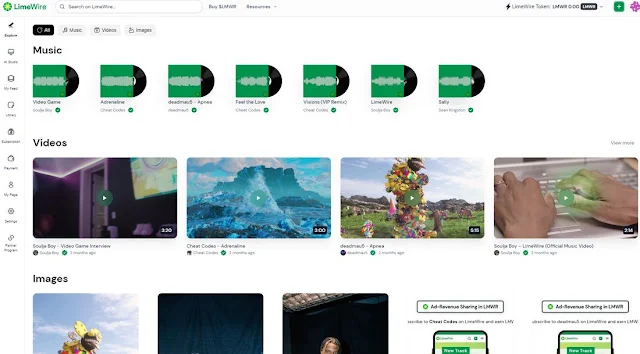
The platform’s transition has been bolstered by the participation of established figures in the music and arts industries. Artists such as Deadmau5, Soulja Boy, and Sean Kingston have utilized LimeWire to publish exclusive content, ranging from NFT-backed music tracks to digital collectibles. This celebrity involvement serves as a proof-of-concept for the platform’s ability to bridge the gap between mainstream entertainment and decentralized technology.
Competitive Landscape
In the broader market, LimeWire competes with AI giants like Midjourney and Adobe Firefly, as well as NFT platforms like OpenSea. However, LimeWire’s unique value proposition lies in its "all-in-one" approach. While Midjourney offers superior image generation, it lacks a native monetization and NFT minting ecosystem. Conversely, while OpenSea is a premier marketplace, it does not provide the generative tools to create the content it hosts. LimeWire’s integration of the entire creative pipeline—from the first prompt to the final sale—positions it as a comprehensive hub for the modern digital creator.
Future Outlook: Expansion into Music and Video
The strategic roadmap for LimeWire indicates a significant expansion beyond static imagery. The company has announced the upcoming release of AI-powered music and video generation tools. This expansion is particularly poignant given the brand’s heritage in the music industry.
The introduction of AI music generation will likely allow users to create original tracks, loops, and vocals, which can then be minted and sold as NFTs or used as soundtracks for AI-generated video content. This holistic approach to multimedia generation could significantly lower the barrier to entry for independent filmmakers and musicians, allowing for the production of high-quality assets without the need for expensive studio equipment or large production teams.
Fact-Based Analysis of Implications
The emergence of platforms like LimeWire signifies a shift toward "AI-as-a-Service" combined with decentralized finance (DeFi). This model addresses several long-standing issues in the creator economy:
- Copyright and Provenance: By automatically minting content on a blockchain, the platform provides a timestamped record of creation, which may assist in intellectual property disputes.
- Monetization Efficiency: The high ad-revenue share (70%) challenges the industry standard and could force other content platforms to reconsider their payout structures to retain talent.
- Accessibility: By providing free daily credits, LimeWire democratizes access to high-end AI models that often require significant technical knowledge or expensive hardware to run locally.
However, the platform also operates within a complex regulatory environment. The legal status of AI-generated art and its eligibility for copyright protection remains a subject of intense debate in various jurisdictions, including the United States and the European Union. Furthermore, the volatility of the LMWR token and the broader cryptocurrency market presents a financial risk for creators who rely solely on the platform for income.
Despite these challenges, LimeWire’s successful rebranding and technical execution demonstrate a viable path for legacy tech brands to achieve relevance in the age of artificial intelligence. By focusing on the needs of the creator and leveraging the transparency of blockchain, LimeWire has transitioned from a controversial historical footnote into a forward-looking infrastructure provider for the next generation of digital artists.
About the Author