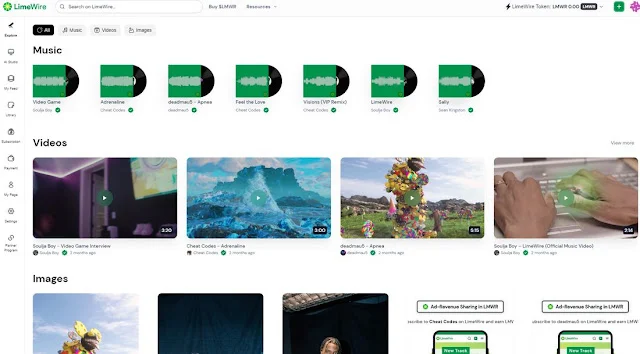
The landscape of digital content creation is undergoing a profound transformation as legacy brands pivot toward emerging technologies. LimeWire, a name once synonymous with the early 2000s peer-to-peer file-sharing era, has successfully completed a comprehensive strategic rebranding. No longer a decentralized file-sharing client, the new LimeWire has emerged as a sophisticated AI-driven content publishing platform. This evolution integrates generative artificial intelligence with blockchain technology, offering creators a multi-faceted ecosystem for production, distribution, and monetization. By positioning itself at the intersection of AI and Web3, LimeWire aims to provide a turnkey solution for artists, musicians, and designers to navigate the complexities of the modern digital economy.
The Historical Pivot: From Infringement to Innovation
To understand the significance of LimeWire’s current trajectory, it is essential to examine its historical context. The original LimeWire was launched in 2000 by Mark Gorton, operating on the Gnutella network. At its peak, it was one of the most popular applications globally, installed on one-third of all PCs. However, its history was marred by extensive legal battles with the Recording Industry Association of America (RIAA), culminating in a permanent injunction in 2010 and a subsequent $105 million settlement.
The brand remained dormant until 2022, when Austrian entrepreneurs Paul and Julian Zehetmayr acquired the rights to the name. Their vision was not to resurrect the old service, but to leverage the brand’s global recognition to build a legitimate, creator-centric platform. In mid-2022, the new LimeWire debuted as an NFT marketplace, and by 2023, it had expanded into the LimeWire AI Studio. This transition represents a shift from a platform that once challenged intellectual property rights to one that is now dedicated to protecting and monetizing them through blockchain-verified ownership.
Technical Architecture of the LimeWire AI Studio
The cornerstone of the platform’s current offering is the LimeWire AI Studio. Currently focused on image generation, the studio provides a user interface that abstracts the complexity of high-end machine learning models. The platform supports several industry-leading generative models, including Stable Diffusion 2.1, Stable Diffusion XL, and OpenAI’s DALL-E 2.
The integration of these models allows users to generate high-fidelity visual content through natural language processing (NLP). Users can input text prompts to generate art in various styles, including cinematic, digital art, pixel art, anime, and analog film. Beyond simple generation, the studio includes advanced tools such as samplers and guidance scales, allowing creators to fine-tune the quality and detail of their outputs.
LimeWire has also signaled its commitment to proprietary technology. The company is actively developing its own in-house AI model, intended to offer unique features and aesthetic qualities not found in third-party APIs. Furthermore, the platform’s roadmap includes the imminent launch of AI-powered music and video generation tools. This expansion is designed to make LimeWire a comprehensive multimedia hub, catering to a wide array of creative disciplines.
Blockchain Integration and Automated Minting
A distinguishing feature of LimeWire is its seamless integration with blockchain protocols. Unlike traditional AI tools where the output remains a standard digital file, LimeWire offers an automated "minting" process. When a creator publishes a piece of content, the platform can automatically convert it into a Non-Fungible Token (NFT) on either the Polygon or Algorand blockchains.
These blockchains were selected for their specific technical advantages. Polygon, a Layer 2 scaling solution for Ethereum, offers high transaction speeds and negligible gas fees, making it ideal for high-volume content creation. Algorand is known for its carbon-neutral footprint and institutional-grade security. By utilizing these networks, LimeWire ensures that every piece of AI-generated content has a verifiable digital signature, establishing clear provenance and ownership.
Creators have granular control over the accessibility of these assets. Content can be released to the public, where it can be traded on the LimeWire marketplace, or restricted to "subscriber-only" access. This flexibility allows creators to build gated communities, offering exclusive digital collectibles to their most dedicated followers.
The Economic Model: Ad Revenue and Royalties
LimeWire’s monetization strategy is designed to be more equitable than traditional social media models. The platform introduces a 70% ad revenue share for creators. When users view content—whether it be images, or the upcoming music and video formats—the creator receives the majority of the advertising income generated by those views. This model incentivizes the creation of high-quality, engaging content rather than simply high-volume output.
In addition to ad revenue, the platform incorporates a secondary market royalty system. Whenever an NFT minted on LimeWire is resold between fans or collectors, the original creator receives a 2.5% royalty fee. This ensures that artists continue to benefit from the appreciating value of their work over time.
The platform’s economy is underpinned by the LMWR token, LimeWire’s native cryptocurrency. Earnings from ad revenue and NFT sales are distributed in LMWR. The token was launched following a successful $10.4 million private sale led by venture capital firms such as Kraken Ventures, Arrington Capital, and GSR. Currently, LMWR is traded on major global exchanges including Kraken, ByBit, and UniSwap, providing creators with a liquid asset that can be converted to fiat currency or used within the LimeWire ecosystem to purchase additional AI generation credits.
Subscription Tiers and Accessibility
To accommodate a diverse user base, ranging from hobbyists to professional design studios, LimeWire operates on a tiered subscription model. While the platform offers a free entry point, the premium tiers provide significantly enhanced capabilities.
- Free Tier: Users receive 10 credits daily, allowing for approximately 20 image generations. This tier includes a 50% ad revenue share.
- Basic Plan ($9.99/month): Provides 1,000 credits and up to 2,000 image generations. Users at this level receive early access to new AI models and a 50% revenue share.
- Advanced Plan ($29/month): Designed for more active creators, offering 3,750 credits (up to 7,500 images) and a 60% ad revenue share.
- Pro Plan ($49/month): Aimed at professional creators, providing 5,000 credits (up to 10,000 images) and a 70% ad revenue share.
- Pro Plus Plan ($99/month): The highest tier, offering 11,250 credits (up to 22,500 images) and the full 70% revenue share.
All premium plans remove advertisements for the user, provide a "Pro" profile badge, offer faster generation speeds, and maintain a full history of all created assets.
Artist Endorsements and Market Reaction
The re-emergence of LimeWire has drawn significant attention from the entertainment industry. Acclaimed artists such as Deadmau5, Soulja Boy, and Sean Kingston have utilized the platform to release exclusive content. These partnerships serve as a proof-of-concept for the platform’s ability to handle high-profile digital assets and engage large fanbases through NFT-backed music and visuals.
Industry analysts view LimeWire’s pivot as a strategic move to capture the "middle class" of the creator economy. While platforms like Midjourney focus purely on the generative aspect and OpenSea focuses on the marketplace aspect, LimeWire’s attempt to unify the entire lifecycle—from prompt to minting to monetization—fills a specific niche in the market.
Broader Implications for the AI and Creative Industries
The integration of AI and blockchain on a platform with LimeWire’s brand recognition has several implications for the broader tech industry. First, it democratizes the creation of high-quality digital assets. By lowering the barrier to entry, individuals without formal graphic design training can now produce and monetize professional-grade visuals.
Second, it addresses the "attribution crisis" in AI. By minting AI generations as NFTs at the point of creation, LimeWire provides a technological solution to the problem of identifying the origin of AI-generated content. This could become increasingly important as copyright laws evolve to address the complexities of machine-learning-derived art.
Finally, the platform’s revenue-sharing model challenges the status quo of the "attention economy." By offering a 70% split, LimeWire is positioning itself as a more lucrative alternative to platforms like Instagram or X (formerly Twitter), which typically offer much lower percentages to their creators.
Conclusion and Future Outlook
LimeWire has successfully navigated a complex transition from a controversial legacy brand to a modern, tech-forward platform. By focusing on the synergy between generative AI and blockchain, it provides a unique value proposition in an increasingly crowded digital landscape. The platform’s commitment to expanding into AI-generated audio and video suggests that it aims to become a central pillar of the Web3 creative ecosystem.
As the technology matures, the success of LimeWire will likely depend on its ability to maintain its competitive revenue-sharing models and the continued stability of its LMWR token. For now, the platform stands as a compelling example of how traditional brands can be reinvented to serve the needs of a new generation of digital creators. With its AI Studio now fully operational and a roadmap for multimedia expansion in place, LimeWire is poised to remain a significant player in the evolution of the creator economy. For those looking to explore the frontiers of AI art, the platform offers a accessible and potentially profitable starting point.
About the Author