The landscape of consumer inquiry has undergone a dramatic transformation. From the initial face-to-face interactions of traditional commerce to the digital queries posed to search engines, the advent of artificial intelligence has introduced a new, potent force in how users seek information. This evolution raises a critical question for businesses: how can one ascertain the effectiveness of their efforts to be visible and influential within these AI-driven information ecosystems? Understanding and quantifying this impact, often referred to as AI Search Visibility ROI, is becoming paramount for businesses aiming to maintain relevance and drive tangible outcomes in the modern digital marketplace.
AI Search Visibility ROI quantifies the business impact derived from a brand’s presence within AI-generated answers across various platforms, including prominent examples like ChatGPT, Gemini, and Google’s AI Overviews. This metric establishes a direct link between the frequency with which AI systems cite or mention a brand and concrete business results such as website traffic, sales pipeline generation, and ultimately, closed revenue. The challenge lies in the inherent opacity of AI search, making its impact far from straightforward to decipher, a lack of clarity that can prove costly for businesses. This comprehensive guide aims to illuminate this complex area, offering a structured approach to understanding AI search’s influence, measuring its return on investment, and effectively communicating these findings to leadership.
The Conundrum of Attribution in the Age of AI Search
A significant hurdle in measuring AI search’s impact is the difficulty in traditional attribution models. While some AI answers provide direct citations that generate referral traffic, a substantial portion of user journeys diverge from this direct path. A common scenario illustrates this complexity: a buyer queries an AI for product recommendations, their brand is mentioned, and days later, they conduct a direct search for the brand on a search engine. If this subsequent search leads to a conversion, particularly through a paid search advertisement, traditional last-click attribution models will erroneously credit the paid search campaign, assigning zero credit to the initial AI interaction.
This disconnect is particularly problematic given the shifting dynamics of online traffic. Data from early 2026 indicated a notable decline in U.S. organic search traffic, while AI referral traffic to retail sites surged dramatically. This signals a fundamental shift in how consumers initiate their research, even if the concept of "organic search" is not entirely obsolete. The core issue is that AI search engines often do not share detailed referral data, rendering their influence invisible within the broader customer journey. The solution, therefore, is not to abandon attribution altogether, but to embrace a more nuanced approach that incorporates awareness metrics and integrates a measurement layer capable of capturing these crucial AI touchpoints.
Key Metrics for Proving AI Search Visibility ROI
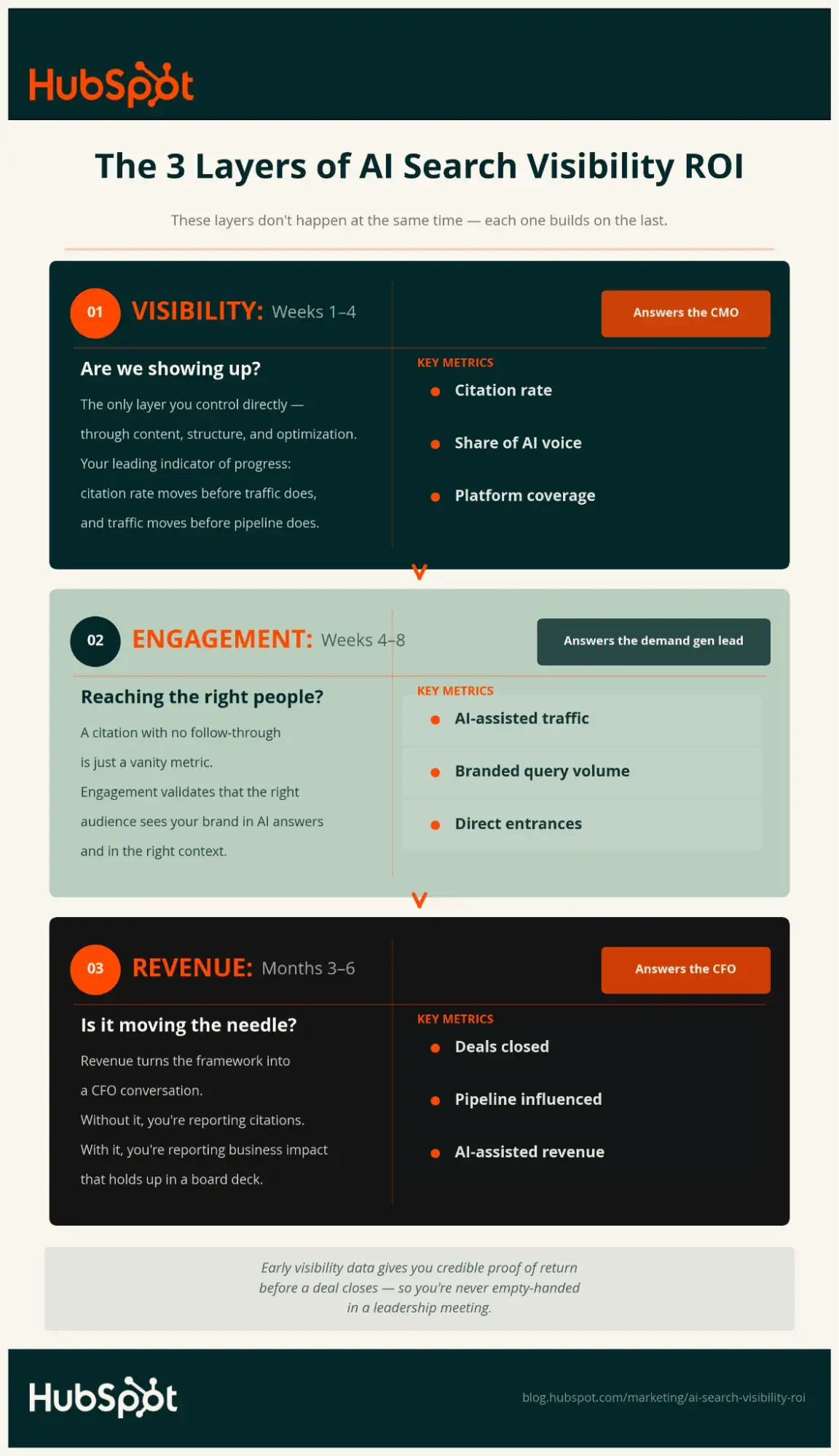
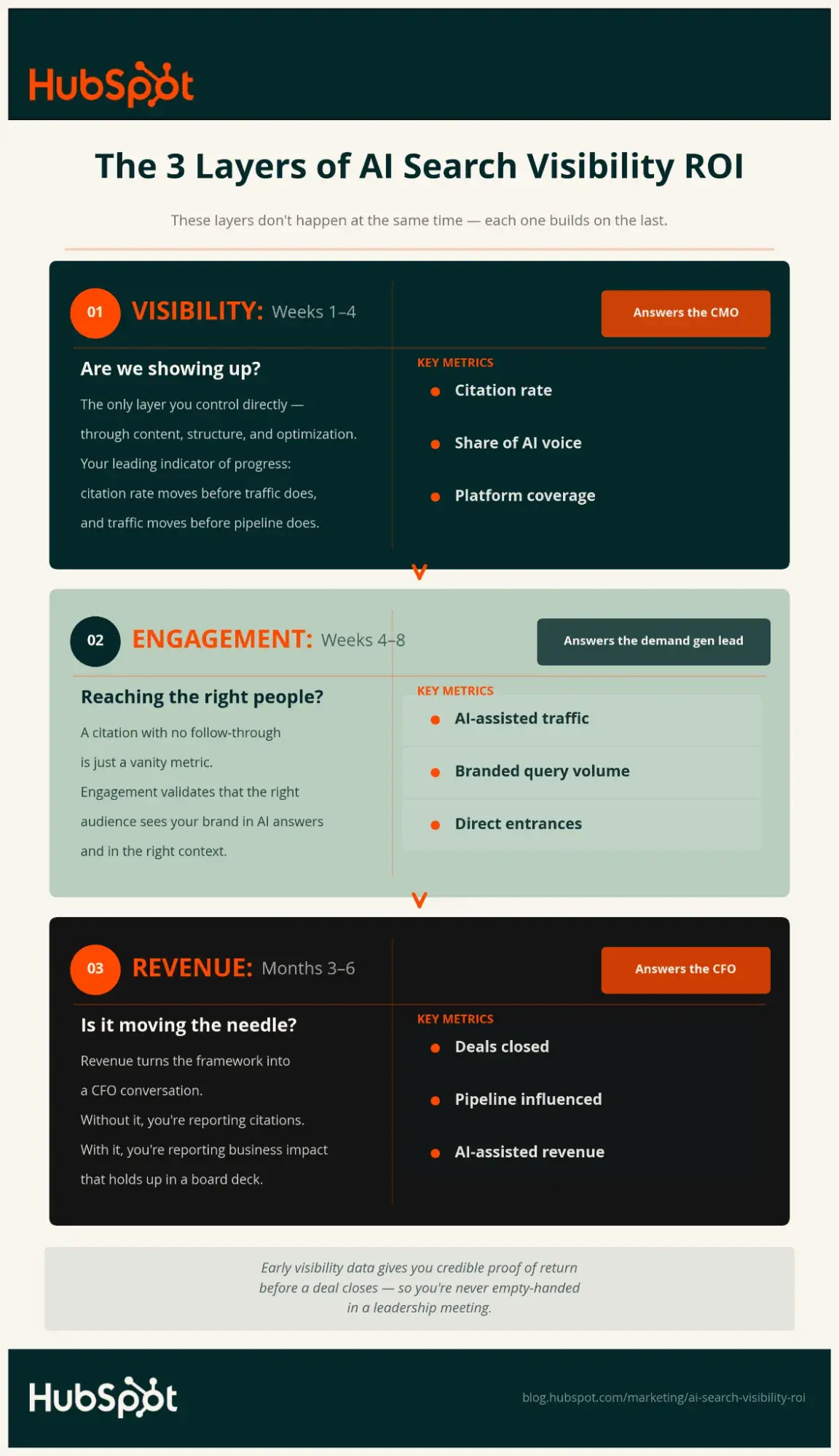
AI Search Visibility ROI is fundamentally about the return on investment derived from a brand’s appearance in AI-generated answers. While specific metrics may vary across different organizations, the analysis typically revolves around three interconnected layers, each serving a distinct purpose in building a comprehensive picture of AI’s impact:
- Visibility: This foundational layer focuses on establishing a brand’s presence within AI responses. It answers the question: "Are we being seen?"
- Engagement: This layer examines how users interact with the brand once they become aware of it through AI. It addresses: "Are people taking notice and acting upon this awareness?"
- Revenue: This is the ultimate layer, connecting AI influence to tangible business outcomes. It asks: "Is this leading to actual business growth and profitability?"
It is crucial to recognize that these three layers operate within a delayed funnel, meaning their effects do not occur simultaneously. Understanding this progression is vital for accurate analysis and reporting. Each layer also serves to address potential skepticism from different stakeholders. Visibility metrics provide early, credible data on AI’s potential impact even before a sale is closed, while engagement and revenue metrics offer the necessary context to validate these initial findings and demonstrate concrete business value to leadership.
Visibility: Tracking Share of AI Voice and Citations
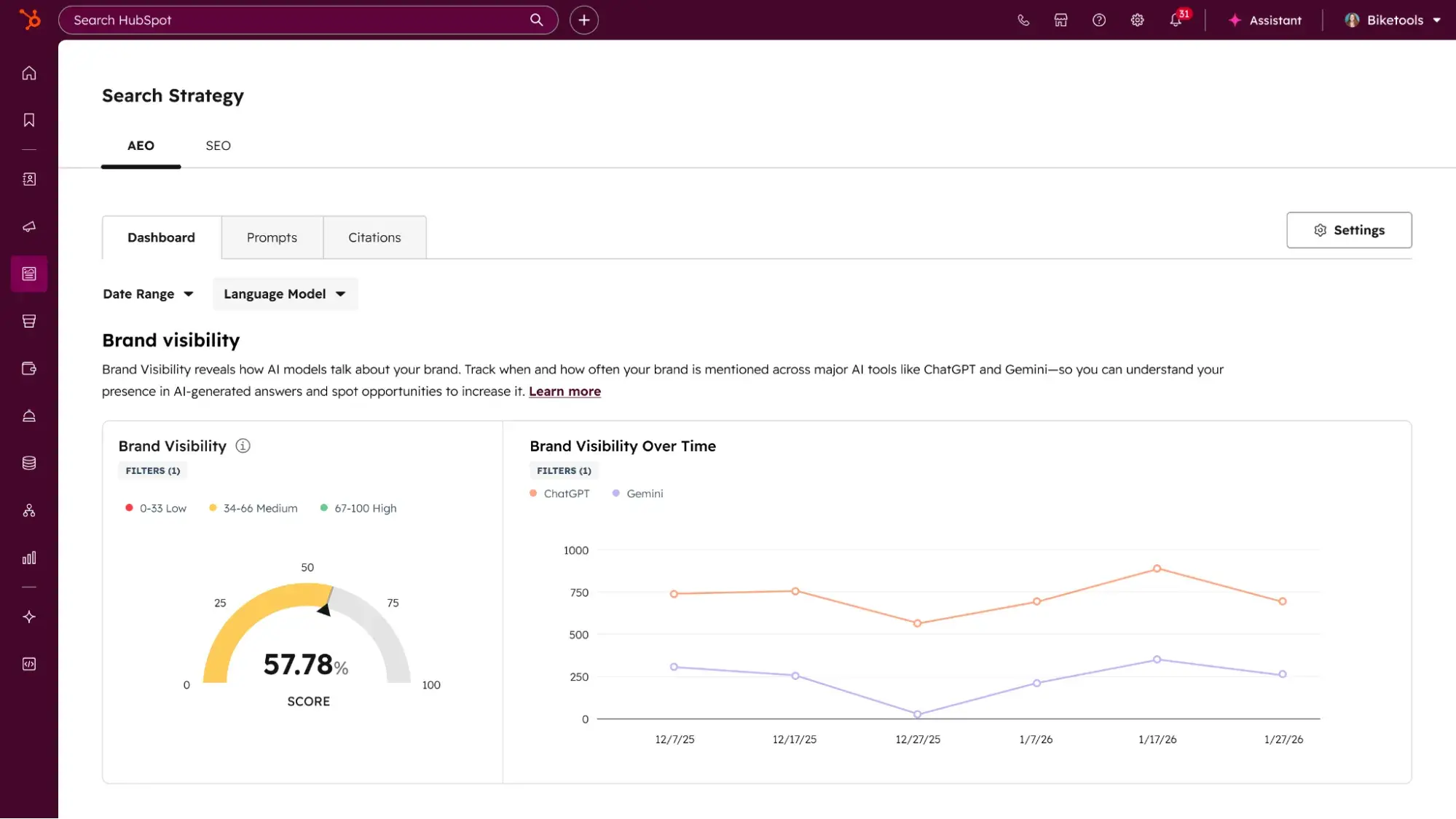
The first step in understanding AI’s impact is to measure how often a brand appears in AI-generated responses. Share of AI Voice (SAIV) quantifies the percentage of tracked prompts where a brand is mentioned in the AI’s answer. Citation tracking delves deeper, indicating whether the brand is explicitly linked as a source, signaling that AI systems deem the content authoritative.
Calculating Visibility Metrics:

- Share of AI Voice (SAIV): This is calculated by dividing the number of prompts where your brand is mentioned by the total number of tracked prompts, then multiplying by 100.
- Formula: (Number of Prompts Mentioning Your Brand / Total Number of Tracked Prompts) x 100%
- Citation Rate: This is determined by dividing the number of prompts where your brand is cited as a source by the total number of prompts where your brand was mentioned, then multiplying by 100.
- Formula: (Number of Prompts Citing Your Brand / Number of Prompts Mentioning Your Brand) x 100%
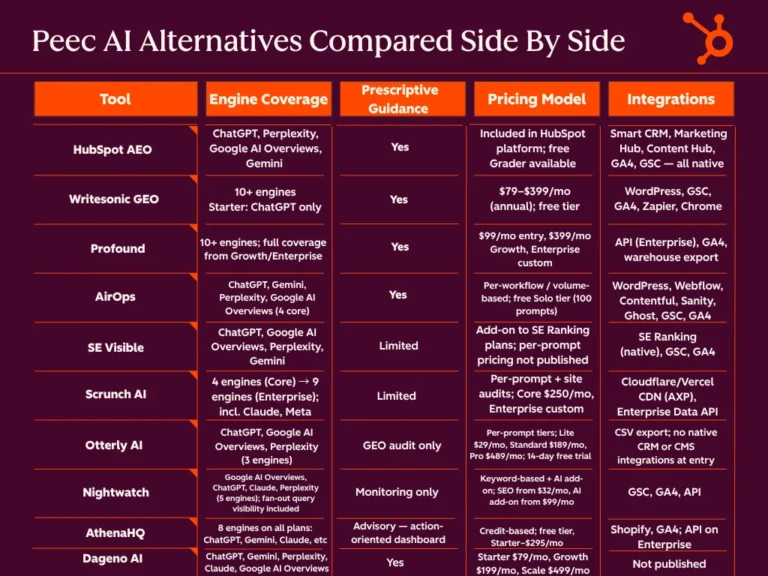
Tools like HubSpot’s AI Optimization (AEO) can automate the tracking of a brand’s Brand Visibility Score across platforms like ChatGPT, Perplexity, and Gemini. These tools can also monitor competitor mentions within a defined set of prompts, identify content gaps, and integrate this visibility data directly with customer relationship management (CRM) systems.
Engagement: Leveraging Branded Search Lift and Direct Traffic
When a brand’s presence in AI answers sparks interest, users often follow up by directly searching for that brand. This behavior manifests as an increase in branded keyword searches and direct website traffic, even without a direct click from the AI response itself. This phenomenon is known as Branded Search Lift.
Calculating Engagement Metrics:
- Branded Search Lift: This is measured by comparing the volume of branded keyword searches before and after a period of AI optimization. It can be tracked using tools like Google Search Console.
- Method: Monitor branded search query volume in Google Search Console. Look for statistically significant increases that correlate with AI visibility efforts, especially in the absence of paid campaigns targeting those keywords.
- Direct Traffic Increase: Analyze website analytics (e.g., Google Analytics 4) to identify any uplift in direct traffic that aligns with AI visibility initiatives.
- Method: Track direct traffic volume in GA4. Segment by time periods and compare to periods with heightened AI visibility. Look for increases that cannot be attributed to other marketing channels.
A sustained increase in branded search volume without a corresponding rise in paid search campaigns is a strong indicator that AI-driven awareness is effectively driving user intent.
Revenue: Attributing Pipeline Influence in Your CRM
Achieving perfect, direct attribution for AI search interactions is challenging due to the indirect nature of many customer journeys. However, the goal is to establish assisted attribution, acknowledging AI’s role in influencing the buyer’s path. The evidence supporting this investment is compelling: a HubSpot survey of over 3,000 CRM purchase decision-makers in January 2026 identified AI search as the single most potent predictor of purchase intent, surpassing even product demonstrations, review sites, and sales calls. Buyers who utilized AI search were found to be 36% more likely to make a purchase.
Calculating Revenue Impact (Assisted Attribution Model):
- Pipeline Influence: This involves identifying contacts within your CRM who have a history of AI-influenced behavior before converting. This can be achieved by:
- Tagging AI-influenced leads: Implement a system to flag leads that have exhibited AI touchpoints (e.g., through website analytics indicating recent AI tool usage or survey data).
- Analyzing CRM data: Examine historical data to identify patterns where AI touchpoints precede lead progression through the sales funnel.
- Assigning an assisted credit: Develop a model to assign a percentage of influenced revenue to AI touchpoints, recognizing it as one of several contributing factors. For example, if AI was one of three significant influences on a deal, it might receive a 25-33% credit.
- AI-Assisted Revenue: This is calculated by multiplying the total revenue from AI-influenced deals by the assigned assisted credit percentage.
- Formula: Total Revenue from AI-Influenced Deals x Assigned AI Assisted Credit Percentage = AI-Assisted Revenue
Benchmarking Brand Visibility in AI Search
To render visibility data actionable, it must be contextualized against a competitive landscape and tracked over time. Benchmarking provides this crucial context, offering a competitive reference point and a trend line. The competitive reference point reveals whether a brand is gaining or losing ground in terms of Share of AI Voice relative to key competitors. The trend line, conversely, indicates whether optimization efforts are yielding measurable improvements over time. Without both, it becomes difficult to articulate strategy effectiveness, justify investments, or demonstrate progress to leadership.
1. Identifying Answer Competitors
In the realm of AI search, "competitors" extend beyond direct product rivals. AI systems cite content based on authority and clarity. This often includes industry publications, analyst blogs, review platforms, and niche newsletters, as well as less predictable blogs and aggregators. Understanding these "answer competitors" is vital for shaping an effective AI strategy. If a prominent media site is consistently cited over your brand for critical buying-stage prompts, this indicates a content gap rather than a product deficiency, a gap that can be addressed through content optimization.
For each relevant topic cluster, meticulously document all sources appearing in AI answers, not just direct brand competitors. This comprehensive mapping of the citation landscape provides a clearer picture of who is influencing AI responses.

2. Constructing a Share of Citations Chart
A monthly analysis of a defined set of prompts can yield valuable insights. For each prompt, record all cited sources and aggregate this data by topic cluster. The resulting chart should clearly display a brand’s citation share against its top competitors, highlighting areas of leadership, areas of weakness, and the magnitude of any gaps.
For example, a chart might show:
| Topic Cluster | Your Brand Citations | Top Competitor Citations |
|---|---|---|
| CRM Software Comparisons | 12/20 prompts | 8/20 prompts |
| Sales Pipeline Management | 6/20 prompts | 14/20 prompts |
| Marketing Automation | 9/20 prompts | 11/20 prompts |
| Email Marketing Tools | 15/20 prompts | 5/20 prompts |
In this scenario, "Sales Pipeline Management" emerges as a priority area for improvement, with the brand being outranked significantly. Conversely, "Email Marketing Tools" represent a strong position to defend.
3. Interpreting Trends Over Time
Changes in citation share can be attributed to several factors: improvements in a brand’s content, degradation in a competitor’s content, or shifts in AI model preferences due to updates. It is crucial to establish a fresh baseline after any significant AI model release (e.g., GPT, Gemini) as these updates can alter citation patterns independent of content quality. The long-term trend line, observed over several months, is more indicative of strategic effectiveness than any single data snapshot.
Integrating this benchmark data with marketing automation platforms can streamline multi-touch attribution and reporting, consolidating AI citation share alongside other marketing channel metrics into a unified view.
Developing a Long-Term Plan for AI Search Visibility Measurement
A robust strategy for measuring AI search visibility requires a systematic, ongoing approach:
1. Defining the Prompt Set
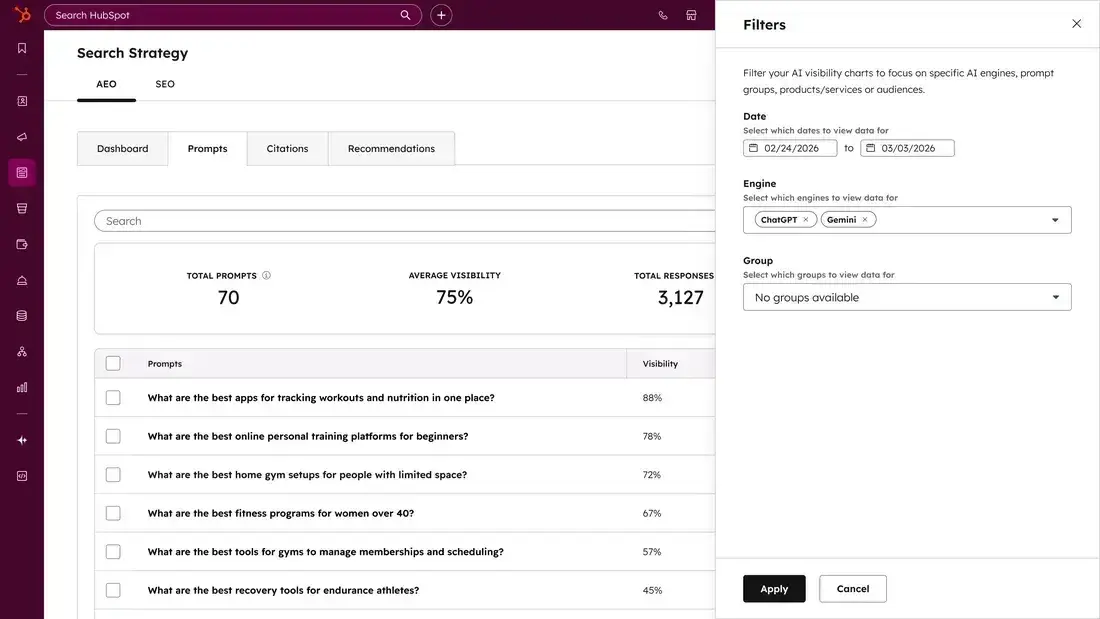
The selection of prompts is critical. Aim for 20-30 prompts that accurately reflect how potential buyers research your category across different stages of the buyer’s journey. This should include prompts related to early-stage research, solution comparisons, and vendor-specific inquiries.
2. Inputting Prompts into AI Visibility Tools
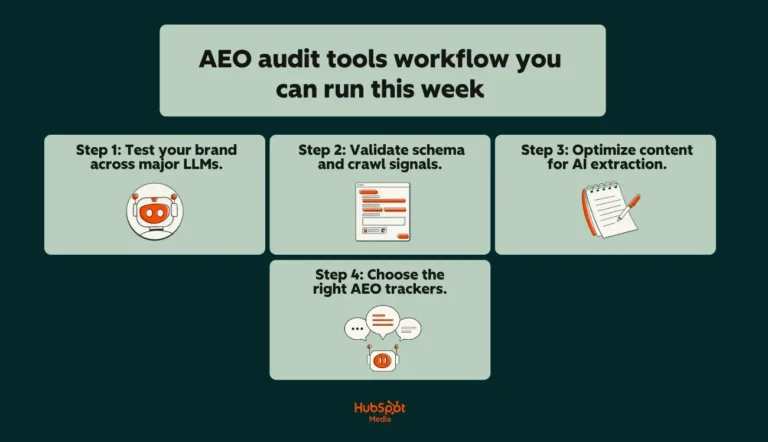
Manually running test prompts across desired AI platforms (ChatGPT, Gemini, etc.) is an option, but specialized tools like HubSpot AEO can automate this process, providing daily updates on citations across multiple platforms. Multi-platform tracking is essential, as AI search visibility is no longer confined to a single dominant player. Reports indicate a significant shift in AI referral traffic distribution, with platforms like Claude and Gemini gaining traction. Therefore, prompt tracking must encompass all major AI surfaces.
3. Recording Brand Visibility Scores
For each prompt, a clear scoring system should be employed: not mentioned, mentioned, cited as a source, or recommended. Aggregating these scores across all prompts and platforms provides a comprehensive Brand Visibility Score, serving as the initial baseline. This process should be repeated regularly, ideally monthly, to track progress.
4. Auditing Existing Content
Conducting an AI search visibility audit, potentially using tools like HubSpot’s free AI Search Grader, can reveal where a brand is visible and where competitors are gaining an advantage. This audit should be documented in a structured format, tracking details such as date, platform, model version, mention/citation status, competitor citations, answer sentiment, and a verbatim or summarized response.
5. Repeating the Process
After implementing content optimization strategies based on audit insights, the same prompts should be rerun and analyzed consistently (weekly or bi-weekly). This iterative process of tracking, analyzing, and refining is key to continuous improvement.
Calculating AI Search Visibility ROI
Given the inherent ambiguity in AI attribution, calculating AI Search Visibility ROI presents challenges. However, a robust estimation is achievable by integrating visibility, engagement, and revenue metrics using a well-defined formula:
*ROI (%) = (AI-Assisted Revenue – AI Costs) / AI Costs 100**
AI-Assisted Revenue
Since AI search rarely provides direct click attribution, marketers must develop an assisted revenue model. This model accounts for AI touchpoints within a customer’s journey leading up to a conversion. Key components include:
- Unified Visibility and Pipeline Data: Integrating AI visibility data with CRM data to connect AI touchpoints with lead progression.
- Attributed Influenced Revenue: Developing a methodology to assign a portion of revenue to AI influence, recognizing its role alongside other marketing and sales efforts.
- AI-Influenced Contact Tagging: Implementing systems to tag contacts exhibiting AI-influenced behavior within the CRM.
AI Costs
The costs associated with AI visibility efforts are generally more straightforward to quantify and typically include:
- AI Visibility Tools: Subscriptions or licensing fees for tools that track AI mentions and citations.
- Content Optimization: Investments in creating and refining content to improve AI search ranking.
- Staff Time: The labor costs associated with managing AI visibility efforts, analysis, and reporting.
Example Calculation:
Assume a team invests $2,000 per month in AI visibility tools and content optimization, totaling $6,000 over a quarter. During this period, the CRM identifies $30,000 in pipeline influenced by contacts with confirmed AI touchpoints. Applying a 25% assisted credit to this pipeline yields $7,500 in AI-assisted revenue.
Using the ROI formula:
ROI (%) = ($7,500 – $6,000) / $6,000 * 100 = 25% ROI
This provides a tangible, defensible metric to present to leadership, even as the AI attribution model continues to mature.
Making the Leadership Case for AI Search
When presenting to leadership, a compelling argument should be structured around three core pillars: opportunity cost, competitive risk, and a clear measurement plan. The presentation should emphasize the cost of inaction rather than solely focusing on potential future results.
Opportunity Cost
Data suggests that AI-referred leads convert at significantly higher rates than those from traditional search. Each month of inaction in measuring or optimizing for AI visibility represents a lost opportunity, as high-intent buyers make decisions without the brand’s presence in the AI-driven conversation. This translates directly to lost revenue.
Competitive Risk
Companies actively optimizing for AI search are demonstrating measurable advantages. HubSpot customers engaged in AI search optimization are generating substantially more Marketing Qualified Leads (MQLs) and closing more deals than their counterparts who are not. The gap between proactive and passive approaches to AI visibility is widening, posing a significant competitive risk for lagging organizations.
Measurement Plan
Leadership requires concrete plans, not vague promises. A clear 30/60/90-day roadmap should be presented, outlining the establishment of a baseline, a defined prompt set, a transparent metric framework, and a CRM attribution model that links visibility signals to pipeline development. This plan should detail precisely how success will be measured and when.
Expected Timelines for AI Search Visibility
A common pitfall is expecting AI search visibility results on timelines comparable to paid media or even traditional SEO. AI visibility strategies require patience, and results manifest in layers. While initial visibility gains may appear relatively quickly, the accumulation of engagement and revenue data necessary for ROI calculation takes time. Understanding these pacing expectations is crucial for sustained investment and strategic success.
Typical AI Search Visibility Milestone Windows
| Timeframe | What You Should See | What to Report |
|---|---|---|
| Days 1-30 | Baseline established, prompt set running | Visibility score, competitor benchmark |
| Days 30-60 | First citation data, branded search trend | Share of AI voice, direct traffic delta |
| Days 60-90 | AI-influenced contacts appearing in CRM | AI-influenced MQL rate, pipeline touch data |
| Days 90-180 | Pipeline influence data, revenue model live | AI-assisted close rate, deal velocity |
Leading Indicators to Monitor
While awaiting pipeline data, leading indicators provide crucial early signals of strategy effectiveness. These include:
- Increased Share of AI Voice: A rising percentage of mentions and citations in AI responses.
- Branded Search Lift: A noticeable uptick in direct searches for the brand.
- Direct Traffic Growth: An increase in website visitors arriving directly.
- Positive Sentiment in AI Answers: AI responses about the brand being favorable.
- Emergence of AI-Influenced Contacts in CRM: Identification of leads with AI touchpoints.
By day 60, observing positive movement in two or more of these indicators provides a credible basis for demonstrating that the AI visibility strategy is on the right track, even before definitive pipeline data is available.
Frequently Asked Questions About AI Search Visibility ROI
How can I improve visibility with an AI search optimization strategy?
Begin by focusing on content structure. AI systems favor content that provides direct, clear answers upfront. Rewrite key pages to address prompts within the first 150 words, utilize question-based headings, and implement FAQ and Article schema. Beyond owned content, improving visibility also involves enhancing brand reputation and securing citations on authoritative third-party sources. A multi-platform strategy is essential, as different AI engines have distinct retrieval logic and citation behaviors.
What timeline should I expect for improvements in AI search visibility?
Content improvements typically manifest in citation rate changes within 30-60 days, with measurable pipeline influence appearing 90-180 days later. AI systems do not update in real-time; content changes require time to be processed and reflected in AI answers. However, signals like branded search lift and direct traffic can shift within four to six weeks. Lower-competition prompts may see citation improvements within a month, while high-intent buying prompts with established competitors will take longer.
How should I pick prompts to track AI share of voice?
Source prompts from sales call recordings, customer support tickets, and existing keyword research to capture authentic buyer questions. Prioritize specificity, as detailed questions yield more consistent and trackable AI answers. Structure the prompt set to cover all funnel stages: awareness, consideration, and decision. Aim for 5-10 prompts per topic cluster initially and revisit this set quarterly.
What if my brand is rarely mentioned today?
A low visibility score indicates a significant opportunity. Audit topic clusters with the lowest citation rates and identify who is currently being cited instead. This reveals what content is performing well and what gaps your content needs to fill. Focus on optimizing high-priority pages for clarity, direct answers, and E-E-A-T (Experience, Expertise, Authoritativeness, Trustworthiness) signals. Begin with two to three topic clusters where competitive gaps are smallest and buyer intent is highest, and then expand. Visibility tends to compound, making it easier to earn citations in adjacent clusters once established.
The era of AI-driven information retrieval is not a distant future; it is the present reality. Buyers have always sought answers, and the entities that provide the clearest, most credible, and timely responses will capture their attention and their business. AI search has fundamentally altered the channels through which these answers are delivered, but the core principle remains unchanged.
The good news is that capitalizing on this shift does not necessitate an exorbitant budget or a dedicated AI team. The journey begins with existing resources. By initiating prompt tracking this week, businesses can begin to build a foundational understanding of their AI presence. Monitoring AI-influenced contacts in the CRM and observing branded search trends over the next 30 days will rapidly clarify the evolving landscape. Every data point collected now serves as a critical building block for future leadership presentations and strategic decisions. The transformation is underway, and the crucial question for every brand is whether it will be an active participant in the AI-powered answers of tomorrow.
About the Author