The marketing landscape is undergoing a profound transformation, driven by the rapid evolution of artificial intelligence and its integration into the consumer search journey. As AI-powered answer engines like ChatGPT, Gemini, and Perplexity become increasingly central to how potential customers discover and evaluate products and services, traditional SEO and content strategies are proving insufficient. This shift necessitates a new class of tools: AI visibility platforms that move beyond mere monitoring to offer actionable insights and integrated workflows. Peec AI, a prominent player in this emerging market, offers AI brand monitoring capabilities, but forward-thinking marketing teams are increasingly seeking alternatives that address critical gaps in remediation, CRM attribution, and scalable program execution.
The year 2026 is poised to see a significant maturation of the AI visibility market, with several platforms emerging as leaders. HubSpot AEO is gaining traction for its native CRM integration, allowing marketing and RevOps teams to directly link AI visibility data to sales pipeline and customer attribution. Writesonic GEO offers a compelling end-to-end optimization solution, bridging the gap between identifying visibility issues and generating content to address them. For enterprises demanding robust analytics and scalability, Profound stands out. Agencies and multi-site management teams are finding value in AirOps for its integrated content operations workflows. These platforms, alongside others, represent the vanguard of AI-driven marketing intelligence, aiming to translate AI presence into tangible business outcomes.
The challenges faced by marketers in this new era are multifaceted. Many find that while AI visibility monitoring tools can identify gaps in how their brand is represented in AI-generated responses, they often lack the functionality to actively close these gaps. Furthermore, AI visibility data frequently remains siloed in separate dashboards, disconnected from the customer relationship management (CRM) systems that are crucial for sales attribution and pipeline management. For global brands and organizations operating across multiple regions, reporting and program management can become unwieldy if the chosen platform doesn’t offer scalable solutions.
The Paradigm Shift: From Traditional Search to AI-Powered Discovery
The fundamental change lies in how consumers now interact with information. The era of solely relying on keyword rankings and organic traffic metrics is rapidly fading. Today’s buyers are leveraging AI chatbots to research complex purchases, asking for recommendations on CRM systems, prompting AI for the best B2B tools, and consuming synthesized information before ever visiting a vendor website. This necessitates a strategic pivot to understand and influence brand presence within these AI answer engines.
AI visibility monitoring, also termed AI brand monitoring, is the practice of tracking the frequency and sentiment of a brand’s appearance in AI-generated responses. Platforms like Peec AI excel at this, measuring not just where a brand is mentioned, but also its position within an AI answer, and whether that mention is favorable, neutral, or negative. This is a critical departure from traditional rank tracking, which focuses on a page’s position on a Search Engine Results Page (SERP) for a specific keyword. AI visibility, conversely, assesses a brand’s inclusion in synthesized answers, the sources AI draws upon, and how competitors are positioned within the same AI-generated response.
Understanding the Mechanics: AI Visibility vs. Classic Rank Tracking
The distinction between AI visibility monitoring and traditional rank tracking is fundamental to developing an effective measurement strategy. Classic rank tracking involves crawling SERPs to determine a page’s ranking for a given keyword. AI visibility monitoring, however, employs structured prompts designed to mimic real buyer intent across various AI platforms. The resulting share-of-voice metric in AI-generated answers is a novel indicator of market presence, distinct from traditional ranking positions.
A key strategic advantage of AI visibility monitoring is citation analysis. If an AI engine recommends a competitor when asked for the "best CRM for mid-market B2B teams," understanding the sources cited by the AI allows marketing and content teams to reverse-engineer the competitor’s advantage. Identifying these citations—whether they originate from third-party reviews, comparison pages, or documentation—provides a prioritized roadmap for content investment. This focus on the citation layer fundamentally reshapes how marketing teams conceptualize authority, moving beyond mere traffic generation to influencing AI-driven decision-making.
Buyer Criteria for AI Visibility Platforms: Beyond the Dashboard
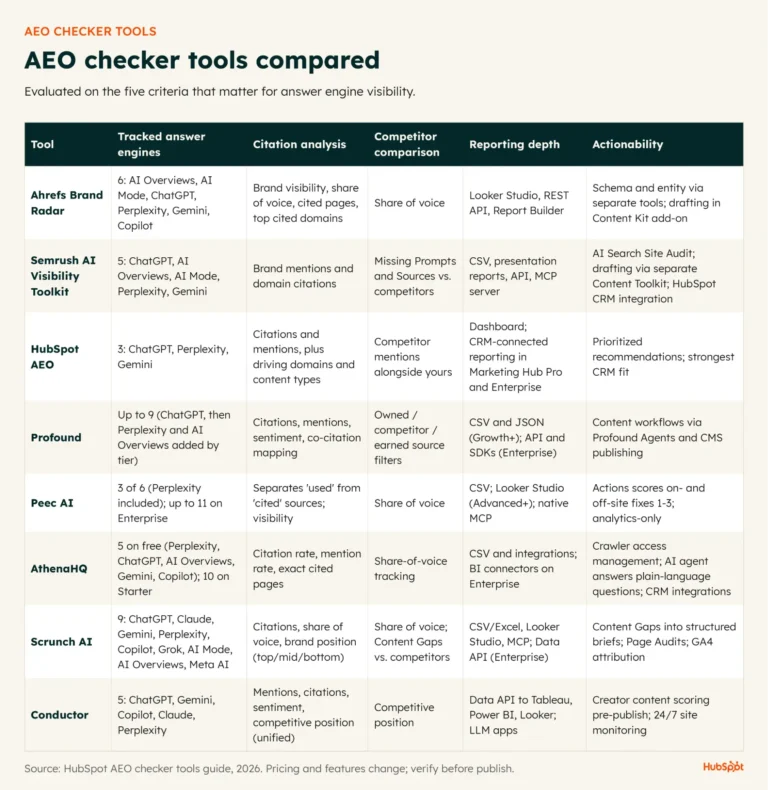
When evaluating AI visibility platforms, it’s crucial to look beyond superficial features and focus on criteria that deliver long-term value. Many marketing teams have experienced the frustration of using tools that identify visibility gaps but offer no means to address them, or platforms where valuable AI data remains disconnected from revenue-generating CRM systems. The following criteria are paramount for assessing the true utility of any AI visibility solution:
-1.png)
- Remediation Capabilities: Does the platform offer tools or integrations to help close identified visibility gaps? This could include content brief generation, AI-assisted copywriting, or automated publishing workflows.
- CRM Integration and Attribution: How seamlessly does the platform connect AI visibility data to CRM records, sales pipeline, and campaign performance? Native integration is ideal, eliminating the need for manual data exports and complex attribution modeling.
- Scalability and Global Reach: Can the platform effectively manage programs across multiple regions and languages? Reporting and workflow scalability are essential for global brands.
- Historical Data and Backfilling: Does the platform offer historical data from the point of sign-up, or can it backfill historical performance to provide a comprehensive trend analysis?
- Platform Coverage and Prompt Methodology: How many AI models does the platform monitor? Does it use real user prompts or synthetic queries, and how does this impact accuracy?
- Actionable Insights and Recommendations: Does the tool provide prioritized recommendations or "actions" that guide teams on where to focus their efforts, rather than simply presenting raw data?
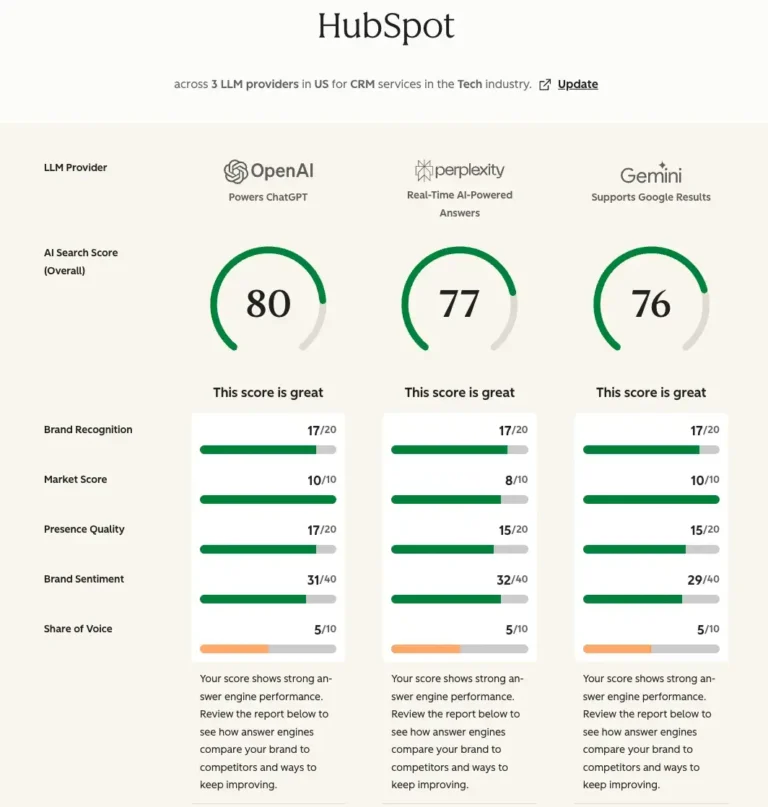
A useful initial step before engaging in paid trials is to benchmark current AI visibility using tools like HubSpot’s AI Grader. This provides a baseline score against which the performance of any new platform can be measured objectively.
Peec AI: Strengths and Limitations in the Evolving Landscape
Peec AI has established itself as a competent AI brand monitoring tool. Its strengths lie in its ability to track brand mentions, sentiment, and citation rates across a significant number of AI models, including a helpful distinction between Google AI Overviews and Google AI Mode, which often operate differently and require separate tracking for accurate reporting. The platform also offers a "Actions" layer, providing prioritized recommendations to address identified opportunities. For global brands and multilingual content teams, Peec AI’s robust country and language-specific tracking is a notable advantage.
However, several limitations are prompting marketers to seek alternatives. The most significant are:
- Remediation Gap: Peec AI identifies visibility issues but does not offer built-in tools for content creation, brief generation, or automated publishing. This places the entire remediation burden on the marketing team’s internal resources and content bandwidth.
- Lack of Native CRM Attribution: Visibility data remains confined to the Peec AI dashboard. Connecting this data to pipeline, revenue, or campaign performance necessitates manual data exports, separate attribution modeling, and ongoing maintenance of these bridges, which is a significant hurdle for RevOps-focused teams.
- No Historical Data Backfill: Tracking begins only upon subscription, meaning prior performance cannot be benchmarked, hindering the understanding of historical AI visibility trends.
- Platform Coverage Nuances: While covering major engines like ChatGPT, Gemini, and Claude, Peec AI’s prompt methodology relies on AI-generated queries rather than actual user prompts, which can impact the accuracy of the data.
These limitations highlight the need for platforms that offer more integrated solutions, bridging the gap between measurement and action, and directly connecting AI visibility to revenue attribution.
Leading Peec AI Alternatives in 2026
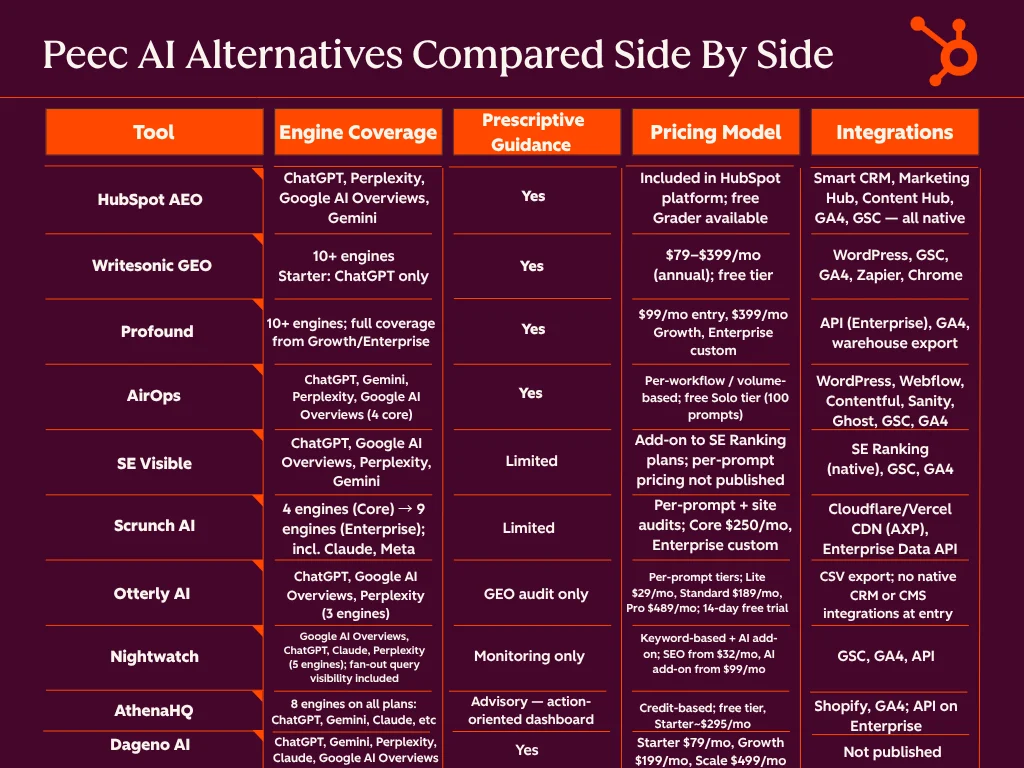
The following platforms are emerging as strong contenders, each addressing specific shortcomings of traditional AI visibility tools:
1. HubSpot AEO – Best for CRM-Native AI Visibility
For B2B marketing and RevOps teams that require AI visibility data to be intrinsically linked to their CRM, contacts, and sales pipeline, HubSpot AEO stands out. As the only platform built natively within a CRM, it tracks brand mentions, citation rates, prompt share of voice, and competitive benchmarks across major AI answer engines. This data is surfaced directly alongside contact records, deal stages, and campaign performance within HubSpot’s Smart CRM, effectively closing the loop between AI visibility and revenue generation without the need for custom integrations or complex workarounds. The immediate context provided to sales reps—understanding if a prospect originated from a ChatGPT citation before the first touchpoint—is invaluable.
- What sets it apart: Seamless, out-of-the-box attribution. Every AI-sourced visit, contact, and deal is automatically tied to CRM data, eliminating manual processes.
- Limitations: Currently in beta, some specialized monitoring depth might be found in dedicated platforms. Its AI development is ongoing.
- Pricing: Included in the HubSpot platform; a free AI Search Grader is available.
2. Writesonic GEO – Best for Prescriptive Optimization
Writesonic GEO positions itself as an end-to-end solution for AI engine optimization. It combines AI visibility monitoring with robust content generation capabilities, enabling teams to not only identify citation gaps but also to immediately address them. This integration of measurement and creation is a significant advantage for teams struggling with content production bottlenecks.
- What sets it apart: The tight integration between visibility data and content creation tools allows for immediate action on identified gaps, fostering a compounding advantage over time.
- Limitations: The monitoring layer is newer compared to established trackers. Engine coverage may be narrower on entry-level plans.
- Pricing: Starts around $79/month, offering a cost-effective combined solution.
3. Profound – Best for Enterprise Security and Compliance
Profound is a comprehensive enterprise-grade platform designed for large organizations and agencies where AI recommendations directly influence revenue. It offers extensive tracking of brand mentions, citations, sentiment, and prompt volume across numerous AI platforms. Its "Agents" feature enables scalable AEO-optimized content creation with human oversight. Profound boasts the largest prompt datasets in the category, providing credibility and depth for sophisticated analytics.
- What sets it apart: The combination of real user prompts and AI-driven content generation makes it a powerful tool for teams needing both measurement credibility and execution capacity. Enterprise-grade security features like SSO and role-based access are crucial for larger organizations.
- Limitations: Higher price point, with the Growth plan at $399/month. May be overkill for smaller teams.
- Pricing: Growth plan at $399/month.
4. AirOps – Best for Agencies and Multi-site Teams
AirOps focuses on content operations, integrating AEO research and visibility analysis with publishing workflows. Its Page360 feature links visibility data to Google Search Console and GA4, while its "Playbooks" feature allows for AI-optimized content research, drafting, and direct publishing to various CMS platforms. This is particularly beneficial for agencies managing multiple client sites or content operations teams handling large content libraries.
- What sets it apart: The integrated CMS publishing layer streamlines the workflow from insight to publication, offering significant operational leverage for agencies.
- Limitations: The monitoring layer is less mature than dedicated tracking tools. Teams prioritizing measurement over production might find it less cost-effective.
- Pricing: Offers a free entry tier; paid plans scale with volume and workflow complexity.
5. SE Visible (by SE Ranking) – Best for Multi-engine Coverage
SE Visible integrates AI overview tracking into the existing SE Ranking ecosystem, providing a unified view of traditional SEO and new AI visibility capabilities. It offers unlimited seats on all plans, making it accessible for entire marketing teams without additional cost.

- What sets it apart: The combined SEO and AEO view offers an efficient path for teams already using SE Ranking, avoiding the need for a second subscription. The historical SEO context provides valuable comparative benchmarking.
- Limitations: AI visibility data is a newer addition compared to SE Ranking’s core SEO features.
- Pricing: Available as part of SE Ranking plans; unlimited seats are a key advantage.
6. Scrunch AI – Best for Enterprise Brands and Agencies (Enterprise Tier)
Scrunch AI targets the enterprise market, offering advanced AI crawler analytics that reveal how AI bots interact with a site before generating answers. Its Agent Experience Platform (AXP) serves AI-optimized content to agents without altering the human-facing website.
- What sets it apart: AI crawler analytics provide deep diagnostic insights into how AI interprets website content, a valuable capability for technical SEO teams.
- Limitations: The $250/month Core plan is a significant entry cost for smaller teams.
- Pricing: Core plan at $250/month; Enterprise pricing is custom.
7. Otterly AI – Best for Low-cost Entry
Otterly AI provides a credible AI visibility monitoring solution at an accessible price point, starting at $29/month. It tracks brand mentions and citations across multiple answer engines and includes a GEO audit feature with fix-it checklists, offering a basic optimization layer uncommon in entry-tier tools.
- What sets it apart: Excellent price-to-functionality ratio for startups, SMBs, and solo founders testing AEO before committing to higher-tier platforms.
- Limitations: Narrower engine coverage than premium tools. No CRM integrations at entry price points.
- Pricing: Lite at $29/month; offers a 14-day free trial.
8. Nightwatch – Best for Understanding AI Reasoning
Nightwatch offers fan-out query visibility, revealing the real-time web searches AI systems conduct before composing answers. This diagnostic capability, coupled with its traditional rank tracking features, helps teams understand the underlying reasons for AI citations or omissions.
- What sets it apart: Fan-out query visibility provides direct insights into content gap prioritization by showing what AI searches for.
- Limitations: Narrower engine coverage than some alternatives. The AI tracking add-on can feel fragmented with the core SEO offering.
- Pricing: Base SEO from $32/month; AI tracking add-on from $99/month.
9. AthenaHQ – Best for Teams Starting Without Budget Commitment
AthenaHQ provides a free entry point, making it ideal for early-stage programs or teams needing to build a business case before securing budget. It offers brand intelligence with AI visibility capabilities, including mentions, citations, and competitive share of voice.
- What sets it apart: Low-friction entry allows for initial data gathering and demonstration of value before significant investment.
- Limitations: Lacks advanced auditing and optimization features, and enterprise-grade security is limited.
- Pricing: Credit-based; free tier available, with paid plans starting around $295/month.
10. Dageno AI – Best for Full-Workflow GEO Execution
Dageno AI aims for a comprehensive workflow, encompassing data monitoring, strategy development, content generation, and attribution. It seeks to bridge the gap between identifying visibility issues and actively resolving them within a single platform, without the high cost of enterprise solutions.
- What sets it apart: The ambitious scope includes an attribution layer, connecting content actions to visibility outcomes, which is crucial for ROI reporting.
- Limitations: As an early-stage tool, the depth of each capability is still developing.
- Pricing: Starter at $79/mo, Growth at $199/mo, Scale at $499/mo.
Choosing the Right Tool: A Decision Framework
The selection of a Peec AI alternative hinges on a team’s specific needs and current limitations.
- For CRM-native AI visibility and attribution, HubSpot AEO is the clear choice, offering seamless integration.
- For content production challenges, Writesonic GEO or AirOps provide integrated monitoring and creation capabilities.
- For enterprise security, compliance, and advanced reporting, Profound is the most suitable option.
- For teams already invested in SE Ranking, SE Visible offers efficient consolidation.
- For agencies and multi-brand management, AirOps excels in content operations, while Scrunch AI is strong for technical AEO.
- For budget-constrained teams, Otterly AI or AthenaHQ provide credible starting points.
- For understanding the "why" behind AI omissions, Nightwatch offers invaluable fan-out query visibility.
Key Questions for Vendors
When evaluating any AI visibility platform, critical questions include:
- What is the precise methodology for prompt generation, and is it based on real user queries?
- What is the platform’s approach to data privacy and compliance (e.g., GDPR, CCPA)?
- How does the platform handle multi-language and multi-region tracking?
- What are the specific capabilities for content optimization and remediation?
- What are the native integration options for CRMs and analytics platforms?
Connecting AI Visibility to Revenue: The Attribution Imperative
Ultimately, the value of AI visibility tools is realized when their data is integrated into the revenue attribution model. This involves several key steps:
- Tagging AI-Sourced Traffic: Implement dedicated UTM parameters and channel groupings in analytics platforms to accurately capture sessions originating from AI answer engines, which often appear as "direct" traffic.
- Standardizing UTM and Tracking: Ensure a consistent UTM taxonomy across AI visibility campaigns, linking specific content efforts to the visibility gaps they address. This creates a traceable path from AI insight to pipeline influence.
- CRM Property Configuration: Utilize custom contact and deal properties within CRM systems (like HubSpot) to tag leads and deals originating from AI visibility initiatives. This allows for pipeline reporting filtered by AI-sourced engagement.
From Monitoring to Action: Building Scalable Workflows
.png?width=650&height=488&name=White%20Simple%20Comparison%20Graph%20(2).png)
Effective AI visibility programs require more than just data; they demand actionable workflows. A structured AEO playbook involves:
- Query Clustering: Grouping tracked prompts by intent (navigational, informational, commercial).
- Citation Gap Analysis: Identifying the specific sources AI uses and where your brand is underrepresented.
- Entity and Schema Hygiene: Ensuring your brand and products are clearly defined in structured data.
- Answer-First Content Creation: Developing content that directly addresses AI queries.
- Comparison and Alternative Formats: Creating pages that compare your offerings to competitors.
- Measurement and Refresh: Regularly tracking citation rates and updating content.
Platforms like HubSpot Content Hub can further streamline these workflows, providing tools for content briefs, approvals, and asset management, while HubSpot’s AI tools can assist in prompt generation and drafting.
The 90-Day Activation Plan
A structured 90-day plan is crucial for successful tool adoption and program activation:
- Days 1-30: Establish tracking, define key metrics, and benchmark current AI visibility.
- Days 31-60: Prioritize identified gaps based on business impact and initiate content production to address them.
- Days 61-90: Measure the impact of initial content efforts on citation rates and AI-referred traffic, and begin planning for program expansion.
Pricing Models and Value Considerations
AI visibility platforms employ various pricing models, including per-prompt, per-seat, and unlimited-seat structures. Understanding these models is key to negotiating effectively and ensuring value. Per-prompt pricing can become costly as keyword universes expand. Per-seat pricing can escalate rapidly for larger teams, making unlimited seat models, like those offered by SE Visible, particularly attractive. Legacy SEO platform add-ons may offer consolidation but can sometimes lack the depth of dedicated AEO tools.
Best Practices for Maximizing Tool ROI
To derive maximum value from any AI visibility tool, marketing teams should adhere to best practices:
- Query Clustering and Intent Mapping: Focus on commercial investigation queries that drive high-value citations.
- Entity and Schema Hygiene: Ensure consistent and accurate representation of your brand and products.
- Answer-First Content Structure: Prioritize direct answers to queries.
- Brand Descriptors: Use specific language for AI entity resolution.
- Comparison and Alternative Formats: Leverage comparative content for better AI citation.
- Testing and Refresh Cadence: Regularly update high-priority content.
- Validate with Owned Data: Cross-reference AI tool data with GA4, Search Console, and CRM insights.
The evolving AI landscape demands a proactive approach from marketing teams. By understanding the strengths and limitations of various AI visibility platforms and focusing on integrated workflows that connect measurement to revenue, organizations can effectively navigate this new frontier and ensure their brand remains visible and influential in the age of AI-powered discovery.
About the Author