The landscape of digital communication underwent a fundamental shift in 2022 as artificial intelligence moved from a niche experimental technology to a primary driver of content production. As businesses face increasing pressure to maintain a consistent presence across multiple digital channels, the adoption of AI-driven writing assistants has become a strategic necessity rather than a luxury. These tools, largely powered by advanced large language models (LLMs) such as OpenAI’s GPT-3, allow for the rapid generation of blog posts, social media updates, and marketing copy, fundamentally altering the economics of the creative industry.
The Technological Context of AI Writing in 2022
To understand the surge in AI content tools, it is necessary to examine the technological milestones that preceded 2022. The release of the GPT-3 (Generative Pre-trained Transformer 3) model in 2020 served as the catalyst for the current generation of software. By 2022, developers had refined the application programming interfaces (APIs) of these models to create user-friendly platforms tailored to specific business needs. Unlike previous iterations of "article spinners" that often produced unintelligible text, the 2022 class of AI generators utilizes deep learning to understand context, tone, and intent, producing content that frequently passes for human-written work.

According to industry data, the global AI market in marketing was valued at approximately $15.84 billion in 2021 and was projected to grow significantly through 2022. This growth is driven by the demand for hyper-personalization and the need to manage the sheer volume of data required for modern SEO (Search Engine Optimization).
Comprehensive Analysis of Leading AI Content Platforms
The market in 2022 is characterized by a diverse range of tools, each catering to different segments of the content ecosystem. From high-end enterprise solutions to budget-friendly options for freelancers, the following platforms represent the pinnacle of current AI writing technology.
1. Jasper AI: The Enterprise Standard for Long-Form Content
Formerly known as Jarvis, Jasper AI established itself as the market leader in 2022 by focusing on "Boss Mode," a feature that allows users to command the AI to write long-form articles in a cohesive manner. Jasper integrates with tools like Grammarly and SurferSEO, making it a comprehensive ecosystem for professional writers.
Jasper’s utility lies in its ability to mimic specific brand voices and its library of over 50 templates, ranging from AIDA (Attention, Interest, Desire, Action) frameworks to YouTube script outlines. The platform’s pricing reflects its premium positioning, starting at $99 per month for Boss Mode, which offers increased character limits and advanced composition features.
2. Copy.ai: Specialized Marketing and Short-Form Copy
While Jasper excels at long-form, Copy.ai has carved a niche in the high-velocity marketing sector. It is designed specifically for social media managers and digital advertisers who require dozens of variations for ad headlines and product descriptions.
In 2022, Copy.ai introduced a robust free tier, providing 100 runs per day for a seven-day trial, followed by a Pro plan priced at $49 per month. Its strength lies in its "90+ templates," which simplify the creation of complex marketing assets like Facebook Ads and "Hook" text for digital storytelling.

3. Frase: Bridging the Gap Between Research and Writing
Frase represents a specialized subset of AI tools that prioritize SEO research alongside content generation. In 2022, the platform became a favorite for SEO agencies because it automatically analyzes the top-ranking results for any given keyword and generates a content brief based on that data.
Frase’s AI writer can then use these briefs to draft sections that are pre-optimized for search engines. Pricing is structured to accommodate various scales, with a Solo plan at $14.99 per month and a Team plan at $114.99 per month, allowing for unlimited document credits.
4. Article Forge: High-Efficiency Automated Generation
Article Forge distinguishes itself through a high degree of automation. Unlike tools that require constant human prompting, Article Forge utilizes a single keyword to generate a complete, 750-word article from scratch. The platform uses unique deep learning models to research the topic in real-time, ensuring that the information is current.
For 2022, Article Forge focused on affordability and volume. Its Basic plan starts at $27 per month for 25,000 words, and it guarantees that all generated content will pass Copyscape, a critical requirement for maintaining site integrity in the eyes of search engines.
5. Rytr: Accessibility for Small Businesses and Students
Rytr has gained traction as the most cost-effective solution for individual creators. By offering a free plan that includes 5,000 characters per month and an "Unlimited" plan for just $29 per month, Rytr lowered the barrier to entry for AI adoption. The tool supports over 30 languages and 20 different tones, making it a versatile option for global users who need basic content support without the high overhead of enterprise software.
6. Writesonic: Multi-Functional Content Suite
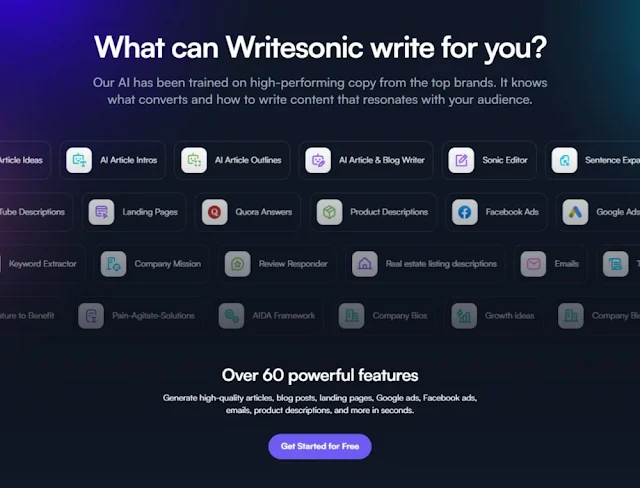
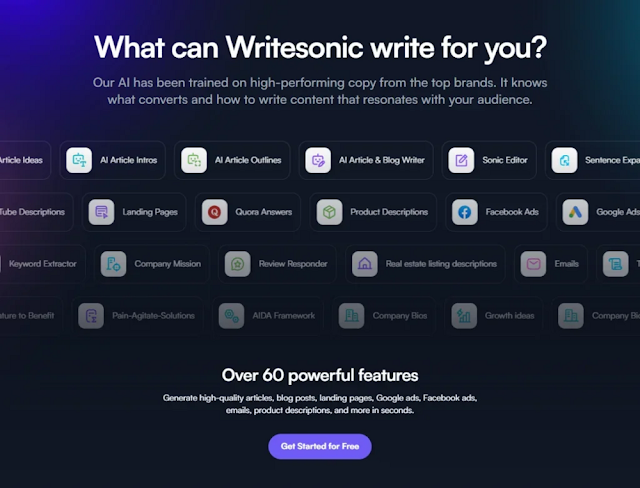
Writesonic is often cited for its balance between quality and speed. It features a built-in grammar and plagiarism checker, addressing two of the primary concerns associated with AI-generated text. In 2022, Writesonic expanded its capabilities to include landing page generation, which can draft a fully functional website layout with copy in seconds. Its tiered pricing—starting at $15 for short-form and $19 for long-form—makes it a flexible choice for growing businesses.

7. Copysmith: Scalability for E-commerce and Teams
Copysmith is engineered for scale, specifically targeting e-commerce platforms that need to generate thousands of product descriptions. Its integration with Shopify and Google Ads allows users to push AI-generated content directly to their storefronts. The platform’s "Growth Plan" at $59 per month includes collaboration tools, allowing teams to review and edit AI drafts in a centralized environment.
8. Hypotenuse.ai: Precision for Product Data
Similar to Copysmith but with a focus on visual-to-text generation, Hypotenuse.ai excels at taking product specifications or images and turning them into persuasive copy. It is a highly specialized tool that reduces the time spent on data entry for retail companies. The "Starter Plan" begins at $29 per month, providing a streamlined interface that appeals to beginners in the AI space.
9. Kafkai: Niche-Specific Bulk Generation
Kafkai operates on a "niche" model, where the AI is trained on specific categories like health, finance, or technology. This specialization ensures that the terminology used is accurate to the industry. It is primarily a tool for SEO professionals who manage large networks of sites. Pricing is volume-based, with the "Industrial Printer" plan offering 2,500 articles per month for $199, bringing the cost per article down to approximately $0.08.

10. Peppertype.ai: The Quality-First Blogging Assistant
Peppertype.ai focuses on the "human-in-the-loop" philosophy, where the AI acts as a collaborative partner to a human writer. It is particularly effective for brainstorming blog ideas and expanding on brief notes. With a Personal plan at $35 per month, it targets professional bloggers who want to increase their output without sacrificing their unique voice.
Comparative Data: Efficiency and Cost-Benefit Analysis
The adoption of these tools is largely driven by quantifiable efficiency gains. Traditional content creation—involving research, drafting, and editing—can take a human writer anywhere from three to six hours for a 1,000-word article. In contrast, an AI content generator can produce a first draft of comparable length in under five minutes.
| Feature | Jasper AI | Copy.ai | Rytr | Article Forge |
|---|---|---|---|---|
| Primary Use | Long-form/Boss Mode | Marketing/Ad Copy | Budget/Individuals | Bulk SEO Articles |
| Starting Price | $99/mo (Boss Mode) | $49/mo | $9/mo | $27/mo |
| Language Support | 25+ | 25+ | 30+ | 7+ |
| Plagiarism Check | Integrated | External | Integrated | Guaranteed Pass |
Industry Reactions and Ethical Considerations
The rise of these tools has not been without controversy. In early 2022, the digital marketing community reacted with a mix of enthusiasm and skepticism. SEO experts have closely monitored Google’s stance on AI-generated content. While Google’s algorithms have become more adept at identifying "low-quality" automated content, the search giant’s official guidelines emphasize "Helpful Content" (E-E-A-T: Experience, Expertise, Authoritativeness, and Trustworthiness) rather than the method of production.
Professional writing unions and freelance organizations have expressed concern regarding the potential for AI to devalue human labor. However, many industry analysts argue that AI is a "force multiplier" that allows writers to focus on high-level strategy and creative direction while the machines handle the repetitive drafting process.
Broader Impact and Future Implications
As 2022 draws to a close, the impact of AI content generators is visible across the entire digital economy. The cost of content production has effectively plummeted, leading to a "content explosion" where the volume of information online is growing at an exponential rate. This has made the role of editors and fact-checkers more critical than ever, as AI is still prone to "hallucinations"—the generation of factually incorrect information presented with high confidence.
The evolution of these tools suggests a future where AI and human creativity are inextricably linked. For businesses, the choice of an AI tool in 2022 is no longer just about saving money; it is about staying competitive in a landscape where speed and volume are the new benchmarks for digital success. Whether through the sophisticated long-form capabilities of Jasper or the rapid-fire marketing focus of Copy.ai, these ten tools have redefined the boundaries of what is possible in modern communication.
About the Author