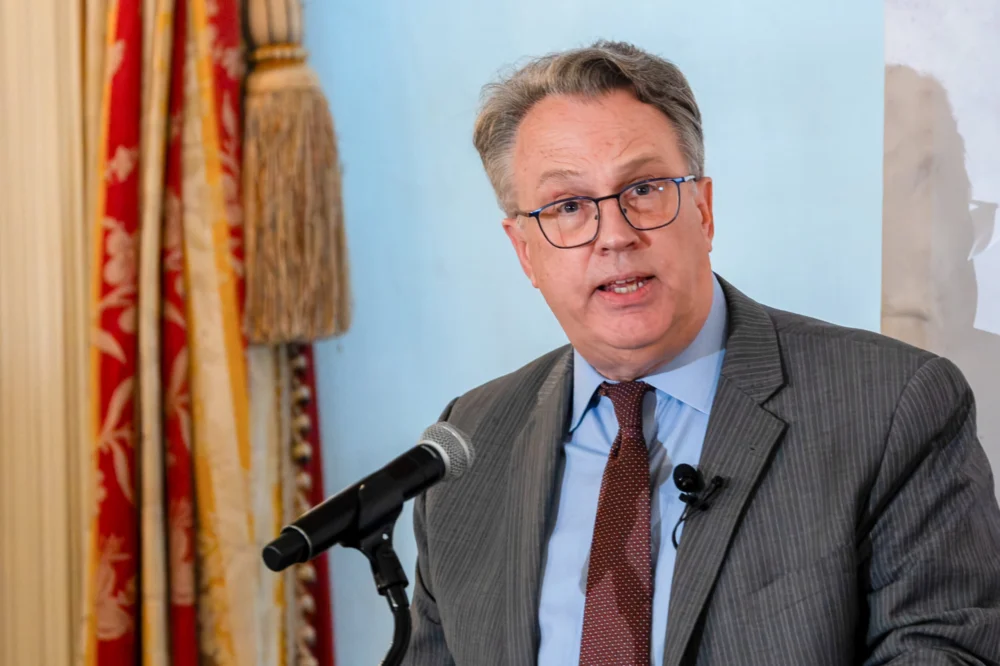
New York Federal Reserve President John Williams stated unequivocally on Tuesday that American consumers and businesses, not foreign exporters, are overwhelmingly shouldering the financial burden of President Donald Trump’s implemented tariffs. Speaking at a conference in Washington, D.C., Williams’s remarks directly challenged the long-standing White House assertion that tariffs primarily impact countries exporting goods to the United States. His statement underscored findings from a New York Fed analysis, which estimates that the majority of the tariff burden has fallen squarely on domestic U.S. firms and their consumers, leading to a meaningful increase in the prices of imported goods and temporarily stalling the Fed’s progress toward its crucial 2% inflation goal.
Unpacking the New York Fed’s Tariff Analysis
Williams’s comments provided public validation for a comprehensive white paper published on the New York Fed’s influential Liberty Street Economics blog, which had generated considerable discussion and some controversy in recent weeks. The research, titled "Who Is Paying for the 2025 U.S. Tariffs?", authored by a team of economists including Mary Amiti, Stephen J. Redding, and David E. Weinstein, presented compelling evidence that up to 90% of the additional costs stemming from the tariffs initiated in 2025 have been passed directly onto domestic producers and consumers. This finding stands in stark contrast to the administration’s repeated claims that foreign companies would absorb these costs in order to maintain market share in the lucrative U.S. market, thereby shielding American consumers from price increases.
The study employed a rigorous methodology, analyzing detailed import and producer price data from the U.S. Census Bureau and the Bureau of Labor Statistics. Researchers examined how import prices for tariffed goods changed relative to non-tariffed goods, and how these changes translated into domestic prices. Their findings indicated that the incidence of the tariffs, which refers to the ultimate economic burden, largely remained within U.S. borders. For instance, the analysis suggested that for every dollar of tariff imposed, nearly 90 cents was paid by American entities, either through higher retail prices for consumers or increased input costs for businesses that rely on imported materials for production. This economic reality has profound implications for household budgets, corporate profit margins, and the overall competitiveness of U.S. industries.
The White House’s Rebuttal and Subsequent Controversy
The New York Fed’s research was not met with universal acceptance, particularly from within the Trump administration. National Economic Council Director Kevin Hassett, a prominent economic advisor to President Trump, vociferously criticized the study shortly after its publication. During an appearance on CNBC, Hassett went as far as to suggest that the researchers responsible for the paper should be "disciplined," labeling it "the worst paper I’ve ever seen in the history of the Federal Reserve system." His strong condemnation ignited a wider debate about the independence of economic research from political influence and the interpretation of trade policy impacts.
Hassett’s initial criticism centered on the argument that the study’s models failed to adequately capture dynamic effects and long-term adjustments, such as supply chain reconfigurations or the potential for foreign suppliers to eventually reduce their prices. He and other administration officials maintained that the tariffs were a necessary tool to address unfair trade practices, protect American industries, and ultimately lead to more balanced trade relationships, with the expectation that the costs would be borne by countries engaging in such practices. However, following widespread pushback from the economic community and concerns about undermining academic freedom within the Federal Reserve System, Hassett later softened his stance, acknowledging the researchers’ right to publish their findings, albeit maintaining his disagreement with their conclusions. Williams’s public endorsement of the study’s core findings effectively reaffirmed the institution’s confidence in its internal research capabilities and its commitment to presenting objective economic analysis.
Tariffs’ Tangible Impact on U.S. Inflation and the Fed’s Mandate
Beyond merely identifying who bears the cost, Williams delved into the macroeconomic consequences of the tariffs, particularly their effect on domestic price levels. He estimated that, to date, the cumulative increase in tariffs has contributed approximately one-half to three-quarters of a percentage point to the current inflation rate, which stood at about 3% at the time of his remarks. This incremental inflationary pressure is significant, especially in the context of the Federal Open Market Committee’s (FOMC) long-term objective of achieving 2% inflation, a cornerstone of its price stability mandate.
"The FOMC defines price stability as 2 percent inflation over the longer run," Williams articulated. "Owing to the effects of tariffs, progress toward that goal has temporarily stalled." This statement highlights a critical challenge for monetary policymakers. The Federal Reserve aims for a stable, moderate rate of inflation, which is considered optimal for economic growth and stability. When external factors like tariffs introduce upward pressure on prices, it complicates the Fed’s ability to steer the economy toward its target. Higher inflation erodes purchasing power for consumers and can create uncertainty for businesses, potentially dampening investment and consumption. The Fed’s dual mandate, encompassing both maximum employment and price stability, requires careful calibration of monetary policy, and tariff-induced inflation introduces a distortion that makes this calibration more complex.

Broader Economic Context and Tariff Chronology
The tariffs in question were a signature policy initiative of the Trump administration, primarily beginning in 2025. These measures included Section 232 tariffs on steel and aluminum imports, justified on national security grounds, and Section 301 tariffs on a wide range of goods imported from China, aimed at addressing intellectual property theft and unfair trade practices. Key trading partners such as China, the European Union, Canada, and Mexico were affected, leading to retaliatory tariffs from these nations on U.S. exports, particularly agricultural products.
The implementation of these tariffs occurred during a period of robust U.S. economic growth, characterized by low unemployment and steady, albeit moderate, inflation. Gross Domestic Product (GDP) had been expanding, and the labor market was nearing what many considered full employment. However, the trade tensions introduced an element of uncertainty for businesses, leading to some delays in investment decisions and shifts in global supply chains. Manufacturers, for example, faced higher costs for imported components, which they either absorbed, passed on to customers, or sought to mitigate by relocating supply sources, often at greater expense. Agricultural sectors, heavily reliant on exports, experienced significant disruptions due as retaliatory tariffs from China and other countries impacted demand for American soybeans, pork, and other commodities.
Implications for Federal Reserve Monetary Policy
Williams’s assessment carries substantial weight given his role as President of the Federal Reserve Bank of New York, which makes him a permanent voting member of the Federal Open Market Committee (FOMC). The FOMC is the principal monetary policymaking body of the Federal Reserve System, responsible for setting the federal funds rate and guiding open market operations. His insights provide a direct window into the considerations shaping the Fed’s approach to monetary policy in the face of ongoing trade disputes.
Despite the inflationary impact of tariffs, Williams offered an optimistic outlook on the U.S. economy’s fundamental strength. He noted that the economy "appears to be on a good footing," suggesting underlying resilience. Crucially, he expressed confidence that the tariff impact on inflation would be temporary, projecting that the Fed would likely achieve its 2% target by 2027. This temporary nature of the tariff effect is a key distinction, as persistent inflationary pressures would necessitate a more aggressive monetary policy response.
Regarding current policy, Williams stated that it is "well positioned" to achieve the Fed’s dual mandate goals of steady prices and full employment. However, he also provided a forward-looking caveat: "Should inflation progress lower after the tariff impact fades, further reductions in the federal funds rate will eventually be warranted to prevent monetary policy from inadvertently becoming more restrictive." This statement signals the Fed’s readiness to adjust its policy stance if conditions warrant. If the temporary tariff-driven inflation subsides and underlying inflation trends lower, the Fed would be inclined to cut interest rates to prevent real interest rates from becoming too high, which could stifle economic growth.
Market Expectations and the Road Ahead
Financial markets closely monitor statements from Fed officials for clues about future monetary policy. Current futures pricing, as tracked by tools like the CME FedWatch Tool, indicates that markets widely expect the Fed to resume cutting interest rates later in the year, with July or September being frequently cited as potential windows for such action. These expectations are largely driven by a combination of factors, including global economic slowdown concerns, persistent low underlying inflation (excluding the tariff effect), and a desire to maintain economic momentum.
The discussion surrounding tariffs and their economic incidence underscores the complex interplay between trade policy and monetary policy. While trade policy is designed to achieve specific international trade objectives, it inevitably spills over into domestic economic conditions, influencing inflation, employment, and investment. For the Federal Reserve, maintaining its independence and providing objective economic analysis, even when it challenges political narratives, is crucial for its credibility and effectiveness. Williams’s remarks serve as a significant data point in this ongoing economic and political dialogue, reinforcing the view that tariffs, while intended to protect domestic industries, carry substantial costs that are ultimately borne by the very consumers and businesses they are designed to serve. The Fed’s careful navigation of these waters will be essential to ensuring continued economic stability and achieving its long-term policy objectives.
About the Author