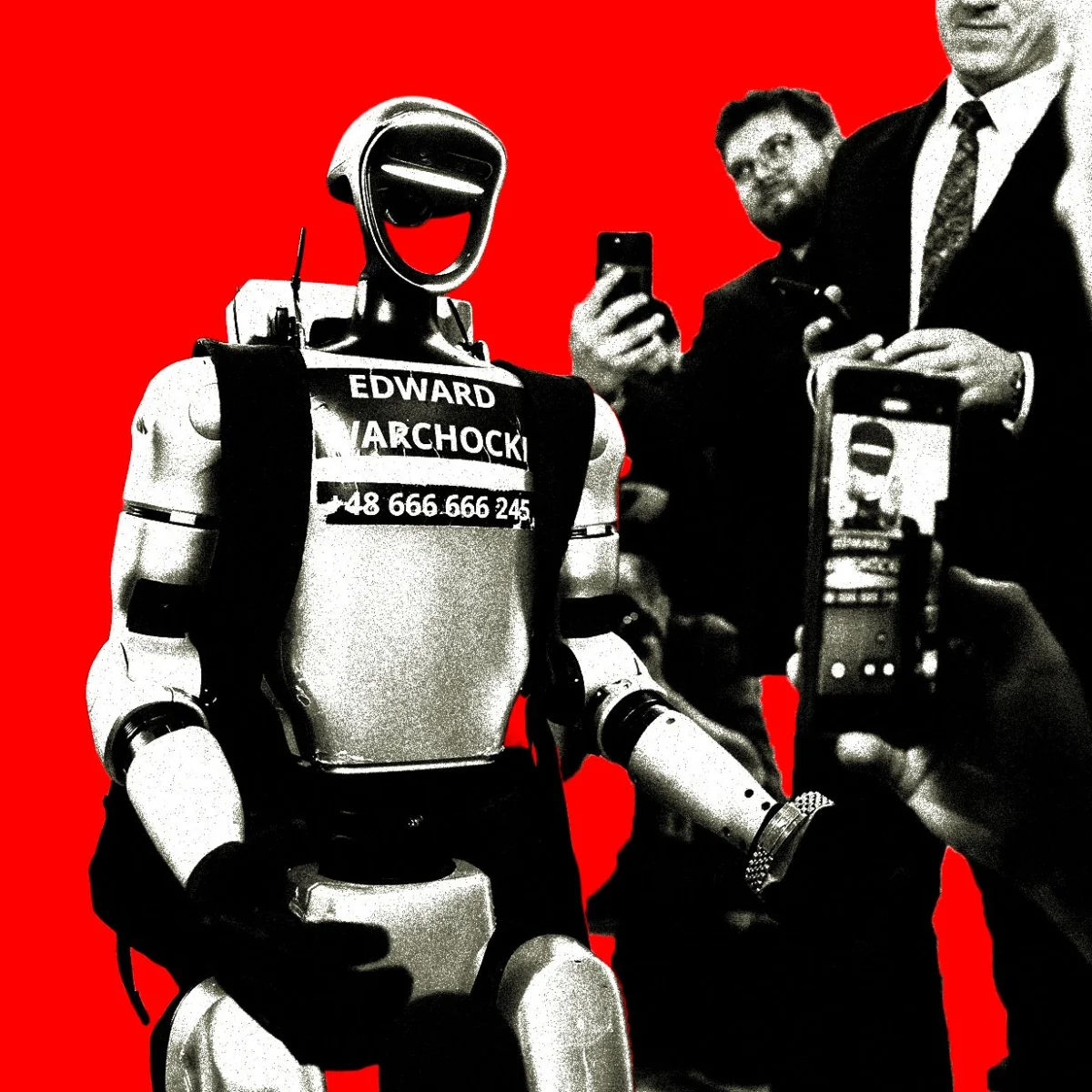
The landscape of social media and urban interaction has undergone a paradigm shift as humanoid robots transition from high-tech laboratories to city streets. In Warsaw, Poland, a four-foot-tall humanoid named Edward Warchocki has become a local celebrity, exemplifying a broader global trend where robotic entities are no longer viewed merely as industrial tools but as "humanoid influencers." Created by software developer Bartosz Idzik and his colleague Radosław Grzelaczyk, Edward represents the intersection of advanced Chinese hardware and sophisticated Western software integration. While the machine initially elicited fear from the public due to its silent, mechanical presence, its integration with a Large Language Model (LLM) transformed it into a conversational companion, capable of engaging in real-time dialogue in Polish. This transition from a "40-kilogram machine" to a social entity has facilitated a massive digital footprint, with Edward amassing over 1 million followers and generating 4 billion views across various social media platforms.
The phenomenon is not isolated to Eastern Europe. By early 2026, similar robotic personalities have emerged in major metropolitan hubs worldwide. In Austin, Texas, a Unitree G1 variant known as "Rizzbot" dons a cowboy hat to flirt with pedestrians, while in New York City, "Bart Robot" gained notoriety for breakdancing with sports fans following a local championship. In Miami, the "Brickell Clanker" became a staple of the World Cup festivities, alternating between national jerseys to party with international fans. Despite their varied personas and geographical locations, these robots share a common technological lineage: they are all Unitree G1 models, a product of the Hangzhou-based Unitree Robotics. This specific model has become the hardware of choice for the burgeoning "robot influencer" industry due to its relative affordability, mobility, and the ease with which it can be customized for social interaction.
The Evolution of the Unitree G1 and the Influencer Chronology
The journey of the Unitree G1 from a prototype to a viral sensation began with its market entry as one of the most accessible humanoid robots globally. Standing roughly the height of a child, the G1 features a distinctive hollowed-out facial structure illuminated by a ring of blue light, with limbs constructed from light-gray aluminum. The chronology of its public integration reveals a rapid expansion of use cases. In late 2024 and throughout 2025, the G1 moved beyond tech trade shows and into the realm of popular entertainment. It has appeared on televised talent competitions, demonstrated traditional martial arts, and participated in parkour and boxing matches.
The viral trajectory of Edward Warchocki serves as a primary case study for this adoption. Six months ago, Idzik and Grzelaczyk imported the robot from China, naming it after Grzelaczyk’s dog, Eddie, and the Polish verb for growling, "warczeć." The initial public reaction was one of apprehension; a silent, bipedal machine navigating public spaces triggered the "uncanny valley" response in many observers. However, the implementation of a voice interface powered by an LLM changed the public’s perception. By April 2026, Edward’s activities ranged from the mundane to the surreal, including a viral incident where the robot, equipped with a backpack and a luxury watch, successfully chased a sounder of wild boars out of a Warsaw residential area. This event solidified the robot’s status as a cultural icon rather than a mere technological novelty.
Technical Specifications and the Cost of Entry
For enthusiasts and entrepreneurs like Jake Cooperstein in Miami, the appeal of the Unitree G1 lies in its balance of capability and cost. On the manufacturer’s official website, the base model G1 is listed at approximately $13,500. However, the actual cost for international buyers is significantly higher due to logistical and regulatory factors. In the United States, distributors typically list the robot at around $19,000 after accounting for shipping, insurance, and import tariffs.
For those seeking more than a basic "clout-seeking" machine, the costs escalate further. Cooperstein, who sought to create his own humanoid influencer after being inspired by the Polish project, noted that the entry-level G1 lacks advanced features such as dexterous hands and is subject to strict modification prohibitions. Consequently, many serious developers opt for the U5 variation, designed primarily for educational and research institutions. The U5 model offers enhanced customization and a more robust set of components but carries a price tag of approximately $66,000. This disparity highlights a growing divide in the robotics market between casual users utilizing the robot for social media content and developers aiming to push the boundaries of robotic autonomy and utility.
Unitree’s Financial Performance and Market Dominance
The commercial success of the G1 has propelled Unitree Robotics to the forefront of the global industry. As the company prepares for its initial public offering (IPO) on the Chinese stock market, its financial disclosures provide a rare glimpse into the profitability of the humanoid sector. Unlike many Western competitors whose products remain in the testing or pilot phases within controlled environments, Unitree has successfully transitioned to mass-market delivery.
In 2025, Unitree reported shipping 5,511 humanoid units, with an average sale price of just under $25,000 per unit. Crucially, the company achieved profitability for the first time in its history last year, a milestone that has eluded many of its more heavily funded rivals. The data also underscores the global nature of this technology; 43 percent of Unitree’s sales in 2025 originated from outside China. This international demand is driven by the fact that the G1 is currently the only humanoid robot in its price bracket that offers a reliable blend of mobility and durability for outdoor use. Bartosz Idzik, the creator of Edward Warchocki, noted that after testing various humanoid models, the G1 proved superior for public-facing roles, suggesting that while the world is accustomed to China emulating foreign technology, in the field of humanoid robotics, the global market is now looking to China for leadership.
Public Perception and the "Clanker" Culture
The integration of robots into daily life has birthed a new subculture, particularly on platforms like X (formerly Twitter) and TikTok. The term "clanker," once a derogatory term in science fiction, has been reclaimed by fans of these machines as a term of endearment. Social media reactions range from genuine fascination to "shitposting" and meme creation. The G1 has been seen in diverse scenarios: being ordained as a monk in Japan and South Korea, praying at a mosque in Dubai, and streaming alongside high-profile internet personalities like Kai Cenat.
However, the rise of the humanoid influencer has also sparked a debate regarding the practical utility of these machines. Critics argue that while robots like Edward Warchocki are excellent for "clout-seeking" and public relations, they have yet to prove their worth in traditional economic roles. The question of when the Unitree G1 will "get a real job"—such as performing domestic chores or working on an assembly line—remains a central point of skepticism. Current models, while agile enough to dance or navigate city streets, still struggle with the fine motor skills required for complex manual labor. For instance, videos of the G1 attempting to cook often end in failure, illustrating the gap between social interaction and physical productivity.
Broader Implications for the Future of Robotics
The success of the Unitree G1 signals a shift in how the robotics industry approaches the market. While companies like Tesla with the Optimus project or Boston Dynamics with Atlas focus on high-end industrial and household applications, Unitree has identified a lucrative niche in the "social robotics" sector. By lowering the price point and allowing for third-party software integration, they have enabled a decentralized wave of innovation.
The implications of this trend are twofold. On one hand, the presence of humanoid robots in public spaces could normalize human-robot interaction, paving the way for more functional service robots in the future. On the other hand, the rise of autonomous, LLM-powered influencers raises questions about digital identity, public safety, and the regulation of AI-driven entities in physical spaces. The "arrest" of Edward Warchocki by Polish police, though conducted jokingly, foreshadows a future where legal frameworks will need to account for the actions and liabilities of robotic citizens.
As Unitree prepares for its IPO, the world will be watching to see if the company can maintain its momentum. The transition from social media novelty to economic necessity will be the next major hurdle. For now, the "clankers" continue to roam the streets, bridging the gap between science fiction and reality one viral video at a time. Whether they are chasing boars in Warsaw or breakdancing in New York, these machines have already achieved something few thought possible: they have become a part of the global social fabric.
About the Author