The International Chamber of Commerce (ICC) has announced the upcoming release of the ICC Global Trade Intelligence Report for the 2025-2026 cycle, marking a significant milestone in the evolution of trade finance data and risk assessment. As the world’s most comprehensive benchmark for trade and supply chain finance, the report is built upon a foundation of over a decade of aggregated data provided by 22 of the world’s leading global financial institutions. With a database covering more than $25.7 trillion in transactions, the report serves as a critical strategic asset for financial institutions, regulators, and non-bank corporations seeking to navigate the complexities of international trade.
The forthcoming edition arrives at a pivotal moment for the global economy, as trade patterns shift in response to geopolitical tensions, digital transformation, and the increasing urgency of environmental, social, and governance (ESG) standards. By providing actionable insights into risk performance, default rates, and loss rates, the ICC Global Trade Intelligence Report enables banks to make more informed credit decisions and optimize their capital allocation strategies.
Historical Context and the Evolution of the Trade Register
The origins of this report trace back to the aftermath of the 2008 global financial crisis. At that time, the banking industry faced heightened scrutiny and more stringent regulatory requirements under the Basel Accords. Trade finance, traditionally viewed as a low-risk asset class, lacked the standardized, large-scale data necessary to prove its safety to regulators. In response, the ICC launched the Trade Register Project in 2009 to provide empirical evidence of the low-risk nature of trade finance compared to other forms of corporate lending.
Over the last 15 years, what began as a defensive effort to protect trade finance from punitive capital requirements has evolved into a sophisticated business intelligence tool. The rebranding from the "ICC Trade Register" to the "ICC Global Trade Intelligence Report" reflects this transition. Today, the report does more than just track defaults; it provides a granular look at market opportunities, regional performance variances, and the efficacy of different trade finance products, such as Letters of Credit (LCs), guarantees, and supply chain finance (SCF) programs.
Strategic Partnerships and Data Integrity
The high standard of the ICC Global Trade Intelligence Report is maintained through a long-standing strategic partnership between the International Chamber of Commerce, the Boston Consulting Group (BCG), and Global Credit Data (GCD). This collaboration ensures that the report combines industry-leading data collection with rigorous analytical frameworks.
Global Credit Data, a non-profit association owned by banks, provides the technical infrastructure for data collection, ensuring that the information is anonymized, standardized, and compliant with strict competition laws. BCG then applies its strategic expertise to interpret the data, identifying trends that assist bank executives in shaping their long-term trade strategies. This tripartite arrangement ensures that the report is not only statistically sound but also commercially relevant for C-suite decision-makers.
The 22 member banks that contribute data represent a significant portion of the global trade finance market. These institutions provide detailed information on their portfolios, including transaction-level data that allows for a deep dive into "Probability of Default" (PD) and "Loss Given Default" (LGD). This level of transparency is essential for the industry to maintain a constructive dialogue with global regulators, such as the Basel Committee on Banking Supervision.
Analyzing the 2026 Report Roadmap
The 2026 edition of the report is expected to introduce several new dimensions to the traditional data set. While the core focus remains on risk performance, the ICC has signaled that the upcoming report will place a greater emphasis on the "Trade Finance Gap"—the difference between the demand for trade finance and the availability of credit, which currently stands at approximately $2.5 trillion globally.
Key features of the 2026 report package will include:
- Global Overview Report: A macro-level analysis of the state of trade finance, highlighting global trends in default rates and portfolio performance.
- Regional Data Analysis: Tailored insights into specific markets, recognizing that trade risks in emerging markets often differ significantly from those in developed economies.
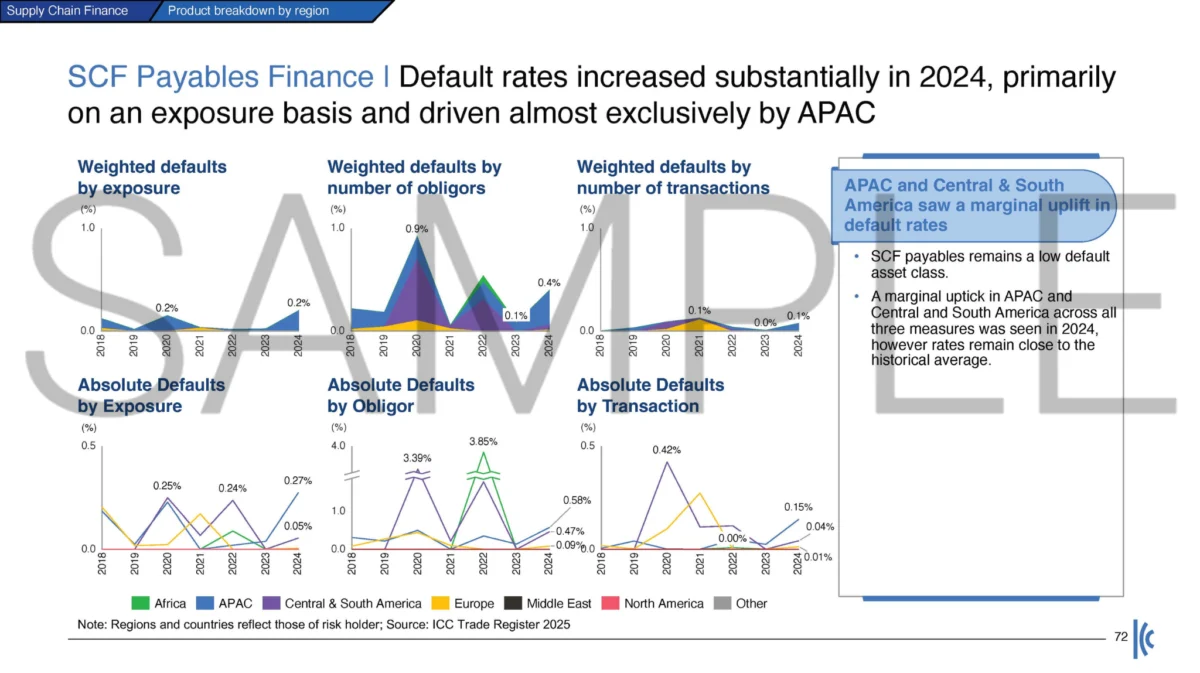
- Product-Specific Reports: Deep dives into individual instruments, such as Documentary Credits and Supply Chain Finance, allowing banks to benchmark their specific product lines against global peers.
- ESG and Digitalization Metrics: Preliminary data on how sustainability criteria and the transition to digital trade documents (such as electronic Bills of Lading) are impacting risk profiles.
The Role of Trade Finance in Global Stability
Trade finance is often described as the "oil" that lubricates the wheels of global commerce. It is estimated that 80% to 90% of world trade relies on some form of financing, insurance, or guarantee. Without these mechanisms, international trade would be significantly more expensive and riskier, particularly for Small and Medium-sized Enterprises (SMEs) in developing nations.
The ICC Global Trade Intelligence Report plays a vital role in ensuring that trade finance remains accessible. By demonstrating that trade finance products have consistently low default rates—often lower than general corporate lending—the report encourages banks to continue lending even during periods of market volatility. This is particularly crucial for emerging markets, where perceived risk often exceeds actual default history. The data provided by the ICC helps to close this perception gap, fostering financial inclusion and economic growth.
Impact on Regulatory Compliance and Capital Requirements
One of the primary applications of the report is its use in regulatory reporting. Under the Basel III and the upcoming Basel IV frameworks, banks are required to hold a certain amount of capital against their risk-weighted assets. The ICC’s data provides the empirical basis for banks to argue for "credit conversion factors" and risk weights that accurately reflect the short-term, self-liquidating nature of trade finance transactions.
Financial institutions that utilize the report have reported improvements in their regulatory capital treatment. By aligning their internal risk models with the global benchmarks provided by the ICC, banks can potentially free up capital, allowing them to extend more credit to exporters and importers. This creates a virtuous cycle where better data leads to better capital efficiency, which in turn supports higher trade volumes.
Membership and Collaborative Industry Shaping
Membership in the ICC Global Trade Intelligence Report project offers institutions a "seat at the table" in shaping the industry’s leading source of intelligence. Member banks receive exclusive benefits, including access to a benchmarking tool that allows them to compare their own portfolio performance against the aggregated industry average. This helps internal risk teams identify areas of over-performance or potential vulnerability.
Furthermore, the ICC encourages non-bank corporations and technology providers to engage with the report through sponsorship and partnership opportunities. As the trade finance ecosystem expands to include fintechs and non-bank lenders, the need for a unified data standard becomes even more pressing. The ICC serves as the neutral platform where these various stakeholders can collaborate to ensure the continued resilience of the trade finance market.
Addressing the Challenges of a Changing Landscape
As the ICC prepares the 2026 report, it must contend with a rapidly changing global environment. The rise of protectionism and the restructuring of supply chains (often referred to as "near-shoring" or "friend-shoring") are altering the traditional routes of trade. The report’s regional analysis will be essential for understanding how these shifts are impacting default rates in different parts of the world.
Additionally, the push for digitalization is transforming the operational side of trade finance. The adoption of the Model Law on Electronic Transferable Records (MLETR) by various jurisdictions is paving the way for a paperless trade environment. Future iterations of the ICC report are expected to track how digitalization reduces operational risks and fraud, which have historically been significant concerns in trade finance.
Conclusion and Future Outlook
The ICC Global Trade Intelligence Report remains the definitive authority on the risk and performance of trade finance. By bridging the gap between raw data and strategic insight, it empowers financial institutions to navigate a volatile global market with confidence. The 2025-2026 report will not only continue the tradition of providing world-class benchmarks but will also evolve to address the modern challenges of sustainability, digitalization, and economic inclusion.
For global banks, the report is an indispensable tool for capital optimization and risk management. For regulators, it provides the transparency needed to ensure financial stability without stifling trade. And for the broader global economy, it serves as a testament to the enduring strength and safety of the mechanisms that power international commerce. As the full report release approaches, the industry anticipates a new set of data that will likely reaffirm trade finance as one of the most resilient and vital sectors of the global financial system.
About the Author