The International Chamber of Commerce (ICC) has announced the forthcoming release of its 2026 Global Trade Intelligence Report, a comprehensive data-driven initiative designed to provide the global banking sector and institutional investors with unprecedented insights into the risk profiles of trade and supply chain finance. This latest iteration of the report, which has evolved from the long-standing ICC Trade Register, is built upon a decade of aggregated data provided by 22 of the world’s leading global banks. By analyzing over $25.7 trillion in transactions, the report serves as the definitive benchmark for assessing default and loss rates across various trade finance instruments. The 2026 edition arrives at a critical juncture for the global economy, as financial institutions navigate shifting regulatory landscapes, geopolitical volatility, and the increasing digitalization of international commerce.
The Strategic Importance of Trade Finance Intelligence
Trade finance is the backbone of the global economy, facilitating approximately 80% to 90% of world trade. Despite its vital role, trade finance has historically faced challenges regarding data transparency and the accurate assessment of risk by regulatory bodies. The ICC Global Trade Intelligence Report addresses these gaps by providing empirical evidence of the low-risk nature of trade finance products compared to other asset classes. The 2026 report is expected to further reinforce the argument for favorable regulatory treatment, particularly under the evolving Basel III and Basel IV frameworks, which dictate the capital requirements for banks.
By leveraging the world’s most comprehensive dataset, global financial institutions can use the report to support more informed decision-making. According to previous user feedback and historical performance metrics, institutions utilizing this intelligence have reported significant improvements in their ability to optimize capital allocation and refine their risk-weighted asset (RWA) calculations. The report’s findings are not merely academic; they are strategic assets that allow banks to justify lower risk premiums for trade-related lending, thereby enhancing liquidity for exporters and importers worldwide.
Evolution and Chronology of the ICC Trade Data Initiative
The journey toward the 2026 Global Trade Intelligence Report began over a decade ago with the establishment of the ICC Trade Register. Initially conceived as a project to gather basic default data to present to the Basel Committee on Banking Supervision, the initiative has grown in both scope and sophistication.
- The Formative Years (2009–2015): In the wake of the 2008 global financial crisis, the ICC recognized a need for standardized data to prove that trade finance did not carry the same systemic risk as other forms of corporate lending. The first reports focused on basic Letter of Credit (L/C) performance.
- Expansion and Collaboration (2016–2020): The project expanded its partnership to include the Boston Consulting Group (BCG) and Global Credit Data (GCD). This collaboration brought advanced analytical capabilities and a more robust data-pooling methodology. The number of participating banks grew, and the volume of analyzed transactions reached the tens of trillions.
- The Rebranding and Digital Shift (2021–2024): Recognizing the broader utility of the data beyond regulatory advocacy, the ICC rebranded the initiative as the Global Trade Intelligence Report. This shift signaled a move toward providing "actionable intelligence" that helps banks identify emerging market opportunities and assess regional risk performance.
- The 2026 Milestone: The upcoming report represents the most technologically advanced version to date, incorporating sophisticated data modeling to account for post-pandemic recovery trends and the impact of digital trade documents.
Detailed Methodology and Data Composition
The integrity of the ICC Global Trade Intelligence Report is maintained through a rigorous data-gathering process managed by Global Credit Data (GCD), a non-profit organization owned by 55 global banks. For the 2026 report, 22 member banks have contributed granular data on their trade finance portfolios. This data is anonymized and aggregated to ensure confidentiality while providing a high-fidelity view of market performance.
The $25.7 trillion transaction pool covers a wide array of products, including:
- Import and Export Letters of Credit: Traditional instruments that provide payment security.
- Loans for Import/Export: Direct financing provided to facilitate the movement of goods.
- Performance and Financial Guarantees: Instruments that ensure contractual obligations are met.
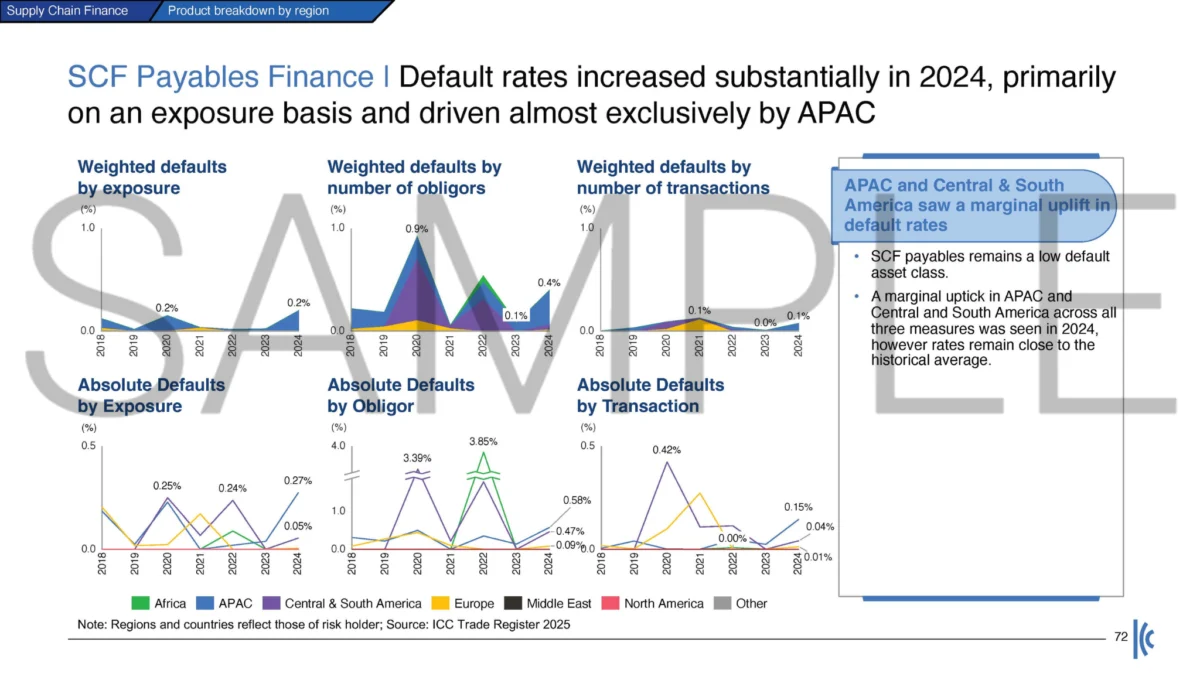
- Supply Chain Finance (SCF): Increasingly popular programs such as reverse factoring that optimize working capital for both buyers and suppliers.
The report’s methodology distinguishes between "default rates" (the frequency of obligor failure) and "loss rates" (the actual financial loss incurred after recoveries). Historically, the ICC data has shown that trade finance loss rates are exceptionally low, often below 0.1%, due to the self-liquidating nature of the transactions and the underlying collateral of the goods being traded.
Key Features of the 2026 Report Package
The 2026 release is structured as a "complete package" to cater to the diverse needs of the financial community. This modular approach allows users to access specific insights relevant to their regional focus or product specialization.
Global Overview Report
The flagship component provides a macro-level analysis of the global trade finance landscape. It includes executive summaries of default and loss rates across all product categories and offers a high-level view of how trade finance risks correlate with global economic cycles.
Regional Data Analysis
Recognizing that risk is not uniform across the globe, the 2026 report includes deep dives into specific geographic markets. This is particularly valuable for banks looking to expand into emerging markets in Southeast Asia, Africa, and Latin America, where perceived risk often exceeds actual historical default data.
Product-Specific Deep Dives
For specialized teams within financial institutions, the report offers detailed performance metrics for specific instruments. This includes an analysis of Supply Chain Finance, which has seen rapid growth and increased regulatory scrutiny in recent years. By providing hard data on SCF performance, the ICC helps banks build more resilient and compliant programs.
Strategic Partnerships and Industry Influence
The high standard of the ICC Global Trade Intelligence Report is enabled by a strategic tripartite partnership between the International Chamber of Commerce, Boston Consulting Group, and Global Credit Data.
- The ICC provides the institutional framework and global reach, ensuring the report aligns with international trade standards and policy goals.
- Boston Consulting Group (BCG) contributes strategic analysis, helping to translate raw data into business insights that bank executives can use for portfolio management.
- Global Credit Data (GCD) manages the technical aspects of the data pool, ensuring that the statistics meet the highest standards of accuracy and reliability required by bank regulators.
Furthermore, the ICC has opened the platform for non-bank corporations to engage with the report. Through sponsorship opportunities, corporate entities can raise their visibility within the financial sector and participate in the dialogue surrounding the future of trade intelligence. This inclusivity reflects the growing interconnectedness of the trade ecosystem, where corporates, fintechs, and traditional banks must collaborate to bridge the global trade finance gap—currently estimated by the Asian Development Bank to be approximately $2.5 trillion.
Analysis of Implications for the Financial Sector
The release of the 2026 report is expected to have several significant implications for the industry. First and foremost is the impact on capital adequacy. As banks implement Basel III "Endgame" standards, the ICC data provides the empirical foundation necessary to argue for lower credit conversion factors (CCFs) for trade finance products. If regulators accept that these products are lower risk, banks can hold less capital against them, thereby freeing up billions of dollars in lending capacity.
Secondly, the report will likely influence the "flight to quality" seen in global markets. By highlighting the stability of trade finance during periods of volatility, the report encourages institutional investors to view trade finance as a viable alternative asset class. This could lead to increased securitization of trade assets, bringing much-needed non-bank liquidity into the market.
Finally, the 2026 report will serve as a baseline for the industry’s digital transformation. As more trade transactions move to digital platforms, the ICC’s ability to track and report on these digital instruments will be crucial for establishing trust in electronic bills of lading and other paperless trade solutions.
Access and Membership
Access to the full suite of data and the Global Trade Intelligence Report is a primary benefit for the 22 member banks that contribute data. These institutions have a "seat at the table" where they help shape the industry’s leading source of intelligence. However, the ICC also makes the Global Overview and specific modules available to the wider public and other financial institutions through its "2go" digital platform.
Prospective members and interested parties are encouraged to monitor the official ICC channels for the exact release date of the 2026 report. As the global trade landscape continues to face challenges from supply chain shifts and geopolitical tensions, the ICC Global Trade Intelligence Report remains an essential tool for those seeking to navigate the complexities of international finance with confidence and data-driven precision.
About the Author