The digital marketing landscape in 2022 has been fundamentally altered by the rapid integration of artificial intelligence into the creative process. As businesses face increasing pressure to produce high-quality content at scale, AI content generators have emerged as a critical solution for maintaining competitive relevance. These tools, largely powered by sophisticated Large Language Models (LLMs) such as OpenAI’s GPT-3, enable users to generate articles, social media posts, and marketing copy with unprecedented speed. The shift toward automated content creation represents a significant pivot in the digital economy, moving from manual labor-intensive writing to a hybrid model where human editors collaborate with machine-generated drafts.
The Rise of Generative AI in the Content Economy
The surge in AI writing technology is not an isolated event but the result of several years of breakthroughs in Natural Language Processing (NLP). By 2022, the technology reached a level of maturity where the output often mimics human tone, syntax, and logic with high accuracy. According to market research, the global AI in marketing market was valued at approximately $15.84 billion in 2021 and is projected to reach over $107 billion by 2028. This growth is driven by the need for personalization and the sheer volume of content required to satisfy search engine algorithms and social media feeds.

Industry analysts note that the primary value proposition of these tools is efficiency. A standard 1,000-word blog post that might take a human writer four to six hours to research and draft can now be outlined and drafted by an AI in under fifteen minutes. This allows marketing teams to focus more on strategy and distribution rather than the mechanical act of writing.
Comprehensive Analysis of Leading AI Content Generators
To navigate this burgeoning market, it is essential to evaluate the tools based on their specific utility, pricing structures, and technological strengths. The following ten platforms represent the vanguard of AI content generation in 2022.
1. Jasper AI: The Enterprise Standard for Long-Form Content
Formerly known as Jarvis, Jasper AI underwent a significant rebranding in early 2022 following trademark discussions with Marvel. It has since established itself as a leader in the long-form content space. Jasper utilizes a proprietary blend of LLMs to offer "Boss Mode," a feature that allows users to write long-form documents through direct commands.
Jasper’s pricing model reflects its professional positioning, with the Boss Mode plan starting at $99 per month. Its key features include a plagiarism checker integration via Copyscape and a "Recipes" function that allows users to create repeatable workflows for different types of content.
2. Copy.ai: Versatility in Marketing and Social Media
Copy.ai focuses on the "short-form" segment of the market, providing over 90 templates for various needs, ranging from Instagram captions to product descriptions. The platform is designed for ease of use, requiring minimal input to generate dozens of variations of marketing copy.
For small businesses and individual creators, Copy.ai offers a free trial followed by a Pro plan priced at $49 per month (or $35 per month when billed annually). Its strength lies in its ability to overcome "writer’s block" by providing diverse creative angles on a single prompt.

3. Frase: Bridging the Gap Between AI and SEO
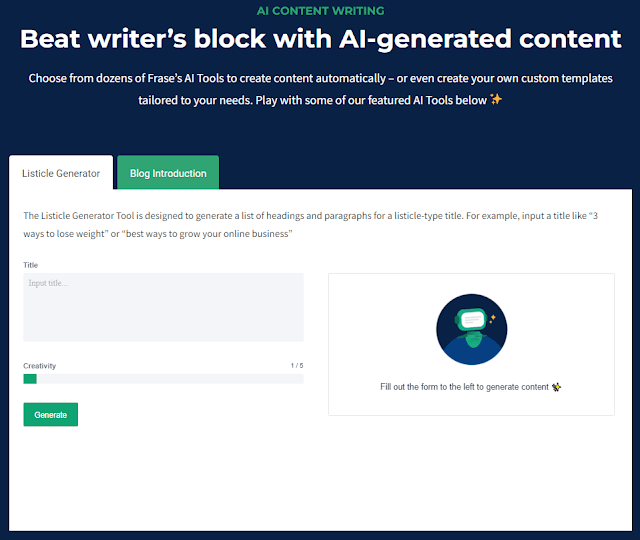
Frase occupies a unique niche by combining content generation with SEO research. Unlike tools that focus solely on the writing process, Frase analyzes the top-ranking search results for a given keyword and helps users create content briefs and drafts that are optimized for search engines.
The pricing structure for Frase is tiered to accommodate different scales, with a Solo plan at $14.99 per month and a Team plan at $114.99 per month. It is widely regarded by SEO professionals as a tool for data-driven content creation rather than just creative writing.
4. Article Forge: High-Speed Automated Article Production
Article Forge distinguishes itself through a "one-click" approach. While other tools require constant human intervention and prompting, Article Forge generates a complete article based on a single keyword. It uses deep learning models to research, plan, and write long-form content autonomously.
The platform offers a Basic plan for $27 per month (limited to 25,000 words) and an Unlimited plan for $117 per month. Notably, Article Forge guarantees that its content will pass plagiarism checks, making it a popular choice for high-volume niche site owners.
5. Rytr: Accessibility and Cost-Effectiveness
Rytr has gained a significant user base by offering a robust free tier and highly competitive paid plans. It supports over 30 languages and features a built-in plagiarism checker and an image generator.
The "Saver Plan" is priced at $9 per month, while the "Unlimited Plan" costs $29 per month. This pricing makes Rytr the preferred choice for students, freelance writers, and startups operating on restricted budgets.

6. Writesonic: Comprehensive Content Suite
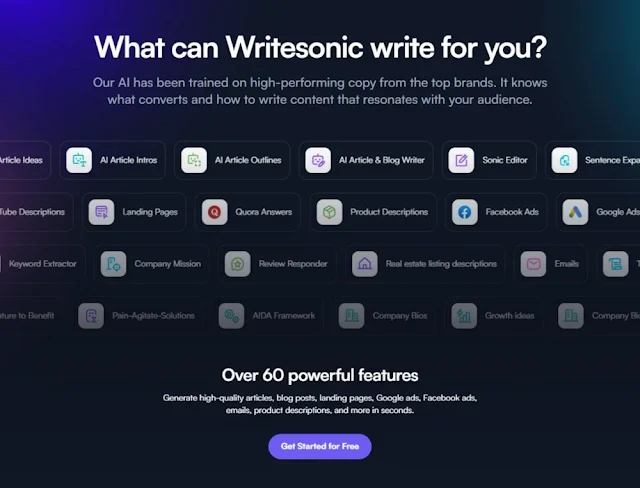
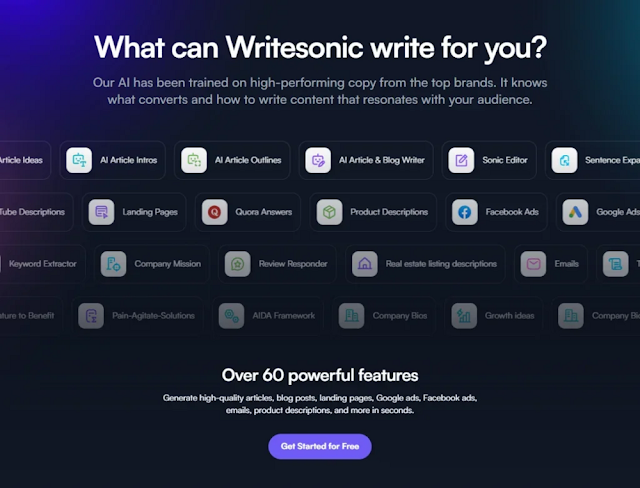
Writesonic offers a diverse array of features, including an AI article writer, a landing page generator, and a paraphrasing tool. It is particularly noted for its "AI Article Writer 3.0," which guides users through a step-by-step process of generating titles, outlines, and full drafts.
The platform utilizes a credit-based system, with short-form plans starting at $15 per month and long-form plans at $19 per month. Its integration of grammar and plagiarism checkers adds a layer of quality assurance necessary for professional publishing.
7. Copysmith: Scalable Solutions for E-commerce
Copysmith is engineered for teams and e-commerce businesses that need to manage large volumes of product descriptions and marketing copy. It features a bulk generation tool and integrates directly with platforms like Shopify and Google Ads.

With a Starter plan at $19 per month and a Professional plan at $59 per month, Copysmith targets the mid-market segment. Its collaborative features allow teams to review and edit content within a shared workspace.
8. Hypotenuse.ai: Specialized E-commerce Optimization
Hypotenuse.ai focuses heavily on the retail sector, using AI to turn product attributes into persuasive descriptions. It also offers a "Content Detective" feature that helps the AI find factual information to include in blog posts, addressing one of the common criticisms of generative AI: factual hallucination.
The Starter plan is priced at $29 per month, while the Growth plan is $59 per month. It is frequently cited for its ability to maintain a consistent brand voice across thousands of product listings.
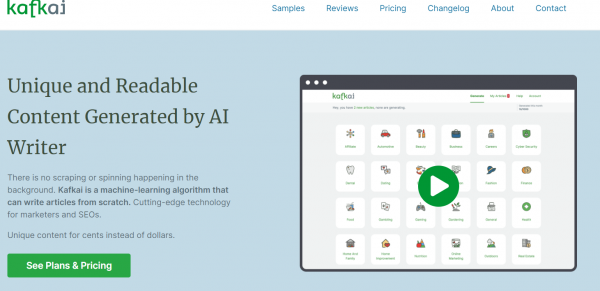
9. Kafkai: Niche-Specific Training Models
Kafkai operates differently by training its AI on specific niches (such as health, finance, or technology) rather than using a general-purpose model. This results in content that is more aligned with the specific terminology and expectations of a particular industry.
Pricing ranges from $29 per month for 100 articles to $199 per month for 2,500 articles. This "per article" pricing model is unique in the industry and appeals to SEO agencies managing multiple client portfolios.
10. Peppertype.ai: Streamlined Content for Small Businesses
Peppertype.ai is designed for speed and simplicity. It provides a clean interface where users can select a content type, enter their brand name and description, and receive multiple copy options instantly.

The Personal plan starts at $35 per month, with a Team plan at $199 per month. It is optimized for social media managers and small business owners who require quick, high-quality copy for daily engagement.
Chronology of Development: From GPT-2 to the 2022 Explosion
The current state of AI content generation is the result of a rapid technological timeline:
- 2019: OpenAI releases GPT-2, demonstrating that AI could write coherent paragraphs, though it often lost the narrative thread.
- 2020: The release of GPT-3 marks a turning point. With 175 billion parameters, the model could write entire essays and even code.
- 2021: Early adopters like Jasper (Jarvis) and Copy.ai begin to build user interfaces around the GPT-3 API, making the technology accessible to non-technical users.
- 2022: The market reaches a "tipping point." Competition drives down prices and leads to specialized features like SEO integration and niche training.
Industry Perspectives and Official Responses
The rapid adoption of AI writing has prompted reactions from major industry players. Google’s Search Relations team has clarified its stance multiple times throughout 2022. Initially, there was concern that AI-generated content would be classified as "spam." However, Google later clarified that its algorithms focus on the quality and helpfulness of the content rather than how it was produced. This shift has validated the use of AI as an assistive tool for creators.

Content marketing experts, however, urge caution. "AI is a calculator for words," says one industry analyst. "It can perform the mechanical tasks of writing, but it lacks the lived experience and original insight that defines high-authority content."
Fact-Based Analysis of Broader Implications
The widespread use of these ten tools carries significant implications for the future of the internet. On the positive side, AI lowers the barrier to entry for small businesses to compete in the digital marketplace. It also democratizes content creation for non-native English speakers who can use these tools to polish their prose.
Conversely, the "commoditization of content" presents risks. As the web becomes flooded with AI-generated text, search engines may find it increasingly difficult to surface truly original human thought. Furthermore, the ethical implications regarding copyright and the training data used for these models remain a subject of ongoing legal debate in 2022.
In conclusion, the top 10 AI content generator tools of 2022 represent a fundamental shift in how information is produced and consumed. While Jasper AI and Frase lead in sophistication and SEO utility, tools like Rytr and Writesonic ensure that the technology remains accessible to a broad audience. As these tools continue to evolve, the distinction between human-authored and machine-generated content will likely continue to blur, necessitating new standards for transparency and quality in the digital age.
About the Author