The pursuit of a top search engine result page (SERP) position has long been the holy grail for marketers and SEO professionals. However, in the rapidly evolving era of artificial intelligence, traditional search engine optimization (SEO) alone no longer tells the complete story of a brand’s online presence. The advent of Answer Engine Optimization (AEO) demands a new approach to measuring success, focusing on a brand’s visibility within AI-generated answers. This shift introduces a crucial set of metrics, including mentions, citations, and share of voice, which are paramount for understanding and tracking a brand’s presence in the burgeoning world of AI search.
Understanding the Paradigm Shift: AI Search Visibility vs. Traditional SEO
AI search visibility quantifies how frequently AI-powered answer engines, such as ChatGPT, Gemini, and Perplexity, incorporate a brand into their responses. Unlike traditional SEO, which prioritizes a website’s ranking on a list of blue links, AI search consolidates information into a single, synthesized answer. A brand’s success in this new paradigm hinges on whether it is included in this singular output.
This fundamental change in how information is presented has a direct impact on the metrics that matter. A top ranking in traditional search no longer guarantees inclusion in an AI-generated answer. A comprehensive analysis by Semrush of 200,000 Google AI Overviews revealed that the leading organic result was cited only 34% of the time on mobile and 46% on desktop. This data underscores the critical need for marketers to adapt their strategies and embrace AEO.
The key metrics for tracking AI search visibility now include:
- Mentions: Instances where a brand is named within an AI answer, irrespective of a direct link.
- Citations: When an AI engine references a specific web page as a source. An "owned citation" occurs when the cited page belongs to the brand.
- AI-Referred Traffic: Website visits originating from clicks on AI-generated citations.
- Conversions and Pipeline Attribution: The downstream impact of AI-referred traffic on lead generation, sales opportunities, and revenue.
- Consistency Over Time: The stability of a brand’s presence in AI answers across repeated queries and over a defined period.
- Accuracy and Hallucination Detection: The rate at which AI engines correctly represent a brand’s information, identifying and mitigating factual errors.
- Sentiment and Tone Analysis: The overall perception conveyed by AI engines when referencing a brand.
- Retrieved and Cited Pages: Identifying which specific content assets are being leveraged by AI engines.
- Share of Voice: The proportion of mentions or citations a brand holds within a specific AI search result compared to its competitors.
The workflow for AEO also differs significantly from traditional SEO. Instead of monitoring keyword positions, AEO involves tracking a fixed set of prompts and observing how different AI engines respond over time. This requires a systematic approach to query formulation and analysis.
It is crucial to emphasize that AEO does not render SEO obsolete. Strong organic rankings, well-structured and crawlable websites, and established topical authority continue to serve as foundational elements that inform the large language models (LLMs) powering AI search. Therefore, AEO should be viewed as an additive layer to existing SEO efforts, rather than a replacement.
A Step-by-Step Approach to Tracking AI Search Presence
Implementing a robust AI search visibility tracking workflow can be achieved manually using spreadsheets or by leveraging specialized AEO tools. Regardless of the method chosen, the process involves four core steps:
1. Define Your Domains and Monitor Prompts
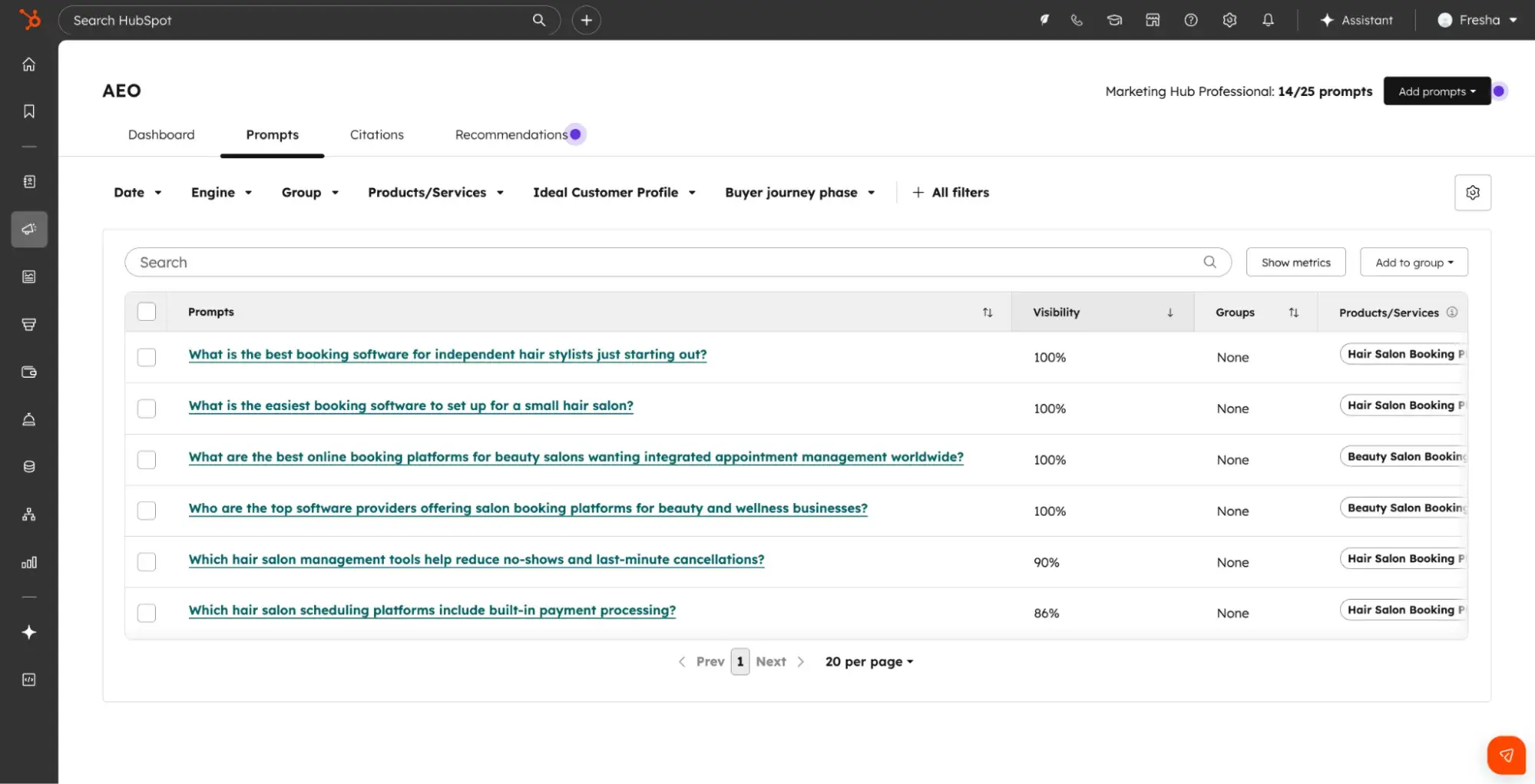
The initial step involves registering your primary domain and any associated subdomains that host your brand’s content. Unlike keyword-centric SEO, AEO focuses on specific prompts. Developing a comprehensive set of prompts is essential. While tracking branded prompts can offer insights into competitive positioning, the greatest impact on visibility scores will come from unbranded, problem-solution-oriented prompts that potential customers are likely to use when seeking information.
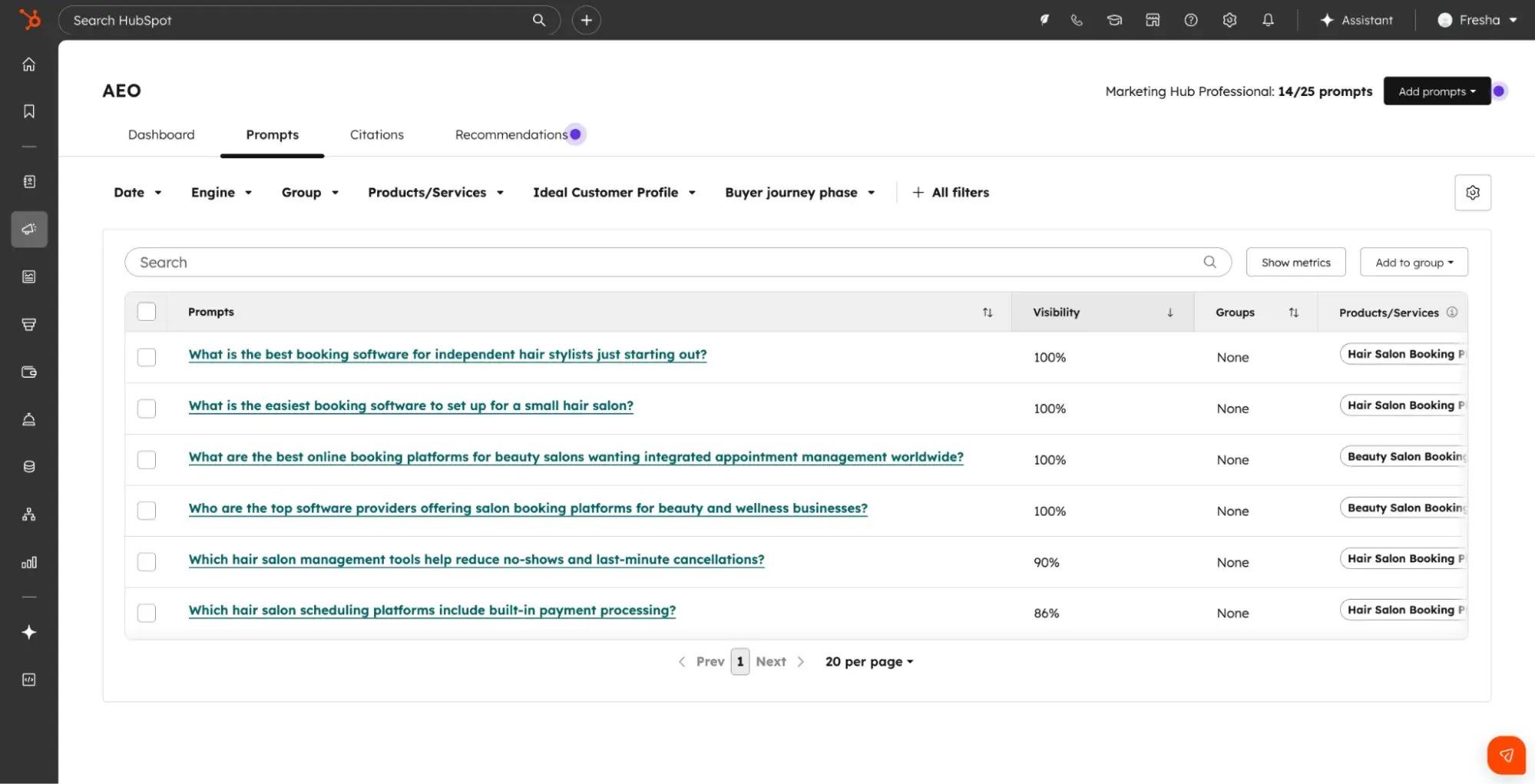
To streamline this process, platforms like HubSpot’s AEO tool can automatically suggest relevant prompts by analyzing your CRM data, providing a contextually informed starting point informed by your business’s unique landscape. This proactive suggestion feature can save significant time and effort in prompt discovery.
2. Configure AI Search Tracking Per Engine
Each AI search engine, including ChatGPT, Gemini, and Perplexity, generates distinct answers. Therefore, it is imperative to run every defined prompt through each engine individually. To ensure unbiased results, it is recommended to use logged-out or temporary browsing sessions, as personalized search results can skew the data. For each response, meticulously record whether your brand is mentioned, which specific pages are cited, and which competitors appear. Tools like HubSpot’s AEO automate this process across multiple engines, eliminating the need for manual re-prompting and data collation.
3. Establish Key Performance Indicators (KPIs) and Build a Dashboard
Selecting a concise set of KPIs is vital for monitoring progress over time. While a spreadsheet might suffice for an initial audit or infrequent checks, manual tracking quickly becomes unwieldy due to the inherent variability of AI answers across different engines, sessions, model updates, and retrieval sources. For ongoing, reliable monitoring, a dedicated AEO tool is indispensable. Such tools can consistently rerun prompts, track citations, benchmark against competitors, and visualize visibility trends, providing a clear and actionable overview.
4. Analyze Competitor Share of AI Voice
For each prompt analyzed, diligently note all competitors mentioned by the AI engine. Calculating your share of voice relative to these competitors provides a clear picture of your competitive standing. Repeating this analysis monthly will reveal which competitors dominate specific question clusters, thereby informing content strategy and prioritization. Tools like HubSpot’s AEO automatically generate competitor presence reports for tracked prompts, enabling the identification of these competitive gaps without manual tabulation.
Key Metrics for Effective AI Visibility Tracking
Once the tracking infrastructure is in place, several metrics are crucial for evaluating a brand’s AI search presence, its potential to drive revenue, and the accuracy of AI representations:
Mentions and Citations: The Foundation of Visibility
A "mention" signifies that a brand’s name appears within an AI answer without a direct hyperlink. A "citation," on the other hand, indicates that the AI engine has referenced a specific web page as a source. When this cited page belongs to the brand, it is considered an "owned citation." It’s also possible for a brand to be cited through pages not directly controlled by the brand.
AI-Referred Traffic: Measuring Engagement
AI-referred traffic represents the number of website visits generated when users click on a link cited within an AI answer. A significant challenge in tracking this metric is that many AI engines do not pass referrer data, causing these sessions to be misclassified as "direct" traffic, thus undercounting AI’s impact. Platforms like HubSpot automatically tag clicks originating from ChatGPT, Claude, Perplexity, and Gemini as a distinct "AI Referrals" source, providing a more accurate representation of AI-driven engagement.
Conversions and Pipeline Attribution: Linking Visibility to Revenue
The ultimate goal for many businesses is to connect AI visibility to tangible business outcomes. This involves tracking leads, sales opportunities, and closed deals that can be attributed to AI discovery. By incorporating a "How did you hear about us?" form field and utilizing a CRM that records the first-touch source for each contact, marketers can effectively link AI-driven visits to revenue generation.
Consistency Over Time: Ensuring Reliability
The dynamic nature of answer engines, influenced by platform, prompt, timing, and user, means that a single data point offers only a snapshot. Consistent tracking over time, on a fixed cadence, is essential for identifying stable trends and understanding how steadily a brand maintains its presence across repeated queries.
Accuracy and Hallucination Detection: Maintaining Brand Integrity
A critical aspect of AEO is ensuring that AI engines accurately represent a brand’s information. Logging instances of incorrect pricing, features, or claims, categorized by engine and prompt, is vital for subsequent correction and brand integrity management.
Sentiment and Tone Analysis: Understanding Perception
The sentiment and tone with which AI engines describe a brand are indicative of perception. Tools that score this sentiment on a scale, for example, from -100% to +100%, can help distinguish between a visibility problem and a perception issue.
Retrieved and Cited Pages: Content Performance Insights
Identifying which specific URLs are being leveraged by AI engines provides valuable insights into content performance. Cited pages, appearing as linked sources, highlight the content that is actively earning visibility, informing future content creation strategies.
Strategies to Enhance AI Search Visibility Through Answer Engine Optimization
With a clear understanding of how to track AEO progress, the next step is to implement strategies that improve a brand’s standing in AI search. While a comprehensive playbook for writing for AI search exists, several key tactics can significantly enhance visibility:

Strengthening External Brand Signals
The online reputation and mentions of a brand across the web significantly influence what AI engines repeat. Studies, such as one by SE Ranking analyzing 129,000 domains, have indicated that the number of referring domains is a strong predictor of ChatGPT citations, outperforming 20 other measured signals. Furthermore, mentions on platforms like Reddit and Quora have been linked to higher citation rates. Building these signals through strategic digital PR, expert commentary, and genuine engagement in relevant online communities can bolster a brand’s authority and visibility.
Leveraging Traditional Search Rankings to Inform LLMs
Answer engines rely on traditional search indexes to formulate their responses. Therefore, maintaining strong organic search rankings remains a prerequisite for AI visibility. ChatGPT’s search capabilities can draw upon Bing results, while Google AI Overviews heavily favor pages that already rank well. Although a top ranking no longer guarantees inclusion, content that ranks poorly is unlikely to appear in AI answers. Ensuring crawlability, topical depth, and effective internal linking are fundamental. The integration of AI tools to enhance SEO workflows can further refine these efforts.
Incorporating Structured Data and Schema Markup
Schema markup provides AI engines with a structured format to parse information about a page’s entities and their relationships. While its direct citation impact is debated, research from HubSpot’s "State of AEO 2026" found that pages featuring a Q&A section alongside FAQ markup demonstrated higher citation rates on Gemini, Google AI Mode, and Perplexity. This suggests that structured data can play a role in improving AI’s comprehension and utilization of content.
Writing with Semantic Clarity
AI engines are more inclined to extract information from declarative, self-contained statements rather than hedging or pronoun-heavy prose. Adopting a subject-verb-object structure for each fact, clearly naming entities instead of relying on pronouns like "it" or "this," and providing direct answers before elaborating on context are key. Maintaining consistent brand names, category definitions, and factual information across a brand’s website, LinkedIn profiles, and review sites like G2 helps AI engines recognize the same entity regardless of where it’s encountered.
Creating Compact, Prompt-Aligned Content Units
AI engines retrieve passages, not entire web pages. Therefore, each content segment must be capable of standing alone. Leading each section with a direct answer, followed by supporting details, is an effective strategy. Utilizing tables and bulleted lists for comparable facts, rather than embedding them within prose, enhances readability and accessibility for AI. Specialized tools can identify these content gaps and provide prioritized recommendations, with AEO platforms offering integrated content tools for remediation.
Choosing the Right AI Visibility Tools
The selection of an appropriate AI visibility tool depends largely on the specific objectives and desired outcomes of a team. Before evaluating options, it is crucial to rank the following questions based on their importance:
- What is the primary goal of tracking AI visibility? (e.g., baseline understanding, ongoing monitoring, lead generation, brand reputation management)
- What is the budget allocated for AEO tools?
- What is the technical expertise of the team responsible for AEO?
- What is the desired level of integration with existing marketing and sales technology stacks?
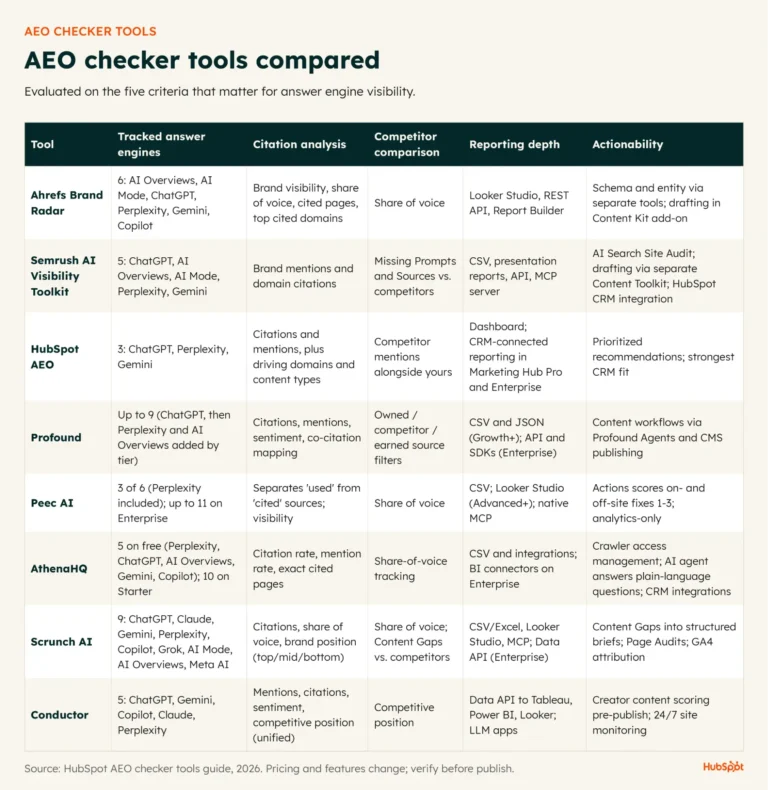
The answers to these questions will help differentiate between standalone monitors that report scores and competitor share, and integrated platforms like HubSpot AEO, which combine tracking with actionable recommendations and CRM integration for pipeline attribution.
Quick Start with a Free Baseline
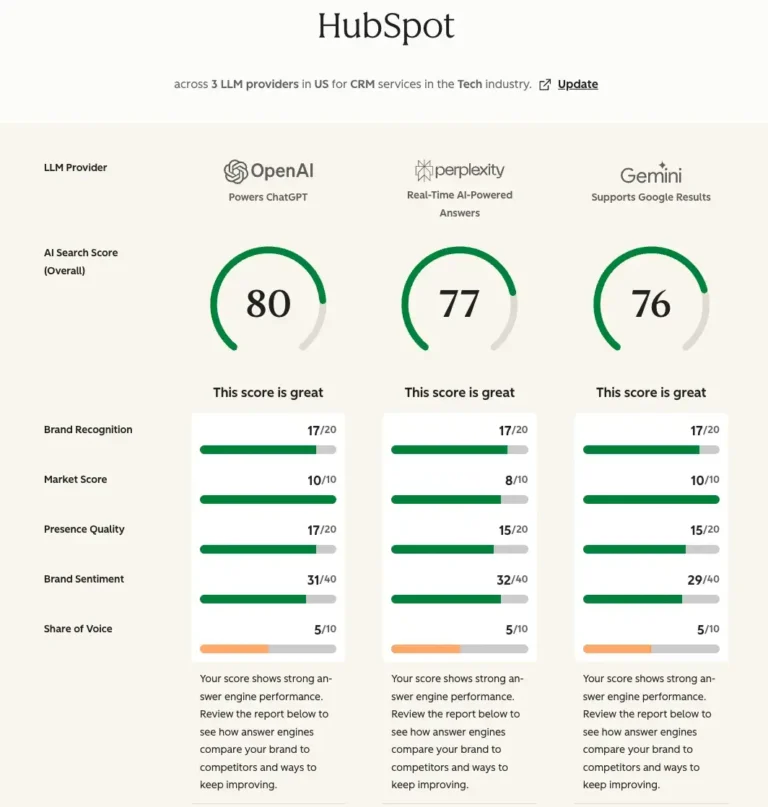
For an initial assessment of how answer engines represent a brand, a free AEO grader offers a valuable starting point. Tools like HubSpot’s AEO Grader provide a scored snapshot across major AI platforms, including a competitive share-of-voice analysis, within minutes. This can be sufficient for occasional pulse checks and can inform decisions regarding the need for more comprehensive solutions.
Connecting AI Search Tracking to Leads and Revenue
Once a brand’s presence in AI answers is established, the next critical step is to demonstrate its impact on lead generation and revenue. This involves tracing a clear path from an AI-referred visit to a qualified lead and ultimately to a closed deal.
The process begins with source attribution. HubSpot automatically assigns an "AI Referrals" original source to visitors arriving from ChatGPT, Claude, Perplexity, and Gemini. This ensures that every contact created from these sessions inherits the correct source label. Reporting on the "Original Source" property then allows for the segmentation of leads, deals, and revenue attributed to AI Referrals, mirroring the reporting for organic search or email campaigns.
Self-reported attribution can bridge the gap where referrer data is absent. Since many AI engines do not pass referrer information, some AI-driven visits may still be categorized as direct traffic. Implementing a "How did you hear about us?" form field with explicit options for ChatGPT, Gemini, and Perplexity empowers customers to manually identify the source that referrer data missed, with their responses recorded directly in the contact record.
Ultimately, a unified CRM dashboard can connect AI visibility metrics with concrete business outcomes. By presenting mentions and citations alongside pipeline generated by source, marketers can provide a holistic view of AI’s impact. HubSpot’s Smart CRM integrates this AI-attributed lead data with existing contact records, allowing for the tracking of each contact’s journey from their initial AI touchpoint to a closed deal. This comprehensive view answers a crucial question: do individuals discovered through AI actually convert into valuable customers? Regular monthly reviews of this data can reveal whether rising AI visibility translates into increased revenue or merely enhanced impressions.
Reporting Results and Governing AI Brand Accuracy
A consistent monthly report serves as a narrative for leadership, transforming scattered tracking data into actionable insights. This report should encompass key metrics such as mentions and citations for reach, sentiment for brand perception, accuracy for error rates, retrieved pages for content performance, and pipeline impact for revenue generation.
Reporting highlights changes and identifies areas for improvement. Governance, conversely, dictates the response when an AI engine misrepresents a brand. Establishing a concise checklist for the team to follow each reporting cycle is essential. This checklist should include:
- Reviewing accuracy metrics for any errors.
- Investigating the root cause of any inaccuracies.
- Prioritizing corrections based on the severity and frequency of errors.
- Assigning responsibility for updating source content or external signals.
- Confirming the resolution in the subsequent reporting cycle.
This reporting and governance loop ensures that identified issues are addressed systematically, and the impact of corrective actions is validated over time.
Frequently Asked Questions About Tracking AI Search Visibility
How often should I re-run prompts and update my AI visibility dashboard?
A monthly cadence is generally recommended for spotting trends, as a single check provides a snapshot rather than a pattern. Maintaining a fixed prompt set and running it consistently ensures comparable month-to-month movement. The frequency can be increased when testing new content or closely monitoring a competitor. Tools like HubSpot AEO can run prompts daily and alert users to significant shifts, proactively surfacing volatility without manual intervention.
What if AI platforms don’t pass referrers and I can’t see traffic sources?
Implement a user-friendly form that allows visitors to self-report their discovery source, including options for ChatGPT, Gemini, and Perplexity. This manual input captures valuable data that referrer information might miss. Additionally, HubSpot automatically tags visits from these engines with an "AI Referrals" source, capturing any available referrer data. The combination of these methods can recover a significant portion of AI-driven sessions that would otherwise be categorized as direct traffic.
How can I correct inaccurate answers about my brand in answer engines?
Direct editing of AI answers is not possible. Correction requires influencing the sources from which AI engines draw their information. This involves updating your own web pages with accurate pricing, features, and claims, and simultaneously strengthening authoritative third-party signals that reinforce these facts. Logging each error by engine and prompt is crucial for verifying the effectiveness of corrections in subsequent runs.
When should I consider a dedicated LLM visibility tool?
A free grader is beneficial for an initial assessment of whether engines are representing your brand at all, which may suffice for occasional pulse checks. A dedicated tool becomes necessary when consistent weekly tracking, prompt-level competitor monitoring, or attribution linking visibility to pipeline are required. Free tools like AEO Grader provide a baseline, while comprehensive platforms like HubSpot AEO offer continuous tracking and recommendations, with AEO in Marketing Hub further integrating these metrics with CRM records for end-to-end revenue attribution.
What is the best way to present AI visibility to executives?
Executives are primarily interested in the business impact of AI visibility. Therefore, reports should lead with metrics such as leads, opportunities, and revenue attributed to AI discovery, rather than simply mention counts. Use metrics like mentions, citations, and share of voice to contextualize and explain trends. A single, consolidated view updated monthly is most effective. Platforms like AEO in Marketing Hub streamline this by placing AI visibility data within the same environment as CRM records, enabling the use of reporting tools to connect AI-referred traffic to actual contacts and deals.
About the Author