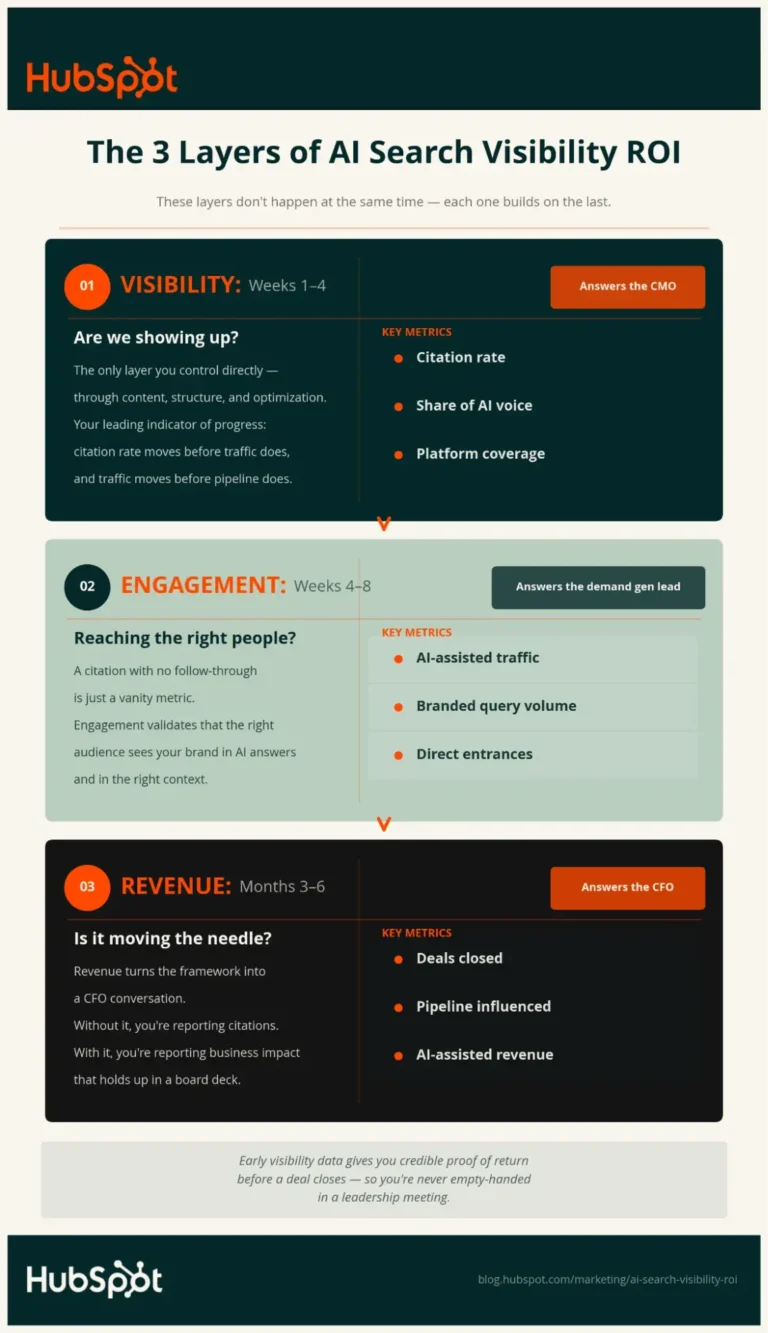
The benchmarks for B2B Search Engine Optimization (SEO) tools have fundamentally evolved. No longer is the sole objective to achieve top rankings on the first page of search engine results. This paradigm shift is driven by the increasing reliance of B2B buyers on AI-generated answers to discover vendors, a trend highlighted in a recent whitepaper, "Inside the B2B Buyers Mind 2025." While a strong Google ranking remains crucial, visibility within AI-driven search is now equally paramount. Consequently, B2B teams must prioritize attracting not just any traffic, but traffic that demonstrates a genuine propensity to convert into pipeline and revenue.
This comprehensive guide delves into the premier B2B SEO tools, meticulously selected for their capacity to empower SEO specialists in driving tangible business outcomes – moving beyond mere traffic generation. Each tool featured possesses the requisite functionalities to ensure visibility in this emerging era of AI-augmented search.
Defining B2B SEO Tools: More Than Just Rankings
B2B SEO tools are sophisticated software platforms designed to enhance a business’s search engine optimization efforts through several key functions:
- Keyword Research: Identifying relevant terms that potential business customers use to search for products and services.
- Content Strategy Development: Guiding the creation of content that addresses user intent and aligns with the buyer’s journey.
- On-Page Optimization: Facilitating improvements to website content and structure for better search engine crawling and indexing.
- Technical SEO Auditing: Monitoring and rectifying technical issues that can hinder search engine performance, such as site speed, mobile-friendliness, and crawlability.
- Performance Tracking: Measuring keyword rankings, organic traffic, and conversion rates to assess the effectiveness of SEO strategies.
While many SEO tools offer cross-industry applicability, certain platforms are particularly adept at serving the unique needs of B2B organizations. Unlike B2C marketing, B2B endeavors are characterized by extended sales cycles, the involvement of multiple decision-makers, and the strategic application of account-based marketing (ABM). Therefore, the ideal tool must effectively support these intricate processes. Marketing teams require SEO solutions that transcend basic ranking metrics; they need tools capable of mapping content to complex buying journeys and, crucially, demonstrating SEO’s direct contribution to the sales pipeline. This is a significant challenge, given that B2B decision cycles can often span months or even years.
Essential Features for Every B2B SEO Tool
A robust B2B SEO tool should encompass five core capabilities:

- Intent-Filtered Keyword Research: This involves identifying keywords that not only have search volume but also signal the buyer’s stage in the decision-making process.
- CRM Integration and Pipeline Attribution: Seamless connection with Customer Relationship Management (CRM) systems to track the impact of organic traffic on sales opportunities and revenue.
- Competitor and Content Gap Analysis: Tools that reveal what competitors are ranking for and identify areas where a business’s content is lacking.
- Technical SEO Monitoring: Continuous oversight of website health to ensure optimal performance and user experience.
- Content Optimization with AI Suggestions: Leveraging artificial intelligence to refine existing content and identify new optimization opportunities.
The optimal combination of these features will vary depending on the specific business. Therefore, a thorough evaluation involving stakeholders from finance, sales, and marketing, as well as the end-users of the tool, is essential before making a purchasing decision.
1. Intent-Filtered Keyword Research: Navigating the Buyer’s Journey
B2B purchases are seldom impulsive. The extended sales cycles necessitate a strategic approach to nurturing leads through various stages of awareness, consideration, and decision. This requires SEO specialists to understand the complete buyer journey for each stakeholder, which may include end-users, IT managers, and procurement officers. Effective keyword research tools must go beyond simple search volume metrics. They need to surface terms that indicate where a buyer is within their journey – whether they are initially diagnosing a problem, comparing potential solutions, or are ready to request a demonstration.
Intent-filtered keyword data empowers marketing teams to create content that resonates with genuine potential buyers at each stage. This distinction is often categorized into three layers of intent:
- Informational Intent: Users are seeking general information or answers to specific questions related to a problem or topic. Keywords might include "what is cloud computing" or "benefits of CRM."
- Navigational Intent: Users are trying to find a specific website or page. Keywords might be brand-specific, such as "Salesforce login."
- Commercial Investigation/Transactional Intent: Users are actively researching solutions or are close to making a purchase decision. Keywords could be "best project management software for remote teams" or "CRM demo request."
By understanding these nuances, B2B SEO strategies can be tailored to attract and engage prospects at the most opportune moments.
2. CRM Integration and Pipeline Attribution: Closing the Loop
A critical deficiency in many SEO strategies is the lack of direct connection between SEO performance and tangible business outcomes. B2B SEO tools must integrate seamlessly with CRM systems. Without this integration, SEO teams are forced to manually correlate data from disparate platforms, leading to guesswork about which content is truly driving opportunities.
CRM integration closes this crucial loop, directly linking organic traffic to closed revenue. This attribution provides SEO with the recognition and justification it deserves, fostering stakeholder buy-in and securing continued investment.

Pro Tip: Platforms like HubSpot’s Smart CRM facilitate direct SEO-to-pipeline attribution by integrating organic search data with contact and deal records. This allows SEO teams to demonstrate, in real-time during pipeline reviews, precisely how specific content pieces are influencing open opportunities.
3. Competitor and Content Gap Analysis: Strategic Positioning
Understanding a competitor’s ranking strategy and identifying gaps in a company’s own content coverage are foundational to any effective B2B SEO strategy. The most effective tools for competitor analysis not only reveal what rivals are doing well but also highlight opportunities where a business can establish a stronger presence. This allows content teams to prioritize topics that have the highest potential to attract qualified traffic away from competitors.
4. Technical SEO Monitoring: Ensuring Site Health and Conversions
Technical SEO is paramount for maintaining website health and optimizing conversion rates. In the B2B landscape, where buyers often evaluate multiple vendors simultaneously, a slow-loading or technically flawed website can silently erode potential conversions.
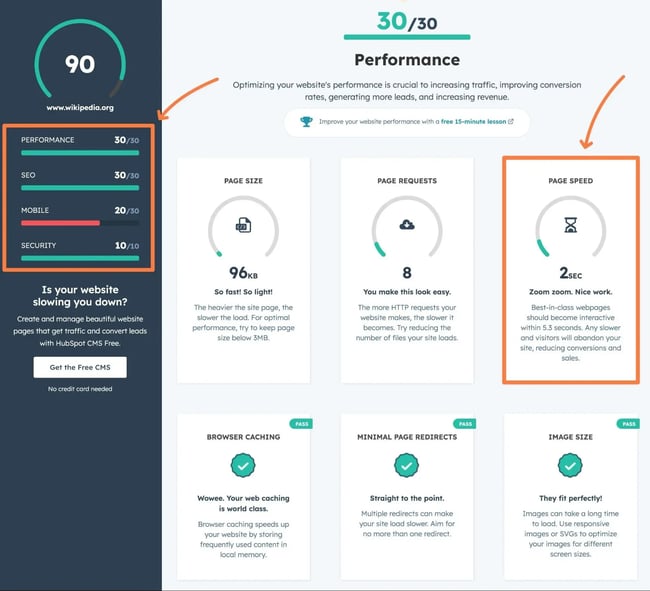
The right tools offer continuous crawl monitoring, Core Web Vitals tracking, and provide actionable, prioritized recommendations rather than merely listing errors. This allows marketing and development teams to focus on improvements that yield the greatest impact.
Pro Tip: While tools like Google Lighthouse offer robust technical checks, they require significant technical expertise. For a more accessible solution, HubSpot’s Website Grader provides a fast and free initial assessment of a website’s technical SEO health.
5. Content Optimization and AI Suggestions: Scaling Excellence
Competing effectively across the entire B2B buying journey necessitates a substantial volume of high-quality content. Modern content marketing tools increasingly incorporate AI capabilities to assist teams in optimizing existing pages, identifying new content opportunities, and maintaining consistency and quality at scale.
Premier SEO Tools for B2B: Driving Pipeline and Visibility
The leading SEO tools for B2B marketing do more than just boost search rankings. They forge a direct link between organic visibility and revenue generation, integrate with CRM systems, and equip marketing teams with strategies to maintain website prominence as search technologies evolve. The following tools have been rigorously vetted for their efficacy in achieving these objectives.
HubSpot’s SEO Tools (within Marketing Hub): The All-in-One Solution for B2B Pipeline Growth
HubSpot Marketing Hub stands out as an AI-powered marketing platform purpose-built for B2B SEO. It is designed for marketing teams seeking to consolidate their SEO workflows within a single, integrated platform, eliminating the need for multiple disparate tools.
HubSpot’s SEO tools provide actionable recommendations throughout the content lifecycle, from initial topic ideation to ongoing performance analysis. Crucially, these insights are delivered within the same platform where campaigns, contacts, and CRM data reside, eliminating the need for additional integrations.
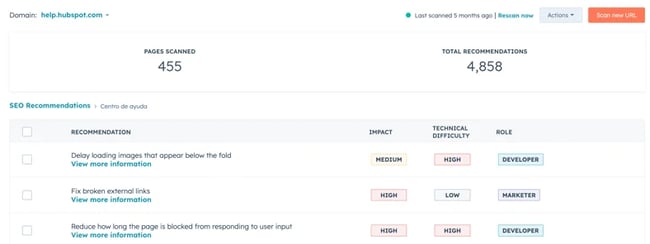
The platform’s SEO recommendations feature performs a comprehensive scan of an entire live website, including pages hosted externally. It surfaces prioritized recommendations across technical SEO, on-page optimization, and accessibility. These issues are categorized by impact, difficulty, and recommended role, enabling efficient task management.
Pro Tip: Many of HubSpot Marketing Hub’s SEO recommendations extend into AI-driven optimization (AEO). Features like structured data and schema markup guidance help format content in a way that AI systems can readily parse and cite. This ensures that B2B teams are not only optimizing for traditional search engines but also for the AI-generated answers that increasingly serve as the initial point of contact in the B2B buyer journey.
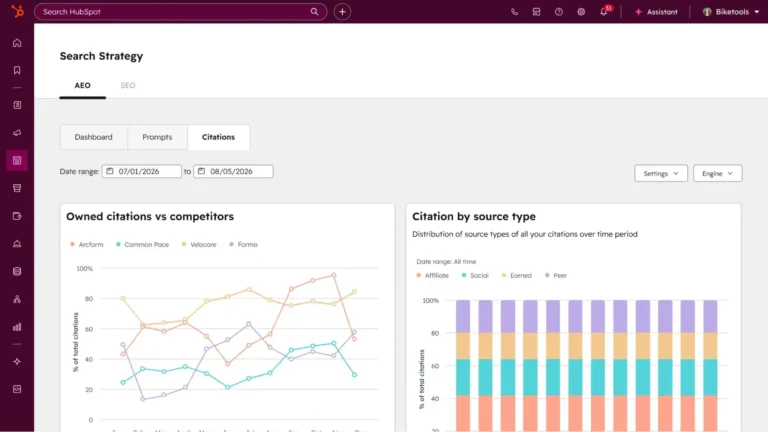
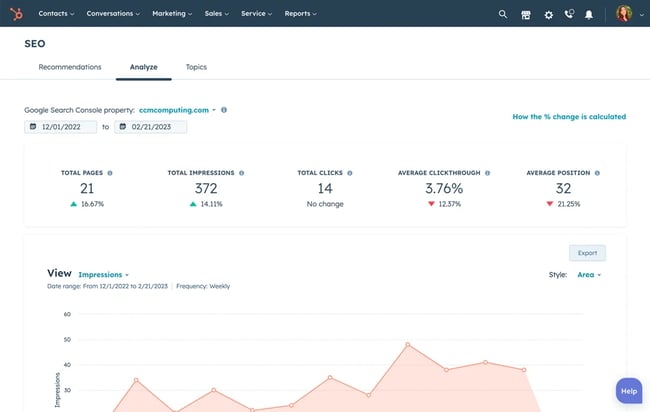
Analyzing SEO performance within Marketing Hub is a streamlined process. Reports allow teams to track organic sessions, impressions, and keyword positions over time at both the domain and individual page levels. The native CRM integration is a significant differentiator for B2B teams, enabling SEO-to-pipeline attribution. This allows SEO efforts to be measured not just by traffic volume but by their direct contribution to demos, opportunities, and ultimately, closed revenue. This level of attribution is notoriously difficult to achieve when SEO tools operate in isolation from the CRM.
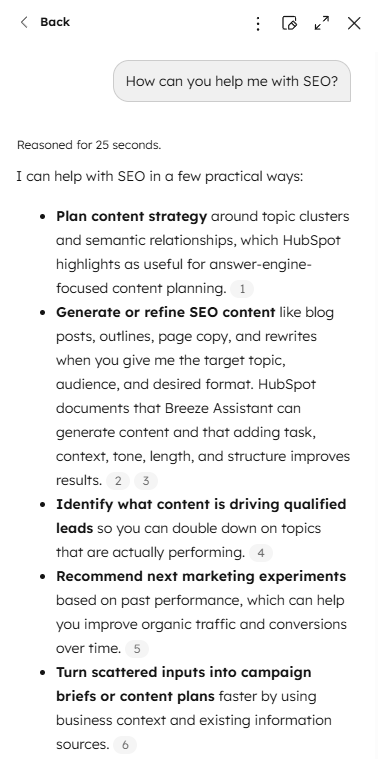
Breeze Copilot, an integral part of Marketing Hub, leverages AI to accelerate SEO and content tasks. This empowers B2B marketers to expedite processes ranging from content brief creation to optimization recommendations, without the need for additional headcount. Breeze tailors its suggestions to the specific account data it’s processing, providing a highly relevant and actionable AI assistant.
Best for: B2B marketing teams that prioritize unified data across SEO, CRM, and content performance, with a clear and measurable link from organic traffic to pipeline and revenue.
What we like: For organizations already invested in HubSpot for marketing automation and CRM, activating the SEO features within Marketing Hub offers a direct and efficient path to connecting SEO activities with leadership-level pipeline metrics. HubSpot’s extensibility, with integrations to thousands of other tools, ensures it can seamlessly fit into any existing tech stack.
HubSpot’s Content Hub: SEO-Integrated CMS for B2B Content Teams
Content Hub serves as HubSpot’s Content Management System (CMS), distinguished by its deeply embedded SEO capabilities. For B2B teams producing content at scale, it offers a uniquely seamless end-to-end content workflow, from initial briefing to final publishing.
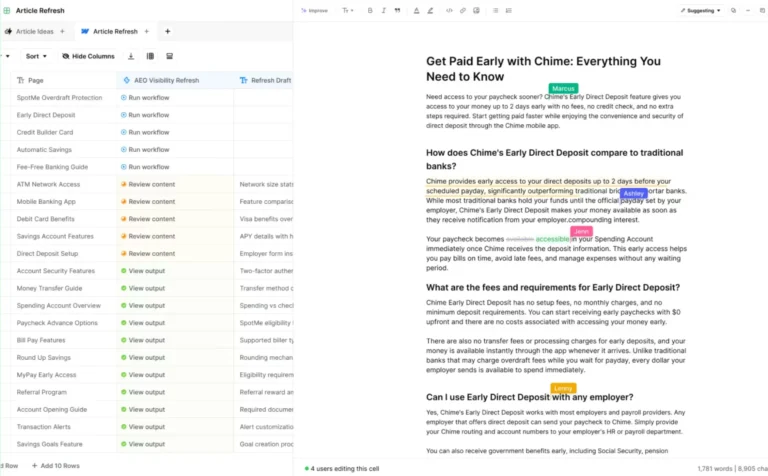
SEO suggestions are integrated directly into the content editing experience. As content teams write within Content Hub, real-time SEO recommendations appear within the editor itself. This immediate feedback loop minimizes the need for multiple optimization tools and empowers writers to address most SEO concerns without constant reliance on SEO specialists.
Schema and Structured Data: For B2B teams focusing on AEO, Content Hub’s support for structured data and schema markup is invaluable. Structured data enhances traditional SEO and is equally critical for AI SEO, as it allows AI crawlers to efficiently read and cite content embedded within the HTML.
AI Content Writer: The AI content writer integrated into Content Hub facilitates AI-assisted drafting, ensuring alignment with a team’s SEO objectives. This capability allows B2B content teams to scale their output significantly without a proportional increase in headcount.
Best for: B2B content teams seeking embedded SEO and AEO guidance within their writing workflow, enabling them to create schema-ready content efficiently and without constant developer intervention.
What we like: The seamless integration of SEO and AEO directly into the CMS streamlines content operations, eliminating the need to stitch together disparate tools. This unified approach significantly boosts tool adoption rates, a common challenge in B2B SEO.
HubSpot AEO Grader: The Premier Free Tool for B2B AI Search Visibility
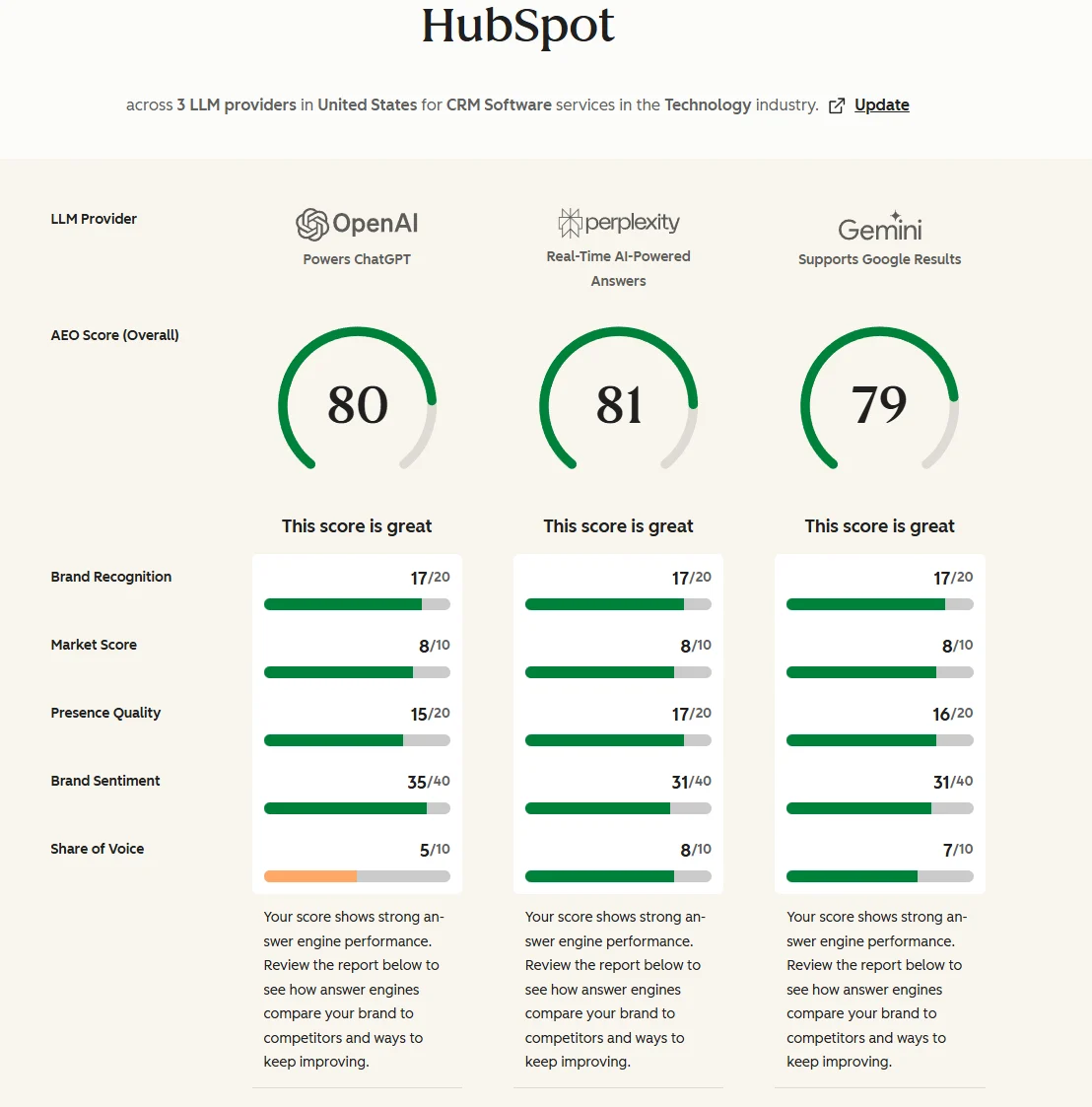
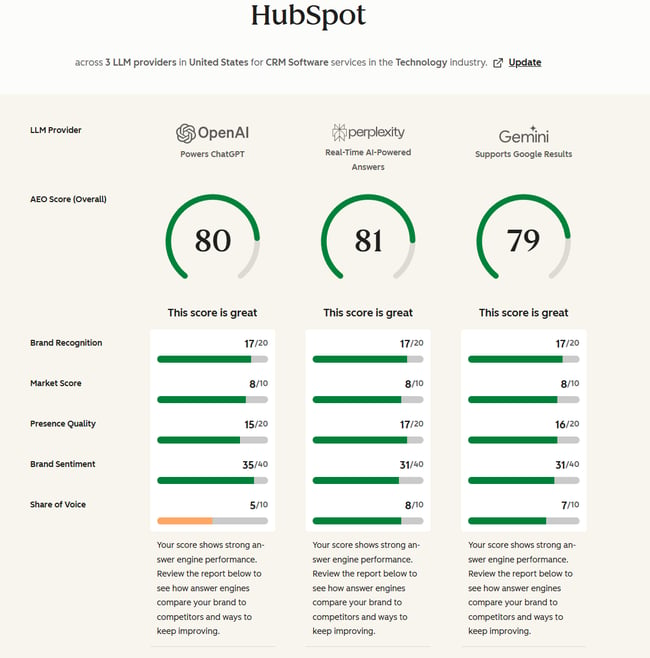
HubSpot’s AEO Grader offers an essential assessment of a brand’s visibility within AI-generated search results. For B2B teams navigating the evolving search landscape, it stands out as one of the most valuable free tools available.
The AEO Grader evaluates a website’s performance across prominent AI search environments, including ChatGPT, Perplexity, and Gemini. The tool generates a brand performance score across five key dimensions:
- AI Search Visibility: Assesses the breadth of a brand’s presence across different AI search platforms.
- Brand Sentiment: Gauges the overall sentiment associated with the brand in AI-generated content.
- Content Relevance: Evaluates how well the brand’s content aligns with user queries processed by AI.
- Data Accuracy: Checks for the factual correctness of information presented about the brand.
- User Engagement Potential: Estimates the likelihood of AI-generated content about the brand leading to user interaction.
The competitive analysis feature is equally insightful. Reports can be generated not only for a company’s own domain but also for any competitor in the market, providing a direct comparison of how AI engines represent them relative to the competition.
Pro Tip: Running the AEO Grader for two or three key competitors immediately after assessing your own brand can reveal crucial insights into AI engine positioning relative to category leaders. This comparison can inform messaging angles and content themes to integrate into an AEO strategy.
Best for: B2B marketers aiming to understand and enhance their brand’s visibility in AI-generated search results, and to benchmark their AI search positioning against competitors, all at no cost.
What we like: In a matter of minutes, HubSpot’s AEO Grader delivers a wealth of actionable information. Its free accessibility makes it a powerful competitive research tool, allowing any B2B team to explore AEO without financial risk.
Semrush: A Comprehensive and User-Friendly SEO Platform for B2B
Semrush is a widely recognized and comprehensive SEO toolkit for B2B teams, offering an all-in-one platform for research, auditing, and strategy development. It covers keyword research, competitor analysis, content strategy, and increasingly, AI search capabilities.
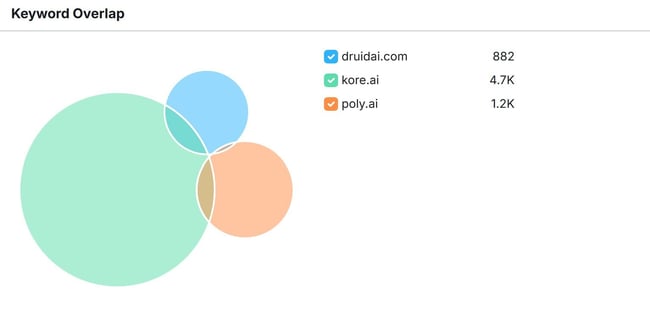
Ramona Joita, an SEO Consultant and Founder of Marketez, highly regards Semrush for its integrated approach to keyword research, competitor analysis, and content strategy. She frequently utilizes the Keyword Overlap/Gap SEO analysis tool to compare multiple competitors, identifying ranking opportunities and content deficiencies. "From there," she states, "I analyze the content that’s already ranking and build a data-backed content plan focused on high-intent topics that can drive pipeline, not just traffic."
Core features:
- Keyword Magic Tool: For in-depth keyword research and analysis.
- Site Audit: Comprehensive technical SEO checks.
- Topic Research: AI-powered content ideation.
- Competitor Analysis: Detailed insights into rival strategies.
- AI Writing Assistant: For content creation and optimization.
Pricing: Plans typically start around $139.95/month for core SEO features, with plans including AI capabilities priced higher.
What we like: Semrush has consistently adapted to the evolving search landscape, integrating AI features early on. With its extensive history in digital marketing and SEO, it remains a robust platform for helping marketing teams navigate the complexities of AI search.
Contentsquare (formerly Hotjar): Understanding On-Page User Behavior
Contentsquare, which acquired Hotjar, provides B2B teams with deep insights into user behavior on their websites. This includes heatmapping, scroll depth analysis, click patterns, and session recordings.

Emina Demiri-Watson, Head of Digital Marketing at Vixen Digital, shared an impactful case study where integrating GA4 with Contentsquare for a B2B e-commerce client revealed how organic search visitors interacted with the site. A seemingly minor adjustment to a navigation label, informed by this data, resulted in a 217% uplift in menu clicks, a significant increase in key events, a 64% rise in revenue, and a 566% surge in new users engaging with that section. Crucially, she noted that the increased engagement came from new visitors, suggesting that friction removal accelerated their early buying cycle.
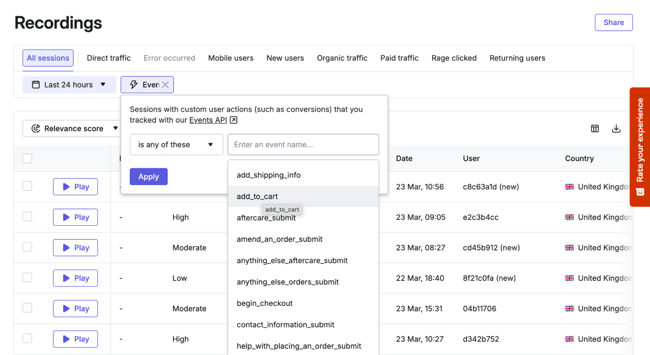
The ability to filter session recordings by specific actions, such as adding items to a cart, provides invaluable qualitative data. Pipeline-focused SEO is not solely about traffic volume but also about understanding and removing obstacles that hinder engagement.
Core features:
- Heatmaps: Visualizing user clicks, scrolls, and attention.
- Session Recordings: Replaying user journeys to identify usability issues.
- Form Analysis: Understanding user drop-off points in forms.
- Surveys and Feedback: Gathering direct user opinions.
Pricing: Following the acquisition, Hotjar’s offerings are now integrated under Contentsquare. A free plan is available, with paid plans starting from approximately $39/month billed annually.
What we like: Contentsquare offers rich qualitative data through session recordings. By observing user interactions leading up to key conversion events, teams can identify areas for improvement in user experience and content accessibility, which is critical for long B2B sales cycles.
One thing to flag: The integration process following the acquisition of Hotjar by Contentsquare has introduced some complexity in setup. However, the depth of behavioral insights gained remains a significant advantage.
Lead Forensics: Connecting Organic Visits to Pipeline
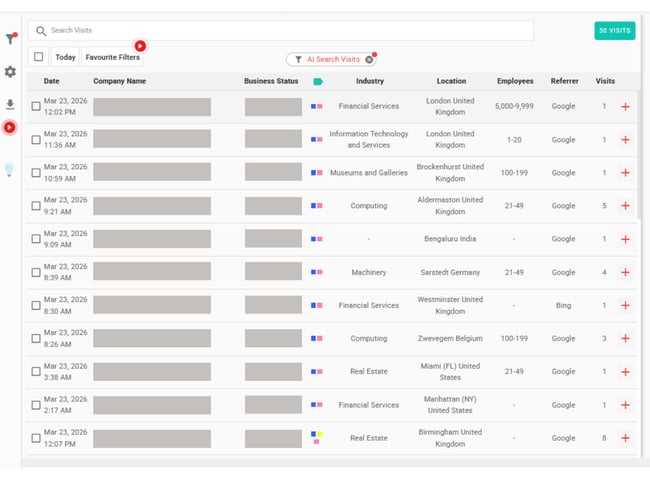
Lead Forensics excels at identifying the companies visiting a website and linking these visits to potential sales pipeline. This capability makes it an exceptionally powerful tool for B2B teams needing to demonstrate the revenue-generating impact of their organic search efforts.
Laura Nineham, Head of Organic Search and Content at Lead Forensics, emphasizes attribution as a core value. The ability to connect company visits to specific interactions and track them through to closed deals "can transform SEO attribution and help us get fair credit for how our activity influences pipeline."
A practical AEO/SEO use case involves identifying companies arriving via organic search or AI referrals. By leveraging firmographic data, teams can confirm visits from ideal customer profiles and subsequently track these organic leads through the sales funnel.
Pro Tip: Integrating Lead Forensics with HubSpot allows for automated record creation based on predefined criteria (firmographics, website engagement, source). This ensures that potential leads from organic search are immediately captured and enriched with valuable engagement data.
Core features:
- Website Visitor Identification: Revealing the identities of companies visiting your site.
- Lead Scoring and Prioritization: Ranking leads based on engagement and fit.
- CRM Integration: Seamless data flow with sales platforms.
- Sales Intelligence: Providing insights into company behavior.
Pricing: Lead Forensics operates on custom pricing models based on traffic volume and team size, available upon request.
What we like: Lead Forensics provides marketing departments with undeniable evidence of their contribution to lead generation and sales. This data empowers marketing teams to articulate their impact more effectively, particularly when showcasing significant wins, such as attracting high-profile target accounts.
Trendos: Tracking AI Search Visibility Over Time
Trendos specializes in monitoring a brand’s presence and performance within AI-generated search results, tracking its visibility and sentiment across various AI answer formats over time.
Eglė Kliukevičienė, Marketing Lead at Trendos, frames AI search visibility as a critical pipeline component. Platforms like ChatGPT and Gemini now play a significant role in how B2B buyers discover and compare brands before even visiting a vendor’s website. Trendos allows users to observe not only current brand placement but also shifts in presence and sentiment over extended periods.
A key practical application is tracking how brands appear in AI-generated "best tools" and "top platforms" lists, which are often where B2B buyers begin their shortlisting process.
Core features:
- AI Answer Monitoring: Tracking brand presence across multiple AI models.
- Sentiment Analysis: Assessing brand perception in AI responses.
- Competitive Benchmarking: Comparing AI visibility against competitors.
- Historical Trend Analysis: Observing changes in AI search performance over time.
Pricing: A free tier is available, with paid plans starting from approximately $169/month billed annually.
What we like: Trendos offers a forward-looking perspective on AI search, a rapidly evolving area. Its free tier provides an accessible entry point for B2B marketers to begin monitoring their AI visibility. The ability to see advertising within ChatGPT also offers valuable intelligence for paid advertising strategies.
Google Keyword Planner + Claude: A Free Workflow for B2B Keyword Intent Analysis
By pairing Google Keyword Planner with Claude, a large language model, raw keyword data can be transformed into sophisticated intent analysis. Google Keyword Planner provides essential search volume and keyword variation data, while Claude interprets the linguistic signals to infer a buyer’s stage in their decision-making process.
Laura I. Abreu, Lead Generation, Ads, and SEO Manager at Global and Search, employs this workflow for extensive keyword sets. She emphasizes that many B2B teams stop at search volume, overlooking the critical signals within the language itself. "Google Keyword Planner gives you data," she explains, "Claude helps you interpret what the language choice reveals about where the buyer is in their decision."
For instance, distinguishing between searches like "SEO expert" and "hire an SEO expert" reveals different levels of intent. The inclusion of "expert" signals a willingness to pay a premium and a focus on value, differentiating these buyers from those searching for "SEO specialist" or "SEO consultant," despite the apparent similarity in surface intent. Abreu notes that Claude effectively flags these distinctions.
Core features:
- Google Keyword Planner: Comprehensive search volume and keyword suggestion data.
- Claude: AI-powered natural language understanding and interpretation.
- Intent Analysis: Categorizing keywords based on buyer stage.
- Competitive Insight: Identifying nuanced differences in buyer language.
Pricing: Both Google Keyword Planner and Claude offer free tiers, making this a cost-effective solution for in-depth keyword analysis.
What we like: Google Keyword Planner remains an indispensable free tool for keyword research. Its combination with Claude’s interpretive capabilities creates a potent and efficient workflow for understanding nuanced buyer intent in B2B search queries.
Frequently Asked Questions About B2B SEO Tools
What are the best SEO tools for B2B SaaS companies?
For B2B SaaS companies, the optimal SEO tool stack typically includes a robust CRM, such as HubSpot Marketing Hub, for pipeline attribution. Complementary tools for keyword research, competitive intelligence, and user behavior mapping are also essential. For those focusing on AI Search Optimization (AEO), HubSpot’s AEO Grader provides critical visibility into brand representation in AI-generated answers, which is increasingly the initial touchpoint in the SaaS buyer journey.
Which free B2B SEO tools should I start with first?
Begin with Google Search Console and HubSpot’s AEO Grader. Both are free and offer insights into performance in traditional and AI search. Google Search Console reveals the queries driving traffic, while the AEO Grader assesses brand representation across major AI search platforms like ChatGPT, Perplexity, and Gemini.
How do I prove SEO’s impact on the pipeline in my CRM?
The most effective method is through a Smart CRM that integrates directly with your SEO platform, enabling SEO-to-pipeline attribution. This links organic traffic data to contact and deal records, allowing you to track the influence of content and keywords on closed-won deals. Without direct integration, manual data correlation is prone to errors and can obscure SEO’s true contribution.
When should you add technical monitoring to your stack?
Technical SEO monitoring is crucial as soon as a website grows beyond a handful of pages. New product pages, landing pages, and blog posts can quickly introduce technical issues like crawl errors or Core Web Vitals problems, which can negatively impact rankings and conversions if left unaddressed.
What’s the best way to evaluate the easiest SEO platform for B2B?
The easiest platforms are those that unify critical workflows—keyword research, content optimization, technical monitoring, and CRM attribution—within a single interface. HubSpot’s Marketing Hub is a strong candidate, as it directly connects SEO performance data to pipeline, minimizing the integration complexities that often complicate B2B SEO stacks.
Conclusion: The Right B2B SEO Tools Drive Revenue
The most effective B2B SEO tools share a common trait: they directly link organic visibility to revenue. Whether it’s HubSpot Marketing Hub attributing a closed deal to a specific blog post or Lead Forensics identifying target accounts arriving via organic search, the focus is on measurable business impact. For organizations looking to enhance their B2B SEO strategy this year, consolidating key functionalities within a unified platform like HubSpot Marketing Hub is a strategic move. This AI-powered platform integrates keyword research, content optimization, technical recommendations, and CRM attribution, streamlining operations and enabling B2B SEO programs to clearly demonstrate their tangible value.
About the Author