The digital marketing arena is undergoing a seismic shift, driven by the rapid integration of artificial intelligence into search engines and conversational AI platforms. As consumers increasingly turn to tools like ChatGPT, Perplexity, and Google’s AI Overviews for direct answers, the traditional visibility gained through search engine optimization (SEO) is being redefined. This new paradigm necessitates a focus on Answer Engine Optimization (AEO), a practice aimed at ensuring brand visibility and accurate representation within AI-generated responses. This comprehensive guide explores the intricacies of AEO, the tools available to measure it, and the strategic implications for businesses navigating this evolving search ecosystem.
The Rise of Answer Engines and the Vanishing Click
For years, businesses have invested heavily in SEO, optimizing their websites to rank highly in search engine results pages (SERPs). The goal was to appear at the top of a list of blue links, encouraging users to click through to their content. However, the emergence of sophisticated AI models capable of synthesizing information from multiple sources and presenting a direct, comprehensive answer has fundamentally altered user behavior. Platforms like ChatGPT and Google’s AI Overviews are designed to resolve queries without requiring users to click through to individual websites. This means that visibility, once a tangible metric tied to rankings, can now dissipate into an AI-generated summary, often unseen by the brand it pertains to.
This phenomenon creates a significant challenge: if a user’s question is answered directly by an AI, and that AI doesn’t cite or mention a brand, that brand effectively loses its presence in the user’s journey. This is where AEO becomes crucial. It shifts the focus from merely ranking for a keyword to ensuring that when a query is posed, the AI either directly answers with information from the brand’s content or at the very least, mentions the brand as a credible source.
What is Answer Engine Optimization (AEO)?
Answer Engine Optimization (AEO) is the strategic process of enhancing a brand’s presence and accuracy within the AI-generated answers provided by conversational AI platforms and advanced search features. Unlike traditional SEO, which focuses on ranking for keywords and driving traffic through links, AEO targets the AI’s ability to parse, understand, and cite a brand’s content. The ultimate goal is to be mentioned and credited within these AI-generated summaries, thereby maintaining brand visibility and influence in an increasingly zero-click search environment.
![AEO checker tools that measure answer engine visibility [2026]](https://53.fs1.hubspotusercontent-na1.net/hubfs/53/aeo-checker-1-20260903-3858273.webp)
The evolution is evident in Google’s recent integration of AI Overviews, which began rolling out in May 2024. These overviews aim to provide concise, synthesized answers to complex queries, often pulling information from various web sources. While this can be a boon for users seeking quick information, it presents a challenge for content creators and businesses. The AI prioritizes direct answers, meaning that if a website’s content isn’t structured for easy parsing or doesn’t directly address the core of the query, it may be overlooked in favor of other sources that do.
AEO and SEO are not mutually exclusive; rather, they are complementary disciplines. Robust SEO practices, such as clear site structure, authoritative content, and strong internal linking, remain foundational. These elements provide the crawlability and authority signals that answer engines rely on to identify credible sources. However, AEO adds a crucial layer by optimizing content for AI comprehension and citation. This includes ensuring clear answers to common questions, structuring data logically, and providing verifiable primary sources for claims made.
The Function of an AEO Checker
An AEO checker is a specialized tool designed to measure a brand’s visibility across various answer engines. Its primary function is to identify how often a brand’s content is cited or mentioned in AI-generated responses and to pinpoint areas for improvement. These tools typically analyze:
- Brand Mentions: Whether the brand name appears in the AI’s answer, even without a direct link.
- Citations: Whether the AI directly links to the brand’s content as a source.
- Competitor Visibility: Which competitors are being cited or mentioned for similar queries.
- Accuracy of Information: Whether the AI accurately represents the brand’s offerings or information.
- Content Gaps: Identifying queries where the brand is not appearing but could or should be.
By providing these insights, AEO checkers enable businesses to diagnose visibility issues, prioritize optimization efforts, and track progress over time. They transform abstract concerns about AI presence into actionable data, allowing for targeted content updates, schema corrections, and entity improvements that are most likely to influence AI citations.
Manual AEO Checks: A Hands-On Approach
While automated tools offer scalability, understanding the manual process of checking AEO is fundamental. This approach provides direct insight into how AI models interpret search queries and present information.
![AEO checker tools that measure answer engine visibility [2026]](https://no-cache.hubspot.com/cta/default/53/9dd5e54b-fbef-4dd0-bc44-1689feb1ea18.png)
Checking Google AI Overviews
Google’s AI Overviews (AIOs) are not triggered for every search query. Google’s systems are designed to display them only when they are deemed additive to the traditional search results, meaning they provide a clear, synthesized answer that goes beyond a simple list of links. This selectivity means that AIOs appear for a subset of queries, and their appearance can vary even within the same search engine.
To manually check AIO visibility:
- Define Priority Queries: Compile a list of critical search terms. This should include your brand name, branded product terms, and key informational questions that your target audience frequently asks.
- Conduct Live Searches: Execute these queries in a signed-out or incognito browsing session to ensure unbiased results.
- Analyze Results: For each query, note the following:
- Does an AI Overview appear?
- If an AIO is present, does your domain appear among its inline source links?
- What specific claim does the AI make about your brand or offerings?
- Interpret Findings: Compare queries where AIOs appear and cite you against those where AIOs are present but competitors are cited instead. The latter group represents your content gap. It’s important to remember that AIOs can fluctuate, so a single absence should prompt a re-check rather than immediate concern.
- Document Results: Screenshot each relevant search result, including the query, date, and location. This creates a verifiable record for before-and-after analysis. Google Search Console’s standard performance reports currently roll AI Overview activity into the general "Web" search type, making it difficult to isolate this data. While Google has introduced dedicated generative AI performance reports, these initially focused on impressions and reached a limited audience.
Manual checks are feasible for a small list of queries, but they become unreliable and time-consuming as the number of queries grows or as AIOs change frequently.
Checking ChatGPT and Perplexity Citations
Both ChatGPT and Perplexity provide mechanisms for users to see the sources they draw upon, making manual citation checks more straightforward.
Perplexity: By default, Perplexity attaches citations directly to its answers, with each citation linking to the original source. Additionally, a dedicated "Sources" panel on the right side of the interface lists all the references used in generating the response.
![AEO checker tools that measure answer engine visibility [2026]](https://53.fs1.hubspotusercontent-na1.net/hubfs/53/aeo-checker-2-20260903-852936.webp)
ChatGPT: When ChatGPT utilizes web search to answer a query, it often displays inline citations. These citations, along with a broader list of sources, are typically found in a "Sources" panel located beneath the main response.
To perform manual checks on these platforms:
- Run Practical Citation Checks: Use the same branded and informational queries defined earlier. For each query, assess:
- Does your domain appear among the cited sources?
- Is your brand name explicitly mentioned within the answer text itself? A citation and a mention are distinct achievements.
- Optimize Prompts for Retrieval: ChatGPT, in particular, will only engage in web search when a question necessitates current information or when the user manually selects the web search option. To ensure your content is considered, frame prompts directly and with a focus on current data. For example, queries structured as "best [category] tools for [specific use case]" are more likely to trigger live web searches.
- Log and Analyze Results: Since AI models can produce varied responses to the same prompt across different sessions, it is crucial to run each prompt multiple times. For each test, record the AI engine used, the prompt, the date, whether your brand was cited or mentioned, and which competitors appeared. This log will reveal inconsistencies and highlight opportunities. If a competitor is cited and your brand is not, this indicates a need to update or restructure your content for that specific query and then re-test after publication.
Essential Criteria for Choosing an AEO Checker
As manual checks become impractical for scaling AEO efforts, selecting the right AEO checking software becomes paramount. These tools automate the monitoring process, providing continuous and comprehensive insights. Key criteria for evaluating AEO checking software include:
- Supported AI Engines: The tool should cover the platforms most relevant to your audience, such as Google AI Overviews, ChatGPT, and Perplexity. Ideally, it should also include emerging AI assistants like Gemini.
- Citation and Mention Tracking: The software must accurately identify both direct citations (links to your site) and brand mentions within AI-generated text.
- Competitor Analysis: The ability to track competitor visibility within AI answers is crucial for understanding the competitive landscape and identifying opportunities.
- Automated Query Testing: The tool should automate the process of running defined queries across AI engines, eliminating manual effort and ensuring consistent testing.
- Data Aggregation and Reporting: A robust AEO checker should aggregate data from various sources, provide clear reports, and offer actionable insights. This includes trend analysis and prioritization of optimization tasks.
- Integration Capabilities: For seamless workflow, integration with existing marketing stacks, such as CRMs and content management systems, is highly beneficial.
- Schema and Entity Readiness Assessment: Advanced tools may also assess how well your website’s structured data (schema markup) and entity recognition are optimized for AI consumption.
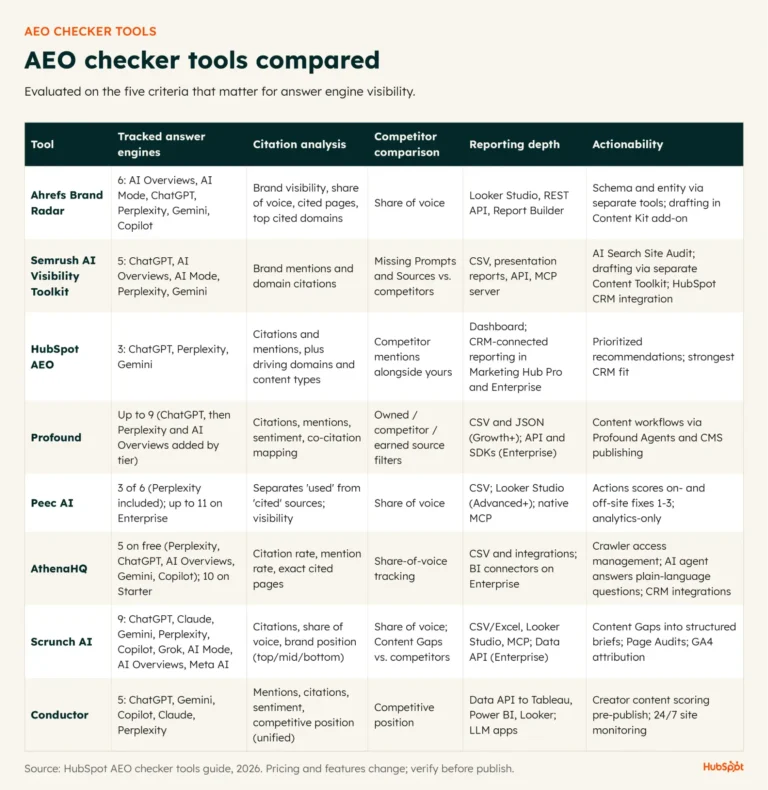
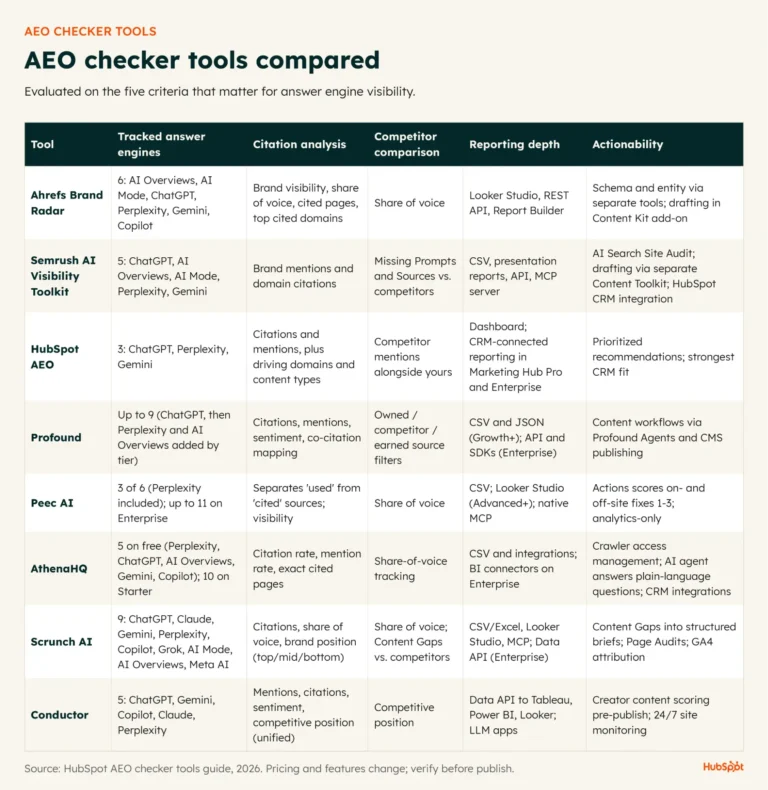
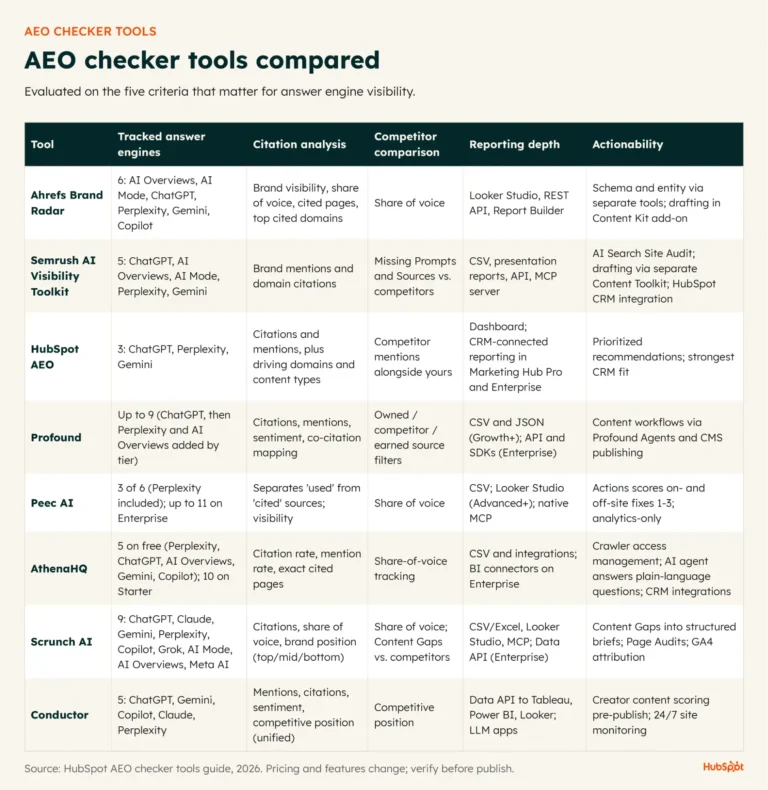
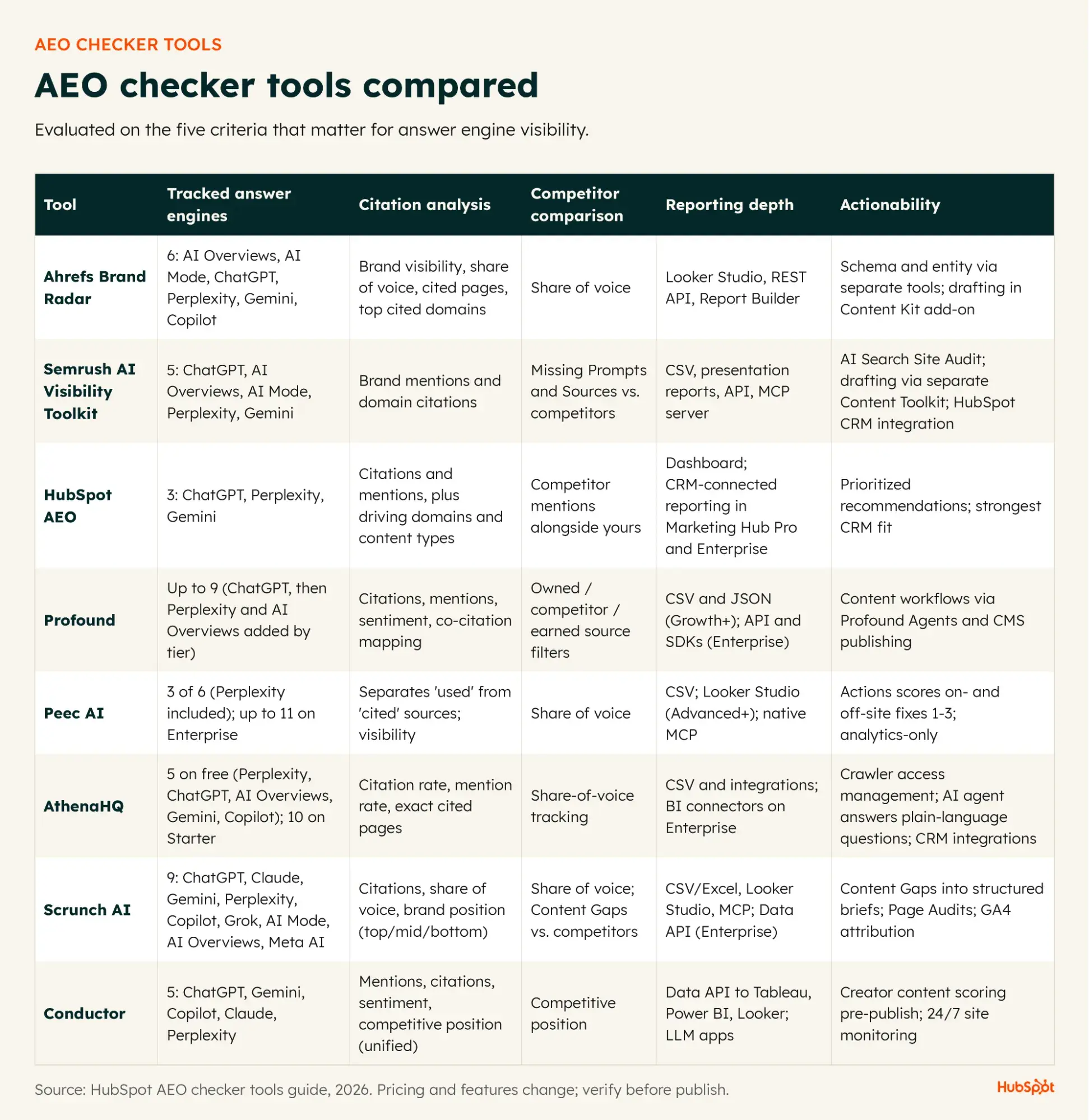
A Comparison of Leading AEO Checker Tools
The market for AEO tools is rapidly evolving. Here’s a look at some prominent options, categorized by their core strengths:
Tools with AI Overviews Tracking
- Ahrefs Brand Radar: This tool distinguishes itself by drawing on real search queries rather than synthetic prompts. Its AI Overviews index is reportedly its most extensive, providing insights into how brands appear in Google’s AI-generated summaries.
- Semrush AI Visibility Toolkit: Semrush’s offering integrates with its existing Organic Research tools. It flags ranking keywords that already trigger AI Overviews, allowing users to prioritize optimization efforts for pages that are close to appearing in these prominent AI features.
Tools with ChatGPT Citation Detection
- HubSpot AEO: HubSpot’s AEO tool offers comprehensive tracking of visibility across ChatGPT, Perplexity, and Gemini. It monitors both citations and mentions, detailing the domains and content types that drive visibility for both the user and their competitors. For users of Marketing Hub Professional and Enterprise, AEO integrates with the CRM, providing context-aware reporting.
- Profound: This tool extends beyond simple citation detection to analyze the context of those citations. It offers sentiment scoring, flags uncited prompts, and breaks down citations by source type (owned, competitor, earned media), providing a deeper understanding of AI referencing patterns.
Tools with Perplexity Monitoring
- Peec AI: Positioned as a pure-play analytics tool, Peec AI focuses on delivering clean and reliable data specifically for Perplexity. This specialized approach can be beneficial for users prioritizing insights from this particular AI engine.
- AthenaHQ: AthenaHQ provides Perplexity monitoring across all its plans, including a free tier. Its conversational assistant feature aims to enhance user interaction and data interpretation.
Tools for Schema and Entity Readiness
- Scrunch AI: This tool focuses on the technical readiness of a website for AI crawlers, assessing whether pages can be reached and rendered effectively. This is a foundational aspect of AEO, ensuring AI can access and process the content.
- Conductor: Conductor combines continuous technical monitoring with a content scoring system. This dual approach helps ensure both the technical infrastructure and the content itself are optimized for AI discovery and comprehension.
Key AEO Metrics to Track
Once an AEO checker is implemented, focusing on specific metrics is crucial for gauging progress and demonstrating ROI. These metrics provide a clear picture of a brand’s performance in the evolving AI search landscape:
![AEO checker tools that measure answer engine visibility [2026]](https://53.fs1.hubspotusercontent-na1.net/hubfs/53/aeo-checker-3-20260903-8904553.webp)
- Brand Visibility Score: This is an overarching metric that quantifies how often and how prominently a brand appears across AI engines. It consolidates data on mentions, citations, and competitive presence.
- Citation Coverage: This metric tracks the percentage of relevant queries for which a brand’s content is cited by AI engines. An increasing citation coverage indicates improved content authority and AI recognition.
- Mention Rate: This measures how frequently a brand is named within AI-generated answers, even if a direct citation is absent. A high mention rate suggests strong brand recall and recognition within AI responses.
- Competitor Citation Share: Analyzing the proportion of citations captured by competitors provides a benchmark and highlights areas where the brand may be losing ground.
- AI-Referred Traffic: While many AI interactions are zero-click, some platforms do direct traffic to websites. Tracking this referred traffic, even if minimal, offers a tangible measure of AI’s impact on website visits.
- Branded Search Lift: An increase in branded search queries following improvements in AEO can indicate that AI mentions are prompting users to directly search for the brand.
These metrics should be viewed as trends over time rather than isolated data points. Consistent monitoring and analysis of directional changes are key to understanding the true impact of AEO strategies.
From Measurement to Action: Integrating AEO into Workflows
The true value of an AEO checker lies not just in its diagnostic capabilities but in its ability to facilitate action. Many tools provide recommendations, but integrating these recommendations into existing workflows is essential for tangible results.
HubSpot’s Marketing Hub, for example, offers an integrated approach. Its AEO tool provides prioritized recommendations for content creation and updates. For users of Marketing Hub Professional or Enterprise, these recommendations are further enhanced by CRM data, allowing for more personalized and targeted actions. The Content Agent feature can even generate AI-powered first drafts of blog posts based on these recommendations, streamlining the content creation process.
This integrated approach addresses the challenge of execution. By keeping diagnosis and action within the same platform, businesses can reduce the time and resources required to implement AEO improvements. Furthermore, HubSpot’s Smart CRM can attribute AI-referred traffic, linking it to specific contacts and deals. This allows for a more holistic understanding of how AI visibility translates into business outcomes, even when direct clicks are not the primary driver.
However, it’s crucial to acknowledge the inherent limitations. Answer engines often resolve queries without sending a click. While AEO tools can measure visibility and track the traffic that does convert, the influence of an unseen mention or citation remains difficult to quantify directly. Therefore, visibility scores and referral revenue should be considered as complementary indicators of AI’s impact.
![AEO checker tools that measure answer engine visibility [2026]](https://53.fs1.hubspotusercontent-na1.net/hubfs/53/aeo-checker-4-20260903-6212698.webp)
Frequently Asked Questions About AEO Checkers
How often should you run an AEO check?
The frequency depends on the method. Manual spot-checks should involve multiple sessions per query due to AI volatility. Automated checkers, running daily or weekly, can capture these fluctuations more effectively, while monthly snapshots may obscure important short-term changes.
Is AEO the same as AI search optimization?
While often used interchangeably, AEO is a more precise term. It specifically refers to optimizing for AI-generated answers in tools like ChatGPT, Perplexity, and Gemini. "AI search optimization" is broader and can encompass various AI-driven search functionalities.
Can you reliably track citations in ChatGPT and Perplexity?
Yes, with a caveat. Both platforms provide source information, making individual responses readable. However, consistency requires repetition. Running prompts multiple times across fresh sessions and analyzing patterns is key to reliability, rather than relying on a single snapshot.
Do AEO checkers replace traditional SEO tools?
No, they serve different purposes. AEO checkers focus on AI citations and mentions, while SEO tools track rankings, keywords, and backlinks. Strong SEO remains foundational for AI engines, so running both types of tools concurrently is recommended.
The Future of Search and the Imperative of AEO
As AI continues its integration into the fabric of online information discovery, AEO will transition from a niche optimization strategy to a core component of digital marketing. Businesses that proactively understand and adapt to this shift will be best positioned to maintain brand relevance and influence in the rapidly evolving search landscape. The ability to be seen, understood, and credited by the AI that is increasingly shaping user decisions is no longer a luxury, but a necessity for sustained digital success.
About the Author