The digital information landscape is undergoing a seismic shift, driven by the rapid advancement and widespread adoption of artificial intelligence in search. Users are increasingly turning to AI-powered chatbots and AI Overviews, such as those provided by ChatGPT, Perplexity, and Google’s own AI Overviews, for direct answers to their queries. This evolution presents a significant challenge for businesses and content creators who once relied on traditional search engine optimization (SEO) for visibility. Now, the focus must extend to ensuring brand presence and content citation within these synthesized AI responses. This is where Answer Engine Optimization (AEO) and the tools that support it, AEO checkers, become crucial.
The core problem identified by the emergence of AI-driven answers is that visibility, once measured by search engine rankings and website traffic, can now be captured and consumed within an AI-generated summary, often without any click-through to the source. This phenomenon effectively moves brand mentions and crucial information from the visible realm of search results pages into a "black box" of AI responses. Understanding which questions surface a brand’s content, which inadvertently highlight competitors, and where AI models might misrepresent a brand’s offerings is paramount. AEO checkers are designed to provide this critical insight, offering a diagnostic tool for businesses to adapt to this new era of search.
![AEO checker tools that measure answer engine visibility [2026]](https://53.fs1.hubspotusercontent-na1.net/hubfs/53/aeo-checker-1-20260903-3858273.webp)
What is Answer Engine Optimization (AEO)?
Answer Engine Optimization (AEO) is the strategic practice of enhancing a brand’s visibility and accuracy within the AI-generated answers provided by conversational AI platforms and integrated AI search features. Unlike traditional SEO, which aims to rank web pages in a list of hyperlinks, AEO focuses on ensuring that a brand is not only mentioned but also accurately represented and cited within the synthesized responses generated by AI models. This includes platforms like ChatGPT, Perplexity, and Gemini, as well as Google’s AI Overviews, which were prominently launched in May 2024.
The distinction between AEO and SEO is not one of competition but of complementarity. Strong SEO remains foundational, providing the crawlability, authority, and structured data that AI engines leverage to identify and cite reliable sources. However, AEO addresses the subsequent layer: how that content is interpreted and presented in a direct-answer format. AI engines prioritize content that is clearly structured, directly answers user questions, and cites verifiable primary sources. Therefore, AEO involves optimizing content and website architecture to meet these specific criteria for AI consumption.
The Role and Function of an AEO Checker
An AEO checker serves as a vital diagnostic and analytical tool, measuring a brand’s presence and performance across various answer engines. Its primary functions include:
![AEO checker tools that measure answer engine visibility [2026]](https://no-cache.hubspot.com/cta/default/53/9dd5e54b-fbef-4dd0-bc44-1689feb1ea18.png)
- Measuring Brand Visibility: Quantifying how often and in what context a brand is mentioned or cited in AI-generated answers.
- Identifying Content Gaps: Pinpointing specific queries where a brand is absent or where competitors are favored in AI responses.
- Detecting Inaccuracies: Flagging instances where AI models misrepresent a brand, its products, or its services.
- Prioritizing Optimization Efforts: Providing actionable recommendations on content updates, schema corrections, and entity improvements that are most likely to enhance AI citation and mention.
Essentially, an AEO checker transforms raw data on AI response patterns into a strategic roadmap for improvement, guiding businesses to address critical areas that impact their digital presence in an AI-first world.
Manual Checks: Navigating AI Overviews, ChatGPT, and Perplexity
While automated tools offer scalability, understanding the manual process of checking AI visibility provides a foundational grasp of the challenges and nuances involved.
How to Conduct an AEO Check in Google AI Overviews
Google’s AI Overviews (AIOs) are designed to surface only when the system determines they offer significant added value beyond traditional search results. This means AIOs do not trigger for every query and can vary from one search session to another. Manual checking requires a systematic approach:
![AEO checker tools that measure answer engine visibility [2026]](https://53.fs1.hubspotusercontent-na1.net/hubfs/53/aeo-checker-2-20260903-852936.webp)
- Define Priority Queries: Compile a list of critical search terms, including brand names, branded product terms, and frequently asked questions by potential buyers.
- Perform Live Searches: Conduct searches using these queries in an incognito or signed-out browser session to simulate a neutral user experience.
- Analyze AI Overviews: For each query, note whether an AI Overview appears. If it does, meticulously examine the inline source links to determine if your domain is cited. Record the exact claims made within the AI Overview.
- Interpret Results and Identify Gaps: Compare queries that trigger AIOs and cite your brand against those where AIOs appear but competitors are cited. The latter represents your content gap list. Given the variability of AIOs, re-checking absent citations is recommended before concluding a loss of placement.
- Build a Reporting System: Document each result with the query, date, and location. This provides a verifiable record. It’s important to note that Google Search Console’s standard performance reports currently do not isolate AI Overview activity, lumping it into the broader "Web" search type. While Google has introduced dedicated generative AI performance reports, these initially focused on impressions for a subset of sites.
Manual checks are feasible for small query lists but become unreliable and unscalable as the volume increases, especially given the dynamic nature of AI Overviews.
Checking ChatGPT and Perplexity Citations
Both ChatGPT and Perplexity provide mechanisms to review their sources, facilitating manual citation checks:
- Run Practical Citation Checks: Use the predefined priority queries and examine each AI response for two key indicators: the presence of your domain among the cited sources and whether your brand is explicitly named within the answer text. A citation and a direct mention are distinct forms of visibility.
- Optimize Prompts for Retrieval: To ensure AI models engage with current information and external sources, phrase prompts directly and with a focus on contemporary needs. For example, queries like "best [category] tools for [use case]" encourage the AI to access live web data.
- Log and Action Findings: Because AI responses can vary, run each prompt multiple times across different sessions. Record the engine, prompt, date, citation status, mentions, and any competitor inclusions. This log will reveal inconsistencies and highlight areas for improvement. For instance, if your brand is cited in one session but not the next, or by Perplexity but not ChatGPT, it indicates a need to refine the content or its structure related to that query.
Key Criteria for Selecting an AEO Checker Tool
As manual checks become insufficient for comprehensive AEO management, businesses need robust, automated solutions. When evaluating AEO checker software, consider the following criteria:
![AEO checker tools that measure answer engine visibility [2026]](https://53.fs1.hubspotusercontent-na1.net/hubfs/53/aeo-checker-3-20260903-8904553.webp)
- Engine Coverage: The tool should monitor visibility across key answer engines relevant to your target audience (e.g., Google AI Overviews, ChatGPT, Perplexity, Gemini).
- Citation and Mention Tracking: The ability to differentiate between direct citations (links to your domain) and brand mentions (your brand name appearing without a link) is crucial.
- Competitor Analysis: Understanding how competitors are performing in AI answers provides valuable benchmarking and strategic insights.
- Content and Schema Analysis: Features that analyze your content structure, schema markup, and entity relevance for AI crawlability and comprehension.
- Actionable Recommendations: The tool should not just report data but also provide prioritized, data-driven recommendations for improvement.
- Reporting and Integration: Customizable dashboards, exportable reports, and integration capabilities with existing marketing stacks (e.g., CRM, CMS) are essential for seamless workflow.
- Scalability and Automation: The ability to continuously and automatically monitor AI visibility across a large number of queries.
- Cost-Effectiveness: Pricing models that align with the business’s budget and the perceived value of the insights provided.
Leading AEO Checker Tools and Their Capabilities
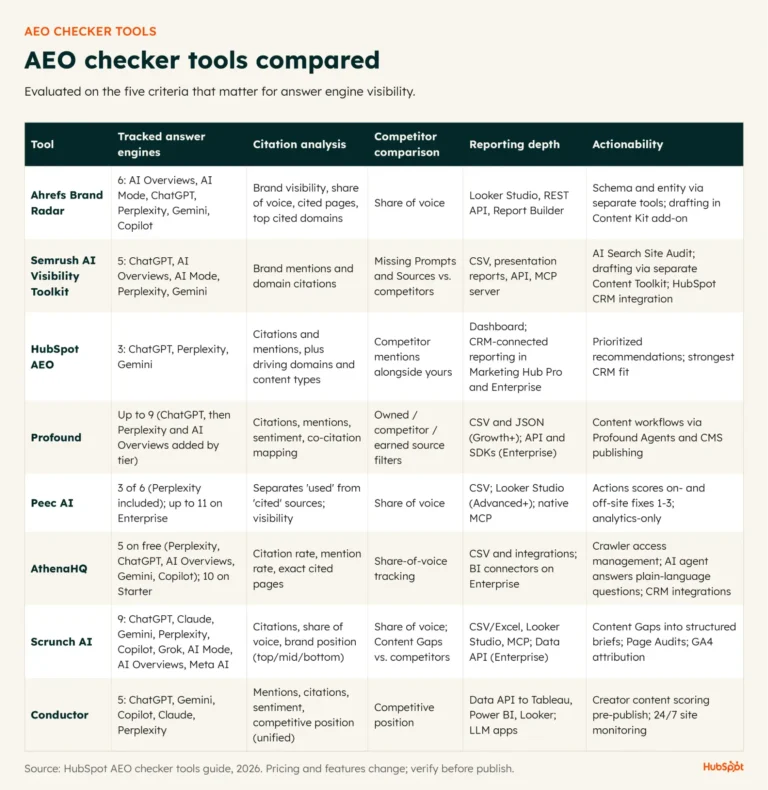
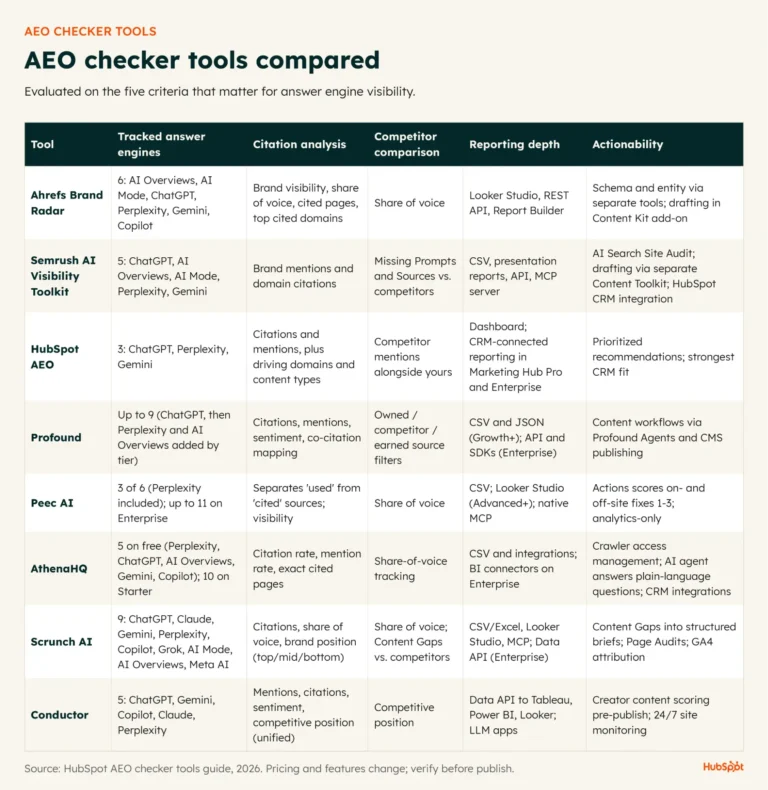
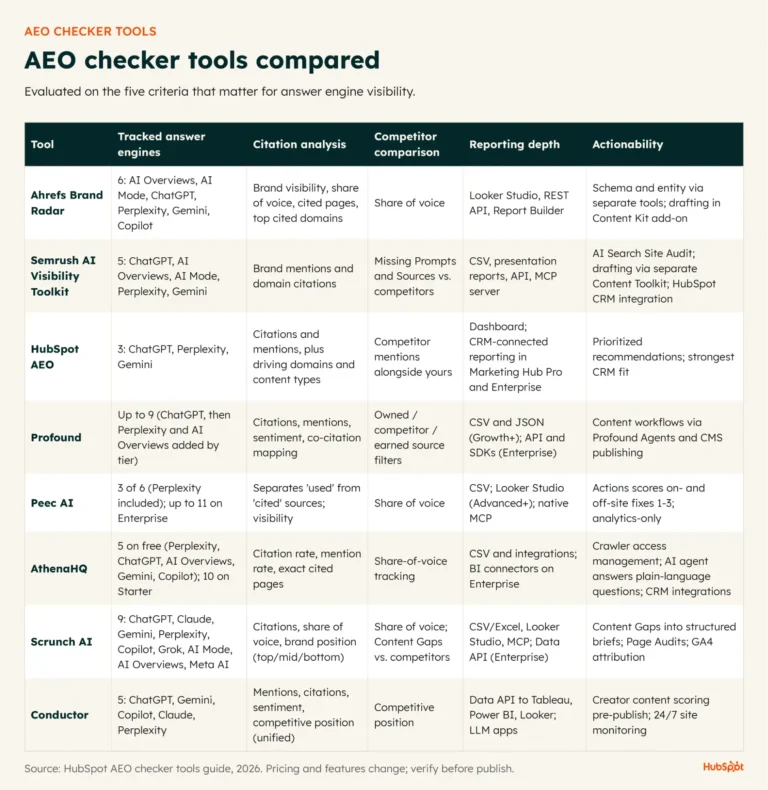
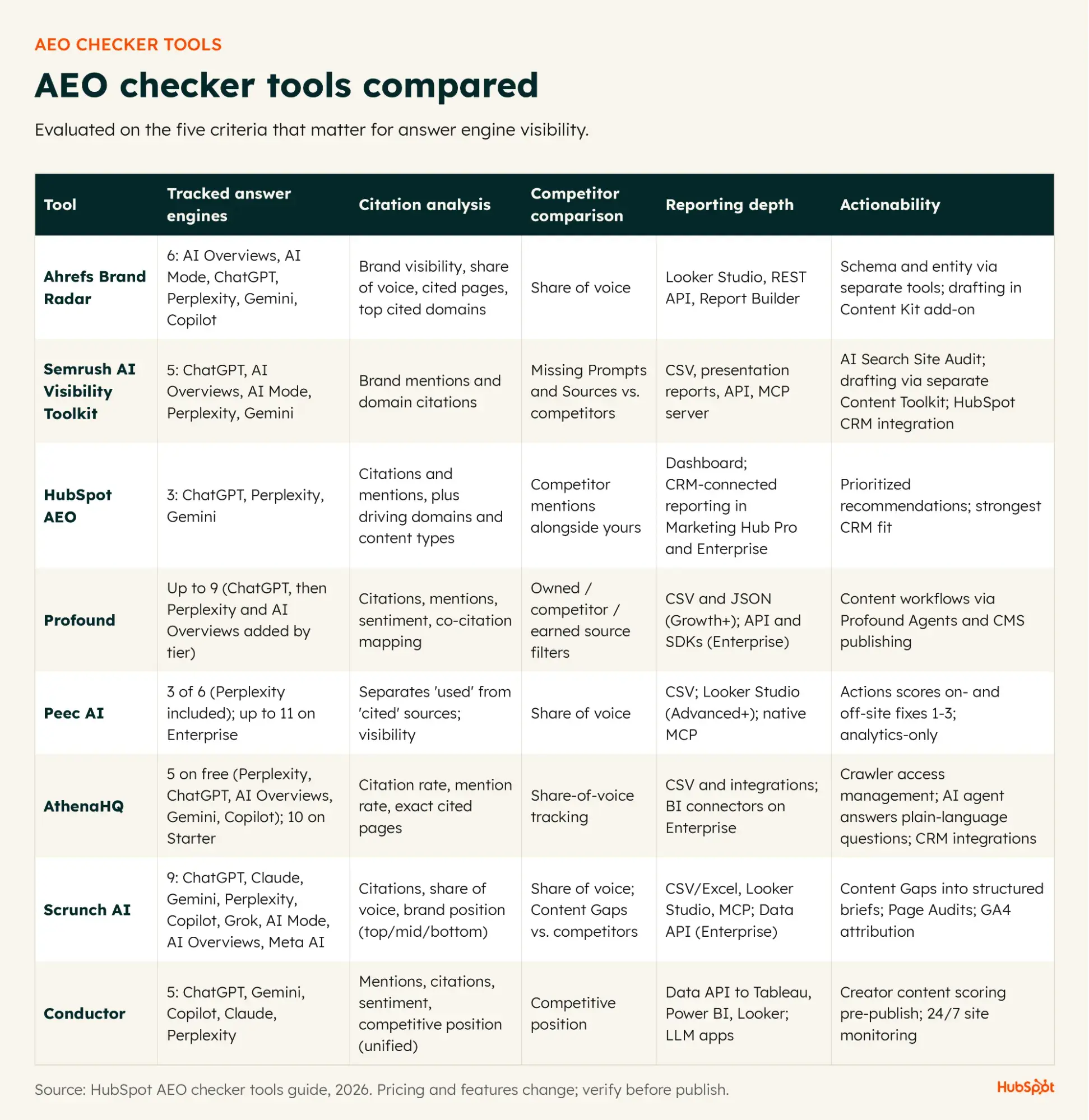
The market offers a growing number of AEO checker tools, each with its unique strengths. Here’s a look at some prominent options:
Tools Featuring AI Overviews Tracking
- Ahrefs Brand Radar: This tool leverages real search queries rather than synthetic prompts, offering a comprehensive index of AI Overviews. It is particularly noted for its extensive AI Overview tracking capabilities.
- Semrush AI Visibility Toolkit: Semrush integrates AI Overview tracking within its existing Organic Research features. It identifies ranking keywords that already trigger AI Overviews, allowing businesses to prioritize optimization efforts on pages with existing potential for AI inclusion.
Tools Featuring ChatGPT Citation Detection
- HubSpot AEO: HubSpot’s AEO tool tracks both citations and brand mentions across ChatGPT, Perplexity, and Gemini. It analyzes the domains and content types driving visibility for both the brand and its competitors, providing a holistic view of AI performance.
- Profound: Beyond simple citation detection, Profound offers deeper analysis, including sentiment scoring of mentions, flagging of uncited prompts, and a breakdown of citations by source type (owned, competitor, earned). This granular data allows for more nuanced optimization strategies.
Tools Featuring Perplexity Monitoring
- Peec AI: As a specialized analytics tool, Peec AI focuses on delivering clean and precise data specifically for Perplexity. It aims to provide clear insights into a brand’s performance on this popular AI search engine.
- AthenaHQ: AthenaHQ offers Perplexity monitoring across all its plans, including a free tier. Its conversational assistant feature can help users interpret the data and formulate strategies.
Tools for Schema and Entity Readiness
- Scrunch AI: This tool focuses on the technical aspects of AI readiness, checking whether AI crawlers can successfully access and render a brand’s web pages. This is fundamental for ensuring content is discoverable by AI models.
- Conductor: Conductor combines continuous technical monitoring with a content scoring system designed to assess a brand’s preparedness for AI search. It aims to provide a comprehensive approach to technical and content optimization for AI.
Essential AEO Metrics to Track
Once an AEO checker is in place, focusing on key metrics is crucial for measuring progress and demonstrating impact:
- Citation Coverage: The percentage of relevant queries where your content is cited by answer engines.
- Brand Mentions: The frequency and context of your brand name appearing in AI answers, even without a direct citation.
- Share of Voice (SOV) in AI Answers: Your brand’s proportion of mentions and citations compared to competitors for a given set of queries.
- AI-Referred Traffic: Website traffic originating from AI tools. While direct clicks are not always the outcome, this metric captures the traffic that does result.
- Branded Search Lift: An increase in direct searches for your brand name, potentially indicating increased awareness driven by AI visibility.
These metrics should be viewed as trends over time. Consistent improvement in citation coverage and brand mentions, coupled with an increase in AI-referred traffic and branded search lift, indicates successful AEO efforts.
![AEO checker tools that measure answer engine visibility [2026]](https://53.fs1.hubspotusercontent-na1.net/hubfs/53/aeo-checker-4-20260903-6212698.webp)
From Measurement to Action: Integrating AEO into Workflows
The ultimate value of an AEO checker lies in its ability to translate data into actionable strategies. Tools like HubSpot’s AEO offer a more integrated approach, moving beyond mere diagnosis to facilitate the implementation of fixes.
HubSpot’s AEO tool, available as a standalone product or within Marketing Hub Professional and Enterprise, provides prioritized recommendations. These recommendations guide content creation, updates, and outreach efforts, clearly articulating the "why" behind each suggestion. For users of Marketing Hub Professional and Enterprise, the process is further streamlined. The platform’s Content Agent can transform a blog recommendation into a researched first draft, ready for team review and publication. This integrated workflow, powered by HubSpot Credits, aims to reduce the friction between identifying an optimization need and executing the solution.
Furthermore, by leveraging HubSpot’s Smart CRM, traffic referred from AI tools is tracked as a distinct source, allowing for the attribution of contacts and deals generated through these channels. This provides a holistic view of the marketing funnel, connecting AI visibility to tangible business outcomes. However, it is important to acknowledge that AEO’s impact isn’t always directly measurable in terms of clicks. Visibility that doesn’t result in a session is difficult to attribute as pipeline. Therefore, visibility scores and referral revenue should be considered as related but distinct measures of success.
![AEO checker tools that measure answer engine visibility [2026]](https://53.fs1.hubspotusercontent-na1.net/hubfs/53/aeo-checker-5-20260903-8938354.webp)
Frequently Asked Questions About AEO Checkers
- How often should you run an AEO check? The frequency depends on the method. For manual checks, multiple sessions per query are needed due to AI variability. Automated checkers can provide daily or weekly refreshes to capture volatility, while monthly snapshots offer a broader trend overview.
- Is AEO the same as AI search optimization? While often used interchangeably, AEO is more precise. It specifically refers to optimizing for AI-generated answers, whereas "AI search optimization" can encompass broader strategies for visibility within AI-driven search environments.
- Can you reliably track citations in ChatGPT and Perplexity? Yes, within limits. Both platforms allow for source review. Reliability is achieved through repetition and tracking patterns across multiple sessions, rather than relying on a single snapshot.
- Do AEO checkers replace traditional SEO tools? No, they serve different purposes. SEO tools focus on rankings, keywords, and backlinks, while AEO checkers measure AI citation and mention. Both are essential, as strong SEO underpins the authority AI engines rely on.
In conclusion, the advent of AI-driven answers necessitates a paradigm shift in how businesses approach online visibility. AEO checkers are indispensable tools for navigating this new frontier, enabling brands to understand their performance in AI summaries, identify critical gaps, and implement strategies to ensure their brand is accurately and effectively represented in the evolving landscape of digital search.
About the Author