The digital landscape is undergoing a seismic shift, driven by the rapid integration of artificial intelligence into search and information retrieval. As consumers increasingly turn to AI-powered platforms like ChatGPT, Perplexity, and Google’s Gemini for direct answers, traditional search engine optimization (SEO) strategies are no longer sufficient. A new discipline, Answer Engine Optimization (AEO), has emerged to address this critical change, focusing on ensuring brands are not just discoverable in search results, but are also accurately and prominently featured within the AI-generated responses that users now rely upon.
At its core, an AEO checker is a diagnostic tool designed to assess a brand’s visibility within these emerging AI answer engines. It answers a fundamental question: when a potential customer asks an AI a question, does your brand appear in the answer, or is it overlooked in favor of competitors? This is crucial because the traditional pathway of a user clicking through a list of links to find information is being bypassed. Instead, AI synthesizes information from various sources, presenting a single, often comprehensive, answer. This can lead to a phenomenon where visibility that once translated into website traffic and conversions now vanishes into an unseen AI response.
Understanding the Evolution: From SEO to AEO
Search Engine Optimization (SEO) has long been the cornerstone of digital marketing, focusing on improving a website’s ranking in organic search engine results pages (SERPs). The goal has been to ensure that when users search for specific keywords, a brand’s website appears prominently among the list of links. However, the advent of generative AI and features like Google’s AI Overviews (formerly Search Generative Experience or SGE) has fundamentally altered user behavior. These AI models are trained on vast datasets and can synthesize information to provide direct answers, often eliminating the need for users to click through to individual websites.
![AEO checker tools that measure answer engine visibility [2026]](https://53.fs1.hubspotusercontent-na1.net/hubfs/53/aeo-checker-1-20260903-3858273.webp)
Answer Engine Optimization (AEO) is not a replacement for SEO but rather a complementary discipline. While SEO aims to get your website listed in search results, AEO focuses on ensuring your brand and content are cited and mentioned within the AI-generated answers. Strong SEO practices, such as creating crawlable, authoritative content and providing clear, verifiable information, remain foundational. Answer engines rely on these signals to determine which sources are credible and relevant. However, AEO adds a new layer of strategic consideration, focusing on how that content is parsed, understood, and ultimately integrated into AI responses.
What an AEO Checker Does: Diagnosing AI Visibility
An AEO checker serves as a critical tool for businesses to navigate this evolving search paradigm. Its primary function is to measure a brand’s visibility across various AI answer engines and translate that data into actionable recommendations for improvement. These tools typically examine several key areas:
- Brand Mentions: Whether your brand name is explicitly stated within an AI-generated answer.
- Content Citations: Whether the AI cites your website or specific content pages as a source for the information provided.
- Competitor Visibility: Identifying when competitors are cited or mentioned in response to queries where your brand is absent.
- Accuracy of Information: Assessing if the AI accurately represents your brand and its offerings when it does appear.
- Query Coverage: Identifying the specific search queries that trigger AI overviews and how your brand performs against them.
Based on this analysis, an AEO checker can prioritize areas for improvement. This might involve identifying content gaps, suggesting schema markup corrections to enhance data parsability, or recommending entity-based optimizations to ensure AI models correctly understand and associate information with your brand. The ultimate goal is to move from measurement to strategic action, ensuring a brand’s digital footprint extends effectively into the AI-driven search experience.
Navigating the AI Landscape: Manual Checks and Automated Solutions
![AEO checker tools that measure answer engine visibility [2026]](https://no-cache.hubspot.com/cta/default/53/9dd5e54b-fbef-4dd0-bc44-1689feb1ea18.png)
For businesses beginning their AEO journey, manual checks can provide initial insights. This involves directly querying AI platforms and meticulously analyzing the results.
Manual Checks in Google AI Overviews:
Google’s AI Overviews, launched in May 2024, represent a significant integration of AI into mainstream search. These overviews are designed to appear when Google’s systems determine a summary adds value beyond traditional search results, meaning they don’t trigger for every query.
- Step 1: Define Key Queries: Identify the most critical search terms, including brand name, branded product terms, and common questions your target audience asks.
- Step 2: Conduct Live Searches: Perform these queries in a signed-out or incognito browser session to get unbiased results. Note whether an AI Overview appears, if your domain is cited, and the specific claims made.
- Step 3: Interpret and Document: Compare results across different queries. Identify instances where AI Overviews appear but competitors are cited instead. Given the dynamic nature of AI responses, it’s advisable to sample queries multiple times to account for variations. Documenting these results with screenshots, dates, and query details is essential for tracking progress.
It’s important to note that Google Search Console’s standard performance reports do not yet isolate AI Overview activity, often rolling it into the general "Web" search type. While Google has begun rolling out dedicated generative AI performance reports, these initially focused on impressions and reached a limited subset of sites.
Manual Checks in ChatGPT and Perplexity:
![AEO checker tools that measure answer engine visibility [2026]](https://53.fs1.hubspotusercontent-na1.net/hubfs/53/aeo-checker-2-20260903-852936.webp)
Platforms like ChatGPT and Perplexity also offer insights into AI citation practices.
- Step 1: Execute Practical Citation Checks: Use your defined queries to prompt these AI models. Look for two key indicators: your domain appearing in the list of cited sources, and your brand name being mentioned within the answer text.
- Step 2: Refine Prompting: To ensure AI models access current information and cite relevant sources, phrase prompts clearly and directly. For example, using "best [category] tools for [use case] in [year]" can encourage web searches.
- Step 3: Log and Analyze: As with Google AI Overviews, repeat prompts multiple times across different sessions. Maintain a detailed log of engine, prompt, date, citation status, mention status, and any competitor mentions. Inconsistencies in citation across runs can highlight areas for content optimization.
While manual checks are valuable for initial exploration, their scalability is limited. The dynamic nature of AI responses and the sheer volume of potential queries necessitate more robust, automated solutions.
Choosing the Right AEO Checker: Key Criteria
As the need for continuous monitoring and analysis grows, selecting the right AEO checking software becomes paramount. Several factors should guide this decision:
- Breadth of AI Engine Coverage: The tool should ideally track visibility across major AI platforms like Google AI Overviews, ChatGPT, and Gemini.
- Citation and Mention Tracking: The ability to differentiate between direct citations (links) and brand mentions is crucial.
- Competitor Analysis: Insights into how competitors are performing within AI answers provide valuable benchmarks and competitive intelligence.
- Prioritization of Recommendations: The software should not only identify issues but also offer actionable recommendations, prioritized by their potential impact.
- Data Granularity and Reporting: Clear, detailed reporting that allows for trend analysis and the tracking of key AEO metrics is essential.
- Integration Capabilities: Compatibility with existing marketing stacks, such as CRMs, can streamline workflows and enhance data utilization.
- Accuracy and Reliability: The tool must provide consistent and trustworthy data to inform strategic decisions.
Leading AEO Checker Tools and Their Capabilities
![AEO checker tools that measure answer engine visibility [2026]](https://53.fs1.hubspotusercontent-na1.net/hubfs/53/aeo-checker-3-20260903-8904553.webp)
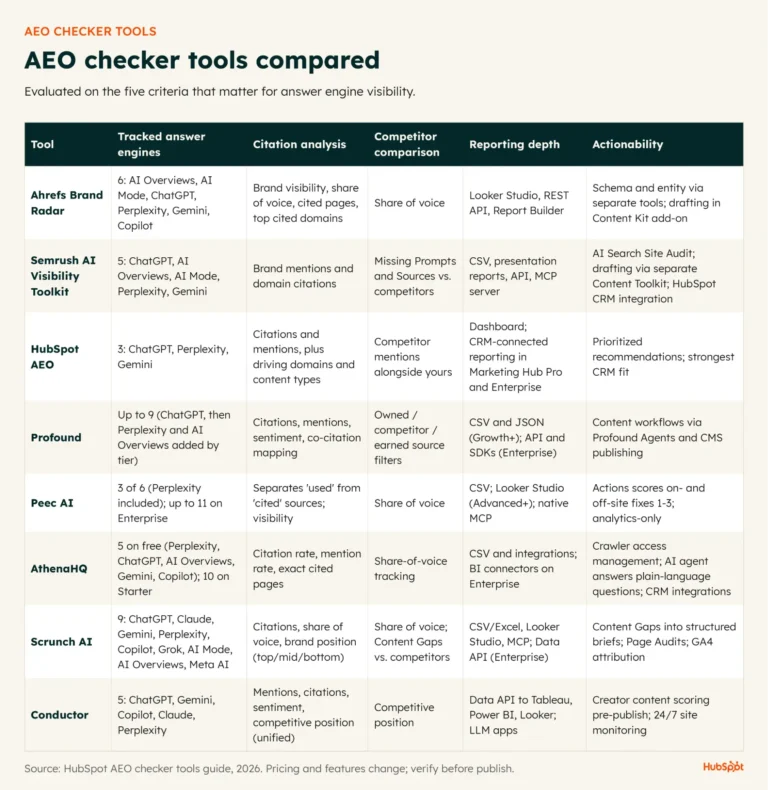
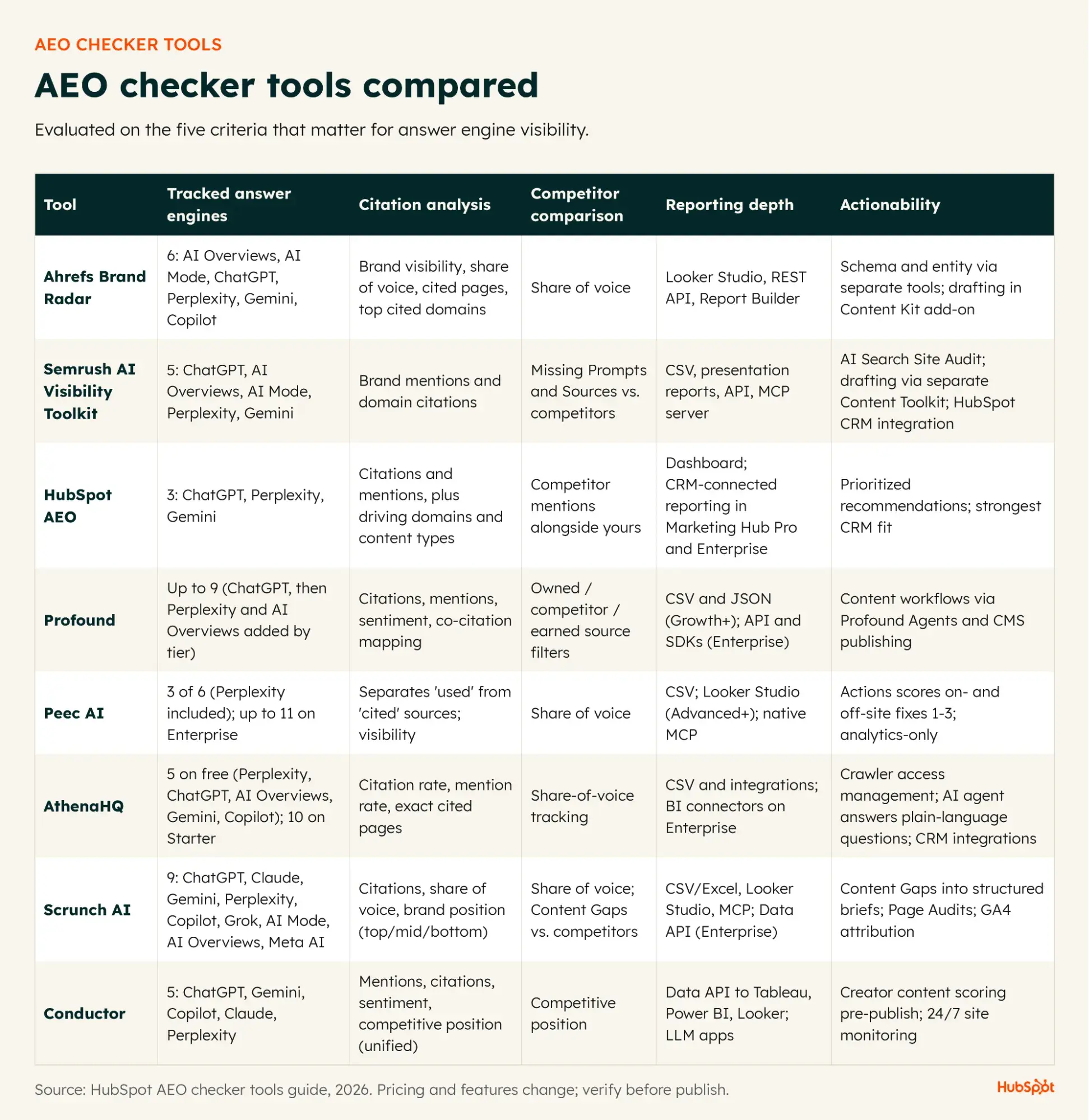
The market for AEO checkers is evolving rapidly, with various tools offering specialized features. A comparative overview highlights key players:
Tools with AI Overviews Tracking:
- Ahrefs Brand Radar: Leverages real search queries to index AI Overviews, offering a large dataset for analysis. It focuses on identifying brand mentions and citations within these AI-generated summaries.
- Semrush AI Visibility Toolkit: Integrates AI Overview tracking into its existing suite, flagging ranking keywords that trigger AI Overviews. This allows users to prioritize content optimization efforts for queries where they are close to appearing in AI responses.
Tools with ChatGPT Citation Detection:
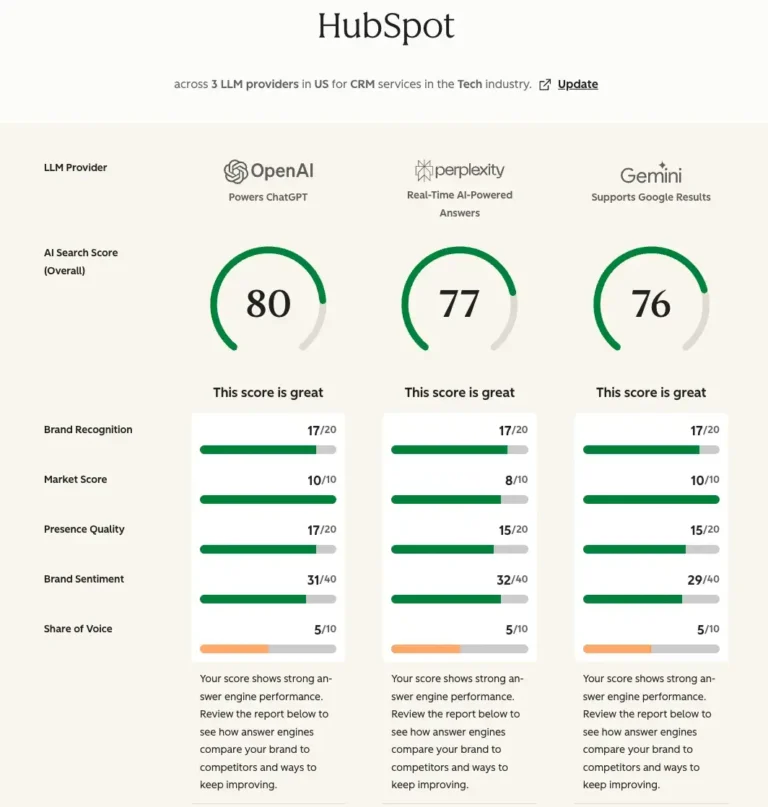
- HubSpot AEO: This tool provides comprehensive tracking of both citations and mentions across ChatGPT and other AI platforms. It also analyzes the content types and domains driving visibility for both the brand and its competitors, offering CRM-connected reporting in higher tiers.
- Profound: Goes beyond simple citation detection by analyzing the context of citations, including sentiment scoring and categorizing sources (owned, competitor, earned). This offers a deeper understanding of how a brand is perceived and referenced by AI.
Tools with Perplexity Monitoring:
- Peec AI: A specialized analytics tool focused on delivering clean and detailed data specifically from Perplexity.
- AthenaHQ: Offers Perplexity monitoring across all its plans, including a free tier, and features a conversational assistant for data interaction.
Tools for Schema and Entity Readiness:
![AEO checker tools that measure answer engine visibility [2026]](https://53.fs1.hubspotusercontent-na1.net/hubfs/53/aeo-checker-4-20260903-6212698.webp)
- Scrunch AI: Focuses on the technical readiness of content for AI crawlers, assessing whether pages can be reached and rendered effectively.
- Conductor: Combines continuous technical monitoring with a content scoring mechanism designed to optimize for AI understanding and inclusion.
Key AEO Metrics to Track
Once an AEO checker is in place, monitoring specific metrics is crucial for gauging progress:
- Citation Coverage: The percentage of AI queries where your brand or content is cited.
- Mention Frequency: How often your brand name appears in AI answers.
- Brand Visibility Score: A proprietary metric often used by tools to quantify overall AI presence.
- Competitor Share of Voice: The proportion of AI answers that feature your competitors versus your brand.
- AI-Referred Traffic: While direct attribution can be challenging due to zero-click searches, tracking any traffic that originates from AI tools is valuable.
- Branded Search Lift: Observing any increase in direct branded searches, which might correlate with increased AI visibility.
These metrics should be viewed as trends over time rather than isolated snapshots. Consistent improvement in these areas indicates a successful AEO strategy.
From Measurement to Action: Integrating AEO into Workflows
The true value of an AEO checker lies in its ability to bridge the gap between diagnosis and action. Tools like HubSpot’s AEO offer an integrated approach, allowing users to not only identify areas for improvement but also to act on them directly within the platform.
![AEO checker tools that measure answer engine visibility [2026]](https://53.fs1.hubspotusercontent-na1.net/hubfs/53/aeo-checker-5-20260903-8938354.webp)
For instance, HubSpot’s AEO tool, available as a standalone product or within Marketing Hub Professional and Enterprise, provides prioritized recommendations. In higher tiers, it leverages CRM data to offer personalized suggestions. Features like Content Agent can even generate AI-powered first drafts of content based on these recommendations, streamlining the creation and publication process. This integrated approach ensures that the insights gained from AEO monitoring are efficiently translated into tangible content updates and optimizations.
The Broader Implications: A New Era of Digital Visibility
The rise of AEO signifies a fundamental recalibration of digital marketing strategy. Brands can no longer solely rely on traditional SEO metrics; they must actively engage with the AI-driven information ecosystem. This involves:
- Content Structuring and Clarity: AI models favor clearly structured content with verifiable sources. Optimizing content for machine readability is paramount.
- Entity Optimization: Ensuring that AI models correctly understand and attribute information to your brand and its entities (products, services, people) is critical.
- Reputation Management in AI: Just as online reviews impact reputation, the accuracy and prominence of brand mentions in AI answers will shape public perception.
- Zero-Click Search Impact: Marketers must find new ways to measure and influence user behavior when direct clicks are bypassed. This may involve focusing on brand recall and consideration generated by AI mentions.
Frequently Asked Questions About AEO Checkers
- How often should AEO checks be performed? Manual checks require frequent sampling due to AI volatility. Automated tools can provide daily or weekly refreshes for continuous monitoring, with monthly snapshots offering broader trends.
- Is AEO the same as AI search optimization? While often used interchangeably, AEO is more precise, focusing specifically on optimizing for AI-generated answers. "AI search optimization" is a broader term.
- Can citations in ChatGPT and Perplexity be reliably tracked? Yes, but reliability comes from repeated checks across multiple sessions to identify consistent patterns rather than single instances.
- Do AEO checkers replace traditional SEO tools? No, they are complementary. SEO tools focus on rankings and backlinks, while AEO tools address visibility within AI-generated answers. Both are essential for comprehensive digital presence.
In conclusion, the advent of AI-powered answer engines presents both challenges and opportunities for businesses. By embracing Answer Engine Optimization and leveraging the insights provided by AEO checkers, brands can ensure their continued relevance and visibility in this transformative new era of digital discovery. The ability to be found, cited, and accurately represented within AI-generated answers is no longer a competitive advantage but a fundamental requirement for sustained digital success.
About the Author