The digital marketing arena is undergoing a seismic shift with the rapid integration of Artificial Intelligence (AI) into search engines. This evolution necessitates a new paradigm for Search Engine Optimization (SEO), moving beyond traditional keyword rankings to encompass visibility within AI-generated answers. AI search optimization tools are emerging as crucial instruments for marketers, providing critical insights into how brands are represented in these new AI-driven search experiences. These tools complement, rather than replace, existing SEO strategies by offering a deeper understanding of where a brand appears in AI-generated responses, which sources are cited, and what areas require improvement.
Traditional SEO focuses on measurable metrics like rankings, click-through rates, and organic traffic. In contrast, AI search optimization introduces a new layer of visibility signals. These include brand mentions, content citations, sentiment analysis of AI-generated responses, and the accuracy of the information presented. As consumers increasingly turn to conversational AI platforms like ChatGPT, Google’s AI Mode, Gemini, and Perplexity for research and information gathering, marketers must adapt their strategies to ensure their brand not only ranks but is also accurately and favorably represented in these answer engines.
The choice of an AI search optimization toolstack is contingent upon specific marketing objectives. Whether the goal is to establish baseline visibility, implement ongoing monitoring, diagnose crawl issues, leverage first-party platform reporting, or execute content improvements, a tailored approach is required. This comprehensive guide explores the various "jobs to be done" within AI search optimization, the tools best suited for each, and the measurable outcomes that should inform investment decisions.
The Genesis of AI Search Optimization
The proliferation of large language models (LLMs) and their integration into search functionalities has fundamentally altered user search behavior. Platforms such as ChatGPT, Gemini, and Perplexity have democratized access to AI-powered information retrieval, transforming how consumers discover and engage with brands. This shift has prompted the emergence of new optimization disciplines, often referred to as Answer Engine Optimization (AEO), Generative Engine Optimization (GEO), or AI SEO. While the terminology may vary, the core objective remains consistent: to enhance how answer engines comprehend, represent, and attribute information from brands.
A recent study, "HubSpot’s State of AEO 2026," revealed a significant impact on purchasing decisions, with 44% of marketers reporting that they have made a business purchase based on brands discovered through answer engines. This underscores the growing importance of AI-driven discovery channels. Furthermore, data from Similarweb’s 2025 ecommerce analysis indicated that visits referred from ChatGPT converted at an impressive 11.4%, significantly outperforming organic search conversions at 5.3%. This suggests that AI-referred traffic represents a high-intent acquisition channel, making AI search optimization a strategic imperative for driving business growth.
Diverging Paths: AI Search Optimization vs. Traditional SEO
It is crucial to understand that AI search optimization is not a replacement for traditional SEO but rather a powerful complement. While SEO continues to be vital for crawlability, indexing, keyword rankings, and driving organic traffic, AI search measurement addresses a new critical question: When an answer engine generates a response, does it accurately mention, cite, and represent your brand? This necessitates a recalibration of how marketing tools are evaluated and utilized.
Traditional SEO tools provide insights into search engine rankings, traffic volume, and keyword performance. AI search optimization tools, however, offer a more nuanced view, examining:
- Brand Mentions: How frequently and in what context a brand is mentioned within AI-generated answers.
- Citations: Which specific pieces of content or websites are credited by AI models.
- Sentiment Analysis: The overall tone and perception of the brand within AI responses.
- Answer Accuracy: Whether the information presented by AI about a brand is correct and up-to-date.
This expanded set of metrics allows marketers to develop a more holistic understanding of their brand’s digital presence in the evolving AI-driven search ecosystem.
Navigating the AI Search Optimization Tool Landscape: Identifying Your "Jobs to Be Done"

The AI search optimization tool market is burgeoning, offering a diverse array of solutions. The key to selecting the right tool lies in identifying the specific "job" or objective you aim to accomplish. This systematic approach ensures that resources are allocated effectively and that the chosen tools align with your strategic priorities.
Job 1: Establishing a Baseline Visibility Assessment
Before implementing any changes, it is imperative to understand your current standing. This initial diagnostic phase involves establishing a baseline of how AI search engines currently represent your brand. This is typically a one-time assessment that provides a snapshot of your brand’s AI visibility.
- Best For: Laying the groundwork for AI visibility strategies and building a compelling internal case for ongoing investment in AI search optimization.
- Outcome: A clear understanding of your brand’s current presence in AI-generated answers, identifying initial areas for improvement.
Job 2: Ongoing Visibility Monitoring
Once a baseline is established, continuous monitoring becomes essential for tracking progress and identifying shifts in AI search performance. This involves consistently evaluating your brand’s visibility against a stable set of prompts and competitor sets.
- Pricing: Self-service options vary, with tools like Otterly.AI starting around $29/month and HubSpot AEO priced at $50/month standalone (or $45/month annually). Higher-tier options exist, and it’s crucial to compare plans based on actual coverage needs, prompt capacity, and reporting depth.
- Goal: To maintain consistent measurement by running priority prompts repeatedly, tracking mentions and citations against competitors, and observing changes in visibility and answer accuracy over time.
- Outcome: Trend data that informs ongoing content and optimization strategies, allowing for proactive adjustments to maintain or improve AI search performance.
Job 3: Diagnosing AI Crawler Site Access
Understanding how AI crawlers interact with your website is critical. This involves examining server logs, utilizing tools like Cloudflare AI Crawl Control, or implementing other crawler diagnostic workflows. These methods reveal whether AI bots such as GPTBot, ClaudeBot, PerplexityBot, and OAI-SearchBot are successfully accessing your site.
- Benefit: Isolating potential access issues before investing heavily in content optimization.
- Outcome: Assurance that AI crawlers can reach your content, eliminating a significant technical barrier to AI search visibility.
Job 4: Leveraging First-Party Platform Reporting
While third-party tools offer valuable insights into AI visibility, first-party data from platforms like Google and Microsoft provides a more direct perspective. However, it’s important to recognize that these platforms measure different aspects of AI performance.
- Pro Tip: Bing’s "grounding queries" and Google’s "generative-AI impressions" offer distinct insights. For conventional Google query analysis, continue to rely on Google Search Console. Treat these datasets as complementary rather than interchangeable.
- Outcome: A more comprehensive understanding of your brand’s performance by combining external estimates with direct platform data.
Job 5: Executing Content and Optimization Strategies
Measurement alone does not drive improvement. This job focuses on the practical implementation of changes based on AI search optimization data. Content operations platforms that bridge the gap between visibility signals and content execution are invaluable here.
- Best For: Teams that have identified specific areas for improvement and seek to streamline the workflow from data analysis to content creation and deployment.
- Outcome: Tangible improvements in AI search visibility through targeted content updates and optimizations.
Ensuring Site Accessibility for AI Systems

A significant technical consideration for AI search optimization is ensuring that websites are accessible to AI crawlers. Research indicates that many major AI crawlers, including GPTBot and ClaudeBot, do not execute JavaScript. This means that content rendered dynamically in the browser might be inaccessible to these bots, even if it’s visible to users. Google’s Gemini, however, is an exception due to its reliance on Googlebot’s rendering infrastructure.
- Tool Recommendation: Cloudflare AI Crawl Control is a valuable tool that monitors AI service access, crawler activity, and request patterns. It also allows for crawler-specific access policies and compliance monitoring with robots.txt.
- Why it Matters: If AI crawler traffic is minimal on key pages, investigate crawl rules, security settings, and response behaviors. While healthy crawler traffic confirms accessibility, it doesn’t guarantee accurate interpretation or citation of content.
- Pro Tip: If you are already a Cloudflare user, AI Crawl Control offers a streamlined interface. Otherwise, server logs filtered by relevant user agents can provide similar access insights.
Making Content Readable for AI Crawlers
To ensure content is readable by AI crawlers, especially those that do not execute JavaScript, it’s recommended to view the page source rather than solely relying on the browser’s developer tools. Search for a sentence from your main body copy within the HTML source. If the text is present in the initial HTML, it has passed a fundamental accessibility check. Additionally, consider the following potential blockers:
- JavaScript Dependencies: Content that relies heavily on JavaScript for rendering may be missed.
- Robots.txt Directives: Ensure that your robots.txt file does not inadvertently block AI crawlers from accessing important content.
- Server-Side Rendering (SSR): Implementing SSR can ensure that content is available in the initial HTML response.
Regarding llms.txt files, current evidence does not support their efficacy as a direct lever for AI search visibility. Google has stated that llms.txt files are not required for its generative AI features and do not impact Search visibility. Ahrefs’ study of approximately 137,000 sites found that the vast majority of valid llms.txt files received no requests, with those that did being accessed more often by coding agents than search-oriented retrieval bots. While maintaining such a file might be useful for other specific services, publishing it is not currently considered a core AEO initiative.
Structuring Content for Citations: The Role of Schema and Direct Answers
The impact of structured data, particularly JSON-LD schema, on AI citations remains an area of active research and evolving understanding. A controlled study by Ahrefs in May 2026 examined the effect of adding JSON-LD to web pages. The findings indicated a statistically insignificant increase in AI Mode and ChatGPT citations, and a slight, though statistically significant, decline in Google AI Overviews. While the study could not definitively attribute this decline to schema implementation, it did reveal a correlation: AI-cited pages were nearly three times more likely to contain JSON-LD.
This correlation is important, but it does not establish causality. Two critical caveats to consider are:
- Correlation vs. Causation: The presence of JSON-LD might be indicative of a well-optimized page rather than the direct cause of AI citations.
- Data Granularity: The Ahrefs study’s broader analysis of 6 million URLs highlighted the correlation, but the specific impact of schema on individual AI features requires further nuanced investigation.
Recommended Approach to Schema Markup:
It is advisable to use relevant structured data types (e.g., Organization, Article, Product, Review) when they accurately describe the on-page content. Structured data provides explicit information to search engines and can enable rich results. However, based on current evidence, it should not be marketed as a direct driver of AI citations.
- Tool Recommendation: Google’s Rich Results Test (free) is an invaluable tool for validating structured data.
- Why it’s Useful: This tool identifies eligible Google-supported rich results and flags technical errors and warnings. It’s important to note that it doesn’t validate every schema.org type, assess quality, or definitively prove AI citation impact.
Prioritizing Content for Extractable Answers:
Beyond schema, certain content patterns are crucial for enabling AI models to interpret passages cleanly. These include:
- Clear, Concise Language: Using straightforward and unambiguous phrasing.
- Standalone Paragraphs: Ensuring that individual paragraphs can function as complete answers without requiring extensive surrounding context.
- Direct Answers: Structuring content to directly address potential user queries.
To test the standalone nature of a paragraph, imagine pasting it into a chat window as a complete answer. If it requires additional context to be understood, it needs to be rewritten.

Tailoring Content Optimization for Different AI Platforms
It’s important to recognize that AI platforms like ChatGPT, Google’s Gemini, Perplexity, and Microsoft’s AI Overviews retrieve and present web information differently. This means a brand’s representation can vary across these platforms, making engine coverage a critical factor in tool selection.
Key differences to consider when evaluating AI search optimization tools include:
-
Prompt Response Variation: How consistently does the tool capture and analyze responses across different AI models?
-
Citation Accuracy: Does the tool accurately identify the sources cited by each AI platform?
-
Sentiment Analysis Nuance: Does the tool account for the subtle differences in sentiment expressed across various AI engines?
-
Coverage of Emerging Features: Is the tool updated to reflect the latest AI features and their impact on search?
-
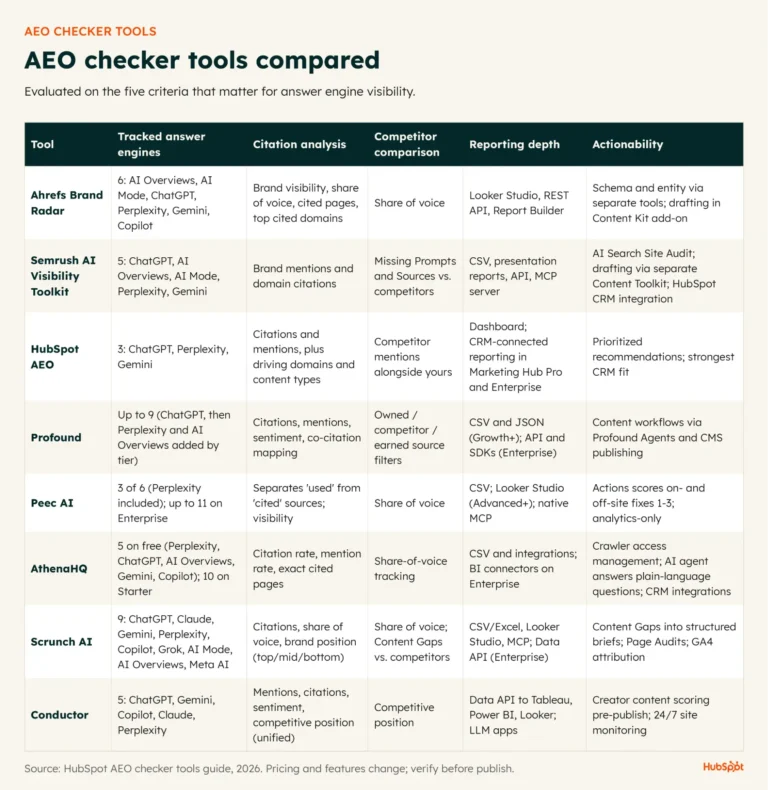
Tool Recommendation: HubSpot AEO, priced at $50/month standalone (or $45/month annually, and included with Marketing Hub Professional and Enterprise), offers a prompt-level view that displays actual answers from ChatGPT, Gemini, or Perplexity, moving beyond a single visibility score.
-
Why it’s Beneficial: Prompts can be filtered by engine, buyer journey phase, and product/service relevance. Citation analysis reveals which domains and content types are driving mentions for both your brand and competitors. For HubSpot Marketing Hub users, integrated CRM context enhances recommendation specificity, and HubSpot’s content tools facilitate action on these insights, aligning with the broader HubSpot ecosystem of Smart CRM and Content Hub.
Tracking Mentions, Citations, and Sentiment with AI Search Optimization Tools
While manual spot-checking can be a starting point for AI search strategies, it is impractical for ongoing reporting due to the lack of consistent trend lines. A robust measurement framework requires:
- Defined Prompts: A stable set of queries that reflect user intent and cover key brand-related topics.
- Competitor Benchmarking: Identifying key competitors to track share of voice and comparative performance.
- Citation Tracking: Monitoring where and how often your content is cited.
- Sentiment Analysis: Assessing the tone of AI-generated responses.
- Regular Reporting: Consistent data collection and analysis to identify trends and inform strategy.
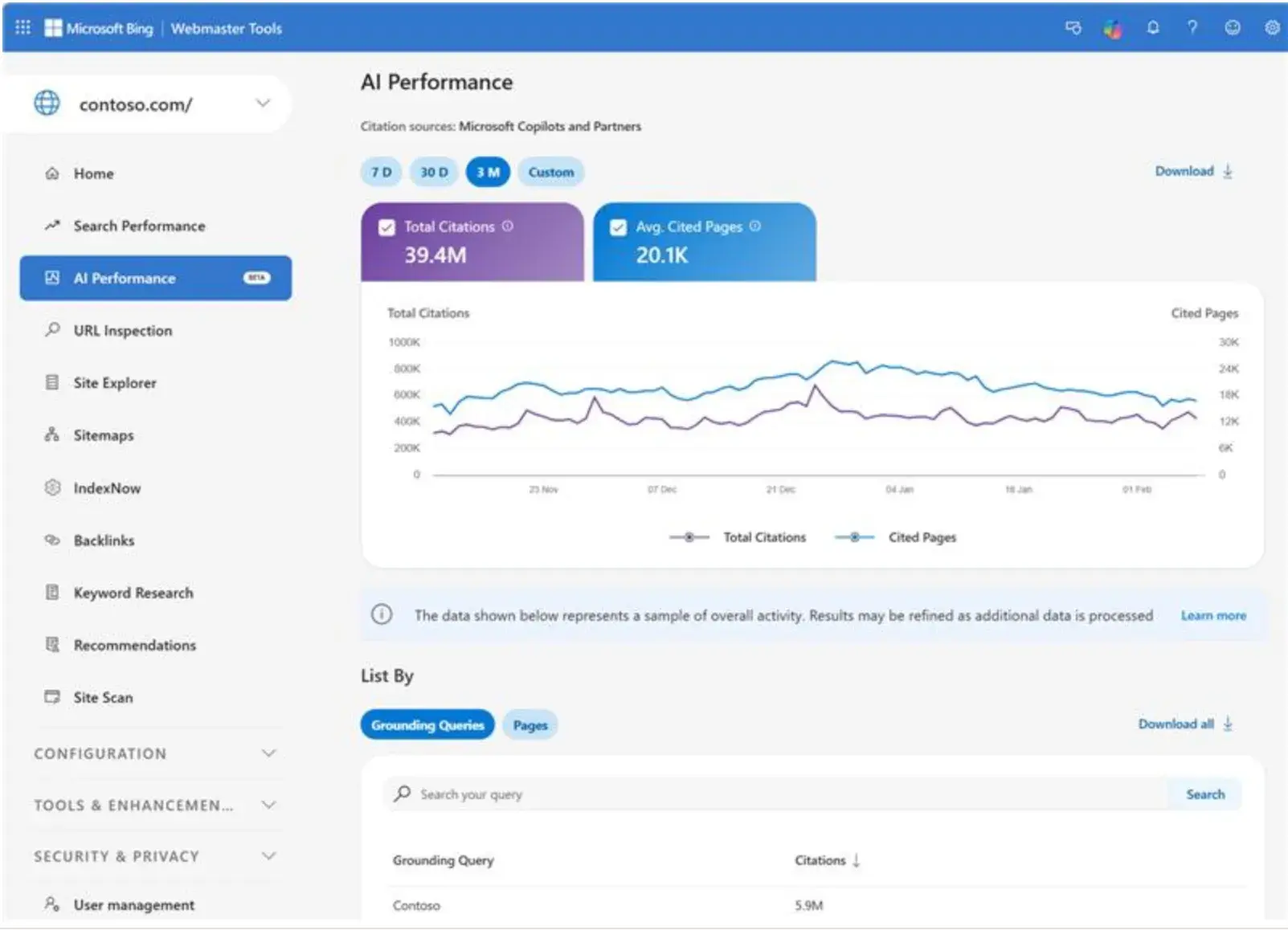
It is essential to manage expectations regarding data reconciliation. Bing’s grounding queries are sampled, and a query-oriented view differs from a page-oriented citation view. These distinctions are also relevant to semantic search. Therefore, focus on reporting trends rather than treating single-day numbers as definitive ground truth.

- Tool Recommendation: Bing Webmaster Tools AI Performance (free) provides first-party data, not external estimates. This report includes total citations across Microsoft AI experiences, cited pages, citation trends, and sampled grounding queries—key phrases used by Microsoft’s systems to retrieve content referenced in AI answers.
- Why it’s Valuable: Grounding queries can illuminate which phrases are most frequently associated with your site being cited in AI answers, offering actionable insights for content optimization.
Choosing AI-Powered SEO Software with an Outcomes-First Framework
In the competitive landscape of AI-powered SEO software, it’s easy to be swayed by extensive feature lists. A more effective approach is to evaluate tools based on the desired outcomes they help achieve. A weighted scorecard can be instrumental in this evaluation process.
When engaging in vendor demonstrations, ask targeted questions:
-
"How would this tool help me solve [specific problem]?" This focuses the demonstration on your unique needs.
-
"What specific content or technical changes would this tool recommend to improve [metric]?" This assesses the tool’s actionable insights.
-
Pro Tip: Bring 10 of your own prompts to every demo. Vendor-provided examples may not reflect your actual user queries. Running these same prompts across competing tools will highlight differences in coverage and results, enabling a more informed decision about which tool offers the most reliable visibility scores.
Piloting AI Search Optimization Tools: A Five-Day Approach
A comprehensive pilot program can be conducted within a single week to determine the suitability of an AI search optimization tool for your workflow.
- Day 1: Baseline Establishment: Begin by establishing a baseline of your current AI search visibility using a diagnostic tool or manual prompt testing.
- Day 2: Technical Audit: Assess your site’s accessibility to AI crawlers by checking server logs and robots.txt directives.
- Day 3: Manual Cross-Check: Conduct manual checks of AI responses for a defined set of prompts to create a reference point for evaluating paid monitoring tools. This is time-consuming but crucial for calibration.
- Day 4: Two-Tool Trial: If feasible, trial two different tools simultaneously. Compare their outputs against your manual checks and each other to identify discrepancies and strengths.
- Day 5: Decision and Selection: Based on the pilot, choose the tool that best aligns with your decision-making needs and sustainable workflow. Commit to one specific change based on the tool’s insights—whether it’s a content update, technical fix, or PR adjustment.
Re-measure your AI search performance after 30 days against the initial baseline. Visible changes often emerge over weeks rather than days, with description accuracy typically being an early indicator before citation volume shifts.
Avoiding Common Pitfalls in AI Search Optimization
As AI search visibility consultants often observe, several common mistakes can hinder the effectiveness of AI search optimization efforts:
- Over-reliance on Third-Party Data: While valuable, third-party data should be corroborated with first-party insights and manual checks.
- Ignoring Crawler Accessibility: Failing to ensure AI bots can access content is a fundamental roadblock.
- Lack of Clear Objectives: Implementing AI search optimization without specific goals can lead to unfocused efforts and wasted resources.
- Treating AI Optimization as a One-Time Task: The AI landscape is constantly evolving, requiring continuous adaptation and refinement of strategies.
- Confusing Visibility with Action: Measurement alone is insufficient; insights must translate into tangible optimization efforts.
- Assuming Universal AI Behavior: Different AI models have unique characteristics, necessitating platform-specific considerations.
Frequently Asked Questions About AI Search Optimization Tools

-
Do AI search optimization tools replace traditional SEO tools?
No. AI search optimization tools augment traditional SEO by providing insights into brand visibility, citations, share of voice, sentiment, and answer accuracy. They do not negate the importance of technical SEO, crawlability, indexing, content quality, and authority, which remain foundational for both traditional and AI-powered search. -
How do I measure ROI from AI search optimization tools?
ROI can be measured across three levels:- Visibility Signals: Track improvements in citation frequency, share of voice, sentiment, and description accuracy against a baseline.
- Referral Traffic: Monitor referral sessions from AI sources in analytics platforms like GA4, capturing clicked citations.
- Pipeline Impact: Connect AI visibility to pipeline metrics through self-reported attribution, CRM data, and branded search volume shifts.
It’s important to acknowledge that attribution from AI sources can be incomplete, as unlinked mentions can influence buyers without generating direct referral traffic.
-
Which AI platforms should I prioritize first?
Prioritize platforms that your target audience actively uses. Leverage your existing referral data, customer research, sales feedback, and current visibility to identify key AI platforms. Also, differentiate between platforms that offer direct reporting (e.g., Google Search Console for generative AI features, Bing Webmaster Tools for Microsoft AI experiences) and those requiring third-party monitoring or manual prompt sets. -
Can a small team benefit from AI for SEO tools?
Yes. Small teams can benefit by focusing on a narrow task and starting with free diagnostic tools to establish a baseline. Define a small set of high-value prompts and consider recurring monitoring only when trend data is essential. For budget-conscious teams, self-service monitoring tools can be sufficient. The key is ensuring that the data generated leads to specific content, technical, PR, or distribution decisions.
Conclusion: A Measured Approach to AI Search Optimization
AI search optimization tools are most effective when employed with a clear understanding of the problem they are intended to solve. Verifying AI crawler accessibility, establishing a baseline for brand representation, defining a consistent set of prompts, and using the resulting data to drive specific content, technical, PR, or distribution decisions are paramount.
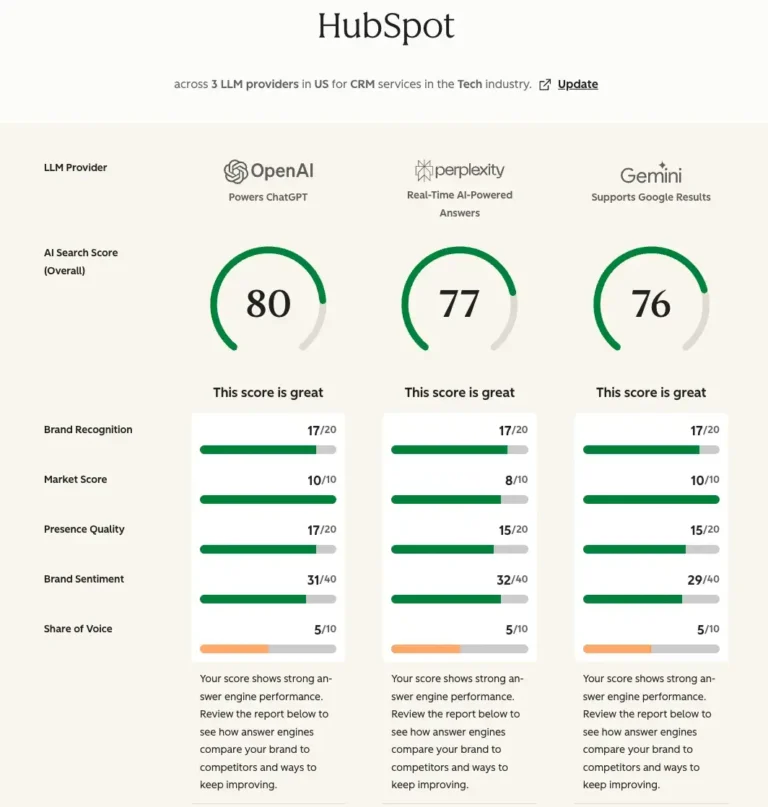
The dynamic nature of AI tools and answer engines requires a flexible measurement framework that is regularly revisited. For those beginning their AI search journey, the free AI Search Grader offers a valuable starting point. For ongoing monitoring needs, solutions like HubSpot AEO provide comprehensive tracking across major AI platforms at a competitive price point, often integrated within broader marketing suites. The future of search is here, and embracing AI search optimization is no longer optional but a strategic necessity for brands aiming to thrive in the evolving digital landscape.
About the Author