The digital marketing world is experiencing a seismic shift, with AI-referred traffic surging by an astonishing 600% since January 2025. This dramatic increase has placed a spotlight on brand discovery and the imperative for marketers to adapt their strategies. As artificial intelligence continues to reshape how consumers find information, the need for specialized tools to navigate this new frontier has become paramount. For marketing teams seeking to understand and capitalize on the impact of AI on brand visibility and pipeline generation, investing in solutions like Profound or Athena AI for Answer Engine Optimization (AEO) is no longer an option, but a necessity. This comprehensive analysis delves into the comparative strengths and weaknesses of these two leading AEO platforms, providing essential insights for SEO strategists, marketing operations leaders, and agencies aiming to scale visibility programs in the burgeoning AI search ecosystem.
The Rise of Answer Engines and the Dawn of AEO
The advent of advanced AI models has fundamentally altered the search paradigm. Traditional search engines, while still relevant, are increasingly being supplemented and, in some cases, superseded by AI-powered answer engines. These platforms, such as ChatGPT, Perplexity, Google AI Overviews, Microsoft Copilot, and Google Gemini, aim to provide direct answers and synthesized information, rather than simply a list of links. This shift necessitates a new approach to search engine optimization, termed Answer Engine Optimization (AEO), which focuses on ensuring brands are visible and accurately represented within these AI-generated responses.
This transformation has been years in the making, with early iterations of AI chatbots and language models laying the groundwork for the sophisticated systems we see today. The acceleration in AI capabilities, fueled by advancements in natural language processing and machine learning, has brought AEO from a nascent concept to a critical component of digital strategy in a remarkably short period. The 600% increase in AI-referred traffic is not merely a statistical blip; it signifies a profound change in user behavior and information consumption patterns. Brands that fail to adapt risk becoming invisible in this new AI-driven landscape.
Profound vs. AthenaHQ: A Comparative Deep Dive
To effectively navigate the complexities of AEO, marketers require tools that can provide both insights and actionable strategies. Profound and AthenaHQ emerge as prominent players in this space, each offering distinct approaches to tackling the challenges of AI search. Understanding their core functionalities, differentiating features, and ideal use cases is crucial for making informed investment decisions.
Monitoring vs. Action: Two Sides of the AEO Coin
A primary differentiator between Profound and AthenaAI lies in their core focus: monitoring and analytics versus automation and workflow integration.
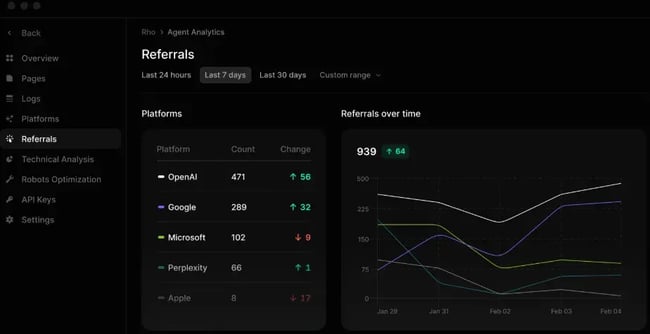
Profound positions itself as a comprehensive AEO platform primarily centered on monitoring and analytics. Its "visibility intelligence command center" synthesizes data from multiple AI engines, offering competitive insights and a clear view of a brand’s performance within AI-generated answers. This platform is designed for SEO professionals who can interpret complex data sets and identify strategic actions based on detailed analytics. The platform’s dashboard provides a consolidated view of referral traffic from AI systems, enabling experts to pinpoint the most effective AI agents for their business and identify areas with significant growth potential. This granular data allows for a deep understanding of how a brand is being perceived and cited across various AI platforms.
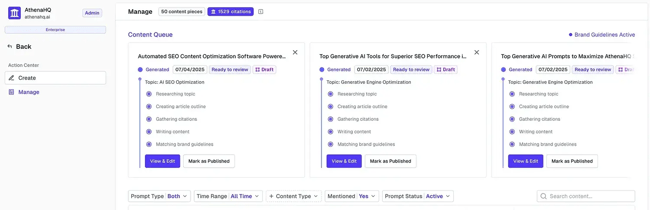
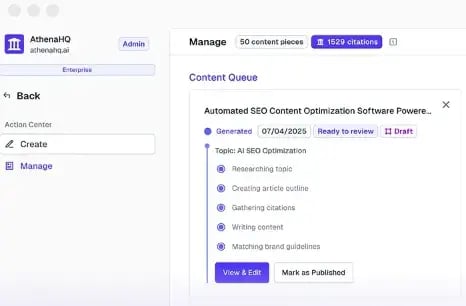
In contrast, AthenaHQ AI is engineered as an AEO and Generative Engine Optimization (GEO) platform with a strong emphasis on automation and seamless workflow integration. Its core value proposition lies in bridging the gap between gaining insights and executing necessary changes through its "Action Center." This includes features for automated content production and outreach tools, aiming to streamline the AEO process. The Action Center is designed to translate data-driven insights into tangible actions, making it more accessible for teams that may not have dedicated data analysts. It provides prioritized recommendations and guided workflows, facilitating quicker implementation of AEO strategies.
Analysis: For teams with established analytics departments capable of deep data interrogation, Profound’s monitoring capabilities offer unparalleled depth. However, for organizations seeking a more integrated and action-oriented solution, AthenaHQ’s focus on automating the execution phase presents a significant advantage. The choice hinges on whether the priority is comprehensive data analysis or streamlined, actionable implementation.
AI Engine Coverage: Broadening the Horizon
The effectiveness of any AEO tool is directly tied to its ability to monitor and analyze performance across the diverse array of AI engines that users are interacting with.
Profound boasts extensive AI engine coverage, supporting prominent platforms such as ChatGPT, Perplexity, Google AI Overviews, Copilot, Gemini, and Claude. Its capabilities extend further to include over ten additional AI engines, encompassing DeepSeek, Grok, Meta AI, and Google AI Mode, providing a broad spectrum for comprehensive monitoring.
Athena AI also offers robust coverage, including ChatGPT, Perplexity, Google AI Overviews, Copilot, Gemini, and Claude as core engines. While additional platforms may be available upon request, it also directly supports Google AI Mode and Grok, ensuring a strong presence across the most widely adopted AI search interfaces.
| Platform | Core AI Engine Coverage | Additional/Extended Coverage |
|---|---|---|
| Profound | ChatGPT, Perplexity, Google AI Overviews, Copilot, Gemini, Claude | DeepSeek, Grok, Meta AI, Google AI Mode, and 10+ other AI engines. |
| AthenaHQ AI | ChatGPT, Perplexity, Google AI Overviews, Gemini, Claude, Copilot, Grok, Google AI Mode | Additional platforms available on request. |
Analysis: While both platforms cover the most critical AI engines, Profound’s pre-configured support for a wider array of specialized and regional AI models might offer a slight edge for international brands or those targeting niche markets. However, AthenaAI’s flexibility with custom requests ensures that most businesses can achieve adequate coverage. The breadth of coverage is becoming increasingly important as new AI models emerge and gain traction.
Analytics and Visibility Tracking: Unpacking the Data
The ability to track and analyze performance is fundamental to any optimization effort. Both Profound and AthenaHQ offer sophisticated analytics, albeit with different emphases.

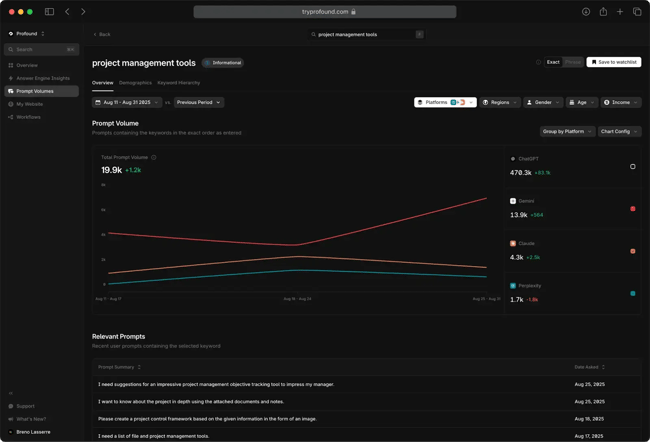
Profound provides in-depth analytics for agent tracking, conversation analysis, and shopping visibility. Its "Answer Engine Insights" feature meticulously monitors AI responses and citations across various AI engines. Users can track a significant number of prompts, with flexibility to adjust them based on their evolving strategies. The platform’s "Prompt Volume" tool offers a detailed view of conversations surrounding specific topics, such as "Project Management tools," allowing for granular analysis of how AI models interpret and respond to user queries. This feature is invaluable for understanding the nuances of AI-driven information retrieval.
AthenaHQ’s analytics are built upon its proprietary "Query Volume Estimation Model" and real-time trend tracking capabilities. Its advanced tiers provide real-time trend analysis, unlimited monthly response analysis, and comprehensive data history with custom export options. A key distinction is its focus on making data more accessible by surfacing prioritized recommendations rather than overwhelming users with raw data. This approach is particularly beneficial for teams that lack dedicated data analysts, streamlining the path from insight to action.
Analysis: Profound’s strength lies in its analytical depth, providing granular data for those who need to conduct deep dives into AI performance. This is ideal for advanced SEO professionals and data scientists. AthenaHQ, on the other hand, excels in translating complex data into clear, actionable recommendations, making it more user-friendly for marketing teams focused on execution. The "Which platform wins?" determination here depends on the user’s technical expertise and the team’s capacity for data analysis versus immediate action.
Content Optimization and Workflow Tools: From Insight to Output
Effective AEO requires not only understanding how brands are represented but also the ability to optimize content to improve that representation.
Profound’s workflow layer is designed to identify content gaps by comparing existing content against what is needed to increase citation frequency. Its "AEO Content Score" is derived from analyzing millions of top-cited pages across AI engines. While powerful, this feature assumes that teams have the capacity and expertise to translate detailed, data-heavy briefs into actionable content updates.
Athena AI distinguishes itself by offering a more integrated content optimization and workflow experience. This includes content brief creation, optimization suggestions, and automated outreach capabilities. The "Action Center" serves as a central hub for automated content production, enabling outreach to third-party sources and providing operational recommendations. Within this center, content teams can manage their entire workflow, from identifying optimization needs to implementing changes and tracking their impact. This holistic approach streamlines the content lifecycle for AEO.
Analysis: Profound provides the intelligence to understand what content will perform best in AI searches. AthenaHQ offers the tools to create that content more efficiently. For content teams, Profound offers a blueprint, while AthenaHQ provides the construction crew and the assembly line. Both contribute to creating superior content for Search Generative Experiences (SGE), but AthenaHQ’s integrated workflow may lead to faster content iteration and deployment.
Brand Sentiment and Reputation Monitoring: Navigating the AI Echo Chamber
In the age of AI, maintaining brand sentiment and reputation is more critical than ever, as AI models can amplify both positive and negative perceptions.
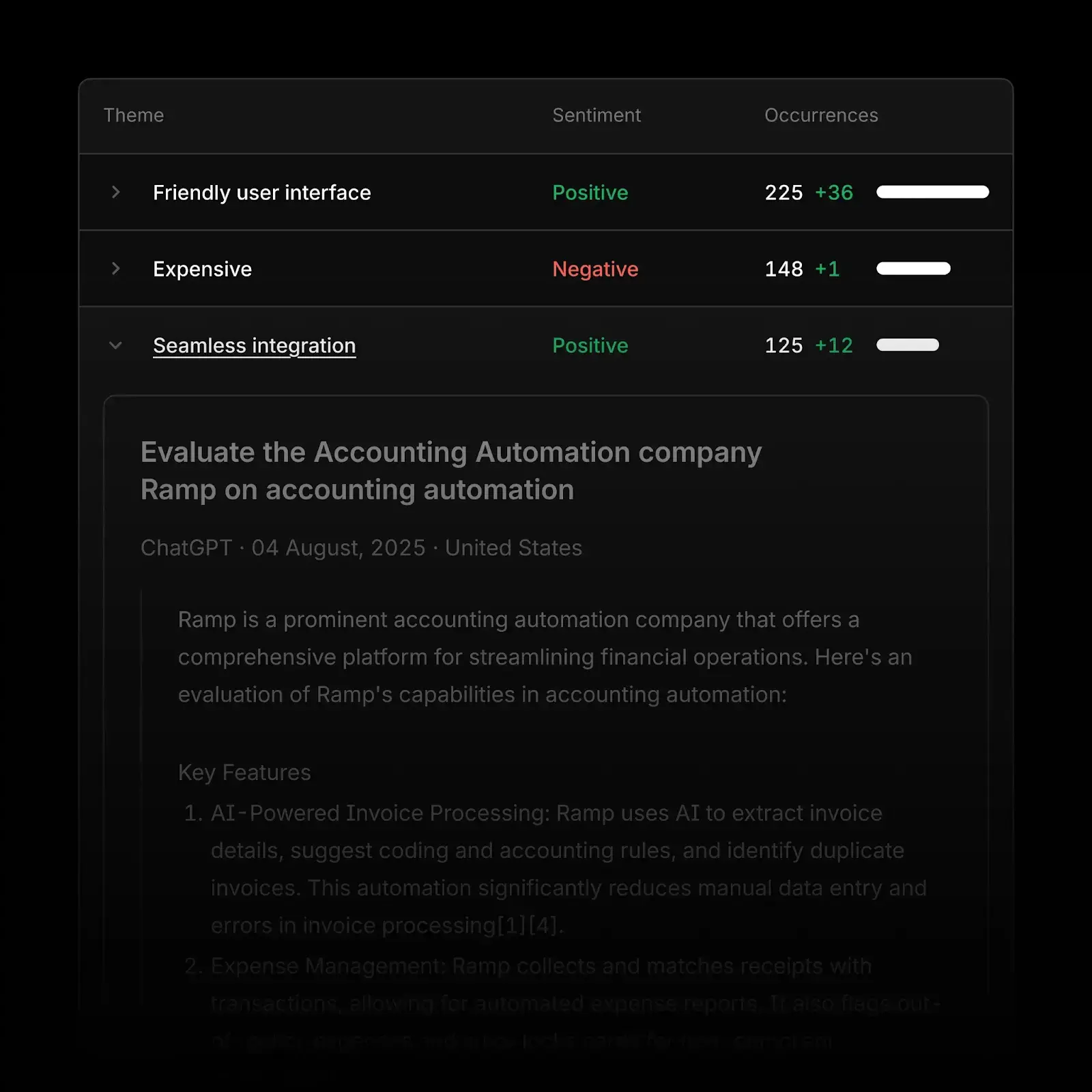
Profound offers advanced sentiment analysis and brand accuracy scoring. This is particularly crucial for enterprise brands, where AI "hallucinations" regarding products, pricing, or services can lead to significant reputational damage and financial losses. Its timestamped screenshot archive provides an evidential record, which is invaluable for compliance and reporting purposes, especially in regulated industries. The platform visualizes sentiment analysis with clear "positive" and "negative" labels, accompanied by a timestamped screenshot for verification.
AthenaHQ also measures brand sentiment, but integrates this with broader market trend analysis, share of voice comparisons, and trending topic identification. Its intelligent PR search functionality allows for monitoring brand reputation across news and social channels, consolidating sentiment analysis within a wider communication context.
Analysis: For brands with stringent compliance requirements or those operating in highly regulated sectors where factual accuracy is paramount (e.g., healthcare, finance), Profound’s focus on accuracy scoring and misinformation detection offers a robust solution. For growth and communications teams aiming for a more integrated view of brand sentiment across PR, social media, and AI-generated responses, AthenaHQ provides a more holistic and actionable dashboard for day-to-day reputation management.
Evaluating Profound vs. AthenaHQ for Your Growth Stack: Key Considerations
Choosing the right AEO platform involves more than just comparing features; it requires aligning the tool with an organization’s existing technology stack, budget, and team capabilities.
Integrations and Tech Stack Compatibility
The integration capabilities of AEO tools can significantly impact their adoption and effectiveness within a broader marketing technology ecosystem.
Profound’s integrations are primarily at the server and infrastructure levels, connecting with platforms like Vercel, AWS, and Cloudflare for data collection, alongside Google Analytics. While this provides powerful data for technical teams managing AI crawler data, it may be less intuitive for marketing operations teams whose daily workflows are centered around CRMs.
AthenaHQ adopts a more workflow-native integration approach. It supports unlimited seats, Single Sign-On (SSO)/SAML, and offers white-glove onboarding, indicating its design for seamless deployment within larger martech environments. This makes it more accessible for multi-team adoption.
For organizations heavily invested in the HubSpot ecosystem, native integrations become a critical factor. HubSpot’s Content Hub, for instance, offers integrated AI capabilities through its "Breeze content assistant," which can draft, expand, and adapt copy for clarity and conversational tone. Combined with HubSpot’s Smart CRM, Marketing Hub, and Breeze AI Suite, this creates a native AEO execution layer that can complement a chosen monitoring platform. HubSpot also provides a free "AEO Grader" tool, offering a baseline assessment of a brand’s AI visibility before significant investment.
Analysis: The integration strategy of AEO tools can be categorized into two main types: those that feed data into existing stacks and those that aim to replace or augment existing functionalities. Profound leans towards the former, providing deep data for technical analysis, while AthenaHQ offers a more plug-and-play solution for marketing workflows. For HubSpot users, the question becomes whether to integrate a standalone AEO tool or leverage the increasingly robust native capabilities within the HubSpot platform.
Pricing and Accessibility: Balancing Cost and Capability
The financial investment required for AEO tools is a significant consideration, especially given the rapid evolution and potential for escalating costs associated with AI technologies.
Profound’s pricing starts at $99 per month for ChatGPT-only coverage. However, for comprehensive AI model support and advanced features, the "Growth" package is priced at $399 per month. This tier unlocks full AI model coverage and API access, making it a premium solution for serious AI strategists.
AthenaHQ’s pricing model begins at $95 for the first month, followed by a monthly rate of $295. It utilizes a credit-based system, which offers flexibility but can increase costs as more prompts and AI answer engines are utilized beyond the base 3,500 credits.
For organizations hesitant to commit to a full-fledged platform, HubSpot’s free "AEO Grader" serves as an excellent entry point. This tool analyzes a brand’s AI visibility, sentiment, and competitive positioning across leading AI platforms like GPT-4o, Perplexity, and Gemini, providing a crucial baseline assessment without financial commitment.
Analysis: Profound’s tiered pricing model suggests a higher investment for full capabilities, positioning it as a solution for larger organizations with dedicated budgets for advanced AI strategies. AthenaHQ offers a more accessible starting point with a potentially scalable cost structure, making it attractive for mid-market companies. The availability of free tools like HubSpot’s AEO Grader democratizes access to initial insights, enabling more informed decisions.
Ease of Use and Learning Curve: Bridging the Gap
The user-friendliness of an AEO tool directly impacts its adoption rate and the speed at which teams can derive value from it.
User feedback often describes Profound’s interface as data-intensive and potentially overwhelming for users without dedicated analytical support. The steep learning curve and occasional technical issues, as noted by reviewers, can contribute to a higher total cost of ownership beyond the subscription fee.
AthenaHQ is designed for greater accessibility. Its Action Center prioritizes recommendations, providing tailored suggestions for content restructuring, schema changes, or strategic outreach. This guided workflow significantly reduces the manual effort required for prompt and response evaluation, proving beneficial for growth teams lacking dedicated data analysts and aiming for quicker time-to-value.
Analysis: For organizations with dedicated analysts adept at interpreting complex data sets, Profound’s depth can be a significant advantage, rewarding the investment in training and analysis. For leaner teams that need to translate insights into action rapidly, AthenaHQ offers a lower-friction path, streamlining the operationalization of AEO strategies.
Which Platform Should You Choose for AEO: Profound or AthenaHQ?
The optimal choice between Profound and AthenaHQ hinges on an organization’s specific needs, size, and strategic objectives within the AEO landscape.
-
Startups: For nascent businesses with limited resources and analyst capacity, AthenaHQ’s lower entry price point and guided workflow make it a more practical choice. The HubSpot AEO Grader is also a valuable free starting point to establish a foundational understanding before committing to paid solutions.
-
Mid-Market Teams: Organizations in the mid-market with developing content operations and moderate analytics maturity will likely find AthenaHQ’s balance of visibility tracking and workflow automation highly beneficial. Its ability to connect insights to execution without requiring extensive data engineering aligns well with the needs of most mid-market growth teams.
-
Enterprise Organizations: For large enterprises with strict compliance requirements, global reach, and dedicated analytics teams, Profound’s comprehensive features justify its premium. Its purpose-built design for cross-engine monitoring, programmatic AEO content workflows, SOC 2 compliance, and HIPAA certification (for regulated industries) makes it a strong contender for complex organizational needs.
-
Agencies: Agencies looking to offer AEO as a service may find Profound’s Agency Growth plan, with its pitch workspaces and consolidated billing, particularly advantageous for prospecting and client management. AthenaHQ also presents a viable option, especially for agencies managing mid-market client programs that prioritize actionable outcomes over deep analytical dives.
-
International Teams: Brands with significant international audiences should prioritize engine coverage. Profound’s broader roster of AI engines, including specialized models like DeepSeek and Meta AI, provides a distinct advantage for global reach.
It is also noteworthy that HubSpot’s recent acquisition of Xfunnel signals a strategic commitment to integrating advanced AEO capabilities directly into the HubSpot platform. For organizations already operating within the HubSpot ecosystem, Xfunnel’s integration may eventually reduce the need for separate, standalone AEO tools, particularly for mid-market businesses.
Frequently Asked Questions About Profound vs. AthenaHQ for AEO
How do Profound and AthenaHQ differ in their approach to measuring AI search visibility?
Profound offers granular, multi-engine data analysis, tracking share of voice, citation rates, and prompt volume across numerous AI platforms for users who prefer to interrogate the raw numbers. AthenaHQ tracks similar core metrics but presents them as prioritized recommendations, facilitating quicker action with less emphasis on raw data granularity.
What are the unique features that set Profound apart from AthenaHQ?
Profound’s standout differentiators include its Conversation Explorer (leveraging over 400 million real user prompts), Agent Analytics integrated with GA4, Shopping Analysis for e-commerce visibility within AI, and SOC 2 Type II compliance. These features are tailored for enterprise-level requirements and lack direct equivalents in AthenaHQ.
Which tool is better for tracking brand sentiment across AI-generated responses?
Profound’s sentiment analysis is geared towards brand accuracy and misinformation detection, crucial for regulated industries or when AI hallucinations pose significant risks. AthenaHQ integrates sentiment analysis with PR and social monitoring into a unified view, making it more practical for daily communications and growth teams.
Do Profound and AthenaHQ support integration with existing marketing technology stacks?
Both platforms integrate with CRM, CMS, and analytics tools. Profound tends to focus on infrastructure-level integrations (GA4, Cloudflare), while AthenaHQ offers more seamless multi-team deployment with SSO/SAML and unlimited seats. For HubSpot users, both can complement native tools like Content Hub and Breeze AI, but neither fully replaces HubSpot’s inherent AEO capabilities.
Choosing the Right AEO Platform for Your Growth Stack
The decision between Profound and AthenaHQ ultimately boils down to a fundamental question: does the team prioritize analytical depth or speed to execution? Profound delivers unparalleled analytical rigor for enterprise teams equipped with the resources to act on detailed data. Conversely, AthenaHQ offers faster time-to-value for growth teams that require both insight and execution within a single platform. For organizations deeply integrated into the HubSpot ecosystem, the native AEO functionalities within Content Hub, Breeze AI, and the recently acquired Xfunnel platform present a compelling alternative that may diminish the necessity for standalone AEO tools over time. As AI continues its relentless advance, strategic investment in AEO solutions will be critical for brands aiming to maintain and grow their visibility in the evolving digital landscape.
About the Author