Wholesale businesses operate on a foundation of intricate relationships, precise pricing, and efficient order fulfillment. Unlike general Customer Relationship Management (CRM) systems, a CRM tailored for wholesalers must excel in managing account-specific pricing, vast product catalogs, the predictability of repeat orders, and intricate sales workflows that seamlessly integrate with inventory and fulfillment systems. When these critical processes operate in silos, the consequences are tangible: quoting processes become sluggish, the incidence of errors escalates, and valuable revenue opportunities are missed. This comprehensive guide delves into the leading CRM solutions for wholesale distributors in 2026, meticulously evaluating each platform against the unique demands of the wholesale sector, including enterprise resource planning (ERP) integration, mobile field sales capabilities, pricing flexibility, and the total cost of ownership.
Understanding the Nuances of a Wholesale CRM
At its core, a CRM for wholesalers is a specialized customer relationship management system engineered to support the unique B2B distribution workflows. This includes the granular management of account-specific pricing, the handling of bulk orders, and sales processes that are intrinsically linked to inventory levels and fulfillment timelines. Such a system empowers wholesale teams to effectively manage their accounts, generate highly accurate quotes, and propel orders through the pipeline without the encumbrance of disconnected and inefficient tools.
The hallmark of an effective wholesale CRM lies in its ability to synchronize customer data with sophisticated pricing logic, robust order workflows, and real-time inventory visibility. This integrated approach enables sales teams to transition from generating a quote to finalizing an order without ever needing to switch between disparate systems. Simultaneously, operations leaders gain invaluable pipeline insights, and field representatives are equipped to operate with maximum efficiency, even from mobile devices.
Wholesale CRM software is adept at handling customer-specific pricing and tiered price lists. This allows distributors to apply contract pricing, volume discounts, and meticulously negotiated terms directly at the account level. Furthermore, it bridges the gap between sales workflows and crucial inventory and order status data, often achieved through seamless integrations with ERP systems. In this operational model, the CRM system typically manages accounts, contacts, deals, and sales activities, while the ERP system takes charge of inventory, purchasing, and fulfillment. This clear division ensures that wholesale teams maintain accurate operational data while providing sales teams with the contextual information they need to quote and sell with precision and speed. These requirements often mirror those found in manufacturing environments, where CRM systems also play a vital role in connecting sales activities with production and fulfillment processes.
The Critical Distinction: Wholesale CRM vs. Standard CRM
The operational landscape of wholesale distribution introduces a set of requirements that standard CRM systems often fail to fully address without significant customization or additional integrations. These differences profoundly impact how teams approach pricing, sales execution, and order fulfillment. While a standard CRM might focus on lead management and general customer interactions, a wholesale CRM must grapple with the complexities of B2B transaction volumes, contractual agreements, and the physical movement of goods.
Best CRMs for Wholesalers at a Glance
The wholesale sector, while sharing some similarities with retail in its customer-centric sales environments, diverges significantly in its pricing models, order volumes, and the structure of its accounts. For a comparative overview of customer-focused sales environments, consulting resources on the best CRMs for retail offers valuable context. This guide, however, focuses on the specific needs of the wholesale distribution industry.
The Leading CRM Software for Wholesalers in 2026
Selecting the right CRM is pivotal for wholesale teams aiming to reduce quoting delays, align sales activities with inventory data, and provide sales representatives with superior account visibility. The following six CRM platforms have been evaluated based on their ability to address diverse wholesale needs, ranging from enhanced field sales capabilities and stock-aware quoting to enterprise-level forecasting and robust ERP connectivity.
1. HubSpot Smart CRM
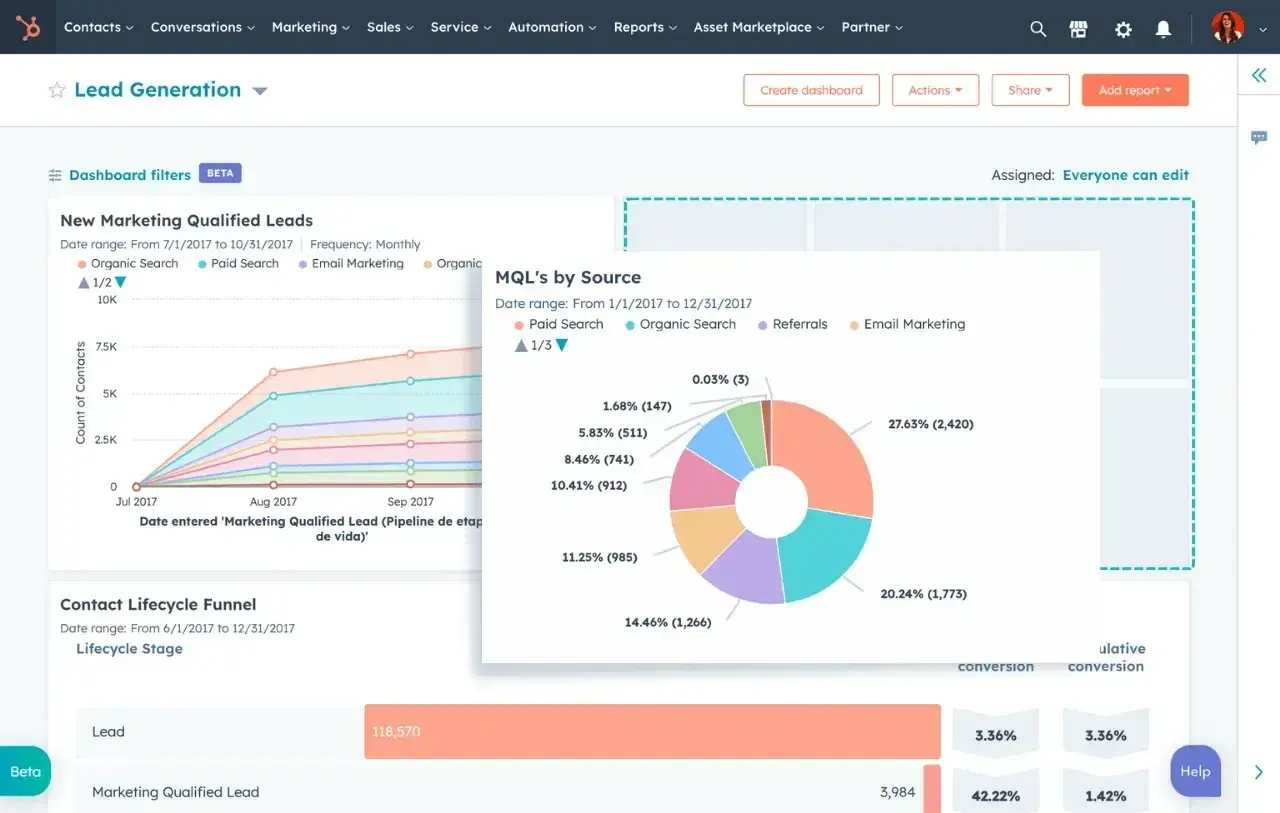
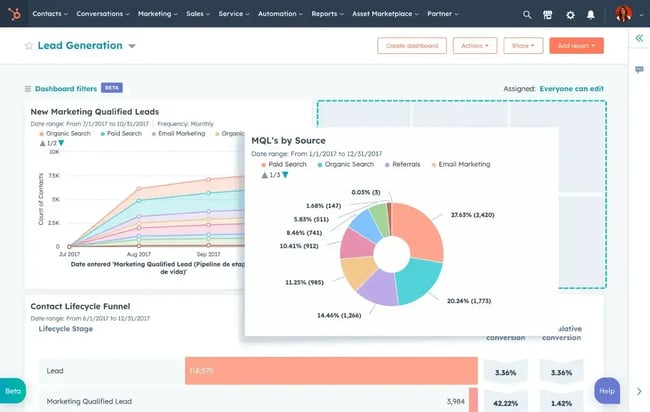
HubSpot Smart CRM, powered by artificial intelligence, serves as a comprehensive system of record for account, contact, deal, and activity data. For wholesale distributors, its capabilities extend to supporting efficient quote-to-order workflows through its robust product libraries, intuitive quoting tools, workflow automation, and advanced reporting features. Crucially, its extensive integration capabilities with ERP, inventory, and order management systems ensure a cohesive operational ecosystem.
HubSpot further enhances its offering by connecting Smart CRM with Commerce Hub and Breeze, HubSpot’s suite of AI-powered tools. This integration empowers wholesale teams to manage customer data, quoting processes, billing, payments, automation, and reporting from a single, unified customer record. This consolidated approach significantly reduces operational friction and enhances data accuracy.
Key Features:
- Unified Customer Database: Centralizes all customer interactions and data.
- AI-Powered Insights: Leverages AI for sales forecasting, task prioritization, and lead scoring.
- Workflow Automation: Automates repetitive tasks and approval processes.
- Product & Quote Management: Streamlines the creation of accurate quotes with product libraries.
- Extensive Integrations: Connects with ERP, inventory management, and other business tools.
- Mobile Accessibility: Provides full CRM functionality on mobile devices.
Pricing: HubSpot offers a tiered pricing structure. Smart CRM Starter is available at $20 per month per seat, Smart CRM Professional at $50 per month per seat (with an annual promotional price of $45 per month per seat), and Smart CRM Enterprise at $75 per month per seat. HubSpot also provides free tools with core CRM functionality, making it accessible for businesses at various stages of growth.
Best for: Wholesalers seeking a unified platform to manage sales, service, and marketing, with seamless integration capabilities for ERP and inventory systems.
What we like: The platform’s strength lies in its ability to combine a unified customer database with powerful automation, AI-driven insights, and flexible integration options. This allows for the effective management of complex B2B relationships without introducing additional operational overhead.
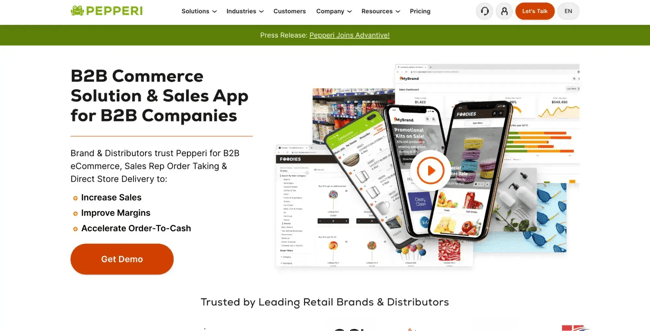
2. Pepperi
Pepperi uniquely combines CRM functionality with B2B e-commerce, mobile order taking, and specialized field sales tools, making it a compelling solution for wholesale distributors and brands. Sales representatives and buyers can leverage Pepperi to access customer-specific catalogs, dynamic price lists, targeted promotions, and streamlined order workflows, all accessible through both web and mobile interfaces.
Pepperi is particularly well-suited for distributors that prioritize robust field sales execution, require offline mobile access for sales teams, support route-based selling, and need to deliver highly personalized, customer-specific buying experiences. The platform’s design directly addresses the needs of mobile salesforces and the demand for efficient, on-the-go order processing.
Key Features:
- B2B E-commerce Integration: Seamlessly blends CRM with online ordering capabilities.
- Mobile Sales Force Automation: Empowers field reps with tools for order taking, catalog access, and customer management.
- Customer-Specific Catalogs & Pricing: Delivers tailored product assortments and pricing for individual accounts.
- Offline Capabilities: Ensures sales reps can function effectively even without an internet connection.
- Order Management: Facilitates efficient processing and tracking of orders.
Pricing: Pricing is available upon request, typically tailored to the specific needs and scale of the business.
Best for: Wholesale distributors requiring an integrated CRM, B2B commerce platform, and comprehensive field sales solution.
What we like: Pepperi’s strength lies in its specialized design for wholesale operations, offering comprehensive support for mobile sales representatives, efficient order taking, and the creation of customized customer catalogs.
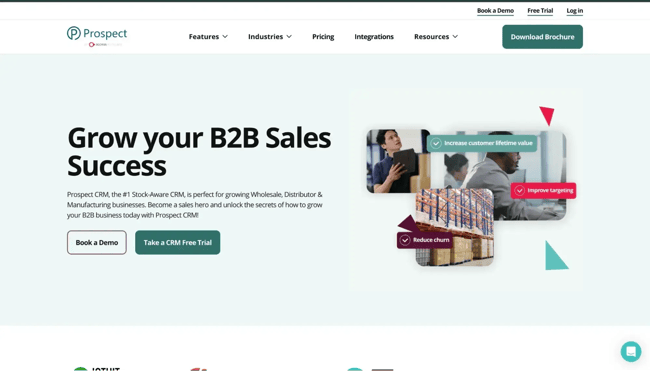
3. Prospect CRM
Prospect CRM is a purpose-built, "stock-aware" CRM meticulously designed for B2B businesses that prioritize product sales. It establishes a crucial link between customer, product, sales, and real-time inventory data. This integration empowers wholesale teams to generate accurate quotes, manage accounts effectively, and prioritize sales activities with an unparalleled understanding of stock levels and customer purchasing patterns.
The platform is exceptionally effective for distributors where CRM records accurately reflect actual product movement, including repeat orders, backorders, and the identification of cross-sell opportunities. This deep integration ensures that sales efforts are always aligned with operational realities, preventing lost sales due to stockouts or outdated information.
Key Features:
- Stock-Aware Quoting: Real-time inventory levels are visible during the quoting process.
- Order History Integration: Access to past orders to inform future sales strategies.
- Product & Inventory Management: Centralized view of product information and stock levels.
- Repeat Order Automation: Facilitates easy reordering for recurring customers.
- Sales Performance Analytics: Tracks sales activities against inventory and revenue goals.
Pricing: Prospect CRM offers tiered pricing, with plans starting at approximately $243 for four users, indicating a competitive entry point for smaller teams.
Best for: Wholesalers who require real-time inventory visibility embedded directly within their CRM system to inform sales decisions.
What we like: Its designation as a "stock-aware CRM" is its defining advantage. By directly connecting sales activity with inventory data, Prospect CRM ensures sales reps are always informed about product availability, leading to more efficient and successful sales interactions.

4. Zoho CRM
Zoho CRM presents itself as a highly customizable CRM solution for small to mid-sized wholesale teams. It offers robust sales automation, sophisticated pipeline management, effective territory management, and a wide array of integration options, all without the prohibitive cost often associated with enterprise-level solutions. Wholesale teams can leverage Zoho CRM by integrating it with Zoho Inventory and other applications within the Zoho ecosystem to manage sales activities in tandem with inventory and order workflows.
Zoho CRM is an optimal choice for cost-conscious teams that possess the flexibility to configure their own workflows and integrations, or for those who are already invested in and benefit from other Zoho products. Its adaptability allows businesses to tailor the CRM to their specific operational needs.
Key Features:
- Customizable Workflows: Adaptable to unique business processes.
- Sales Automation: Automates repetitive sales tasks and follow-ups.
- Territory Management: Organizes sales efforts by geographic region or other criteria.
- Integration with Zoho Ecosystem: Seamless connection with other Zoho business applications.
- Affordable Pricing: Offers competitive pricing for small and medium-sized businesses.
Pricing: Zoho CRM offers per-user pricing starting at $20 per user per month for its Standard plan, with higher tiers offering more advanced features.
Best for: Small to mid-sized wholesalers seeking an affordable CRM with significant customization capabilities and integration potential.
What we like: The platform strikes an excellent balance between cost and functionality, featuring powerful process automation and the option for inventory integration through the broader Zoho ecosystem, providing a comprehensive business management solution.
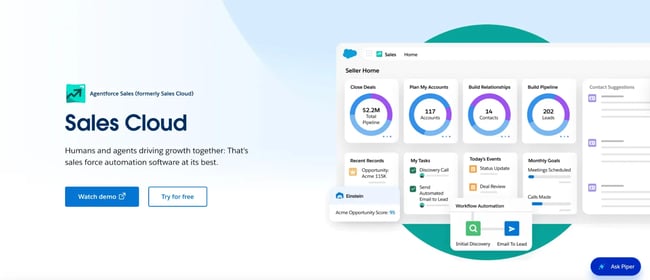
5. Salesforce Agentforce Sales (formerly Sales Cloud)
Salesforce Sales Cloud, now presented as part of Agentforce Sales, caters to sales teams that demand deep customization, advanced AI capabilities, robust forecasting tools, sophisticated territory management, comprehensive product and price book management, and extensive app integration possibilities. Wholesale distributors can configure Salesforce to accommodate complex account structures, intricate pricing models, multi-tiered approval workflows, and diverse multi-team coverage strategies.
Salesforce is typically the preferred choice for larger distributors that possess the financial resources and internal expertise to manage its implementation, administration, and ongoing customization. Its power and flexibility come with a higher investment requirement, both in terms of cost and human capital.
Key Features:
- Advanced Customization: Highly adaptable to complex business needs.
- AI-Powered Forecasting: Leverages AI for more accurate sales predictions.
- Territory and Quota Management: Tools for structuring and managing sales territories and goals.
- Product and Price Book Management: Comprehensive features for managing product catalogs and pricing.
- Extensive AppExchange Ecosystem: Access to a vast marketplace of third-party applications.
Pricing: Salesforce Sales Cloud offers various editions with pricing typically starting around $25 per user per month for the Essentials edition, escalating to $150 per user per month for the Unlimited edition.
Best for: Enterprise-level wholesalers with complex territory structures, sophisticated pricing models, and extensive customization requirements.
What we like: The platform’s highly configurable nature, coupled with powerful tools for territory forecasting, intricate product pricing structures, and a vast ecosystem of integrations, makes it a formidable solution for large-scale wholesale operations.
6. Microsoft Dynamics 365 Sales
Microsoft Dynamics 365 Sales serves as Microsoft’s CRM offering for sales teams already operating within the Microsoft ecosystem. Wholesale distributors can enhance their experience by pairing Dynamics 365 Sales with Microsoft 365, Power BI, Teams, and Dynamics ERP tools. This integration creates a unified environment that connects sales activities with essential context related to product information, pricing, quotes, orders, and fulfillment.
This platform is particularly beneficial for wholesalers already invested in Microsoft technologies or those seeking a closer integration between their CRM and ERP workflows. The synergy between these Microsoft products can lead to significant operational efficiencies and a more unified data strategy.
Key Features:
- Microsoft Ecosystem Integration: Seamlessly connects with other Microsoft business applications.
- Unified Sales & ERP Processes: Tight integration between CRM and ERP for streamlined operations.
- AI and Analytics: Utilizes AI for insights and Power BI for advanced reporting.
- Sales Process Automation: Tools to automate sales tasks and workflows.
- Built-in Pricing & Territory Management: Supports complex sales structures.
Pricing: Microsoft Dynamics 365 Sales pricing is modular, with the Sales Enterprise plan starting at $65 per user per month, and additional modules available.
Best for: Wholesalers who are already utilizing Microsoft tools or require a tightly integrated CRM and ERP system.
What we like: The strong alignment between CRM, ERP, and productivity tools, combined with built-in support for sophisticated pricing models and sales territories, offers a cohesive and powerful solution for businesses within the Microsoft ecosystem.
The Transformative Benefits of CRM Software for Wholesalers
Implementing dedicated CRM software for wholesale operations dramatically enhances how teams generate quotes, execute sales, and manage their client accounts. By centralizing customer data and connecting it with critical elements like pricing, inventory levels, and order fulfillment processes, a CRM becomes an indispensable tool. For distributors handling high volumes of orders, a significant proportion of repeat business, and complex pricing structures, a CRM significantly reduces manual workload while providing unprecedented visibility across the entire sales cycle.
Operational Efficiency: Accelerating the Quote-to-Cash Cycle
Wholesale teams often find themselves navigating a labyrinth of disparate systems to compile quotes, verify pricing, confirm inventory availability, and process orders. This fragmented approach inevitably leads to delays, redundant efforts, and the circulation of inaccurate customer information. CRM software revolutionizes this process through several key mechanisms:
- Centralized Data Access: All relevant customer, product, and pricing information is accessible from a single interface, eliminating the need to search across multiple platforms.
- Automated Quoting: Pre-configured pricing rules, product catalogs, and discount structures allow for the rapid generation of accurate quotes.
- Real-time Inventory Visibility: Sales representatives can instantly check stock levels, preventing the quotation of out-of-stock items and managing customer expectations proactively.
- Streamlined Order Processing: Integration with ERP or order management systems allows for the seamless transfer of finalized quotes into orders, reducing manual data entry and potential errors.
- Workflow Automation: Automated approval processes for quotes or orders ensure that deals move forward efficiently without unnecessary bottlenecks.
Where HubSpot Fits: HubSpot excels in this area by enabling the creation of quotes directly from deal records within the CRM. Its workflow automation capabilities can manage follow-ups and approval chains. Furthermore, with Commerce Hub, teams can manage the entire quote-to-payment process within a single system, significantly reducing friction between sales and finance departments.
Enhancing Customer Retention and Account Growth
Sustained growth in the wholesale sector is heavily reliant on cultivating repeat orders and fostering enduring account relationships. In the absence of a CRM, critical account history, communication logs, and purchasing patterns are often dispersed across various systems or are solely held by individual sales representatives. This fragmentation poses a significant challenge for maintaining continuity, especially during staff transitions, and hinders the identification of opportunities for account expansion.
A CRM provides a consolidated repository for every account, meticulously documenting order history, communication logs, and engagement across all touchpoints. This comprehensive view equips wholesale distribution teams with:
- A 360-Degree Customer View: Understanding of each client’s complete interaction history, purchasing behavior, and preferences.
- Proactive Reorder Management: Automated reminders and follow-ups based on past purchasing cycles to ensure timely reorders.
- Identification of Upsell/Cross-sell Opportunities: Insights into purchasing patterns that reveal potential for offering additional products or higher-value items.
- Improved Account Management: Consistent and informed engagement with clients, regardless of who is interacting with them.
- Enhanced Customer Service: Faster resolution of inquiries and issues due to readily available historical data.
Where HubSpot Fits: HubSpot’s Smart CRM unifies customer data across all teams, simplifying the tracking of account activity and ensuring continuity. Its workflow automation can trigger reorder reminders or follow-up actions based on specific customer behaviors, proactively engaging clients and reinforcing loyalty.
For businesses managing a high volume of customer interactions, CRM functionalities often intersect with call center operations. Exploring guides on the best CRMs for call centers can provide further insights into managing inbound and outbound communication strategies.
Driving Revenue Impact and CRM ROI
The adoption of CRM technology directly translates into revenue growth by accelerating the sales cycle, boosting sales representative productivity, and providing enhanced visibility into pipeline performance and account profitability. For wholesale distributors, the most substantial gains typically stem from the reduction of manual tasks, the capture of a greater volume of repeat orders, and the effective identification of upsell and cross-sell opportunities.
Furthermore, a CRM significantly improves forecast accuracy by ensuring that pipeline data remains current and by directly linking sales activities to tangible revenue outcomes. This enables leadership teams to make more informed strategic decisions regarding inventory management, staffing requirements, and long-term growth planning.
Key revenue drivers stemming from CRM adoption include:
- Increased Sales Velocity: Streamlined processes lead to faster deal closures.
- Improved Sales Productivity: Automation frees up reps to focus on selling rather than administrative tasks.
- Higher Close Rates: Better data and insights empower reps to present more targeted and effective solutions.
- Increased Order Value: Identification and pursuit of upsell and cross-sell opportunities.
- Reduced Churn: Enhanced customer relationships and proactive engagement lead to greater loyalty.
To quantify the Return on Investment (ROI) of a CRM system, wholesale teams often analyze:
- Time Savings: Measuring the reduction in time spent on administrative tasks.
- Increased Revenue: Tracking the uplift in sales attributed to CRM-driven activities like repeat orders and upselling.
- Improved Forecast Accuracy: Assessing the financial impact of more reliable revenue predictions.
- Reduced Error Rates: Quantifying cost savings from fewer order processing errors.
Even marginal improvements across these critical metrics can compound over time, resulting in substantial revenue gains for the business.
Where HubSpot Fits: HubSpot integrates pipeline tracking, reporting, and automation into a singular platform, facilitating cleaner data management and enhancing forecasting accuracy. Advanced AI tools like Breeze assist with task prioritization and execution, reducing the time spent on manual endeavors and maximizing sales team efficiency.
Eight Essential Features for a Wholesale CRM
A robust wholesale CRM must be equipped to handle complex pricing structures, high-volume ordering, and sales processes that are intrinsically linked to inventory and fulfillment systems. The features detailed below represent the capabilities that most distributors require to manage their accounts efficiently and scale their operations effectively.
1. Customer-Specific Pricing and Quoting
The ability to manage account-specific pricing, including contract pricing, volume discounts, and negotiated terms, is fundamental. This ensures that quotes accurately reflect agreed-upon pricing without the need for manual adjustments, which are prone to errors.
Look for:
- Tiered Pricing Capabilities: Ability to set different price levels based on volume or customer segment.
- Contract Management: Features to store and apply customer-specific contract terms.
- Quote Generation Tools: Intuitive interfaces for creating and sending quotes quickly.
- Version Control for Quotes: Ability to track changes and revisions to quotes.
HubSpot Support: HubSpot facilitates the organization of product libraries and direct quote creation from deals. Tiered pricing capabilities are readily available through its Commerce Hub integration.
2. ERP and Inventory Integration
Seamless integration between the CRM and ERP/inventory management systems is paramount. This allows sales representatives to quote based on real-time stock availability and monitor fulfillment status without needing to switch between different software applications.
Look for:
- Real-time Inventory Sync: Up-to-the-minute stock levels displayed in the CRM.
- Two-Way Data Flow: Ability for data to be updated in both systems.
- Order Status Visibility: Tracking of order progress from placement to fulfillment.
- Pre-built Connectors: Availability of direct integrations with popular ERP systems.
HubSpot Support: HubSpot integrates with a wide array of inventory and ERP tools via the HubSpot Marketplace, promoting shared visibility across all connected systems.
For organizations managing more intricate delivery, warehousing, or supply chain operations, CRM requirements can extend into logistics coordination. Exploring guides on the best CRMs for logistics businesses can offer additional options and insights.
3. Product Catalog and SKU Management
Wholesale teams often manage extensive product catalogs with numerous SKUs, variations, and complex pricing structures. A CRM should provide the capability to organize and easily access this data during sales workflows, ensuring that sales representatives have immediate access to the product information they need.
Look for:
- Centralized Product Database: A single source of truth for all product information.
- SKU and Variation Support: Ability to manage multiple product variations (e.g., size, color).
- Product Grouping and Categorization: Tools to organize products logically for easier searching.
- Image and Description Hosting: Storage for product images and detailed descriptions.
HubSpot Support: HubSpot’s product libraries are designed to help sales teams efficiently organize products and add them to quotes without having to rebuild catalog information from scratch.
4. Repeat Order and Reorder Workflows
The backbone of wholesale operations is built upon repeat purchases. A CRM should empower teams to track buying patterns and proactively trigger follow-ups based on reorder timing. This proactive approach is crucial for preventing missed reorder opportunities and significantly improving customer retention.
Look for:
- Order History Tracking: Comprehensive record of past customer purchases.
- Automated Reorder Reminders: Notifications for sales reps or customers when an order is due for repeat.
- "Quick Reorder" Functionality: Streamlined process for customers to easily repurchase past items.
- Analysis of Buying Cycles: Insights into customer purchasing frequency.
HubSpot Support: HubSpot’s workflow automation can effectively manage follow-ups and reminders based on customer behavior or deal activity, ensuring timely engagement.
5. Territory Management and Account Ownership
Wholesale sales teams are frequently structured around distinct territories, account coverage areas, or specific product lines. A CRM system should facilitate clear ownership assignments and provide robust territory-based reporting capabilities.
Look for:
- Configurable Territory Structures: Ability to define territories based on various criteria (geography, industry, etc.).
- Account Assignment Rules: Automation for assigning accounts to specific reps or teams.
- Territory Performance Reporting: Dashboards and reports that track sales performance within defined territories.
- Hierarchical Account Structures: Support for managing parent-child account relationships.
HubSpot Support: HubSpot assists teams in assigning and tracking account ownership through its company record properties, lists, and reporting views that can be customized to reflect territory or coverage models.
6. Mobile Access for Field Sales Teams
Field sales representatives require unrestricted access to CRM data while visiting clients, taking orders, or managing accounts on the go. A mobile-friendly CRM is no longer a luxury but a necessity for modern sales operations.
Look for:
- Dedicated Mobile App: Intuitive and fully functional mobile application.
- Offline Access: Ability to access and update data without an internet connection.
- Mobile-Specific Features: Optimized interfaces for on-the-go tasks like order entry and client lookup.
- GPS and Location Services: Integration for route planning and client visit tracking.
HubSpot Support: HubSpot’s mobile app provides sales reps with the ability to manage deals, tasks, and contacts from virtually anywhere, ensuring they remain productive even when away from their desks.
7. Reporting and Revenue Visibility
A sophisticated wholesale CRM should effectively link sales activities to revenue outcomes, empowering teams to meticulously track performance and accurately forecast demand. This provides crucial insights for strategic decision-making.

Look for:
- Customizable Dashboards: Visual representations of key sales metrics.
- Pipeline Forecasting Tools: Features to predict future revenue based on deal stages.
- Sales Performance Analytics: Reports on individual and team performance.
- Quote-to-Revenue Tracking: Ability to trace revenue from initial quote to final sale.
HubSpot Support: HubSpot offers customizable dashboards and comprehensive reporting tools that enable teams to monitor pipeline progress and assess sales performance effectively.
8. Automation for Sales and Operations Workflows
Automation is a critical lever for reducing manual effort and ensuring consistency across sales and operational processes. This workflow enhancement is particularly vital for wholesalers managing high order volumes and complex, multi-step approval procedures.
Look for:
- Lead Nurturing Automation: Automated email sequences and follow-ups for leads.
- Deal Progression Triggers: Automation that advances deals based on specific actions.
- Task and Notification Automation: Automated task creation and reminders for sales reps.
- Integration with Operations: Workflows that connect sales actions to inventory or fulfillment updates.
HubSpot Support: HubSpot’s workflow automation empowers teams to automate repetitive tasks and streamline handoffs between sales and operations, significantly enhancing efficiency.
A Step-by-Step Approach to Choosing a Wholesale CRM
Selecting the right CRM is a strategic decision that requires careful consideration. A structured approach ensures that the chosen solution aligns with the business’s unique needs and objectives.
Step 1: Map Your Current Processes
Begin by meticulously documenting your existing workflows. Identify all touchpoints in your sales cycle, order processing, customer communication, and reporting procedures. Pinpoint areas where inefficiencies exist or where a CRM could introduce significant improvements in speed and accuracy.
Step 2: Define Integration Requirements
Compile a comprehensive list of all external systems that your CRM must integrate with. This typically includes ERP systems, accounting software, inventory management platforms, and e-commerce solutions. Thoroughly investigate each potential CRM’s integration capabilities and explore middleware solutions if direct integrations are not readily available.
Step 3: Calculate Total Cost of Ownership
Beyond the initial subscription fees, consider all associated costs. This includes implementation expenses, costs for training staff, ongoing support services, and any potential customization fees. A realistic assessment of the total cost of ownership will prevent unexpected financial burdens down the line.
Step 4: Involve Key Stakeholders
Ensure that representatives from all relevant departments—sales, customer service, operations, and even finance—are involved in the decision-making process. Their input is invaluable for identifying departmental needs and ensuring the chosen CRM will be adopted and utilized effectively across the organization.
Step 5: Test with Real Scenarios
Leverage free trials or request detailed demos to test potential CRMs using your actual business scenarios. Create sample quotes, manage test orders, and evaluate the ease of use and functionality from the perspective of your end-users. This hands-on testing is crucial for assessing practical applicability.
Step 6: Plan for Scalability
Select a CRM solution that possesses the inherent flexibility to grow alongside your business. A scalable platform will allow you to start with essential features and add more advanced capabilities as your operational complexity and volume increase, avoiding the need for a costly system migration in the future. HubSpot’s scalable platform is a prime example, enabling businesses to begin with free tools and progressively incorporate advanced sales, marketing, service, automation, and commerce features.
Frequently Asked Questions
What is considered the best CRM for wholesalers?
The designation of the "best" CRM for wholesalers is highly contextual, depending on factors such as the business’s size, the complexity of its sales operations, and the extent of its integration needs with inventory, pricing, and order systems.
HubSpot stands out as a robust choice for teams seeking a unified platform for sales, service, and marketing. Its advanced automation, AI tools, and extensive integrations with ERP and inventory systems are particularly beneficial for wholesalers aiming to streamline quote-to-order workflows and enhance visibility across the entire customer lifecycle.
What are the essential features to look for in a wholesale CRM?
A wholesale CRM must excel in managing pricing complexities, facilitating sales workflows integrated with inventory, and supporting repeat ordering processes. Key features include:
- Customer-specific pricing and quoting: Accurate and tailored pricing for each account.
- ERP and inventory integration: Real-time synchronization with operational data.
- Product catalog and SKU management: Efficient organization and access to product information.
- Repeat order and reorder workflows: Streamlined processes for recurring business.
Additional critical capabilities include territory management, mobile access for field sales, revenue-linked reporting, and workflow automation, all of which contribute to scaling operations and maintaining accurate pipeline visibility. Platforms like HubSpot support these features through product libraries, automation tools, and integrations with external inventory and ERP systems.
Is HubSpot a suitable CRM for wholesale businesses?
Yes, HubSpot is exceptionally well-suited for wholesale businesses, especially those aiming to centralize their sales, service, and marketing efforts on a single, integrated platform. HubSpot supports wholesale workflows through its customizable properties, powerful automation capabilities, and seamless integrations with ERP and inventory systems. Features such as product libraries, quote creation tools, and the integrated Commerce Hub empower teams to manage pricing effectively and expedite the journey from quote to payment. Furthermore, Breeze, HubSpot’s suite of AI tools, assists teams in automating tasks, prioritizing opportunities, and maintaining a clean and accurate pipeline, which is indispensable for managing high-volume, repeat-order sales environments.
What is the typical cost of a wholesale CRM?
The cost of CRM solutions for wholesale operations can vary significantly, influenced by the breadth of features, the number of users, and the level of customization required. For instance, Pepperi’s Pro plan begins at $500 per month, while Prospect CRM starts at approximately $243 for a group of four users. Zoho CRM offers more accessible per-user pricing, starting at $20 per user per month, making it a popular choice for smaller teams. Enterprise-grade platforms like Salesforce and Microsoft Dynamics 365 typically have higher per-user price points.
HubSpot provides free CRM functionality, encompassing contact management, deal tracking, and reporting. Its paid tiers include Smart CRM Starter at $20 per month per seat, Smart CRM Professional at $50 per month per seat (with an annual promotional price of $45 per month per seat), and Smart CRM Enterprise at $75 per month per seat.
Meet HubSpot: A Premier CRM Choice for Wholesale Distributors
HubSpot emerges as a highly adaptable CRM solution for wholesalers seeking to modernize their operations, streamline quote-to-order workflows, and cultivate stronger, more enduring customer relationships. Wholesale businesses are increasingly choosing HubSpot for several compelling reasons:
- Unified Platform: Consolidates sales, marketing, and service activities, providing a holistic view of the customer.
- Scalability: Offers a tiered approach, allowing businesses to start with free tools and scale up to advanced features as they grow.
- Automation Capabilities: Automates repetitive tasks, freeing up sales teams to focus on selling and relationship building.
- Integration Ecosystem: Connects seamlessly with a vast array of business applications, including ERP and inventory management systems.
- AI-Powered Tools: Leverages artificial intelligence to enhance productivity, forecasting, and customer engagement.
- User-Friendly Interface: Designed for ease of use, promoting rapid adoption and reducing training time.
For wholesale distributors ready to transform their operations, beginning with HubSpot’s free CRM tools is a strategic starting point. As the business expands, advanced sales, marketing, service, automation, and commerce features can be seamlessly integrated, ensuring a continuously optimized operational landscape.
Editor’s note: This article was originally published in July 2025 and has been updated to reflect the latest advancements and market trends in CRM technology for the wholesale sector.
About the Author