The digital landscape is undergoing a profound transformation, driven by the rapid integration of artificial intelligence into search engines. As AI Overviews, ChatGPT, and Perplexity become increasingly prevalent, they are fundamentally altering user search behaviors and compelling marketers to rethink their strategies. The traditional focus on ranking for a list of blue links is rapidly becoming obsolete, replaced by the critical need to understand and optimize for AI-driven search experiences. This evolution, highlighted by recent industry reports, signifies a paradigm shift from search engine optimization (SEO) to answer engine optimization (AEO).
The urgency of this transition is underscored by data from HubSpot’s 2026 State of AEO Report. The report reveals that a significant 58% of marketers are actively optimizing their content for answer engines, indicating that AEO has moved from an experimental concept to a mainstream marketing priority. This widespread adoption signals a clear recognition within the industry that the way users find information has fundamentally changed.
Understanding that AEO is crucial is one thing; knowing how to effectively implement it is another. The good news for content creators and marketers is that content most likely to be cited by AI-driven search features shares a distinct set of characteristics, primarily revolving around its structural integrity. This article delves into the content formats that are proving most effective in AI search environments, examining everything from the strategic use of question-led headings and direct-answer summaries to the implementation of structured data and the meticulous design of site architecture for maximum impact.
The Evolution of Search: From Links to Synthesized Answers
The core of the current search evolution lies in its shift from presenting a multitude of links to delivering a single, synthesized answer. Google’s AI Overviews, along with platforms like ChatGPT and Perplexity, are no longer solely functioning as aggregators of web pages. Instead, they are increasingly capable of:
- Directly answering user queries: By extracting relevant information from various sources, these AI systems provide immediate answers without requiring users to click through to individual websites.
- Summarizing complex topics: They can condense information from multiple sources into concise summaries, offering users a high-level understanding of a subject.
- Generating new content based on existing information: AI models can synthesize information to create original text, answering nuanced questions or exploring topics in greater depth.
This means that visibility in the modern search environment is no longer solely determined by ranking within the top ten blue links. Instead, it hinges on whether an AI engine can cleanly extract a self-contained passage from a webpage and accurately attribute it to the originating brand. The underlying structure of a webpage is the primary mechanism that enables this extraction process.
Structural Themes Driving Citation Rates
The content that consistently achieves citation in AI-driven search results exhibits several recurring structural themes. These can be broadly categorized as core tenets of Answer Engine Optimization (AEO):
- Clarity and Directness: Content that directly addresses user queries with unambiguous answers is favored.
- Logical Organization: Well-structured content with clear headings and subheadings makes it easier for AI to parse and understand.
- Machine-Readable Data: The use of structured data (schema markup) helps AI understand the context and entities within a page.
- Authoritative Signals: Demonstrating credibility and trustworthiness is paramount for AI to confidently cite a source.
- Strategic Linking: A well-defined internal linking architecture helps AI understand the relationships between different pieces of content.
- Passage-Level Optimization: Content should be written in self-contained, easily extractable units.
Schema and Entities: The Machine-Readable Layer
To facilitate AI’s understanding, content must incorporate a machine-readable layer. This is where schema markup and entity modeling become crucial. Schema, a form of structured data, explicitly defines the content of a page and the entities it represents (people, organizations, products, etc.). This explicit labeling helps AI engines identify the source with confidence, which is a prerequisite for citation.
Key schema types that are particularly impactful for AEO include:
- Organization Schema: Details about the company or brand.
- Person Schema: Information about authors or key individuals.
- Article Schema: Metadata about the content itself, including its type and publication details.
- FAQPage Schema: Specifically for pages formatted as frequently asked questions, highlighting question-answer pairs.
Measuring Success in AEO
The effectiveness of AEO strategies must be quantifiable. Marketers can gauge their progress by tracking key performance indicators (KPIs) that reflect their content’s visibility and citation rates in AI-generated answers. Three primary signals are essential:
- Citation Volume: The number of times content is cited or referenced in AI Overviews, ChatGPT responses, or other AI-generated answers.
- Brand Mentions in AI Answers: Tracking how often the brand name or associated entities are mentioned within AI-generated responses.
- Topical Authority Signals: Measuring the AI’s perception of the brand’s expertise and trustworthiness on specific topics, often reflected in the breadth and depth of cited content.
How Answer Engines Parse and Cite Content
The process by which answer engines discover and cite content is a critical aspect of understanding AEO. Before a citation appears, the engine typically engages in a multi-step process:
- Crawling and Indexing: AI systems, much like traditional search engines, crawl the web to discover and index content.
- Parsing and Chunking: Once a page is indexed, the AI parses its content, breaking it down into smaller, digestible segments or "chunks." These chunks can be paragraphs, list items, table rows, or even individual sentences.
- Scoring and Relevance Assessment: Each chunk is then scored against the user’s query based on relevance, clarity, and factual accuracy.
- Information Synthesis: For complex queries, the AI may synthesize information from multiple high-scoring chunks across different pages.
- Citation Attribution: When a specific chunk or passage is deemed the most appropriate answer, the AI attributes it to the source webpage, often including a link.
Understanding this "parse-then-cite" pipeline is fundamental to earning citations. Answer Engine Optimization (AEO) is the practice of structuring content in a way that facilitates this process, making it easier for AI engines to extract, understand, and appropriately cite the information.
What Makes a Passage Citable?
The core of successful AEO at the content level lies in making passages "citable." This means ensuring that any piece of content—whether a paragraph, a list, or a table—can stand alone and provide a complete answer to a specific question. This is the bedrock of optimizing content for AI Overviews and gaining broader visibility.
Key elements that contribute to citable content include:
- Self-contained answers: Each passage should provide a complete response without relying on preceding or succeeding text for context.
- Directness and conciseness: Answers should be presented clearly and succinctly.
- Clear attribution potential: The content should be structured in a way that makes it easy for the AI to identify the source.
Theme 1: Question-Led Headings and Direct-Answer Summaries
One of the most impactful structural strategies in AEO is the strategic use of question-led headings and direct-answer summaries. Research from AirOps’ 2026 State of AI Search Report indicates that sequential heading structures can increase citation odds by an impressive 2.8 times. This is because these formats directly map a query to a passage, providing the AI with a readily extractable answer.
Question-Led Headings
A question-led heading directly mirrors the query a user or an AI might input. This format ensures that when an AI parses the content, it can immediately associate a specific section with a user’s question. For example, instead of a heading like "Benefits of Content Marketing," a question-led heading would be "What are the benefits of content marketing?"
Direct-Answer Summaries (TL;DR)
Direct-answer summaries, often referred to as "Too Long; Didn’t Read" (TL;DR) sections, provide a concise answer to a question at the very beginning of a piece of content. These summaries should be one or two sentences long and offer the core answer before delving into any supporting context. This ensures that even if an AI only extracts the initial summary, it has a complete and accurate answer.
Formatting Q&A Blocks for Maximum Citation Potential
Question-and-answer (Q&A) blocks are particularly effective for AEO. They pair an explicit question with a concise answer, creating a highly citable structure. To maximize citation potential, Q&A blocks should be formatted as follows:
- Clear Question Heading: Use an H2 or H3 tag that precisely states the user’s question.
- Immediate, Concise Answer: Follow the question with a brief, direct answer, ideally within a single paragraph.
- Supporting Details (Optional): Provide further explanation or context after the initial answer.
This approach directly addresses the AI’s need for clear, extractable information.
Theme 2: Semantic Schema and Entity Modeling
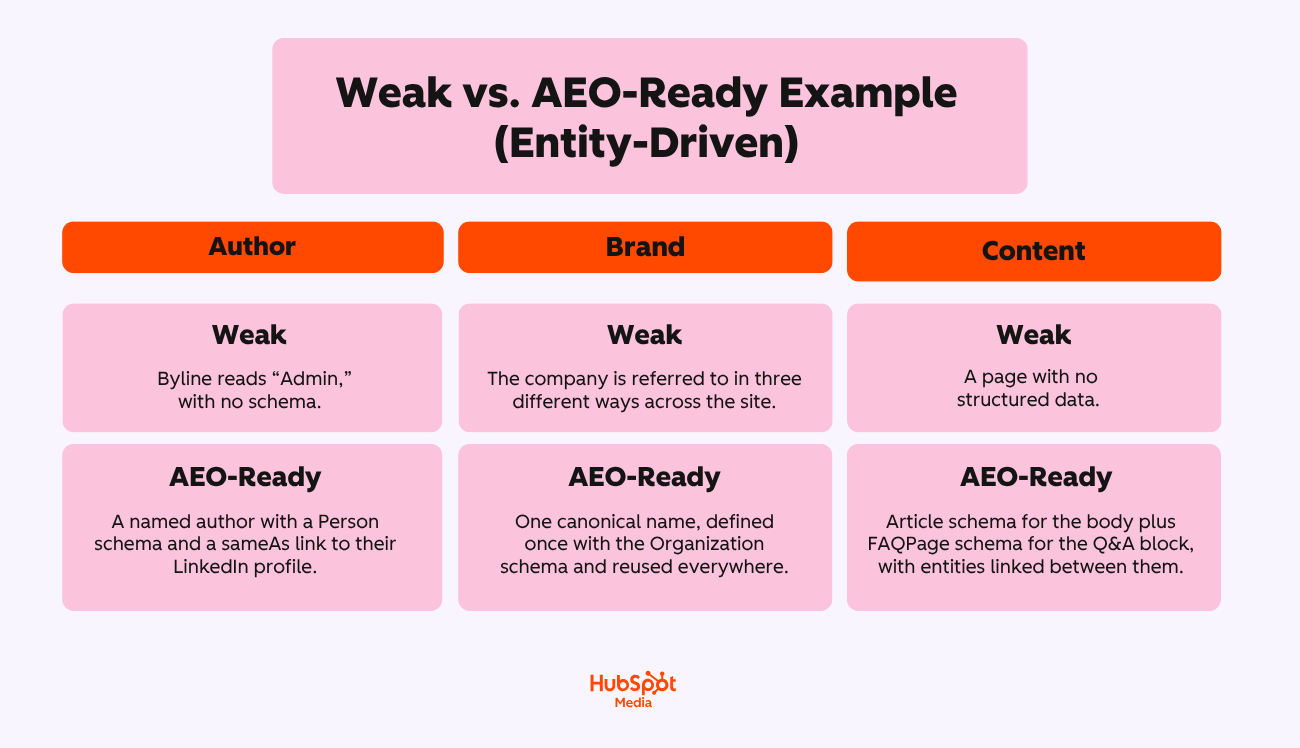
Schema and entity modeling form the machine-readable backbone of AEO. They provide AI engines with explicit facts about a webpage’s content, its author, and the brand behind it. This structured layer helps overcome the ambiguity that can lead to content being overlooked, even if it contains valuable information. While clear prose communicates meaning to humans, schema communicates it to machines in an actionable format.
Schema Types Describing Content
Structured data labels different components of a webpage, allowing AI to understand their purpose without inference. The most critical schema types for AEO citations include:
- Organization Schema: Identifies the entity responsible for the content, including its name, logo, and URL.
- Person Schema: Details the author or contributor, including their name, job title, and affiliations.
- Article Schema: Provides metadata about the content, such as its headline, publication date, and author.
- FAQPage Schema: Specifically designed for Q&A content, it helps AI understand the question-answer relationships.
Modeling Entities for Recognition and Citation
Entity modeling involves defining the entities (people, brands, products) present on a website as consistent, interconnected concepts rather than isolated words. A well-defined entity model strengthens brand consistency and clarifies relationships between authors, products, and the brand, building AI confidence over time.
A practical sequence for modeling entities that AI engines can recognize and cite involves:
- Identify Key Entities: Determine the primary people, brands, and products relevant to your content.
- Create Canonical Representations: Establish a consistent naming convention and description for each entity across your website.
- Implement Schema Markup: Apply relevant schema types (e.g., Organization, Person) to pages featuring these entities.
- Link Entities Internally: Use internal links with descriptive anchor text to connect related entities and content.
- Ensure External Consistency: Maintain consistent entity information on external platforms (e.g., social media, industry directories).
This systematic approach ensures that AI engines can confidently identify and attribute information to the correct sources.
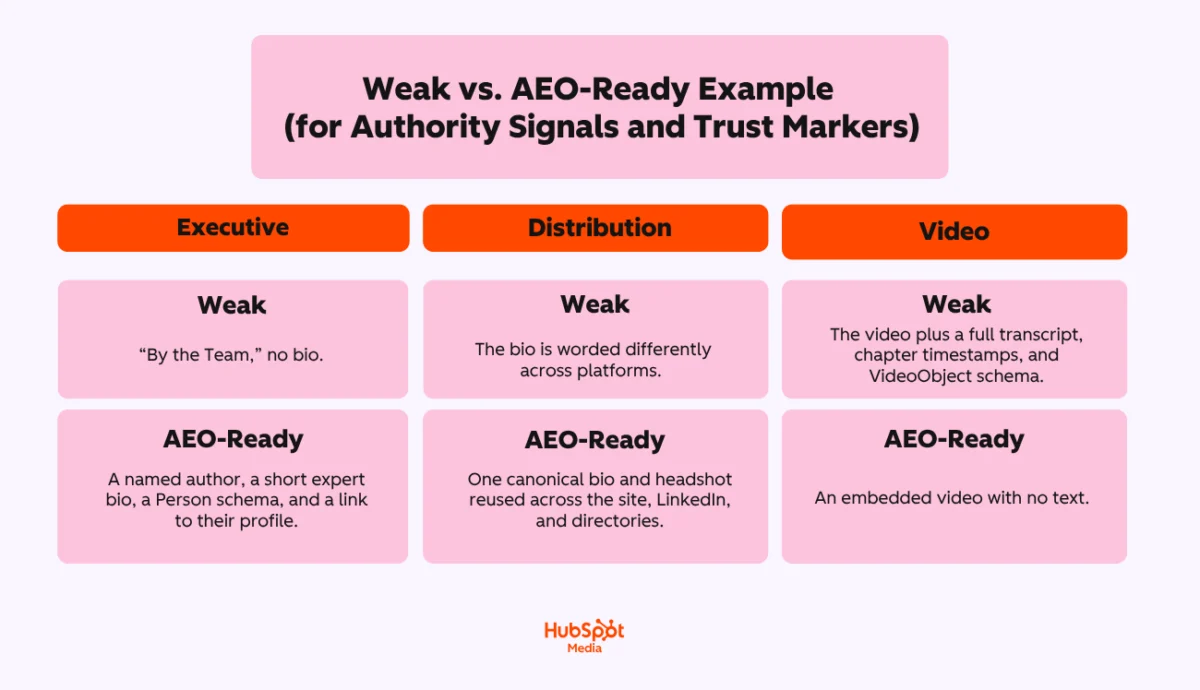
Theme 3: Authoritative Signals and Trust Markers
A critical factor for AI in deciding whether to cite content is trust. Even if two pages answer a question equally well, AI systems will favor the source they can verify and trust. These "authority signals" directly influence the quality and likelihood of a mention.
Authoritative Brand, Executive, and Product Profiles
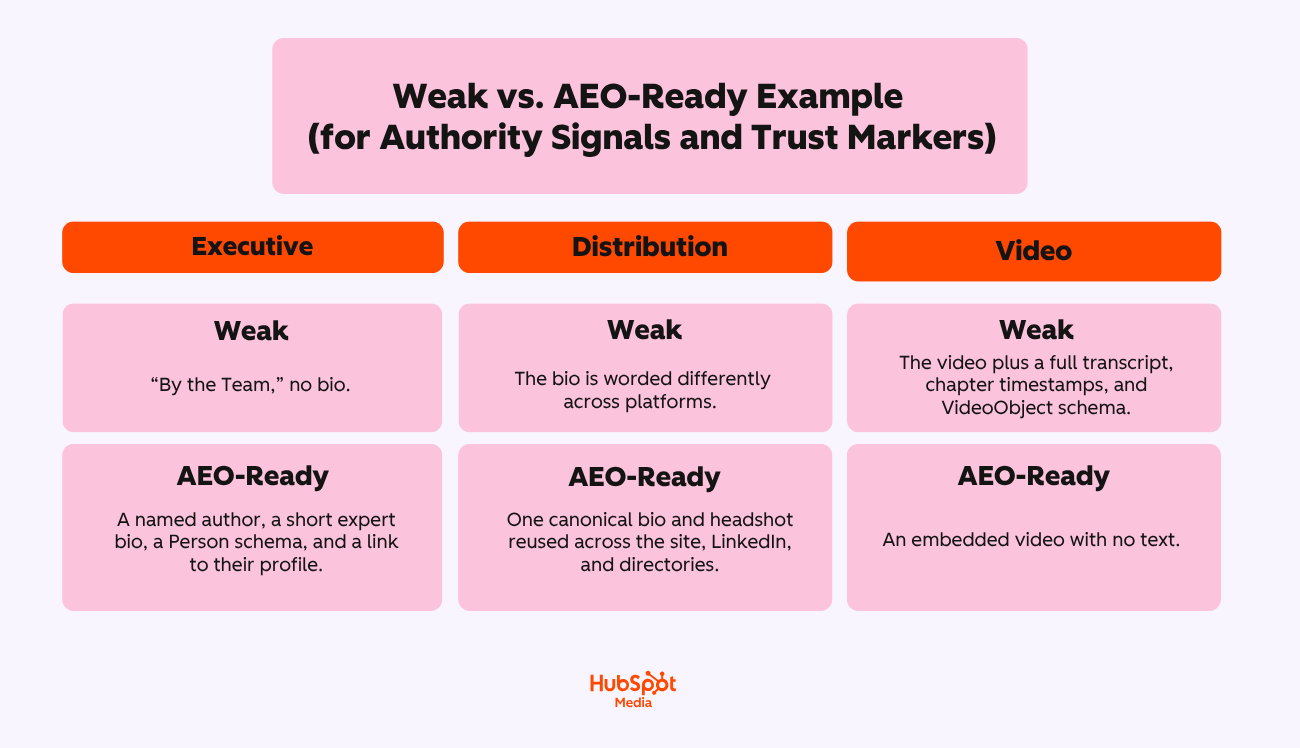
A strong profile is characterized by a stable, well-described entity that an AI engine can recognize and trust. These profiles should be explicit about who or what they represent. This includes:

- Detailed Company Profiles: Including history, mission, values, and contact information.
- Executive Biographies: Highlighting expertise, credentials, and contributions.
- Product Specifications and Use Cases: Clear descriptions of products and their benefits.
This profile layer ensures that AI engines receive verifiable entities rather than vague mentions.
Distribution Across Trusted Ecosystems
The presence of content and entities across reputable external platforms serves as a powerful trust signal for AI. Corroboration from trusted sources enhances a brand’s perceived authority. This includes:
- Industry Publications: Mentions and features in respected trade journals and news outlets.
- Academic Citations: References in scholarly articles or research papers.
- Reputable Directories: Listings in authoritative online directories and databases.
- Social Media Authority: A strong, consistent presence on established social media platforms.
Video Transcripts, Timestamps, and VideoObject Schema
Video content, while valuable, is inherently difficult for AI to parse unless it is made text-readable. To make video more accessible to AI, several additions are crucial:
- Comprehensive Video Transcripts: Providing full text versions of video content.
- Timestamped Chapters: Breaking down videos into distinct, searchable segments.
- VideoObject Schema: Utilizing schema markup to provide metadata about the video, including its title, description, and upload date.
These elements transform video from an opaque format into a more AI-comprehensible resource, increasing its potential for citation.
Theme 4: Strategic Internal Linking Architecture
Internal linking serves as the site-level manifestation of content structure and is a key element in maximizing citation potential. A well-defined internal linking architecture helps AI engines crawl, group, and trust related content. Conversely, weak or haphazard linking can isolate valuable answers and make them difficult to associate with their broader topics.
Hub-and-Spoke Structure, Glossary Pages, and Sibling Links
A "hub-and-spoke" model is an effective way to organize content. It centers around a core authoritative page (the hub) that links to more focused supporting pages (the spokes). This structure helps AI understand the topical hierarchy and relationships between different pieces of content.
- Hub Pages: Broad, in-depth articles that cover a topic comprehensively.
- Spoke Pages: Specific articles that delve into sub-topics, linking back to the hub.
- Glossary Pages: Centralized definitions of key terms, linking to relevant content.
- Sibling Links: Links between pages that cover similar sub-topics within a larger theme.
Clear Anchor Text and Early Link Placement
The anchor text used in internal links and the placement of these links within the content significantly inform search engines about the nature and importance of the linked page.
- Descriptive Anchor Text: Using clear, keyword-rich anchor text that accurately describes the linked content.
- Early Placement: Placing important internal links higher up in the content, signaling their relevance to the primary topic.
Internal Link to Topic Clusters
A topic cluster is a group of interlinked pages that collectively address a subject in detail. This comprehensive approach helps AI recognize the breadth of a brand’s expertise on a given topic, further enhancing its authority.
Theme 5: Passage-Level Optimization for Extraction
Passage-level optimization is the practice of writing each content segment so it can be independently lifted and cited by an AI engine. The goal is to ensure that each passage makes complete sense out of context, functioning as a self-contained unit of information. This passage-first mindset is fundamental to AEO at the content creation level.
Stand-Alone Paragraphs That Answer One Question
Each paragraph should ideally address a single question and be self-sufficient. This means starting with the answer and then providing supporting details. It’s crucial to avoid pronouns or references that point to preceding text, as these can break the passage’s coherence when extracted.
Lists, Tables, and Definition Boxes
Structured formats such as lists, tables, and definition boxes are highly snippet-friendly and easily extractable by AI. Incorporating these formats enhances the scannability and comprehensibility of content for AI engines.
Concise, Extractable Sentences
The length and clarity of sentences directly impact how cleanly an AI can quote content. Shorter, more direct sentences are generally easier to extract and understand, contributing to higher citation rates.
Aligning Structural Themes with Google’s Quality Guidelines
It is crucial to remember that structural optimization for AI is only effective when the underlying content is genuinely helpful and high-quality. Google’s primary focus remains on rewarding "people-first" content. Strategies that attempt to game the system by adding structure to weak content are likely to backfire.
The structural themes that resonate with AI citation—clear headings, direct answers, and schema markup—serve to amplify existing quality. They do not replace it. Therefore, content accuracy, relevance, and user context remain paramount.
Accuracy, Quality, Relevance, and User Context
Google evaluates content against several core dimensions. These should be considered prerequisites for any AEO efforts:
- Accuracy: Information must be factually correct and verifiable.
- Quality: Content should be well-written, insightful, and comprehensive.
- Relevance: The content must directly address the user’s query.
- User Context: Understanding the user’s intent and providing information that meets their needs.
Disclosure When Automation Assists
Transparency regarding the use of automation in content creation is increasingly important. Google accepts AI-assisted content when it is helpful and not primarily intended to manipulate rankings. Disclosing the use of AI can help maintain reader trust.
Do / Do-Not Guardrails for Helpful Content
Establishing clear guidelines for content creation ensures consistency and adherence to quality standards. These guardrails should focus on producing content that is genuinely useful to the reader:
Do:
- Prioritize factual accuracy and provide supporting evidence.
- Focus on the user’s needs and intent.
- Ensure clear attribution and author credibility.
- Structure content for readability and ease of understanding.
Do Not:
- Prioritize AI generation over human expertise and review.
- Create content solely to manipulate search rankings.
- Use misleading or deceptive tactics.
- Present AI-generated content as solely human-created without disclosure.
By adhering to these principles, marketers can ensure that their AEO efforts reinforce, rather than undermine, Google’s quality guidelines.
Measuring Citation Performance and Structural Impact
A significant challenge in AEO is proving its efficacy. While implementing structured content is achievable, quantifying whether these structural changes actually lead to more citations can be difficult. Measurement is the key to bridging this gap and confirming that structural improvements are yielding tangible results.
The Three KPIs That Matter
To effectively measure AEO success, it’s essential to track three core KPIs:
- Citation Volume: The number of times content is directly cited by AI answer engines.
- Brand Mentions in AI Answers: The frequency with which the brand or its associated entities appear in AI-generated responses.
- Topical Authority Signals: How AI engines perceive the brand’s expertise and trustworthiness across relevant topics.
The Measurement Loop: Diagnose, Test, Measure, Iterate
AEO should be approached as a continuous process of improvement. This involves a cyclical approach:
- Diagnose: Identify areas for structural improvement on existing content.
- Test: Implement specific structural changes (e.g., add a Q&A block, optimize schema).
- Measure: Track the impact of these changes on the defined KPIs.
- Iterate: Refine the strategy based on the measurement results and repeat the process.
This iterative loop ensures that AEO strategies are data-driven and continuously optimized for better performance.
Operationalizing High-Citation Content Themes
The true power of AEO is realized when winning structural themes are systematized into a repeatable workflow. Operationalizing AEO means ensuring that every piece of content, regardless of who creates it, is structured for citation readiness. This consistency is achieved through clear roles and reusable templates.
Role-Based Checklists
Assigning specific AEO responsibilities to different team members ensures that all aspects of the optimization process are covered:
- Content Strategists: Identify high-potential topics and plan content structure.
- Content Writers: Implement question-led headings, direct-answer summaries, and passage-level optimization.
- SEO Specialists: Oversee schema markup, entity modeling, and internal linking architecture.
- Editors: Review content for quality, accuracy, and adherence to AEO best practices.
Templates in Content Hubs
Reusable content templates can standardize structural elements, removing guesswork for writers. These templates can incorporate predefined sections for Q&A blocks, TL;DR summaries, and structured data elements, ensuring consistency across all published content.
Frequently Asked Questions (FAQs) About Structuring Content for Answer Engine Citations
Do I need a new page for AI Overviews or can I optimize existing content?
Existing content can almost always be optimized for AI Overviews. Creating new pages is rarely necessary. The key is to enhance the structure and clarity of what already exists to make it more accessible to AI engines.
Which schema types help most for B2B content citations?
For B2B content, prioritizing schema that establishes credibility and structure is essential. This includes Organization Schema, Person Schema for author expertise, and Article Schema for content context. FAQPage Schema is also highly beneficial for Q&A-driven B2B content.
How often should I refresh content to maintain citation rates?
Content refresh schedules should be tied to the volatility of the topic, not a fixed calendar. Topics that change rapidly require more frequent updates. This includes updating facts, reconfirming direct answers, and refreshing structured data to signal freshness.
Can I restrict LLMs and still perform in traditional search?
While restricting AI crawlers can limit content visibility in some answer engines, it can also negatively impact traditional search rankings. The structural elements that benefit AI citations often also improve traditional SEO. A more effective approach is to remain open to answer engines and compete on structural optimization.
What’s the best way to align the answer engine structure with our CRM funnel?
Map content structure to funnel intent, then connect it to your CRM for measurement. For example, top-of-funnel content can be structured to answer broad questions, while mid-funnel content can address more specific pain points. By linking citation data to CRM insights, you can demonstrate how AEO contributes to revenue generation.
Conclusion: Winning in the AI Search Era
The transition to Answer Engine Optimization (AEO) may seem daunting, but mastering it boils down to a learnable discipline: structure. AI prioritizes clear, direct, and well-organized content. Every format that earns citations is an expression of this principle. The focus should be on making the best answers easy to find, extract, and attribute, rather than reinventing content entirely.
Operationalizing AEO involves creating repeatable workflows through role-based checklists and reusable templates. This ensures that citation-ready structure becomes the default for every page. By treating AEO as a systematic process rather than a guessing game, brands can build a durable competitive advantage in the evolving search landscape. The first step is to assess your current standing and begin implementing these foundational AEO principles.
About the Author