The digital landscape of information retrieval is undergoing a profound transformation. Search engines, once primarily repositories of blue links, are evolving into sophisticated answer engines. This paradigm shift, driven by advancements in artificial intelligence, is fundamentally altering how users seek information and, consequently, how businesses must adapt their online strategies. A recent report by HubSpot, "The 2026 State of AEO Report," highlights the urgency, revealing that 58% of marketers are already actively optimizing their content for these new "answer engines." This transition from traditional Search Engine Optimization (SEO) to Answer Engine Optimization (AEO) signifies a critical evolution for marketers aiming to maintain and enhance their online visibility.
The core of this transformation lies in the ability of AI-powered search tools like Google’s AI Overviews, ChatGPT, and Perplexity to directly synthesize answers from web content. Instead of presenting a list of potential sources, these platforms are increasingly providing direct, concise responses, often extracting information directly from the most relevant web pages. This necessitates a fundamental re-evaluation of content creation and optimization strategies. Marketers can no longer solely focus on ranking within the top ten blue links; their primary objective must be to ensure their content is easily discoverable, understandable, and citable by these advanced AI systems.
Understanding the mechanics of how these answer engines parse and present information is paramount. The process generally involves an engine reading a page, breaking it down into manageable segments, and evaluating each segment against the user’s query. A citation appears only when the engine can confidently extract a clean, self-contained passage and attribute it to a credible source. This extraction process is heavily influenced by the underlying structure of the content. Therefore, content structure has emerged as the critical factor determining citation rates in AI-driven search results.
Key Structural Themes Driving Citation Rates
Research and industry reports consistently point to several structural themes that correlate strongly with higher citation rates in answer engines. These themes, primarily centered around clarity and directness, form the bedrock of effective AEO.
1. Question-Led Headings and Direct-Answer Summaries:
The practice of framing content with question-led headings that directly mirror user queries, followed by concise, direct-answer summaries (often referred to as TL;DR sections), significantly increases the likelihood of citation. A report by AirOps on "The 2026 State of AI Search" indicates that sequential heading structures can boost citation odds by as much as 2.8 times. These formats effectively map a query to a specific passage and provide the AI with a readily extractable answer, simplifying the attribution process for the search engine. When implemented as Q&A blocks, pairing an explicit question with a succinct answer, the content becomes highly citable. This approach ensures that the most critical information is presented upfront, allowing AI to easily lift and attribute it.
2. Semantic Schema and Entity Modeling:
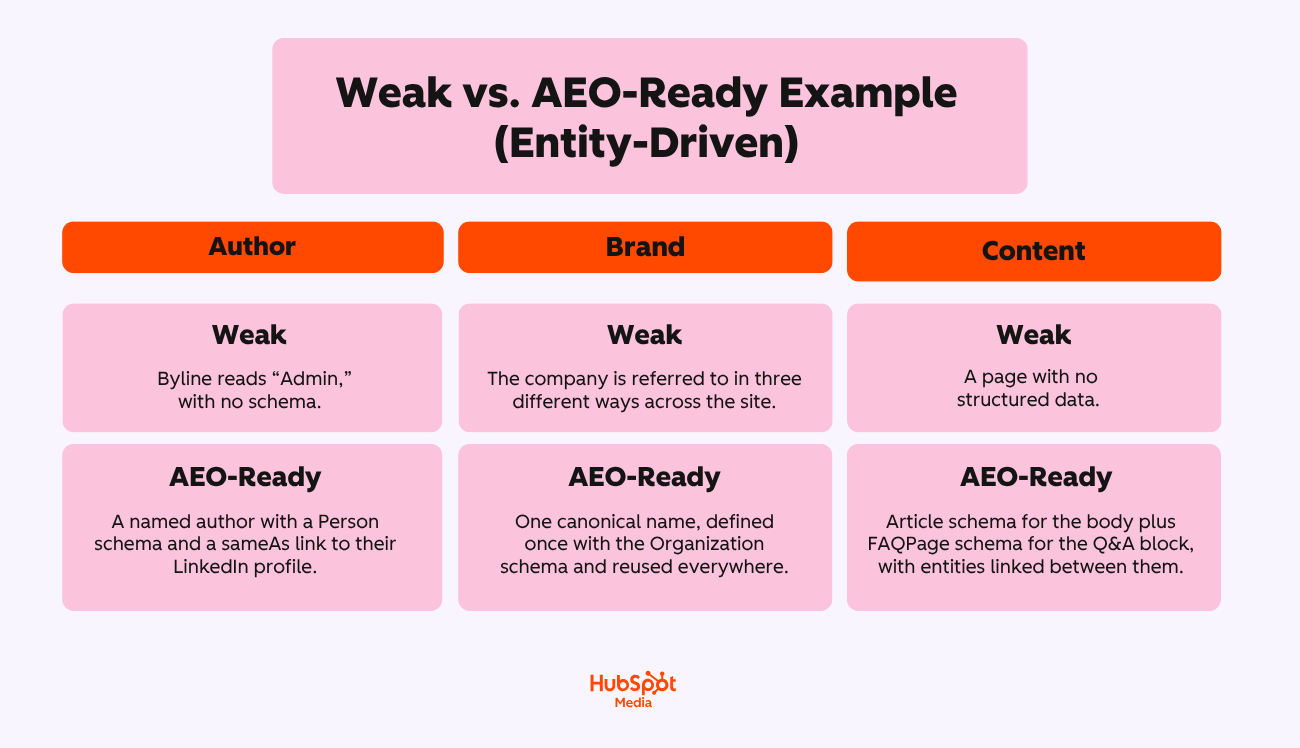
Beyond clear prose, a "machine-readable layer" is crucial for AI to understand and trust content. This layer is built through semantic schema and entity modeling. Schema markup provides explicit data about a page’s content, authorship, and the brand behind it, thereby closing the "weak-schema gap" that can prevent even well-written content from being cited. Key schema types that describe content effectively include:
- Article Schema: Details information about articles, news, and blog posts.
- Organization Schema: Provides information about the publishing organization.
- Person Schema: Identifies authors and their credentials.
- VideoObject Schema: Describes video content, including transcripts and metadata.
Entity modeling involves defining entities like people, brands, and products as consistent, interconnected concepts. This consistency strengthens brand, product, and author relationships, building confidence for AI systems over time. A deliberate entity model ensures that AI can identify and attribute information with a higher degree of certainty.

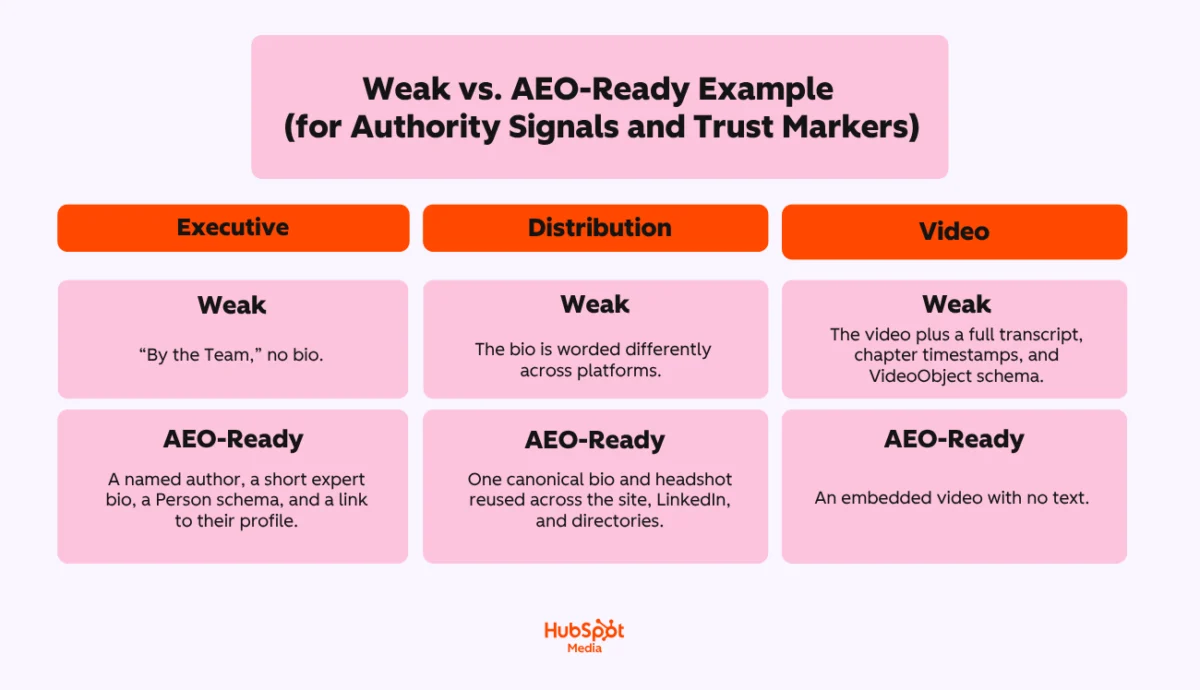
3. Authoritative Signals and Trust Markers:
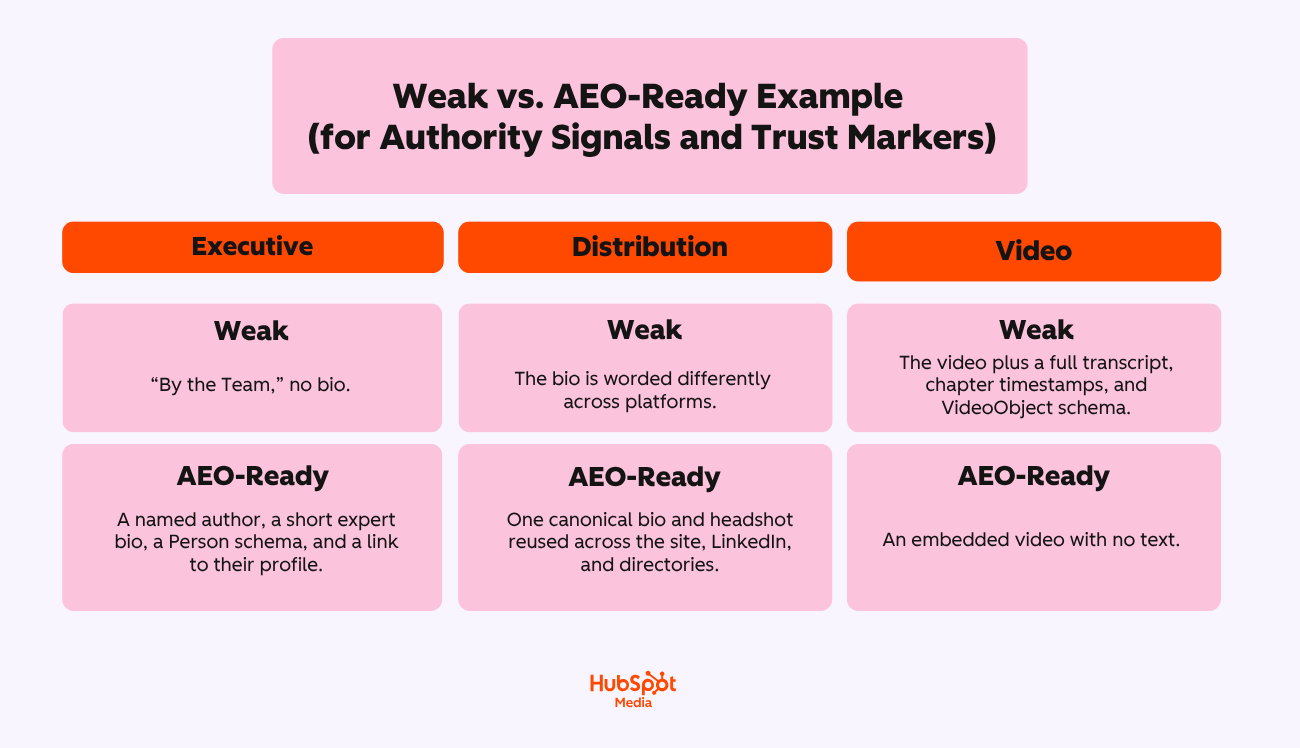
Answer engines prioritize trust and verifiability. When two pieces of content equally answer a question, the AI will favor the source it can more confidently verify. These "authority signals" and "trust markers" are essential for earning citations. These include:
- Authoritative Brand, Executive, and Product Profiles: Well-defined and explicit profiles for brands, executives, and products allow AI to recognize and trust them as stable entities.
- Distribution Across Trusted Ecosystems: Content and entities appearing across reputable external sources act as corroborating trust signals for AI.
- Video Transcripts and Structured Video Data: Making video content accessible to AI through transcripts and the
VideoObjectschema is vital for its discoverability and citation.
4. Strategic Internal Linking Architecture:
A well-structured internal linking strategy acts as the site-level expression of content organization. It aids AI in crawling, grouping, and trusting related content. A "hub-and-spoke" model, where a central authoritative page links to supporting content, along with clear anchor text and early link placement, helps AI understand the context and importance of linked pages. Topic clusters, where interconnected pages comprehensively cover a subject, further reinforce this structure.
5. Passage-Level Optimization for Extraction:
This theme focuses on writing each individual passage so it can stand alone and be cited without relying on surrounding context. Each paragraph should ideally answer a single question and be self-contained, avoiding pronouns that reference previous text. Structured formats like lists, tables, and definition boxes are highly snippet-friendly and contribute to extractability. Concise and clear sentences also enhance the ability of AI to quote content accurately.
The Mechanics of AI Parsing and Citation
Answer engines do not "rank" pages in the traditional sense; they "read" them. The process leading to a citation involves several steps:
- Crawling and Indexing: AI systems first discover and process web pages.
- Content Parsing: The content is broken down into smaller, digestible units, such as paragraphs, lists, or tables.
- Query Matching: Each parsed segment is evaluated against the user’s search query for relevance and accuracy.
- Citation Attribution: If a segment is deemed a strong answer, the AI extracts it and attributes it to its source.
Answer Engine Optimization (AEO) is the strategic practice of structuring content to facilitate this extraction, understanding, and citation process. This involves a deep understanding of how AI parsers break down pages and what makes a passage "citable." Citable passages are typically those that directly answer a question, are self-contained, and are clearly attributed.
Measuring Success in the Age of AEO
Demonstrating the efficacy of AEO efforts is crucial for ongoing investment and strategy refinement. Measurement closes the gap between implementing structural changes and observing their impact. Key performance indicators (KPIs) that matter most include:
- Citation Volume: The number of times content is cited in AI Overviews or other AI-generated answers.
- Brand Mention Volume: The frequency with which the brand is mentioned or attributed in AI responses.
- Passage Extraction Rate: The proportion of specific, optimized passages that are successfully lifted and cited by AI.
A cyclical measurement approach—diagnose, test, measure, and iterate—is essential. This involves treating structural optimizations as testable hypotheses, implementing changes, tracking their impact on KPIs, and then refining the strategy based on the data.
Operationalizing AEO for Scalability
For AEO to be truly effective, it must move beyond ad-hoc efforts and become a systematic, repeatable workflow. Operationalizing AEO involves two key systems:
- Role-Based Checklists: Assigning clear ownership for each stage of the AEO process to specific roles within a content team ensures accountability and consistency.
- Templates in Content Hubs: Developing and utilizing reusable templates for content creation, incorporating AEO best practices by default, removes guesswork for writers and ensures every page is optimized. This can be accelerated with AI drafting tools, followed by human review to maintain quality guardrails.
Aligning Structure with Quality Guidelines
It is imperative to understand that structural optimization for AI is only effective when the underlying content is genuinely helpful and high-quality. Google’s quality guidelines, which emphasize accuracy, relevance, and user context, remain paramount. AEO should amplify existing quality, not mask poor content. Transparency about AI assistance in content creation is also crucial, fostering reader trust. Guardrails for helpful content, focusing on "Do’s" and "Don’ts," ensure that AI-assisted content remains reader-centric and avoids manipulation.
The evolving search landscape demands a strategic pivot towards Answer Engine Optimization. By focusing on clear structure, direct answers, semantic data, and authoritative signals, businesses can ensure their content not only ranks but is also recognized, understood, and cited by the next generation of search engines, securing their visibility in the AI-driven era.
About the Author