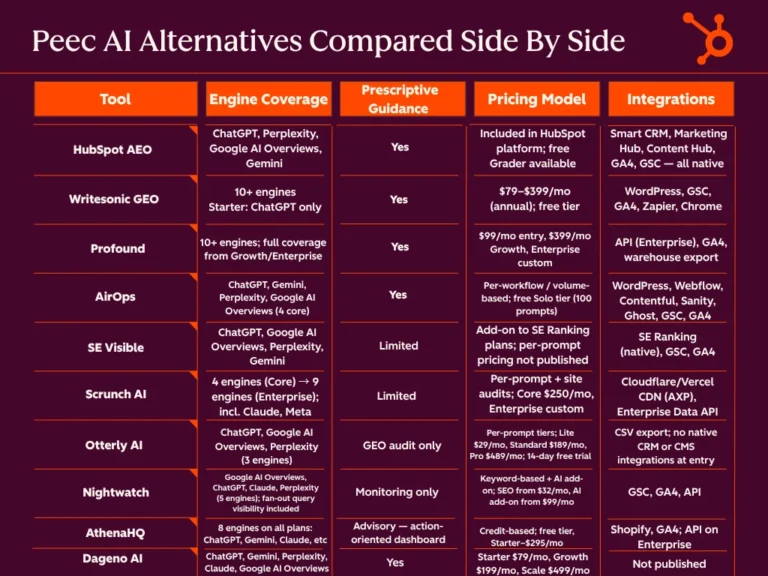
The way consumers discover and interact with brands is undergoing a seismic shift, driven by the rapid integration of artificial intelligence into search engines. No longer are potential buyers passively scrolling through traditional Google results; increasingly, they are turning to conversational AI platforms like ChatGPT, Perplexity, and Gemini for direct vendor recommendations and information. This fundamental change underscores the growing imperative for businesses to ensure their brand visibility within these emerging "answer engines" is not just present, but optimized. The burgeoning discipline of Answer Engine Optimization (AEO) has moved from a niche concern to a critical strategic priority for marketers worldwide, prompting a surge in demand for dedicated tools to monitor, measure, and enhance AI-driven brand perception. While awareness of AI’s impact on search is widespread, the challenge now lies in selecting the most effective tools to navigate this new frontier.
This evolving market has seen the emergence of several key players, with HubSpot AEO and Peec AI standing out as prominent platforms. However, these tools, while both addressing AEO, serve distinct strategic functions. Understanding these differences is crucial for businesses to align their investment with their specific needs, team resources, and existing technology stack. Choosing the wrong solution can lead to underutilized capabilities or an inability to act upon collected data. This comprehensive analysis will delve into the features, pricing, supported AI engines, integration capabilities, and actionable insights offered by both HubSpot AEO and Peec AI, providing a clear framework for marketers to determine the optimal AEO strategy for their organization.
Understanding the Core of Answer Engine Optimization
At its heart, AEO is about ensuring a brand’s accurate, positive, and prominent representation within the AI-generated answers that users receive from conversational search interfaces. This goes beyond traditional Search Engine Optimization (SEO), which focuses on ranking for specific keywords in organic search results. AEO considers how AI models interpret and synthesize information from vast datasets to formulate responses. Factors such as brand sentiment, the quality and accuracy of information presented, brand recognition, competitive positioning within AI answers, and the frequency of brand mentions all contribute to a brand’s overall visibility and credibility in this new search paradigm.
The implications of neglecting AEO are significant. If a potential customer asks ChatGPT for recommendations for a specific service or product, and a competitor’s brand is prominently and favorably featured while yours is absent or misrepresented, that represents a lost opportunity of considerable magnitude. This shift necessitates a proactive approach to understanding and influencing how AI platforms perceive and present a brand.
HubSpot AEO Grader: A Free Snapshot of Brand Perception
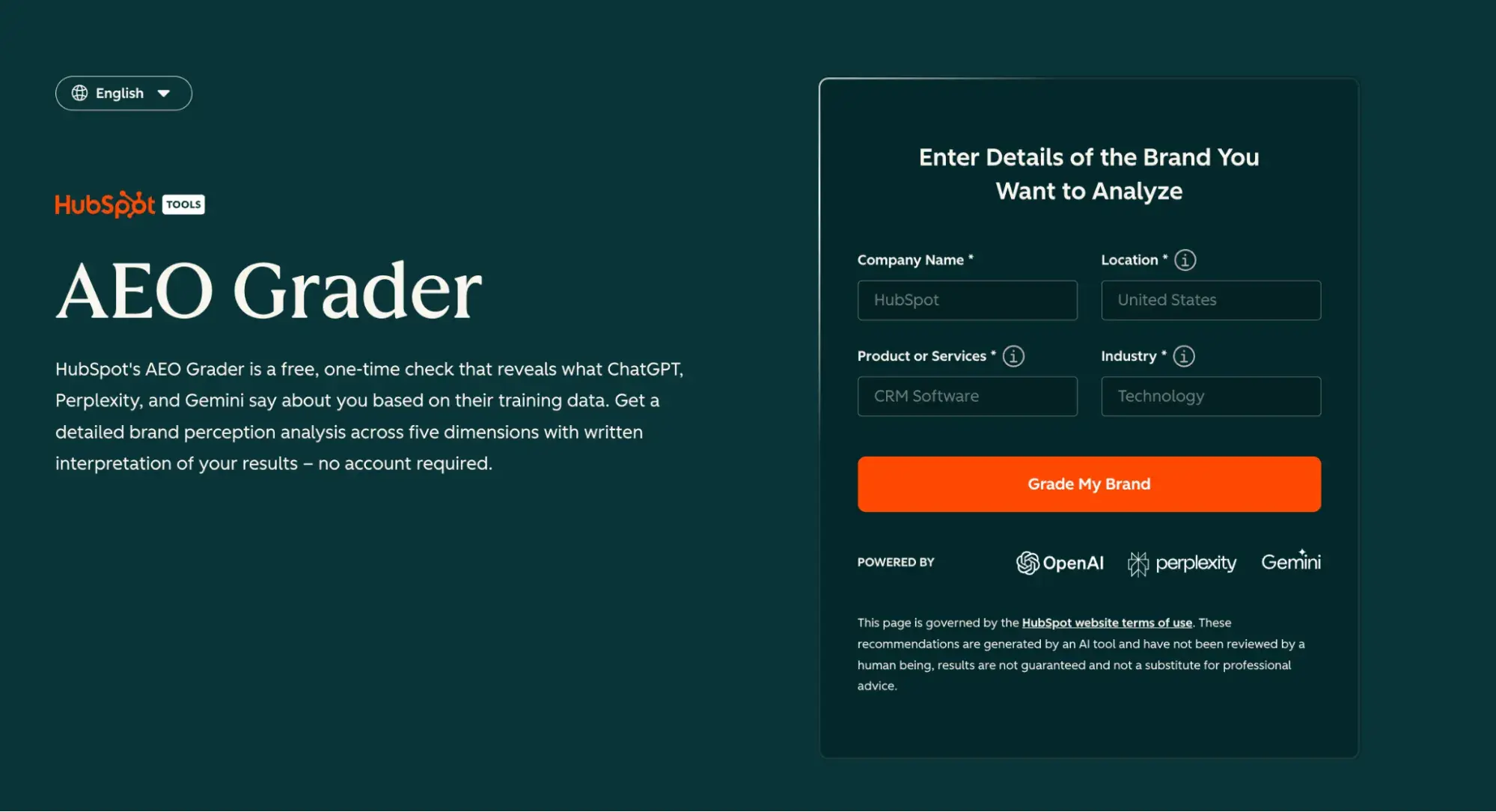
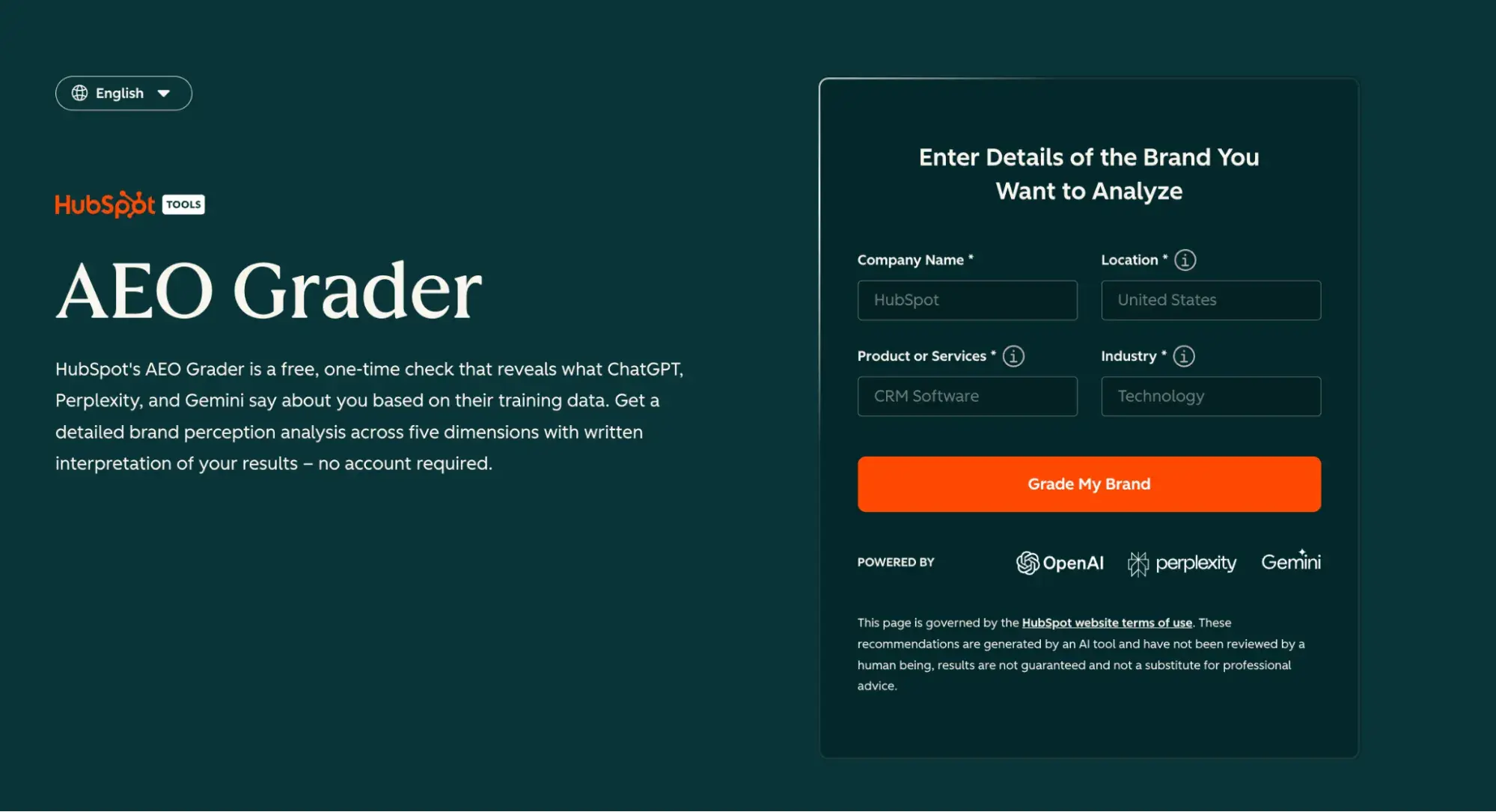
HubSpot’s AEO Grader offers a no-cost, immediate assessment of a brand’s visibility and characterization across three major AI engines: ChatGPT, Perplexity, and Gemini. This free tool provides a crucial baseline by evaluating how these AI platforms represent a brand based on their underlying training data. The process requires no account creation, credit card information, or usage limits, making it an accessible entry point for any business looking to gauge its current standing in AI-driven search.
To utilize the AEO Grader, users simply input their company name, location, industry, and product details. The tool then initiates a series of test queries across the selected AI engines, generating a composite score out of 100. Within minutes, users receive a detailed interpretation of their results, highlighting strengths and weaknesses across key dimensions of AI brand perception. This quick diagnostic is invaluable for building an initial business case or understanding immediate areas for improvement.
Peec AI: Comprehensive Monitoring and Reporting Infrastructure
In contrast to the snapshot provided by HubSpot’s AEO Grader, Peec AI positions itself as a robust visibility monitoring platform. It focuses on tracking the frequency with which a brand appears in AI-generated responses to user queries. Peec AI employs advanced UI scraping technology, simulating real user interactions to capture AI responses. This method ensures that the data logged accurately reflects what actual users see, providing a more granular and realistic view of brand presence than API-based querying alone might offer.
Peec AI is designed to deliver deep monitoring and reporting capabilities, serving as a data infrastructure that can feed into external tools and agency dashboards. Its strength lies in providing continuous tracking and detailed analytics, enabling businesses to observe trends, benchmark against competitors, and identify specific areas where their brand is either excelling or lagging in AI search results.
Differentiating the Tools: A Functional Comparison
It is critical to recognize that HubSpot AEO (including its Grader tool and the broader AEO platform) and Peec AI are not interchangeable. They serve distinct, albeit related, purposes within an AEO strategy. HubSpot’s AEO Grader offers a foundational, one-time assessment, while the full HubSpot AEO platform integrates this monitoring with content execution workflows. Peec AI, on the other hand, focuses on providing extensive monitoring and reporting infrastructure for ongoing analysis. The choice between them, or a combination thereof, hinges on a team’s current stage of AEO maturity, available resources, and strategic objectives.

HubSpot AEO Grader: Establishing Your Baseline Score
The HubSpot AEO Grader’s baseline score is meticulously structured around five key dimensions, each assigned a specific weight to reflect its impact on AI’s characterization of a brand:
- Sentiment Analysis (40 pts): This dimension assesses the overall tone and sentiment AI employs when describing a brand. It encompasses general sentiment, contextual sentiment across various topics, and the credibility of the sources that shape this characterization. This is the most heavily weighted factor, as the how of a brand’s portrayal is paramount.
- Presence Quality (20 pts): This measures the depth and accuracy with which AI engines describe a brand’s offerings, capabilities, and unique selling propositions. It evaluates whether AI accurately conveys what the brand does and what makes it stand out.
- Brand Recognition (20 pts): This metric determines whether AI engines reliably identify, name, and correctly categorize a brand when responding to relevant queries. It speaks to the fundamental awareness and discoverability of the brand within AI’s knowledge base.
- Share of Voice (10 pts): This assesses how frequently a brand appears in AI responses relative to its competitors within the same category. It’s a measure of competitive presence in the AI-generated landscape.
- Market Competition (10 pts): This dimension evaluates a brand’s perceived competitive positioning and overall market standing as reflected in AI-generated answers. It provides insight into how AI perceives the brand’s place within its industry.
The AEO Grader’s ability to provide a scored baseline across these crucial areas in under five minutes makes it an indispensable tool for initial AEO assessment and for building internal consensus around the need for AEO strategies.
HubSpot AEO: Continuous Monitoring with Integrated Execution
HubSpot’s full AEO platform builds upon the insights provided by the AEO Grader, shifting the focus from a one-time check to ongoing management and action. While the AEO Grader answers, "How does AI represent my brand right now?", the HubSpot AEO platform addresses, "How is that changing, and what should I do about it?"
This integrated approach means that HubSpot AEO not only tracks brand visibility but also provides actionable recommendations directly linked to content creation and execution workflows. Key features include:
- CRM-Driven Prompt Generation: Leverages Smart CRM data (customer profiles, product details, competitor information) to generate relevant prompts that align with a company’s actual business context.
- Prioritized Recommendations: Surfaces specific content creation or optimization tasks based on identified AI visibility gaps.
- Content Execution Integration: Connects directly with HubSpot’s Marketing Hub tools, allowing teams to create and publish content that addresses AEO issues without leaving the platform.
- Performance Tracking: Monitors the impact of implemented changes on AI visibility metrics over time.
This integrated workflow transforms AI visibility data from mere metrics into actionable intelligence, streamlining the process from identification to publication.
Peec AI: Monitoring and Reporting at Scale for Data-Driven Insights
Peec AI excels in providing a sophisticated monitoring and reporting infrastructure. Its core strength lies in its ability to continuously track brand presence across a wide array of AI engines, offering deep insights into how a brand is perceived and where opportunities for improvement lie.
Key functionalities of Peec AI include:
- Extensive Engine Coverage: Tracks visibility across multiple AI engines, with options for broader coverage through paid add-ons.
- UI Scraping Technology: Simulates real user interactions to provide accurate, real-world visibility data.
- Detailed Reporting: Offers comprehensive dashboards and exportable reports for in-depth analysis.
- Competitor Benchmarking: Allows for direct comparison of a brand’s AI visibility against competitors.
- Gap Analysis: Identifies areas where competitors are present in AI responses but the brand is not, pinpointing opportunities for outreach and content strategy.
- External Integration Focus: Designed to feed data into existing BI tools and agency dashboards, facilitating custom reporting and analysis.
Peec AI is particularly well-suited for organizations that require granular control over AI engine selection, need to integrate AEO data into diverse reporting stacks, or manage multiple client brands with complex reporting requirements.
Navigating the Choice: Snapshot vs. Continuous Monitoring
The decision between a snapshot tool like HubSpot’s AEO Grader and a continuous monitoring platform like Peec AI or the full HubSpot AEO solution depends heavily on a company’s current AEO maturity and its intended use of the data.
A Practical Decision Framework:

| Your Situation | Recommended Tool | Why |
|---|---|---|
| You’ve never measured AI brand visibility. | HubSpot AEO Grader (free) | Establishes a scored baseline across five categories in under five minutes – zero commitment required. |
| You need continuous tracking and competitor benchmarking. | HubSpot AEO ($50/mo) or Peec AI ($95+/mo) | Both offer ongoing monitoring. HubSpot AEO includes CRM-connected recommendations; Peec AI offers deeper multi-engine reporting. |
| You need to act on visibility gaps (not just measure them). | HubSpot AEO + Marketing Hub | HubSpot AEO surfaces what to fix. Marketing Hub is where you build and publish the content that fixes it. |
| You manage multiple client brands and need scaled reporting. | Peec AI | Multi-project accounts, agency credit systems, white-label dashboards, and per-project engine selection. |
| You’re building a business case for leadership buy-in. | HubSpot AEO Grader (free) | A composite score out of 100 with a written interpretation is significantly more communicable than paid-tool dashboards. |
Pro Tip: If there’s uncertainty about the value of continuous monitoring, starting with the AEO Grader is a prudent step. A low score in Sentiment Analysis or Share of Voice can quickly signal the urgency for more robust monitoring and execution strategies. Conversely, a strong baseline score might indicate that maintaining existing visibility is the priority, a goal that a continuous monitoring tool can effectively support.
Features and Engines: A Detailed Comparison
To facilitate an informed decision, a granular comparison of features and supported AI engines is essential. The true value of an AEO tool lies not just in its feature list but in its ability to translate data into actionable outcomes.
Engines Tracked
- HubSpot AEO: Includes comprehensive tracking for ChatGPT, Gemini, and Perplexity across all plans at no additional cost. This ensures core AI search engines are covered without incurring extra fees or making difficult engine selection choices. Furthermore, HubSpot’s broader web analytics identify AI referral clicks from other engines like Copilot, Claude, and Meta AI, offering a more holistic attribution picture.
- Peec AI: Offers ChatGPT, Perplexity, and Google AI Overviews as standard on all plans. Claude, Gemini, DeepSeek, and Grok are available as paid add-ons. Each self-serve plan limits engine selection to three out of the seven available options, meaning that choosing Gemini, for example, might require dropping another engine unless an additional fee is paid.
Pro Tip: For businesses prioritizing Gemini’s B2B relevance, HubSpot AEO’s inclusion of this engine across all plans presents a distinct advantage. Peec AI’s model requires an add-on for Gemini, which can impact cost and engine diversity.
Prompt Tracking and Caps
The core functionality of both platforms revolves around prompt tracking, but the methodologies and limitations differ:
- HubSpot AEO: Utilizes Smart CRM data to auto-generate prompts tailored to a company’s specific products, Ideal Customer Profiles (ICPs), and competitive landscape. This ensures that prompt tracking is directly relevant to a business’s actual sales and marketing context. Prompt caps are tied to plan tiers, with the standalone plan offering 25 prompts daily.
- Peec AI: Suggests prompts based on search intent signals and allows organization by persona or funnel stage. Peec AI generally offers higher raw prompt volume at comparable pricing tiers, appealing to users who prioritize extensive prompt testing.
The trade-off is clear: HubSpot AEO offers fewer prompts but deeper CRM integration and workflow continuity. Peec AI provides greater prompt volume but requires more manual effort for contextualization and action.
Citation and Source Insights
Understanding where AI sources its information is crucial for identifying content gaps and opportunities:
- HubSpot AEO: Integrates citation analysis directly into content execution workflows. It categorizes sources by type (e.g., news, academic, blog, forum) and links insights to prioritized recommendations within Marketing Hub, enabling seamless content updates or creation.
- Peec AI: Focuses on detailed monitoring and reporting through its "Sources" feature, which lists exact URLs cited by AI engines. It categorizes these sources and offers a "Gap Analysis" to highlight competitor citations, providing targets for digital PR and authority-building efforts.
Update Frequency
Both platforms provide daily data refreshes, ensuring that users have access to current AI visibility information. HubSpot AEO runs tracked prompts daily on a 24-hour cycle, while Peec AI also tracks daily on paid plans, with its UI scraping technology offering the potential to capture subtle interface differences that API-based tools might miss.
Exports, Reporting, and Integrations
This is a significant differentiator:
- HubSpot AEO: Keeps reporting native within the HubSpot ecosystem, integrating seamlessly with Marketing Hub, Sales Hub, and Service Hub dashboards. This native integration streamlines workflows and reduces the need for manual data transfer. Exports are available via HubSpot reporting tools.
- Peec AI: Employs a more open export architecture. CSV exports are available on all plans, with Looker Studio connectivity on higher tiers. API access is typically reserved for enterprise-level plans. Peec AI’s MCP integration, available on all paid plans, facilitates custom reporting and automation through tools like Slack and Make.
Pricing and Scalability: Matching Needs to Budget
The pricing models of HubSpot AEO and Peec AI reflect their different strategic orientations.
Entry Pricing and Free Tiers
- HubSpot AEO: Offers a free AEO Grader for baseline assessment. The standalone AEO product starts at $50/month for 25 daily prompts across ChatGPT, Gemini, and Perplexity. It’s also included with Marketing Hub Professional and Enterprise at no additional cost.
- Peec AI: Does not offer a free tier. Its paid plans begin with the Starter tier at $95/month for 50 daily prompts.
Tier-by-Tier Comparison
| Feature | HubSpot AEO Standalone | Marketing Hub Pro (AEO Incl.) | Marketing Hub Ent. (AEO Incl.) | Peec AI Starter | Peec AI Pro | Peec AI Advanced |
|---|---|---|---|---|---|---|
| Monthly Price | $50 | $890 | $3,600 | $95 | $245 | $495 |
| Prompts | 25 | 25 | 50 | 50 | 150 | 350 |
| Engines | 3 (fixed) | 3 (fixed) | 3 (fixed) | 3 of 7 (choose) | 3 of 7 (choose) | 3 of 7 (choose) |
| Seats | Unlimited viewers | 3 core | 5 core | Unlimited | Unlimited | Unlimited |
| Projects/Brands | 1 | 1 | 1 | 1 | 2 | 5 |
| Free Trial | 28 days | N/A | N/A | 7 days | 7 days | 7 days |
Pro Tip: If your organization already subscribes to HubSpot Marketing Hub Professional or Enterprise, HubSpot AEO is included, making it a cost-effective solution.
Prompt Caps and Scaling
- HubSpot AEO: Offers fewer prompts at lower tiers but integrates them deeply with CRM data for higher-quality, contextually relevant insights. Scaling prompt volume often involves upgrading to higher Marketing Hub tiers.
- Peec AI: Provides significantly more prompts at each tier, offering greater volume for extensive prompt testing and monitoring. This is ideal for teams prioritizing sheer data volume.
Seats and Access
- HubSpot AEO: Standalone plans allow unlimited viewers. Marketing Hub plans include a set number of core seats, with additional seats available for purchase.
- Peec AI: Offers unlimited seats across all paid plans, a significant advantage for large teams and agencies.
Actionability and Workflows: From Insight to Execution
The ultimate value of an AEO tool lies in its ability to translate data into actionable strategies.
HubSpot AEO Workflow: Track, Identify, Create, Publish, Monitor
HubSpot AEO is designed to facilitate the entire AEO workflow within a single platform. It guides users from initial tracking and identification of visibility gaps to the creation, publication, and ongoing monitoring of content designed to address those gaps. This integrated approach minimizes friction and accelerates the time from insight to impact.
Peec AI’s Workflow: Monitoring and Reporting Focus
Peec AI excels in the monitoring and reporting phases. It provides comprehensive data on brand visibility, competitor performance, and citation analysis. However, the execution of content and strategy typically occurs outside the Peec AI platform, requiring teams to integrate its insights into their existing content management and publishing workflows.
Ease of Use and Adoption
Both platforms are generally user-friendly, but they cater to different adoption paths.
- HubSpot AEO: Offers a guided onboarding process that leverages CRM data, simplifying prompt selection and ensuring immediate relevance. Its integration within the HubSpot ecosystem means teams already familiar with the platform experience minimal learning curve.
- Peec AI: Features a clean interface and rapid activation. Prompt selection relies on user knowledge of search intent or Peec AI’s suggestions. While highly intuitive, the lack of direct CRM integration means contextualization and action planning may require more manual effort.
Pro Tip: HubSpot Academy offers a free AEO Certification course, providing structured training that can accelerate team adoption and understanding of AEO principles.
Who Should Choose Which Tool?
The optimal choice between HubSpot AEO and Peec AI hinges on specific organizational needs and existing workflows.
Choose HubSpot AEO If:
- Your primary goal is to act on AI visibility data and integrate it into content creation and campaign management.
- Your team already utilizes HubSpot CRM and Marketing Hub.
- You require seamless integration between AI insights and your content execution platform.
- You prioritize a unified workflow from insight to publication.
- You are an SMB looking for an accessible, cost-effective entry into AEO.
Scenarios where HubSpot AEO is the clear fit:
- A small team needing a fast path from baseline to daily tracking.
- Mid-market teams already invested in the HubSpot ecosystem.
- Enterprise teams prioritizing deep CRM integration and RevOps alignment.
Choose Peec AI If:
- Your primary need is advanced AI visibility monitoring, deep analytics, and comprehensive reporting.
- You require extensive AI engine coverage beyond the core three.
- You manage multiple client brands and need robust multi-client management and reporting capabilities.
- Your existing technology stack is diverse, and you need to export data to various BI and reporting tools.
- You prioritize scalability for large teams and agencies with unlimited seat requirements.
Use cases where Peec AI is recommended:
- Agencies requiring scaled multi-client management and reporting.
- Organizations needing detailed competitor benchmarking and gap analysis.
- Teams prioritizing extensive AI engine coverage and custom integrations.
Conclusion: Aligning Tools with Workflow
Ultimately, the decision between HubSpot AEO and Peec AI is not about identifying a universally superior tool, but about selecting the platform that best aligns with an organization’s existing workflows and strategic priorities. HubSpot AEO offers a compelling integrated solution for teams deeply embedded in the HubSpot ecosystem, transforming AI insights into actionable content. Peec AI provides a powerful monitoring and reporting engine for organizations that need advanced analytics, extensive engine coverage, and flexible data export capabilities to feed into their existing technology stacks.
By carefully evaluating current team resources, existing software infrastructure, and overarching AEO objectives, businesses can confidently select the tool that will most effectively enhance their brand’s visibility and credibility in the evolving landscape of AI-driven search. The key to success in AEO lies not just in choosing the right technology, but in consistently leveraging it to adapt and thrive in this dynamic digital environment.
About the Author