The digital marketing sphere is undergoing a seismic shift, driven by the rapid integration of artificial intelligence into search engines. While Semrush, a long-standing leader in traditional Search Engine Optimization (SEO) and rank tracking, has introduced AI visibility features to its suite, the market is actively exploring a diverse range of alternatives. These emerging tools are crucial for SEO leaders, content marketers, demand generation managers, and RevOps teams aiming to understand and optimize their presence within the complex, AI-generated answers that now dominate user search experiences. This comprehensive guide delves into the nuances of AI search visibility and evaluates eight prominent alternatives, including HubSpot’s Answer Engine Optimization (AEO) tool, to help organizations identify the most suitable solutions for their reporting needs, budget constraints, and existing technology stacks.
Understanding AI Search Visibility: A New Paradigm for Online Presence
AI search visibility represents a fundamental departure from traditional search engine rankings. Instead of measuring a brand’s position within a list of "blue links," AI search visibility assesses a brand’s presence within AI-generated responses. This includes citations, summaries, and recommendations produced by advanced AI engines such as ChatGPT, Perplexity, Google AI Overviews, and Gemini. The core distinction lies in the underlying mechanics: traditional SEO heavily relies on factors like backlinks, domain authority, and keyword optimization, whereas AI search visibility hinges on an AI engine’s ability to confidently interpret, extract, and attribute information from a brand’s content.
A brand might hold a top-tier position in conventional organic search results yet remain entirely absent from AI-generated answers. This occurs because AI systems prioritize clarity, entity authority, and cross-platform consistency over traditional ranking signals alone. Consequently, a page that expertly targets keywords for human readers might not be structured or presented in a way that AI can readily synthesize and cite. This dynamic necessitates a shift in strategic focus, moving beyond mere keyword rankings to encompass the conceptual authority and structured presentation of content.
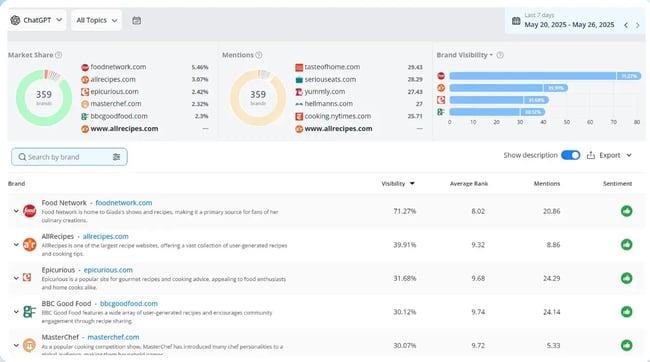
The practical measurement of AI search visibility is often distilled into three key metrics:
- Citation Frequency: This metric quantifies how often a brand’s content is cited within AI-generated responses. A higher frequency indicates that AI models are more likely to draw upon a brand’s information.
- Share of Voice (SOV): SOV in the context of AI visibility measures a brand’s presence in AI answers relative to its competitors. It highlights how effectively a brand is capturing attention within the AI-driven information landscape compared to others in its industry.
- Sentiment: This metric assesses the tone and nature of the AI’s portrayal of a brand. Positive sentiment suggests that AI engines are describing the brand in a favorable light, while negative sentiment could indicate issues with how the brand’s information is being interpreted or presented.
Collectively, these metrics offer a more holistic understanding of AI search visibility than any single metric in isolation. A brand might achieve high citation frequency but suffer from negative sentiment, or conversely, have a low SOV but consistently earn strong positioning within the citations it does receive. A comprehensive approach that analyzes all three is vital for deriving actionable insights and informing strategic adjustments.
Semrush’s Position in the AI Visibility Landscape
Semrush has integrated AI visibility tracking as an extension of its comprehensive SEO suite. This addition layers AI Overview monitoring, limited citation insights, and keyword data for AI-influenced queries onto its established traditional SEO functionalities. For organizations already invested in Semrush for technical SEO, backlink analysis, and competitive research, this integration offers the convenience of a unified workspace, reducing the need to switch between multiple tools.

However, Semrush’s AI visibility features primarily focus on prominent platforms like Google AI Overviews, Gemini, and ChatGPT, with integrations extending to traditional search. Crucially, they do not currently encompass emerging AI assistants such as Meta AI, Copilot, or Yahoo Scout. This oversight can be a significant limitation for teams requiring broader cross-engine visibility. Furthermore, for organizations not already standardized on the Semrush platform, its pricing can present a considerable barrier to adopting its AI-focused capabilities. This has spurred a market demand for dedicated and more specialized AI visibility solutions.
Evaluating Semrush AI Visibility Alternatives: A Comparative Analysis
The evolving nature of AI search demands specialized tools that can effectively track and optimize for this new frontier. Here, we examine eight compelling alternatives to Semrush’s AI visibility offerings, providing insights into their strengths, weaknesses, and ideal use cases.
1. HubSpot AEO (Answer Engine Optimization)
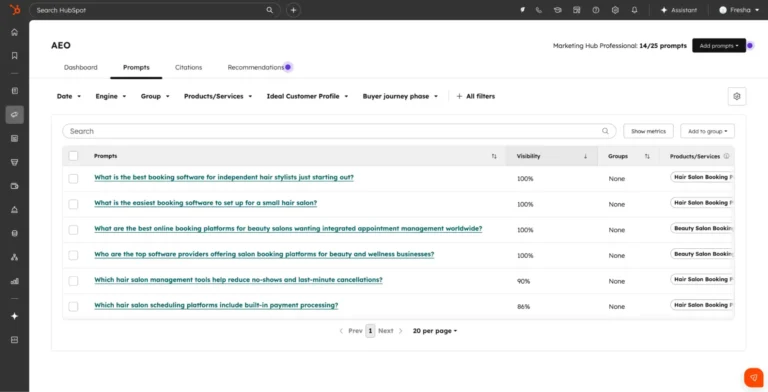
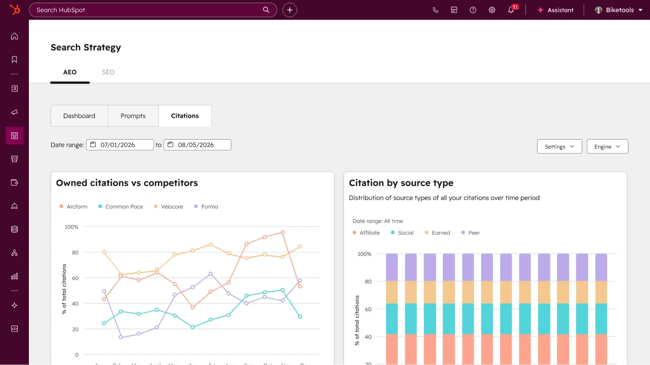
HubSpot’s Answer Engine Optimization (AEO) tool is purpose-built for tracking and enhancing brand visibility within AI-generated answers. Unlike many SEO tools that treat AI visibility as an add-on, HubSpot AEO is fundamentally designed around this new paradigm. It seamlessly connects citation data, share of voice, and competitor analysis directly to the CRM context and content tools that marketing and RevOps teams already utilize.
Key Features and Differentiators:
- Comprehensive Tracking: HubSpot AEO monitors brand presence across major AI engines, including ChatGPT, Gemini, and Google AI Overviews. It provides detailed citation analysis, showing exactly where and how a brand is mentioned.
- Integration with HubSpot Ecosystem: The standout feature of HubSpot AEO is its deep integration with Marketing Hub and the Smart CRM. This allows demand generation teams to not only see where their brand appears in AI answers but also to track whether these AI-influenced touchpoints translate into tangible business outcomes like contact acquisition, deal generation, and pipeline growth.
- AEO Grader: HubSpot offers a free AEO Grader tool, which provides a baseline assessment of a brand’s AI visibility across key engines and identifies competitor citations. This serves as an excellent starting point for teams before committing to a full platform.
- Revenue Attribution: For RevOps teams, the integration with the Smart CRM closes the attribution loop, enabling them to directly tie AI visibility data to revenue reporting.
Expert Insights: Peter Baraník, founder of ColorWee, praises HubSpot AEO for its out-of-the-box capabilities, including a visibility score, prompt tracking, citation analysis, and prioritized recommendations. He notes its straightforward setup and interpretable data, making it accessible without a dedicated SEO team. However, he points out a limitation: it currently covers only three platforms, potentially leaving gaps for those tracking other assistants like Claude or Grok.
Best For: Marketing, demand generation, and RevOps teams who require AI visibility data to be intrinsically linked with CRM reporting and pipeline impact.
Pro Tip: Utilize the AEO Grader to establish a robust baseline before engaging in competitive analysis. This benchmark data provides your RevOps team with a credible starting point for measuring progress effectively.

2. LLM Pulse
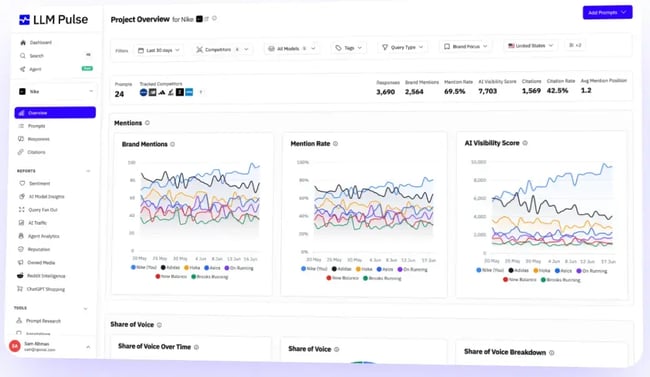
LLM Pulse emerges as a dedicated AI visibility platform, focusing intently on citation analysis, sentiment tracking, and query fan-out research across a spectrum of major AI models. A key advantage of this platform is its ability to display actual AI responses, offering teams a granular view of what AI engines are literally communicating about their brand, rather than relying solely on aggregated scores.
Key Features:
- Actual AI Response Display: Provides direct access to AI-generated answers, allowing for detailed audits.
- Query Fan-Out Analysis: This feature reveals the full array of prompts AI engines employ to retrieve content on a given topic, which is invaluable for crafting effective AI search content strategies.
- Citation and Sentiment Tracking: Offers robust capabilities for monitoring brand citations and the sentiment associated with them.
- White-Label Reporting: A significant benefit for agencies, LLM Pulse provides customizable white-label reports for clients.
Pricing: Plans typically start around $59 per month.
Expert Insights: Doug Darroch, Managing Director at Renaissance Digital Marketing, highlights LLM Pulse’s white-label reporting capabilities and its comprehensive coverage of citation analysis, sentiment, query fan-out, and prompt research across major models. He notes that while the optimization suggestions are AI-generated, the strategic execution still rests with the user.
Best For: Agencies managing AI visibility for multiple clients and brands that wish to scrutinize the exact AI responses referencing their content.
3. BrightEdge
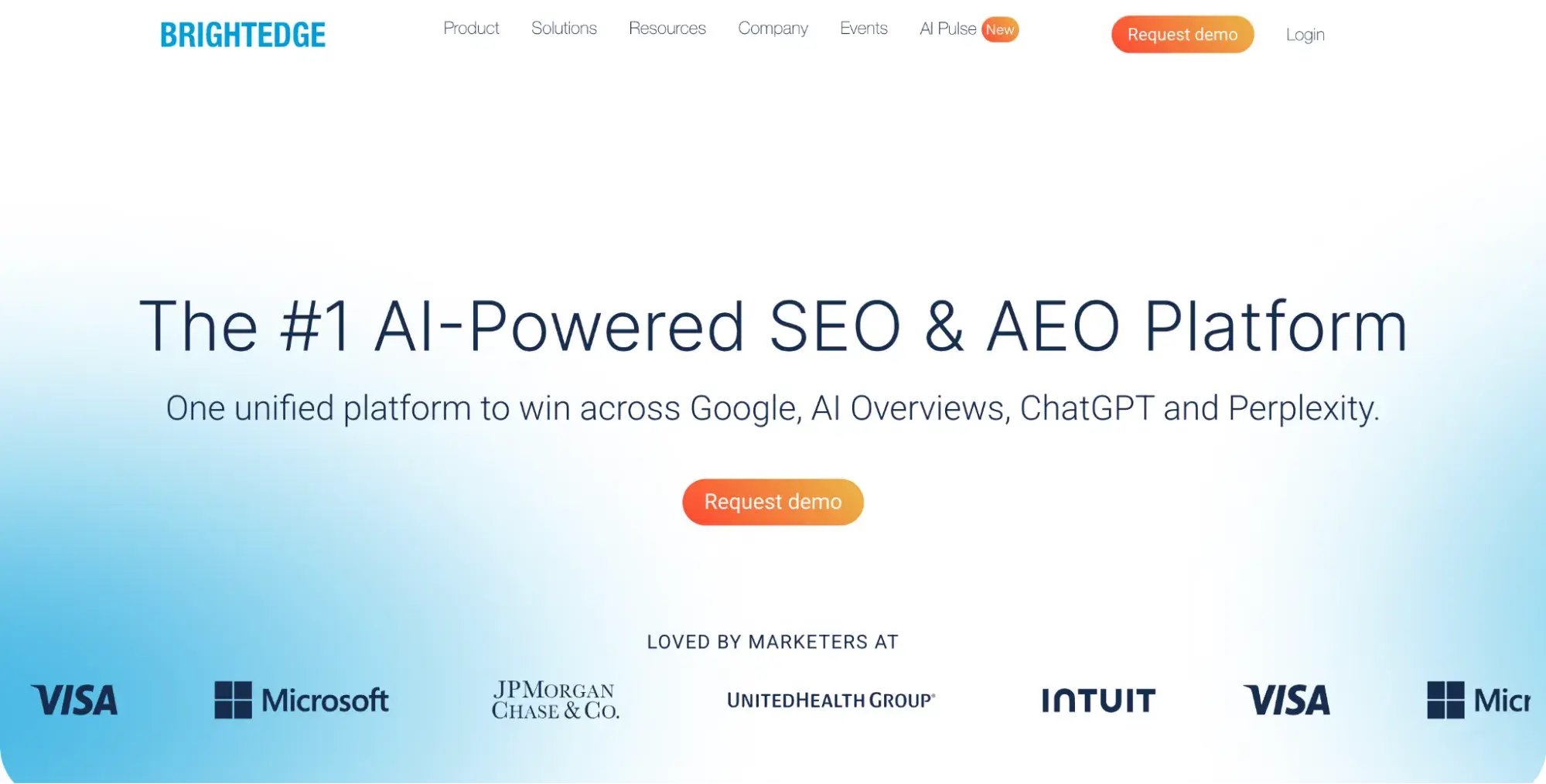
BrightEdge operates as an enterprise-grade SEO platform that has strategically expanded its offerings to include AI search tracking. The platform integrates AI Overview monitoring, content recommendation engines, and large-scale keyword analysis, catering to organizations with substantial content operations.
Key Features:
- Enterprise SEO Integration: Seamlessly incorporates AI visibility into existing enterprise SEO workflows.
- AI Overview Monitoring: Tracks brand presence and performance within AI-generated search results.
- Content Recommendations: Offers data-driven suggestions for content optimization to improve AI visibility.
- Large-Scale Keyword Analysis: Supports comprehensive keyword research and tracking across traditional and AI search environments.
Pricing: Requires a custom quote, typically suited for enterprise-level budgets.
Expert Insights: While acknowledging BrightEdge’s impressive data capabilities and suitability for enterprise SEO workflows, some experts, like Peter Baraník, note that it may be overkill for organizations specifically focused on AI search visibility challenges. Its platform is geared towards large teams with dedicated SEO resources, and its pricing reflects this.
Best For: Enterprise SEO teams already utilizing BrightEdge who wish to extend their visibility tracking into AI Overviews without adopting a new, standalone platform.
4. Authoritas
Authoritas focuses on measuring a brand’s visibility across AI search experiences, tracking which entities, products, and competitors are surfaced in AI answers and with what frequency.
Key Features:
- URL-Level AI Overview Tracking: Provides granular insights into which specific pages are being cited by AI engines, offering more detailed data than a general visibility score.
- Entity and Competitor Tracking: Monitors how entities, products, and competitors are mentioned in AI responses.
- Structured Data Analysis: Offers a clear, structured view of brand presence in AI search without ambiguity.
Pricing: Requires a custom quote.
Expert Insights: Raúl Menoyo, Founder of Citora, values Authoritas’s URL-level tracking for its precision in identifying cited pages. However, he points out that its strength lies primarily in Google AI Overviews, with less robust coverage of standalone assistants like ChatGPT, Claude, and Perplexity, necessitating supplementary tools for comprehensive AI assistant monitoring.
Best For: SEO teams prioritizing Google AI Overviews who require detailed, page-level citation data to guide content updates.
5. Advanced Web Ranking
Advanced Web Ranking (AWR) provides robust tracking of how brands appear across AI search results, detailing competitor surfacing and shifts in visibility over time.
Key Features:
- Historical Data Tracking: Offers extensive historical data, making it easy to demonstrate progress and trends over time, which is crucial for stakeholder reporting.
- Multi-Location and Multi-Market Visibility: Supports tracking of visibility across various locations, devices, and search engines.
- Comprehensive Reporting: Delivers detailed reporting data essential for SEO professionals.
Pricing: Starts from $139 per month.
Expert Insights: Manpreet Kaur, an SEO Specialist, identifies AWR as a go-to tool for keyword tracking and SEO reporting, appreciating its ability to track rankings across diverse parameters and provide historical trend information.
Best For: SEO teams managing multi-location or multi-market visibility who require reliable historical tracking alongside AI search data.
6. Semrush’s AI Visibility Features
While exploring alternatives, it’s essential to understand Semrush’s own AI visibility capabilities. Semrush has integrated AI Overview monitoring, limited citation insights, and keyword data for AI-influenced queries into its existing SEO suite. This approach appeals to existing Semrush users by consolidating their toolset. However, its current limitations in covering a broad range of AI assistants and its potential cost barrier for new adopters are points of consideration.
7. Other Emerging Tools and Approaches
The AI search landscape is dynamic, with new tools and features constantly emerging. Some platforms are developing more advanced sentiment analysis, while others are focusing on the nuances of prompt engineering and its impact on AI-generated content. Additionally, many SEO professionals are adopting a hybrid approach, combining traditional SEO tools with specialized AI visibility solutions to cover all bases. The key takeaway is that the market is actively responding to the need for specialized AI search tracking.
8. Manual Testing and Free Resources
For organizations with limited budgets or those in the initial exploration phase, manual testing and free resources offer a viable starting point. Manually running target buyer queries across major AI engines like ChatGPT, Perplexity, and Gemini and documenting the results provides a foundational understanding of current visibility. HubSpot’s AEO Grader is a notable free tool that offers a structured benchmark, scoring visibility and highlighting competitor presence. While these methods lack the scalability and automation of paid platforms, they are invaluable for establishing initial baselines and informing the selection of more robust solutions.
Strategic Considerations for Choosing AI Visibility Tools
Selecting the most appropriate AI visibility tool hinges on several critical factors:
- Target AI Engines: The primary decision point is understanding where your target audience conducts their research. If Google AI Overviews are dominant, tools with strong Google coverage like Authoritas or BrightEdge are beneficial. For audiences utilizing ChatGPT, Perplexity, or Gemini, cross-assistant tracking is paramount, making tools like HubSpot AEO and LLM Pulse more suitable.
- Optimization Workflow: The "best" tool depends on the specific optimization workflow. HubSpot AEO excels when visibility data needs to be tied directly to CRM and pipeline, offering seamless integration. LLM Pulse is advantageous for agencies requiring flexible, white-label reporting. Authoritas provides deeper insights into Google AI Overviews for content-focused teams.
- Cross-Platform Support: Confirming support for key AI assistants such as ChatGPT and Perplexity is essential. HubSpot AEO and LLM Pulse are strong contenders here. It is crucial to verify current engine support directly with vendors, as this landscape evolves rapidly.
- CRM Integration: For seamless data flow and reporting, native CRM integration is a significant advantage. HubSpot AEO stands out for its direct connection to the Smart CRM, eliminating manual data exports. Standalone tools often require manual data integration, adding a layer of complexity.
Piloting an AI Search Visibility Strategy: A Six-Step Framework
Launching an effective AI search visibility strategy requires a structured approach. The following six-step framework is recommended:
Step 1: Define Target Queries
Identify 10-15 queries that accurately reflect how your buyers conduct research within AI engines, particularly during evaluation and decision stages. These should be real-world buyer questions, not internal keyword lists. Examples include: "best project management software for small teams," "how to choose a sustainable energy provider," or "what are the benefits of cloud computing for startups."
Step 2: Establish a Baseline
Before implementing any tracking tools, manually execute your target queries across ChatGPT, Perplexity, and Gemini. Document citation frequency, competitor mentions, and the nature of AI descriptions of your brand. This baseline serves as the crucial starting point for measuring progress and makes the initial reporting cycle more meaningful. Utilizing HubSpot’s AEO Grader can provide a structured benchmark.
Step 3: Select Your Tracking Platform
Based on the criteria outlined above—including target AI engines, optimization workflow needs, and CRM integration requirements—choose the tool that best aligns with your team’s operational structure and goals.
Step 4: Prioritize Content Updates
Identify AI visibility gaps that correspond to content deficiencies. These often indicate areas where a brand’s expertise is not sufficiently clear, well-structured, or up-to-date for AI engines. Review top-performing pages that rank well in traditional search but appear infrequently in AI answers. Focus on structural improvements such as:
- Enhancing clarity and conciseness.
- Ensuring factual accuracy and up-to-date information.
- Structuring content with clear headings, subheadings, and bullet points.
- Incorporating relevant entities and concepts that AI models can easily extract.
- Building topical authority through comprehensive content on key subjects.
Step 5: Measure Presence, Citations, Sentiment, and Business Impact
After a defined reporting period (typically 4-8 weeks), assess four key areas:
- Presence: How often your brand appears in AI answers.
- Citations: The frequency and context of your brand’s citations.
- Sentiment: The tone and nature of AI descriptions.
- Business Impact: Metrics such as website traffic, lead generation, and conversion rates influenced by AI visibility.
Step 6: Connect Visibility to Revenue
This is often the most challenging step. To make AI visibility data actionable for budget allocation and strategic investment, it must be linked to revenue. HubSpot AEO’s integration with Smart CRM and Marketing Hub facilitates this by allowing AI-influenced touchpoints to be directly tied to contacts, deals, and pipeline. For standalone tools, a manual bridge must be built by tagging contacts based on AI-influenced discovery sources and tracking their conversion path within the CRM.
Frequently Asked Questions About AI Visibility Tools
Q: Can I track AI visibility without switching from Semrush?
A: Yes. Many teams maintain Semrush for traditional SEO tasks like technical audits and backlink analysis while layering a dedicated AI visibility tool, such as HubSpot AEO, for citation monitoring and AI engine coverage. These workflows operate independently.
Q: What is the difference between AI visibility and rank tracking?
A: Rank tracking measures a webpage’s position in search results. AI visibility assesses a brand’s presence within AI-generated answers, which lack traditional ranked positions. AI visibility focuses on citation frequency, share of voice, and sentiment rather than numerical ranking.
Q: Are there any free AI visibility options?
A: HubSpot’s AEO Grader offers a free score of brand visibility across major AI engines and identifies competitor presence. Manual prompt testing is also a cost-free method for initial baseline assessment. However, these free options lack the scalability and automation for ongoing monitoring and reporting.
Q: How do I connect AI visibility to leads and revenue?
A: Connecting AI visibility to revenue requires a bridge between citation data and CRM records. Platforms with native CRM integration, like HubSpot AEO, offer the most direct path. For standalone tools, manual tagging of contacts and CRM pipeline tracking are necessary to attribute leads and revenue to AI-influenced touchpoints. Defining AI-influenced touchpoints before a pilot begins is crucial for accurate attribution.
The Future of Search Visibility: Actionable Insights for Growth
In conclusion, AI search visibility represents a critical new frontier for digital marketers. While Semrush offers foundational AI features, the evolving landscape necessitates exploring specialized alternatives. Tools like HubSpot AEO, LLM Pulse, BrightEdge, Authoritas, and Advanced Web Ranking offer distinct approaches to tackling this challenge.
For most marketing teams, AI search visibility currently presents a reporting gap. However, the ability to connect citation data to revenue conversations is paramount for securing ongoing investment in this channel. HubSpot AEO’s integration with Smart CRM and Marketing Hub provides a comprehensive solution for closing this loop, with the AEO Grader offering a valuable, free starting point.
As teams evaluate Semrush AI visibility alternatives, the recommendation is to begin with the AEO Grader for a baseline assessment, clearly define target queries and success metrics before launching any pilot program, and prioritize the tool that best integrates actionable visibility data into existing workflows. The future of search visibility lies not just in appearing, but in being understood, cited, and ultimately, connected to tangible business outcomes.
About the Author