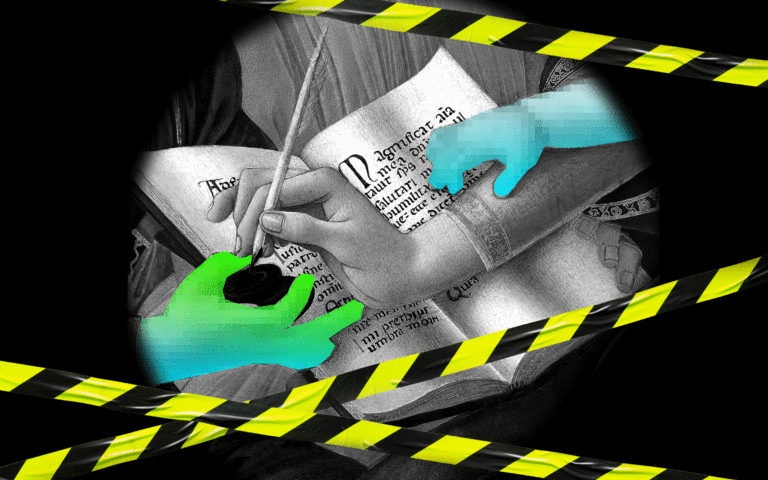
In a significant move reflecting the evolving landscape of artificial intelligence regulation, AI research company Anthropic has begun embedding invisible watermarks into the outputs of its large language model, Claude. This strategic decision, implemented in response to the European Union’s Artificial Intelligence Act (EU AI Act), aims to ensure transparency by marking content as AI-generated or edited in a way that is detectable by computer systems. While this initiative satisfies stringent regulatory demands, it has ignited a predictable debate within the AI user community, highlighting the complex interplay between technological advancement, legal compliance, and user perception.
The EU AI Act and the Mandate for Transparency
The EU AI Act, a landmark piece of legislation that came into force with the aim of establishing a comprehensive legal framework for AI, places a strong emphasis on transparency. One of its key provisions, the "Transparency Code," mandates that providers of AI systems clearly label content that has been generated or manipulated by AI. This requirement is designed to empower individuals and prevent deception, particularly in contexts where AI-generated content could be misrepresented as human-created. Anthropic’s adoption of invisible watermarking for Claude is a direct response to this mandate, demonstrating the company’s commitment to adhering to the new regulatory standards.
Invisible watermarking, a sophisticated technique, involves embedding data into an output in a way that is imperceptible to the human eye but can be reliably detected by specialized algorithms. This approach allows for the identification of AI-generated text without compromising the readability or aesthetic quality of the content itself. For regulatory bodies, this offers a robust mechanism for verifying the origin of digital content, a crucial step in combating misinformation and ensuring accountability in the rapidly expanding AI ecosystem.
User Reactions: A Spectrum of Discontent and Support
The introduction of watermarking has predictably sparked a range of reactions among Claude’s user base, with discussions prominently featured on online forums such as Reddit. A notable segment of the user community has expressed strong disapproval, framing the new policy as an infringement on user autonomy and a potential tool for punitive action.
One particularly vocal user, posting under the username "visionode" on the r/artificial subreddit, articulated a dramatic perspective, likening the watermarking system to a "draconian conspiracy designed to victimize innocent chatbot users worldwide." Visionode’s argument, though characterized by some as hyperbolic, centered on the perceived disparity in detection capabilities between sophisticated users and the average individual. According to this viewpoint, users adept at paraphrasing or employing other AI tools to "clean" their Claude outputs might evade detection. However, the average user, the argument goes, will be readily identified, facing potential repercussions.
Visionode provided several examples to illustrate this concern: "The student who used Claude to reorganize a paragraph. The journalist who asked the AI to summarize a two-hundred-page transcript. The writer who had creative block and asked for synonyms. Those guys come out of the process with a digital tattoo on their foreheads." This narrative paints a picture of ordinary individuals being unfairly targeted for leveraging AI assistance for common tasks.
However, this perspective has not found universal agreement. Critics of Visionode’s stance have pointed out the ethical implications of verbatim copying and pasting of AI-generated content without proper attribution or modification. The article’s author, for instance, questioned the validity of these examples, suggesting that a journalist summarizing a lengthy transcript or a student reorganizing a paragraph would not typically face issues unless they were attempting to pass off the AI’s work as their own – an act considered unethical regardless of watermarking. The sentiment among some users is that these examples represent misuse rather than legitimate assistance.
The broader sentiment on Reddit appears to lean towards a more pragmatic acceptance of the watermarking. Many users have dismissed the more extreme criticisms, with comments like "Get a load of this guy" and pleas for the original poster to "take a deep breath" indicating a lack of widespread sympathy for the victimhood narrative.
The "Tool" Argument and Counterarguments
Another line of criticism has emerged from users who view Claude primarily as a sophisticated tool that facilitates their own work. These users argue that they invest significant effort in crafting prompts, providing context, and refining outputs, thereby doing the "lion’s share of the work." From this perspective, watermarking Claude’s outputs is seen as an unfair claim of credit by the AI or, worse, an imposition that undermines the user’s contribution.
One user lamented, "I gave the instructions, context, decisions, and countless refinements, claude was the tool. If Claude starts watermarking the code or anything else it generates, what exactly is it claiming credit for?" This sentiment suggests a feeling of proprietary ownership over the final output, with the AI’s contribution being viewed as ancillary.
However, this argument is also met with counterarguments from within the user community. Many users have pushed back against the notion that watermarking constitutes an unwarranted claim of credit. Instead, they emphasize the primary purpose of the technology: detection and transparency. As one user articulated, "It’s not claiming credit though. It’s about being able to detect AI generated outputs because of the risks AI generated outputs can cause in various situations." This perspective highlights the potential for AI-generated content to be misused for malicious purposes, such as spreading disinformation, generating fake news, or creating deceptive content. The watermark, in this view, serves as a crucial identifier for mitigating these risks.
A particularly sharp retort on Reddit highlighted the perceived hypocrisy of complaining about Claude’s watermarking, possibly by using Claude itself to formulate the complaint: "Bro couldn’t even complain about Claude without using Claude to write it." This quip underscores the pervasive nature of AI tools in contemporary digital communication and the often-unacknowledged reliance on them.
Nuanced Critiques and Broader Implications
Beyond the immediate reactions of outrage or defense, some critics have raised more nuanced concerns about Anthropic’s policy. One prominent critique centers on the perceived hypocrisy of an AI model, whose training data is derived from vast amounts of human-created content, now watermarking its own outputs. This user argued, "I think it’s a very sinister direction to take. I don’t use Claude to write anything but having an AI that watermarks your work is terrifyingly ironic given how many of the frontier models came by their training data."
This perspective touches upon the ongoing debate surrounding the ethical sourcing of training data for large language models. Many foundational AI models are trained on massive datasets scraped from the internet, which include copyrighted material and content created by individuals without their explicit consent for AI training. The argument here is that if AI models are built upon the uncredited labor of human creators, then their subsequent efforts to label their own outputs could be seen as disingenuous or hypocritical.
Despite these more complex criticisms, the prevailing sentiment among many AI users appears to be one of support for the watermarking system. Many view it as a necessary and sensible measure for tracking algorithmically generated material. The argument often boils down to a simple principle: transparency is beneficial, and the desire to avoid watermarking is often linked to an intent to deceive. As one user succinctly put it, "There is literally no good argument for why this isn’t a good idea. The only reason you wouldn’t want this is to lie to people."
The Future of AI Transparency and Regulation
Anthropic’s implementation of invisible watermarking for Claude is more than just a technical update; it represents a significant step in the ongoing effort to align AI development with regulatory frameworks and societal expectations. The EU AI Act is setting a precedent, and other jurisdictions are likely to follow with their own forms of AI governance.
The debate surrounding watermarking underscores several key challenges:
- Defining AI Assistance: The line between using AI as a tool for legitimate assistance and engaging in academic or professional misconduct through over-reliance or plagiarism is often blurry. Watermarking could help clarify this distinction, but its effectiveness will depend on how it is implemented and enforced.
- User Education: A significant portion of the user community may not fully grasp the implications of AI-generated content or the rationale behind regulatory requirements. Educating users about the purpose of watermarking and ethical AI usage is crucial.
- Technological Arms Race: As watermarking technologies become more sophisticated, so too will methods for circumventing them. This suggests an ongoing technological arms race between AI developers and those seeking to exploit AI.
- Global Regulatory Harmonization: With different regions adopting varying approaches to AI regulation, companies operating globally will face the challenge of complying with a patchwork of rules. The EU AI Act’s emphasis on transparency could influence global standards.
The move by Anthropic signifies a broader trend in the AI industry, where companies are increasingly proactive in addressing regulatory concerns and public perception. While the immediate reactions from users highlight a divide in understanding and acceptance, the underlying principle of transparency is likely to become a cornerstone of future AI development and deployment. The invisible watermark in Claude’s output is not just a technical marker; it is a visible symbol of the complex negotiations underway as humanity grapples with the profound implications of artificial intelligence. As AI continues to evolve, so too will the strategies employed to ensure its responsible and ethical integration into society.
About the Author