Community marketing, a strategic approach centered on active customer participation, is rapidly transforming how businesses foster engagement, build trust, and cultivate lasting loyalty. By bringing customers, partners, and advocates together around shared interests and challenges, this strategy not only enhances customer retention and drives referrals but also significantly lowers customer acquisition costs. When meticulously designed and integrated with Customer Relationship Management (CRM) and lifecycle data, community programs can expedite sales cycles, reduce support overhead, and cultivate credible brand advocates, ultimately delivering measurable business impact. This comprehensive guide delves into the core principles of community marketing, its pivotal role in modern lifecycle marketing, and actionable strategies for building and scaling impactful community programs.
The Evolving Landscape of Customer Engagement
In an era where consumers are increasingly inundated with marketing messages, the traditional broadcast model is losing its efficacy. Consumers are seeking authentic connections and value-driven interactions. This shift has paved the way for community marketing to emerge as a potent strategy. Unlike social media management, which often focuses on content distribution, community marketing emphasizes active participation and genuine dialogue. Research indicates a strong preference for community-driven engagement: 81.6% of consumers report being more likely to remain loyal to a brand after engaging with it in an online community. Furthermore, a significant 67% of consumers feel more connected to brands through community platforms than through social media. This sentiment underscores a fundamental change in consumer behavior, moving away from passive consumption towards active involvement and co-creation.
Community marketing also distinguishes itself from generic "community building" by directly linking a sense of belonging to tangible business outcomes. While community building fosters a sense of belonging, community marketing explicitly connects this to metrics such as retention rates, referral generation, product adoption, and support efficiency. Within the framework of modern lifecycle marketing, community marketing plays a crucial role in the "Amplify" stage, extending value beyond initial conversion and empowering customers to share, contribute, and champion the brand. The integration of community activity with CRM data provides invaluable insights into how engagement directly influences revenue, renewal rates, and overall business growth.
Driving Advocacy and Reducing Acquisition Costs Through Community
The efficacy of community marketing stems from its ability to foster trust more rapidly between peers than between brands and consumers. Studies reveal that 55% of social media users are more inclined to trust brands that feature human-generated content. Witnessing real individuals engaging in discussions, asking questions, and candidly sharing their experiences builds a level of trust that polished marketing collateral often struggles to achieve. This accelerated trust-building process facilitates quicker purchasing decisions and alleviates pressure on costly paid advertising campaigns.
Nicole van Zanten, Co-President & Chief Growth Officer at ICUC.social, articulates this point clearly: "When done with meaning, engagement, and purpose, we see that customers convert faster, stay longer with a brand or business, and refer more often." From a cost perspective, community marketing achieves significant reductions in reliance on paid channels and support teams through several key mechanisms:
- Reduced reliance on paid acquisition: Word-of-mouth referrals and organic advocacy generated within communities can significantly offset the need for expensive advertising.
- Lowered support costs: Peer-to-peer problem-solving and knowledge sharing within a community can preemptively answer customer questions and resolve issues, thereby reducing the volume of inbound support tickets.
- Increased customer lifetime value: Engaged community members tend to exhibit higher loyalty, leading to increased repeat purchases and opportunities for upselling or cross-selling.
Instead of acquiring every customer through direct advertising or outbound sales efforts, brands benefit from the compounding value created by their existing customer base. The most compelling metrics that demonstrate this impact include:
- Customer retention rate: The percentage of customers who continue to do business with a brand over a specified period.
- Customer lifetime value (CLTV): The total revenue a business can expect from a single customer account throughout their relationship.
- Net Promoter Score (NPS): A metric that measures customer loyalty and willingness to recommend a brand.
- Referral rates: The number of new customers acquired through existing customer recommendations.
When community members feel acknowledged and valued, their propensity to continue engaging with and purchasing from a brand increases substantially. This trust translates directly into purchasing behavior, with trusted relationships making repeat purchases 2.3 times more likely.
Developing a Robust Community Marketing Strategy
A substantial 66% of companies report that their community initiatives have a positive impact on customer retention. The most successful community marketing programs are built with a clear objective in mind, informed by an understanding of audience behavior, and supported by appropriate platforms and workflows. Brands looking to implement a results-driven community marketing strategy should consider the following steps:
1. Define a Specific Problem the Community Will Solve
Effective community marketing programs begin by addressing a distinct customer pain point. This could involve improving the onboarding experience, enhancing product education, or facilitating peer-to-peer support. Attempting to serve every audience and use case simultaneously can dilute focus. High-performing communities are anchored to a clear, actionable outcome, such as:
- Accelerating product adoption: Providing resources and peer guidance to help users maximize their use of a product or service.
- Reducing support tickets: Empowering users to find answers and solutions through community interaction.
- Gathering product feedback: Creating a channel for direct customer input on features and improvements.
- Driving customer advocacy: Identifying and nurturing brand champions who can spread positive word-of-mouth.
Defining a specific problem provides the community with a clear purpose beyond mere engagement. It also establishes a framework for decision-making regarding platform selection, programming, and measurement. As Nicole van Zanten advises, "Community efforts fail when they try to be everything for everyone. The most successful teams identify a problem area or opportunity and let everything cascade back to that outcome."
2. Understand Customer Behavior Before Platform Selection
Platform decisions should be guided by existing audience behavior, not fleeting trends. Communities are more likely to thrive when established in spaces where members already spend their time and feel comfortable engaging. Before selecting a platform, marketers should analyze patterns in:
- Current communication channels: Where do customers naturally congregate to discuss related topics?
- Content consumption habits: What types of content do they engage with most?
- Information-seeking behaviors: How do they typically find answers to their questions?
This contextual understanding helps teams avoid forcing engagement into unfamiliar environments and instead design communities that feel intuitive from the outset. Van Zanten emphasizes the importance of social listening: "Understand what customers are talking about, what tensions exist, and what parallel interests show up. That context tells brands what they are actually building for."
HubSpot Pro Tip: Consider the potential of offline community marketing. While often associated with online interactions, in-person events and user groups can drive similar retention and advocacy outcomes, provided engagement is tracked and integrated into broader marketing systems.
3. Select a Platform Aligned with Audience Needs and Operational Realities
There is no universally optimal platform for every community. The primary considerations are how an audience already interacts online and the functional requirements of the community as it grows. Key practical questions to address include:
- Is the platform accessible and intuitive for the target audience?
- Does it support the desired types of interaction (e.g., forums, chat, Q&A)?
- Can it be easily integrated with existing CRM and marketing automation tools?
- What are the moderation and governance capabilities?
- What is the cost and scalability of the platform?
Van Zanten notes, "Some brands will thrive on Discord or Reddit, while others perform better in close Facebook Groups or LinkedIn communities. The best platform is the one aligned with the audience and operational needs."
HubSpot Pro Tip: Platform selection directly impacts the ease of integrating community data with a CRM. Opting for tools that offer native integrations with platforms like HubSpot simplifies the process of connecting engagement metrics to lifecycle outcomes.
4. Design Engagement Programs That Encourage Participation, Not Broadcasting
Communities flourish when members are actively invited to participate. Programs designed around interaction consistently outperform passive content streams. Effective engagement often manifests as:
- Q&A sessions: Facilitating spaces for members to ask and answer questions.
- User-generated content initiatives: Encouraging members to share their experiences, tips, and creations.
- Polls and surveys: Soliciting opinions and gathering feedback.
- Challenges and contests: Creating interactive opportunities for engagement and friendly competition.
Intentional engagement increases the likelihood of members asking questions and assisting one another, thereby strengthening trust and maintaining community vitality. Van Zanten shares, "We’ve seen strong success with dedicated Discord communities where brands host live AMAs, exclusive content, and behind-the-scenes access. When community members feel invited into the process, engagement increases significantly."
HubSpot Pro Tip: HubSpot’s Marketing Software can assist teams in promoting community discussions and events through scheduled social posts and a unified social inbox, streamlining participation across channels and maintaining conversation flow without adding manual overhead.
5. Enable Peer-to-Peer Support and Contribution
One of the most scalable advantages of community marketing is its capacity for peer-to-peer support. When members assist each other in problem-solving, answering questions, and sharing experiences, communities generate value independent of internal teams. This dynamic can reduce support volume, accelerate issue resolution, and foster deeper trust among members. Guidance from peers who have navigated similar challenges often resonates more strongly, encouraging greater engagement and contribution. The outcome is a self-sustaining community that becomes increasingly valuable and credible as participation grows. Van Zanten highlights a tangible example: "In one healthcare community, peer-generated answers reduced support tickets by nearly 30%. That insight justified expanding the program and investing in more structured workflows."
6. Align Community Data with CRM and Lifecycle Metrics
Community marketing programs tend to secure ongoing investment when teams can clearly link participation to demonstrable outcomes and metrics valued by leadership. This connection is typically achieved by aligning community activity with CRM data, allowing engagement to be viewed within the context of the entire customer lifecycle. This visibility facilitates an understanding of:
- How community engagement impacts customer retention and churn rates.
- The correlation between community participation and expansion revenue (upsells/cross-sells).
- The influence of community support on reducing customer service costs.
- The role of community in driving product adoption and feature usage.
Without these insights, the impact of community initiatives remains anecdotal and can struggle to justify budget allocations.
HubSpot Pro Tip: Utilizing Customer Service Software can transform community marketing from a standalone initiative into a measurable growth channel. Marketing, sales, and customer service teams can leverage this data to evaluate performance through a shared lens.
7. Build for Long-Term Advocacy, Not Short-Term Campaigns
Community marketing yields its greatest value when treated as an ongoing relationship. Programs primarily designed to promote product launches, discounts, or announcements often experience temporary spikes in activity followed by periods of inactivity. In contrast, communities where members feel recognized, supported, and genuinely heard foster organic advocacy. Observing consistent contributors and active participants makes it easier to establish ambassador programs or referral initiatives, transforming advocacy from a vague success story into a scalable, actively supported endeavor. Van Zanten emphasizes, "The strongest communities build belonging first, product second. People resonate more with real, authentic customer voices than polished brand messaging – and that’s what drives long-term advocacy."
8. Integrate Community Data with CRM
Tying community engagement back to CRM data reveals patterns that would otherwise remain hidden. Brands can observe how participation correlates with retention, referrals, and even reduced support demand. This data integration provides a clearer understanding of who is actively participating, how community activity fits into the broader customer lifecycle, and whether the community is contributing tangible business value.
HubSpot Pro Tip: HubSpot’s CRM enables teams to connect community participation with the overarching customer journey, thereby enhancing attribution clarity and facilitating cross-team alignment.

9. Support Community Managers with Automation
As communities expand, operational bottlenecks such as comment moderation, content creation, and approval processes can emerge. AI-powered tools can significantly assist community moderators by automating tasks like:
- Content moderation: Identifying and flagging inappropriate or spam content.
- Response suggestions: Providing AI-generated replies to common queries.
- Content summarization: Condensing lengthy discussions for easier review.
- Automated reporting: Generating performance metrics and insights.
Automation tools empower community managers to dedicate more time to relationship-building and strategic program development, rather than getting bogged down in repetitive tasks.
HubSpot Pro Tip: Content Hub’s AI tools, including its image generator, can help teams rapidly produce guides, discussion prompts, event graphics, and educational resources, keeping communities active and engaging without increasing team workload.
Community Engagement Programs to Launch Now
Effective community programs need not be overly complex. The most successful initiatives often address a clear customer need and create recurring incentives for participation. Here are several proven engagement programs and why they are effective:
1. Customer Forums
Customer forums provide lasting value by offering a dedicated space for users to ask questions, exchange solutions, and learn from one another. Over time, these conversations evolve into a searchable, invaluable resource. When integrated with product education and support workflows, forums transcend being mere help centers and become shared workspaces.
- Best for: Product adoption and support deflection.
- Why it works: The value of forums compounds. A single well-answered question can assist numerous future users searching for similar information. As the knowledge base grows, peer-generated responses often become the most trusted reference point, even surpassing official documentation.
2. Virtual Events and Office Hours
Virtual events and office hours foster real-time connections between brands and community members. These sessions can include:
-
Ask Me Anything (AMA) sessions: Direct access to product experts or leadership.
-
Product demos and walkthroughs: Showcasing new features or best practices.
-
Customer spotlight interviews: Highlighting successful user stories.
-
Workshops and training sessions: Providing skill-building opportunities.
-
Best for: Trust-building, education, and early-stage engagement.
-
Why it works: Smaller, recurring sessions tend to outperform large, infrequent webinars. Consistency lowers the barrier to participation and builds familiarity. Members are more likely to engage when events feel conversational rather than promotional.
3. Ambassador Programs
Ambassador programs formalize brand advocacy by providing engaged customers with clear avenues to promote the brand through referrals, content creation, testimonials, or speaking opportunities. These programs typically involve incentives, recognition, and clearly defined expectations.
- Best for: Advocacy, referrals, and social proof.
- Why it works: The scalability of ambassador programs is a significant advantage. When incentives and recognition are clearly defined, advocacy becomes repeatable. Ambassadors often assume leadership roles, helping to set community norms and encourage broader participation.
4. Partner Communities
Partner-led communities unite customers, experts, and complementary brands around shared objectives. These communities often feature joint programming, co-created content, or shared learning initiatives.
- Best for: Reach expansion, credibility-building, and shared growth.
- Why it works: Partner communities are most effective when collaborators serve overlapping audiences. This approach expands reach while distributing operational efforts, enabling faster community growth without compromising relevance or trust.
5. Content-Led Communities
Content-led communities are built around education and thought leadership. Members engage through discussions tied to articles, guides, events, research, or ongoing learning series.
- Best for: Early-lifecycle engagement and long-term brand affinity.
- Why it works: Educational communities attract members before they are ready to purchase and provide ongoing reasons for them to return. When content fuels conversation rather than existing passively, it becomes a catalyst for engagement and relationship-building.
Community Platforms and Partners to Consider
Selecting the right community platform is both a strategic and operational decision. Platforms influence member engagement and the ease with which engagement data can be linked to business outcomes.
Owned vs. Third-Party Community Platforms Comparison
| Consideration | Owned Platforms | Third-Party Platforms (Slack, Discord, LinkedIn) |
|---|---|---|
| Best for | Long-term community programs, attribution, lifecycle integration | Early-stage communities, rapid experimentation |
| Data Control | Full control over data, governance, and integrations | Limited control over data and customization |
| CRM Integration | Easier integration with CRM (e.g., HubSpot); direct lifecycle ties | Difficult integration; limited data access |
| Setup Time | Longer initial setup; requires hosting/management | Lower barrier to entry; reduced setup; familiar to members |
| Measurement & Attribution | Easier to track influence on retention, expansion, advocacy | Limited visibility into business outcomes; data extraction challenges |
| Scalability | Built for long-term growth and operational scalability | Governance and scalability limitations may emerge as communities grow |
| Member Familiarity | May require onboarding to new platform | Members already familiar, accelerating early participation |
| Cost Consideration | Investment in platform and hosting required | Often free or low-cost to start |
| Governance & Moderation | Full control over safety, moderation policies, and features | Limited control; dependent on platform’s built-in features |
| Ideal Use Case | Programs where measurement and business outcomes are paramount | Testing engagement formats and building momentum before committing |
Key Takeaway: Third-party platforms serve best as initial stepping stones rather than permanent solutions. They are excellent for testing engagement formats and building momentum. However, owned platforms become essential for robust measurement, CRM integration, and long-term scalability.
1. Owned Community Platforms
Owned community platforms provide brands with complete control over their data, simplifying governance and integrations. These platforms, typically hosted or managed by the organization, can be closely aligned with CRM and lifecycle data.
- Best for: Long-term community programs, attribution, and lifecycle integration.
- Why it works: Owned platforms are preferable for programs where measurement is critical. When community engagement directly links to contact records and lifecycle stages, it becomes easier to understand how participation influences retention, expansion, and advocacy, especially when integrated with a CRM like HubSpot.
2. Slack or Discord
Third-party platforms like Slack or Discord reduce the barrier to entry and setup time. Members are often already familiar with these tools, which can accelerate initial participation.
- Best for: Early-stage communities and rapid experimentation.
- Why it works: These platforms are ideal as initial launchpads. They facilitate testing engagement formats and building momentum, but limitations in data access, governance, and long-term scalability may arise as communities mature.
3. LinkedIn Groups
LinkedIn Groups offer built-in discovery and access to professional audiences, making them useful for sparking discussion without requiring members to join a new platform.
- Best for: Early engagement and professional networking.
- Word of caution: While effective for gathering like-minded professionals, LinkedIn Groups offer limited control over data and customization. This can pose challenges for operational scaling and integration with broader marketing and CRM systems over time.
4. Partner Ecosystems
Partner-led communities bring together customers, experts, and brands around shared goals. These ecosystems often include:
-
Co-marketing initiatives: Joint campaigns and content creation.
-
Shared learning resources: Collaborative development of educational materials.
-
Joint problem-solving: Tackling challenges with complementary expertise.
-
Best for: Reach expansion, credibility, and shared growth.
-
Why it works: Partner ecosystems consolidate multiple incentives into a unified community experience. The HubSpot ecosystem, for instance, connects agencies, consultants, and technology partners to foster education and advocacy across diverse audiences.
Measuring Community Marketing and Proving ROI
Measuring community marketing requires looking beyond superficial engagement metrics and focusing on indicators of genuine business impact. The most effective programs combine behavioral metrics with lifecycle and revenue data to articulate value clearly. Key metrics include:
1. Engagement Rate
- What it measures: Active participation, not just member count.
- Engagement rates indicate whether members are actively contributing, participating, and returning, or passively disengaging. Tracking engagement trends over time helps identify momentum or areas needing intervention.
- What I’ve learned: Prioritizing active members over total member counts provides a more accurate picture of success. A smaller, consistently engaged community typically delivers more value than a large, passive one.
2. Retention and Expansion Influence
- What it measures: Long-term customer value and account growth.
- Retention and expansion metrics reveal whether community participation contributes to customer longevity and deepening relationships. Communities that support onboarding, education, and peer problem-solving often influence these outcomes.
- What the expert says: Van Zanten states, "The most reliable ROI signals are centered around retention and renewal rate of community members, contribution and engagement levels, sentiment, and how conversations evolve over time."
- What I’ve learned: The impact on retention may not be immediate. Members who engage early and consistently tend to remain loyal longer and expand their relationships, especially when the community helps them derive value more quickly.
3. Referral and Advocacy Activity
- What it measures: Willingness to recommend, share, and speak on behalf of the brand.
- Referral traffic, reviews, testimonials, and user-generated content are indicators of advocacy, signifying that members trust the brand enough to lend their own credibility. Communities that foster contribution consistently outperform passive groups.
- What I’ve learned: Advocacy is first observable in behavior. Early signals, such as thoughtful answers or unsolicited recommendations, often form the foundation for long-term word-of-mouth growth.
4. Pipeline and Revenue Influence
- What it measures: Community impact on revenue and deal progression.
- Pipeline influence assesses whether community participation translates into tangible sales activity, such as leads generated from community discussions, increased conversion rates for community members, or reduced sales cycle lengths for engaged users.
- What I’ve learned: Once participation can be linked to pipeline contributions or cost savings, community marketing shifts from being perceived as a brand initiative to a recognized growth lever.
Community Building Examples Across B2B and D2C
Examining successful community programs across various industries provides practical insights into effective community marketing.
1. HubSpot Community
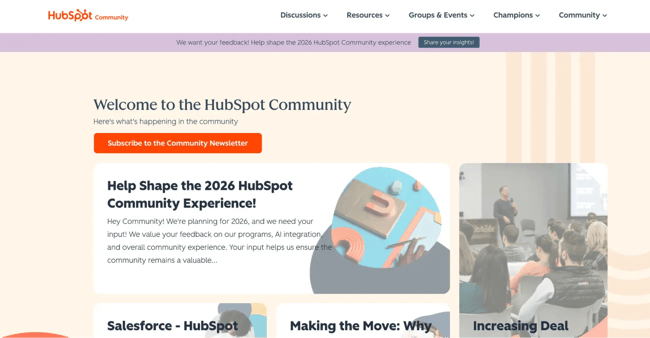
The HubSpot Community brings together customers, partners, and experts to facilitate product education, peer-to-peer problem-solving, and continuous learning. Members can pose questions, share insights, and access guidance across HubSpot’s suite of tools and use cases.
- What stands out: Community activity complements, rather than competes with, support, content, and product education, making it feel like a natural extension of the customer experience.
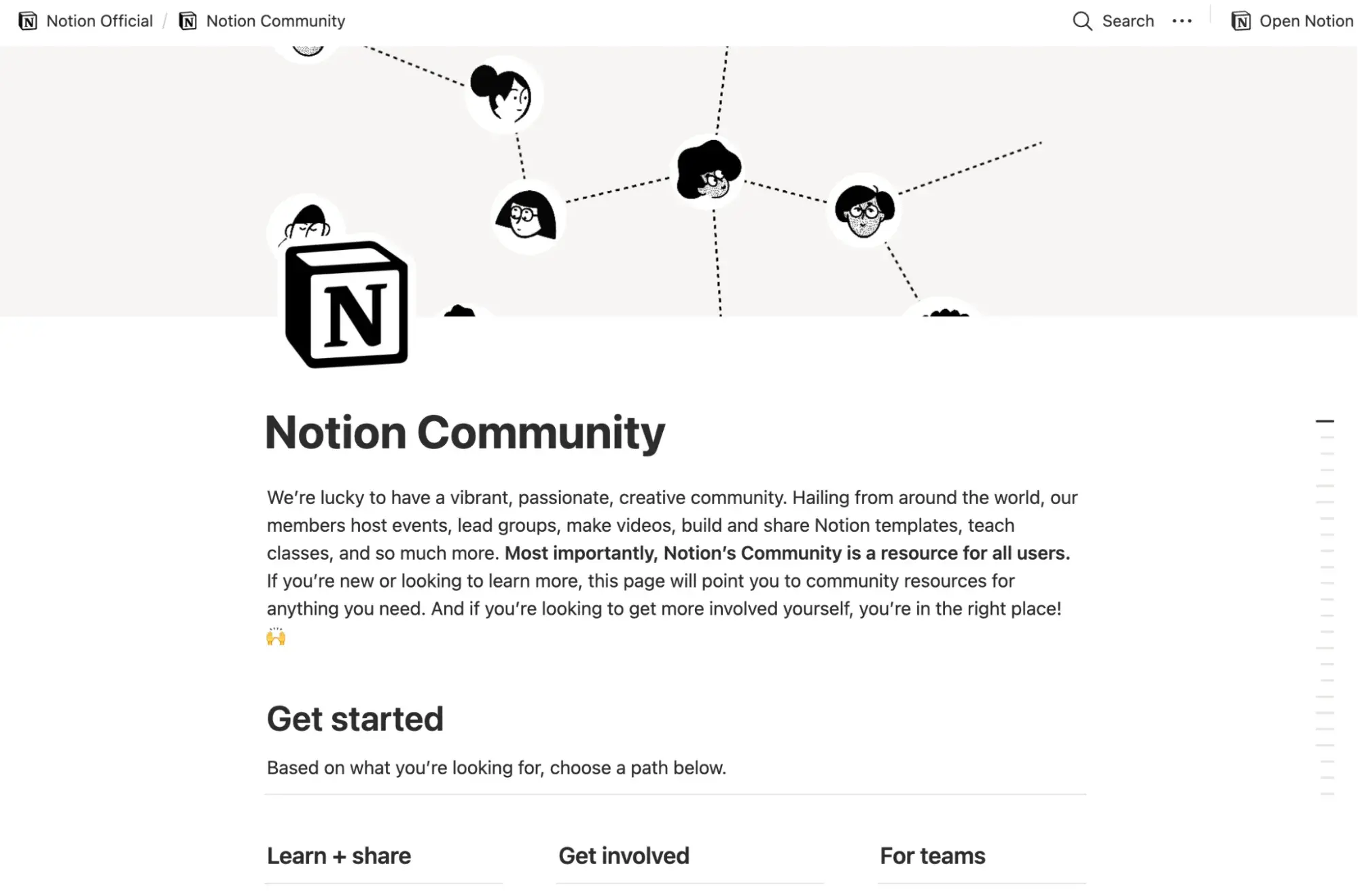
2. Notion Community
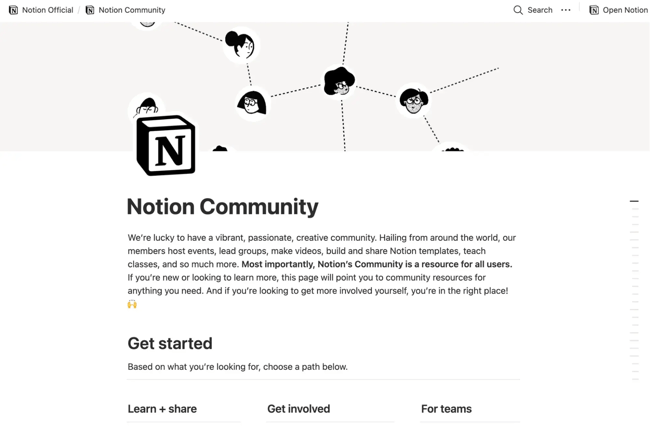
Notion’s community is centered on co-creation. Members share templates, workflows, and use cases, enhancing product value for others while demonstrating the platform’s versatility.
- What stands out: The emphasis on contribution transforms customers into collaborators. By enabling users to build and share easily, Notion’s community scales product education and fosters a strong sense of ownership and pride among its members.
3. Peloton Community
Peloton’s community, spanning platforms like Facebook, integrates content, challenges, and shared progress to foster momentum and accountability. Members engage not only with the brand but also with each other through milestones and collective experiences.
- What stands out: The emotional investment drives retention. By combining progress tracking with shared achievement, Peloton’s community transforms individual usage into a collective journey, making participation motivating rather than transactional.
Frequently Asked Questions About Community Marketing
Is community marketing the same as social media marketing?
No. Social media marketing is primarily a distribution channel for broad reach, while community marketing focuses on building relationships within a defined group. Social platforms prioritize visibility; communities prioritize participation, trust, and long-term value. Social media can support community growth but does not replace its depth.
How long does it take to see results from community marketing?
Early engagement signals like participation and discussion typically emerge within the first few months. Measurable business outcomes, such as improved retention or referral rates, usually become apparent over six to twelve months, depending on the community’s purpose, audience readiness, and integration with lifecycle metrics.
Which platform is best for a brand community?
The ideal platform depends on audience behavior, internal resources, data needs, and long-term goals. Owned platforms offer greater control and CRM integration, while third-party platforms reduce setup friction and can accelerate early engagement. The most effective communities prioritize platform fit over popularity.
How do I resource a community program with a small team?
Small teams can run effective programs by prioritizing focus and leveraging automation. Clear programming, repeatable engagement formats, and content reuse minimize manual effort. AI-powered tools can support moderation and content creation, allowing teams to scale participation without scaling headcount.
How do I start if I don’t have an existing audience?
Most communities begin with an existing customer base engaged in onboarding, support, or education. Starting with a small, relevant group helps establish norms, generate early value, and build momentum before expanding to a broader audience.
Building Customer-Led Growth Through Community Marketing
Community marketing delivers its greatest value when treated as a long-term growth strategy. When communities are designed with intention and measured against tangible business outcomes, they become powerful drivers of advocacy, retention, and reduced acquisition costs. Integrating community activity with content, CRM, and lifecycle marketing provides the visibility needed to understand what works and where to invest next. HubSpot’s connected platform supports this approach by unifying engagement, automation, and customer data. For marketing teams focused on transforming participation into measurable impact, community marketing is foundational to building durable, customer-led growth.
About the Author