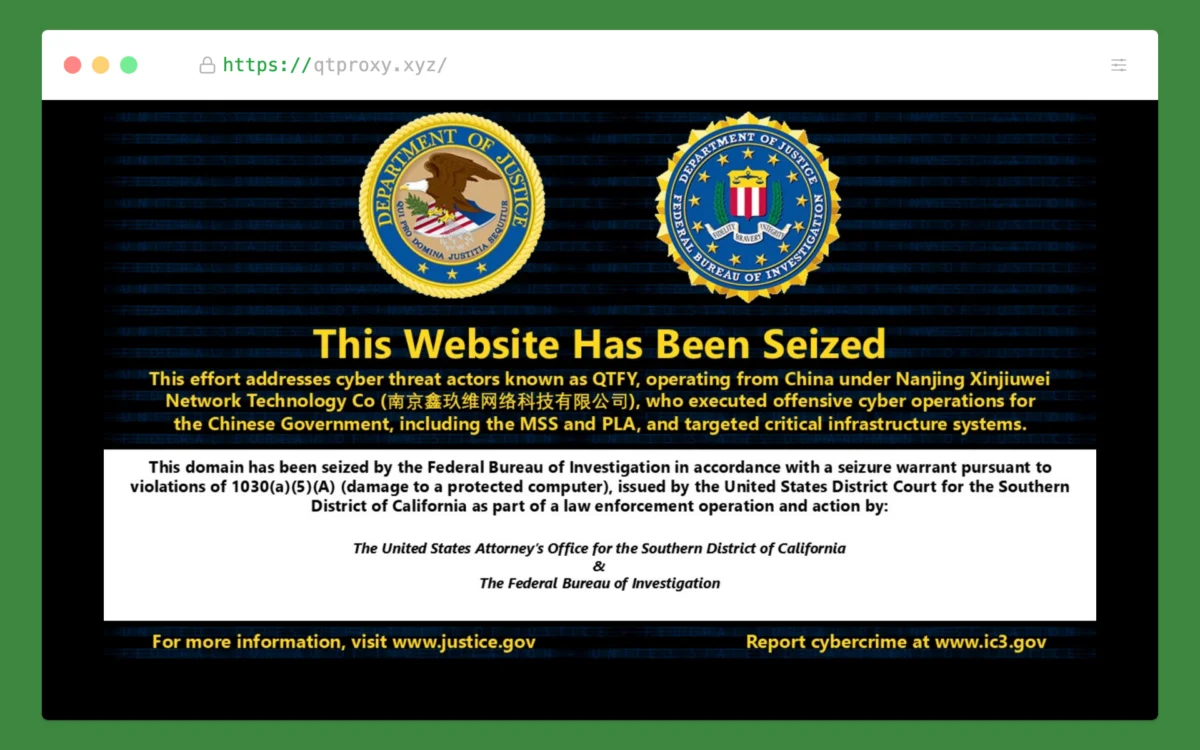
The Federal Bureau of Investigation has successfully seized a network of internet domains that served as the operational backbone for a sophisticated, China-backed botnet, disrupting a significant cyber espionage campaign that has targeted numerous sensitive American entities for years. The operation, revealed by the Justice Department, represents a critical blow against a state-sponsored hacking group responsible for infiltrating computer systems across vital sectors, including healthcare, defense contracting, and multiple federal government departments. This action effectively severs the command and control infrastructure of the botnet, rendering it inoperable and significantly hindering the malicious activities of its operators.
The Anatomy of the QTFY Botnet
The botnet, identified by prosecutors as operating under the moniker QTFY, was allegedly developed and managed by Nanjing Xinjiuwei Network Tech, a Chinese technology company. This entity is accused of creating and orchestrating a vast network of compromised internet-connected devices, effectively transforming them into a tool for obfuscation. These compromised devices were designed to route and conceal malicious traffic generated by hackers, making it substantially more difficult for cybersecurity professionals and law enforcement to trace the origins of cyberattacks.
Prosecutors assert that QTFY’s business model extended beyond merely operating the botnet; it offered computer hacking services to a clientele that included state-sponsored hackers affiliated with China’s Ministry of State Security. This arrangement allowed these government-backed actors to leverage the botnet’s infrastructure for their own clandestine operations, effectively outsourcing aspects of their cyber espionage efforts. The services provided by QTFY would have enabled these actors to conduct reconnaissance, exfiltrate data, and potentially disrupt critical systems with a reduced risk of attribution.
A Long-Standing Campaign Against American Interests
The scope and duration of the QTFY botnet’s operations paint a concerning picture of sustained cyber aggression against the United States. The hacks attributed to this network date back to at least 2018, a period marked by increasing concerns over foreign interference and cyber espionage. The targets were not random; they represent the very core of American governmental and technological infrastructure.
Among the prominent entities confirmed to have been compromised are:
- NASA: The National Aeronautics and Space Administration, a symbol of American innovation and scientific endeavor, was a target, suggesting an interest in proprietary research, technological advancements, or sensitive operational data.
- The Federal Reserve: As the central bank of the United States, the Federal Reserve holds vast amounts of sensitive financial data and plays a critical role in economic stability. Infiltrating its systems could provide insights into economic policy, market movements, or even enable financial manipulation.
- The Department of Energy: This department oversees critical energy infrastructure and nuclear technology, making it a prime target for intelligence gathering or disruption.
- The Department of Justice: The presence of the DOJ on the target list indicates a potential interest in sensitive legal proceedings, law enforcement investigations, or internal governmental communications.
- The Department of Health and Human Services: This department manages vital public health initiatives and sensitive patient data, making it a valuable target for intelligence gathering or potentially for the theft of personal health information.
Perhaps most alarmingly, the government’s affidavit seeking the court order to seize the botnet’s domains revealed that the U.S. Senate was compromised as recently as 2026. This indicates that the threat has not only persisted but has continued to evolve and adapt, reaching into the legislative branch of the U.S. government. The fact that the compromise extended so recently into the Senate underscores the persistent nature of the threat and the ongoing challenges in defending against sophisticated state-sponsored actors.
The Technical Takedown: Domain Seizures
The success of this operation hinges on the FBI’s ability to disrupt the botnet’s command and control (C2) infrastructure. The Justice Department announced that the seized domains were hardcoded into the botnet’s operational code. These domains served as critical communication channels, enabling the operators to issue commands to the compromised devices and receive data back. By seizing these domains, the FBI has effectively severed these vital links, rendering the botnet’s C2 servers inoperable and its distributed network of compromised machines unable to receive further instructions or transmit exfiltrated data.

This method of disruption is a common and effective tactic in dismantling botnets. Unlike simply taking down individual compromised machines, which can be quickly replaced, targeting the central command infrastructure cripples the entire operation. The domains acted as the central nervous system of the botnet, and their seizure has effectively paralyzed its ability to function.
Collaboration and Intelligence Sharing
The dismantling of the QTFY botnet was not an isolated effort. Network giant Lumen, through its threat intelligence arm, played a crucial role in identifying and tracking the group’s activities. Lumen reported observing the hackers actively profiling and targeting government agencies, the defense and aerospace sectors, and other critical industries for at least the past year. This proactive monitoring and subsequent sharing of threat intelligence with the FBI were instrumental in building the case for the seizure operation.
Such collaborations between private cybersecurity firms and law enforcement agencies are increasingly vital in combating sophisticated cyber threats. Private companies often have the deep network visibility and analytical capabilities to detect emerging threats, while law enforcement agencies possess the legal authority and investigative resources to take decisive action. The sharing of information in this instance highlights a critical synergy in the ongoing battle against cybercrime and state-sponsored espionage.
Broader Implications and Future Outlook
The seizure of the QTFY botnet domains carries significant implications:
- Deterrence: This action sends a clear message to China and other nation-states that the United States is committed to identifying and disrupting their cyber espionage operations. While it may not halt all malicious activity, it can serve as a deterrent by increasing the risk and cost associated with such operations.
- Protection of Sensitive Data: By dismantling this botnet, the U.S. has likely prevented the exfiltration of further sensitive data from critical infrastructure and government agencies, safeguarding national security and economic interests.
- Disruption of Services: The botnet was designed to be an obfuscation tool, meaning it was likely used to facilitate a wide range of malicious activities, from espionage to potential disruption. Its takedown disrupts these ongoing or planned operations.
- Evolving Threat Landscape: The fact that the compromise extended to 2026 highlights the persistent and evolving nature of cyber threats. Adversaries are continually refining their techniques and adapting to defensive measures. This necessitates ongoing vigilance and investment in cybersecurity capabilities.
- International Cooperation: While this operation targeted a China-backed group, it also underscores the need for international cooperation in cybersecurity. Many botnets operate across borders, and effective disruption often requires collaboration with international partners.
The Justice Department’s statement emphasized that the seizure of these domains "denies the operators access to the platforms." This is a direct and tangible outcome of the operation. The hardcoding of these domains into the botnet’s architecture meant that their seizure was a critical vulnerability. Without the ability to communicate with their command and control infrastructure, the thousands of compromised devices that constituted the botnet are rendered inert, a testament to the effectiveness of this targeted disruption.
The implications of this takedown extend beyond the immediate disruption. It highlights the intricate ecosystem of cybercrime, where companies like Nanjing Xinjiuwei Network Tech can act as enablers for state-sponsored hacking groups. This raises questions about the responsibility of technology providers and the international legal frameworks needed to address such activities. The U.S. government’s robust response, leveraging both investigative prowess and legal mechanisms, demonstrates a commitment to holding actors accountable for cyber aggression.
As the digital landscape continues to evolve, the threat of sophisticated cyberattacks from nation-state actors remains a paramount concern. The successful dismantling of the QTFY botnet serves as a significant victory in this ongoing struggle, showcasing the effectiveness of coordinated efforts between law enforcement, intelligence agencies, and the private sector in safeguarding national interests in the digital realm. However, the persistence of such threats, as evidenced by the 2026 compromise, indicates that this will be a continuous battle requiring sustained investment, innovation, and international collaboration.
About the Author